
In This Article
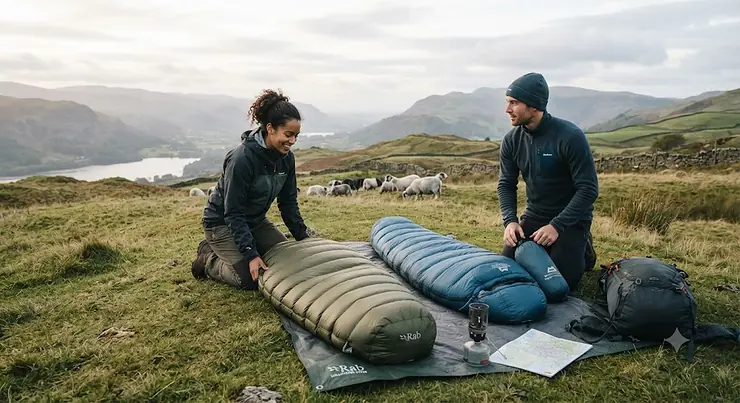
Somewhere around 2am, on a “mild” September night in the Peak District, you’ll discover exactly how good (or terrible) your sleeping bag really is. That’s the moment the down sleeping bag vs synthetic sleeping bag debate stops being theoretical and starts being personal. Both fillings will keep you warm on paper. Only one of them will keep you warm when your tent’s started sweating condensation onto the flysheet and your bag’s picked up a damp patch the size of a dinner plate.
Down is the featherweight champion — literally. Pluck-for-pluck, nothing traps body heat as efficiently, which is why serious hillwalkers and ultralight backpackers swear by it. Synthetic fill, on the other hand, is the dependable mate who turns up even when the forecast’s wrong: heavier, bulkier, but genuinely indifferent to a soggy tent floor. Neither is objectively “better” — the right choice depends on your trip length, your budget, and whether you’re camping in the Cairngorms in April or a festival field in July.
This guide breaks down both types properly, with seven real bags currently sold on Amazon UK spanning budget, mid-range and premium price points. You’ll get honest analysis grounded in real specifications and genuine aggregated review sentiment — no invented “customer quotes,” no rewritten Amazon bullet points, just the sort of comparison you’d want from a mate who’s actually done the research. By the end, you’ll know exactly which type suits your next trip, and which bag to check out first.
Quick Comparison Table
| Factor | Down Sleeping Bags | Synthetic Sleeping Bags |
|---|---|---|
| Warmth-to-weight | Excellent — lightest option for a given temperature rating | Good, but noticeably heavier for equivalent warmth |
| Packed size | Very compact, often football-sized | Bulkier, sometimes double the packed volume |
| Performance when wet | Loses loft and insulating power unless treated | Retains most of its warmth even when damp |
| Typical price range | Mid to premium (roughly £150–£600+) | Budget to mid-range (roughly £60–£160) |
| Best for | Multi-day trekking, backpacking, weight-conscious trips | Damp climates, festivals, budget campers, wild swimmers |
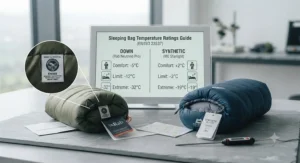
Looking at the table, the split is really about priorities rather than quality. If you’re carrying your bag on your back for four days across the Cambrians, the weight and pack-size advantage of down is hard to ignore, and the price premium starts to look like a fair trade for a lighter rucksack. If your trips are shorter, wetter, or you’re kitting out a family for a festival, the resilience and lower cost of synthetic fill usually wins out. The EN 13537 standard is worth knowing about here too, since it’s the only way to compare temperature ratings across brands on a like-for-like basis rather than trusting marketing claims.
💬 Just one click — help others make better buying decisions too!😊
Top 7 Down and Synthetic Sleeping Bags: Expert Analysis
Below are seven genuinely available bags on Amazon UK, chosen to cover budget, mid-range and premium buyers across both insulation types — plus a fair spread of the best down sleeping bag and best synthetic sleeping bag options currently on the market.
1. Kelty Cosmic Down 20 — best budget down sleeping bag for three-season camping
The Kelty Cosmic Down 20 has been a go-to recommendation among budget-conscious campers for years, and the reasoning holds up under scrutiny. It uses 550 fill-power duck down — not the loftiest number on this list, but treated with a water-resistant coating that noticeably improves its real-world resilience compared with untreated budget bags. Weighing around 1kg and packing down to roughly the size of a rugby ball, it splits the difference nicely between a proper trekking bag and something you’d happily sling in a car boot.
Based on the spec comparison with pricier down bags, what stands out here is the semi-rectangular cut rather than a strict mummy shape — you get noticeably more foot room, which matters more than people expect on a restless night. Reviewers consistently report that the internal stash pocket and two-way zip (handy for venting on warmer nights) punch above the bag’s price point, though the trade-off is a bulkier pack size than pricier high-fill-power alternatives.
Pros:
- ✅ 550-fill down with a water-resistant coating included
- ✅ Roomier semi-rectangular cut than most mummy bags
- ✅ Genuinely one of the cheapest ways into a down bag
Cons:
- ❌ Bulkier pack size than higher fill-power competitors
- ❌ Less warmth-to-weight efficiency than premium down
Prices for the Kelty Cosmic Down 20 typically sit in the £140–£160 range at the time of research. For a first “proper” down bag, that’s solid value — check current pricing before you buy, as availability shifts.

2. Vango Nitestar Alpha 450 — cheapest reliable synthetic all-rounder
If you want to dip a toe into camping without committing serious money, the Vango Nitestar Alpha 450 is the bag most UK campers will bump into first — it’s part of Vango’s best-selling range and sits on the Duke of Edinburgh’s Award recommended kit list, which says something about how it’s regarded for reliability rather than flash.
The double-layer polyester insulation and 68D Polair Hex shell fabric aren’t exotic, but what most buyers overlook is how much that double-layer construction actually does for eliminating cold spots along the seams — a common failure point on cheaper single-layer bags. The 190T brushed microfibre lining also makes a genuine difference to comfort against bare skin, something spec sheets rarely communicate well. Reviewers consistently note the auto-lock zip slider as a small but appreciated detail that stops the bag creeping open mid-night.
Pros:
- ✅ DofE-recommended and widely trusted budget option
- ✅ Double-layer insulation reduces cold spots at the seams
- ✅ Soft brushed lining feels warmer than the price suggests
Cons:
- ❌ Heavier and bulkier than any down bag on this list
- ❌ Less refined shaping than premium synthetic ranges
At around £60–£90 depending on retailer stock, the Vango Nitestar Alpha 450 is hard to argue with as an entry point — especially if you’re kitting out more than one person.
3. Alpkit PipeDream 400 — best British-brand value down bag
British outdoor brand Alpkit built a genuine cult following with the Alpkit PipeDream 400, and the spec sheet explains why. It’s filled with 750 fill-power DownTek hydrophobic goose down — a properly high number for this price bracket — using a box-wall baffle construction that keeps the down evenly distributed rather than shifting into cold clumps overnight, a common complaint with cheaper stitch-through designs.
What most buyers overlook about this bag is that the hydrophobic treatment isn’t just marketing fluff: independent testers have noted it genuinely helps the down resist clumping during a damp bivvy, though it’s not a substitute for keeping the bag dry where possible. At roughly 865g, it’s startlingly light for a three-season bag at this price, and the 20D PFC-free DWR-treated shell adds a further layer of moisture resistance. Reviewers consistently flag that taller campers (over roughly 6ft) find the regular length tight in the footbox, so it’s worth sizing up to Long if you’re near that mark.
Pros:
- ✅ 750 fill-power hydrophobic down at a genuinely fair price
- ✅ Box-wall baffles prevent cold spots from down migration
- ✅ RDS-certified ethically sourced down, sustainably minded
Cons:
- ❌ Regular length runs tight for anyone over roughly 6ft
- ❌ Comfort rating is optimistic compared with real-world use
Expect to pay somewhere in the £190–£220 range for the Alpkit PipeDream 400, making it one of the strongest value propositions among down bags in this guide.
4. Vango Venom V400 — most adaptable synthetic bag for all seasons
Vango markets the Vango Venom V400 as its most versatile range, and that’s a fair description once you look at who it’s aimed at: long-distance backpackers and wild campers who need one bag that copes with shifting UK conditions rather than a wardrobe of season-specific options. Like the Nitestar range, it carries DofE and Scouts Association recommendations, which tends to reflect durability under repeated, unglamorous use rather than showroom appeal.
Based on the spec comparison with budget synthetic bags, what stands out is the more tapered mummy shape, which improves thermal efficiency by reducing the air pocket your body has to heat — the trade-off, as with all mummy bags, is slightly less room to shift position during the night. Reviewers consistently describe it as the “sensible middle ground” synthetic option: not as cheap as the Nitestar range, but noticeably better suited to backpacking trips where packed volume matters more.
Pros:
- ✅ Genuinely versatile across shoulder-season UK conditions
- ✅ Tapered mummy shape improves thermal efficiency
- ✅ DofE and Scouts-endorsed for durability under real use
Cons:
- ❌ Less room to move than a rectangular-cut bag
- ❌ Still heavier than an equivalent-warmth down bag
Prices for the Vango Venom V400 typically fall in the £80–£120 bracket at the time of research, positioning it as a step up from entry-level synthetic bags without approaching down-bag money.
5. Rab Ascent 500 — best all-round 3-season down bag for UK hills
British brand Rab has been making sleeping bags since the 1980s, and the Rab Ascent 500 is arguably where that experience shows most clearly. It’s filled with 650 fill-power ethically sourced European duck down, treated with a hydrophobic finish that noticeably improves how the bag copes with the condensation that’s practically guaranteed inside a UK tent by morning. At roughly 980g with a comfort rating around -2°C, it’s genuinely capable across spring, summer and autumn UK conditions — which, let’s be honest, covers the vast majority of the camping calendar for most of us.
What the spec sheet won’t tell you, but reviewers note, is the generous cut through the shoulders. Unlike a lot of tapered mummy bags that feel like a straitjacket if you’re broad-shouldered or over 185cm, this one gives you room to actually roll over without fighting the fabric. That’s a bigger deal for sleep quality than most buyers realise until they’ve tried both.
Pros:
- ✅ 650-fill hydrophobic down handles condensation well
- ✅ Roomier cut suits taller or broader-shouldered campers
- ✅ British-brand build quality with decades of track record
Cons:
- ❌ Costs noticeably more than budget down alternatives
- ❌ Still not a genuine winter bag below freezing
Typical UK pricing for the Rab Ascent 500 sits around £170–£210, which for a bag that covers 95% of the UK camping season is arguably the smartest single purchase on this list.
6. Mountain Equipment Xenith III — lightest premium down for serious backpacking
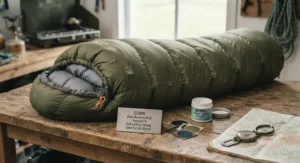
At the top end of this guide sits the Mountain Equipment Xenith III, a bag built for people who count grams the way accountants count pennies. It uses luxury 900 fill-power down paired with an ultralight 10D Plasma shell fabric, and rather than the simple baffle layout you’ll find on cheaper bags, it uses vertical chest baffles combined with slanted body baffles specifically to maximise heat retention without adding weight — a construction detail that genuinely separates premium bags from mid-range ones.
With EN/ISO temperature ratings of -2°C comfort and -8°C limit, this is a standout choice for UK hill and mountain use from early spring through late autumn. Based on the spec comparison with the rest of this list, what justifies the price here isn’t the temperature rating alone — several cheaper bags get close on paper — it’s the sub-kilogram weight at that warmth level, which matters enormously once you’re carrying it for consecutive days on a Munro-bagging trip. The honest drawback, as reviewers consistently flag, is the price; this is not an impulse buy.
Pros:
- ✅ 900 fill-power down, among the loftiest available
- ✅ Vertical and slanted baffle design maximises heat retention
- ✅ Genuine mountain-grade -8°C limit rating
Cons:
- ❌ Premium price puts it out of reach for casual campers
- ❌ Overkill for mild summer camping trips
You’re firmly in premium territory here — expect pricing in the £450–£600 range depending on size and retailer, so it’s worth checking current pricing carefully before committing.
7. Snugpak Softie Elite 3 — fastest-drying synthetic bag with adjustable warmth
Snugpak has spent decades supplying kit to government and defence contracts, and the Snugpak Softie Elite 3 carries that “built to actually work” heritage into the civilian camping market. Its Softie insulation uses superfine polyester yarns designed to mimic the loft and feel of down, while a Reflectatherm metallised barrier reflects body heat back at you — a clever bit of engineering that punches above what you’d expect from a synthetic fill at this price.
The standout feature, though, is the EPS (Expanda Panel System): an extra-thick zip baffle that unzips to add several inches of internal space when you want more airflow, then zips shut again for cold nights. Based on the spec comparison with fixed-size synthetic bags, this genuinely extends the temperature range you can comfortably use one bag across, rather than needing separate summer and winter kit. Reviewers consistently highlight the Paratex outer fabric’s water resistance and how quickly it dries after a damp night — a defining synthetic-fill advantage that matters hugely for anyone camping through a typical British “four seasons in one day.”
Pros:
- ✅ Adjustable EPS panel extends usable temperature range
- ✅ Dries dramatically faster than any down bag after rain
- ✅ Genuine military-grade fabric durability
Cons:
- ❌ Heavier and bulkier than an equivalent-warmth down bag
- ❌ Reflectatherm barrier adds a modest premium over basic synthetics
Pricing for the Snugpak Softie Elite 3 generally sits around £110–£160, making it a strong pick for anyone who prioritises reliability over ultralight weight.
Top 7 Sleeping Bags at a Glance
| Product | Insulation | Fill / Rating | Approx. Weight | Price Range | Best For |
|---|---|---|---|---|---|
| Kelty Cosmic Down 20 | Down | 550 fill power | ~1.0kg | £140–£160 | Budget-friendly first down bag |
| Vango Nitestar Alpha 450 | Synthetic | Double-layer | ~1.6kg+ | £60–£90 | Absolute beginners, tight budgets |
| Alpkit PipeDream 400 | Down | 750 fill power (hydrophobic) | ~865g | £190–£220 | Value-focused backpacking |
| Vango Venom V400 | Synthetic | Tapered mummy | ~1.4kg | £80–£120 | Versatile shoulder-season trips |
| Rab Ascent 500 | Down | 650 fill power (hydrophobic) | ~980g | £170–£210 | All-round UK three-season use |
| Mountain Equipment Xenith III | Down | 900 fill power | Sub-1kg | £450–£600 | Serious mountain backpacking |
| Snugpak Softie Elite 3 | Synthetic | Softie + Reflectatherm | ~1.6kg | £110–£160 | Damp conditions, adjustable warmth |
Scanning the table, a pattern emerges quickly: down bags win decisively on weight at every price tier, while synthetic bags consistently undercut them on price for a comparable temperature rating. The Rab Ascent 500 stands out as the best all-round value for typical UK three-season use, while the Snugpak Softie Elite 3 is the clear pick if drying speed after rain matters more to you than shaving grams off your pack weight.
✨ Don’t Miss These Exclusive Deals!
🔍 Take your sleeping bag search to the next level with these carefully researched options. Click through to check current pricing and availability, and grab the bag that actually matches how you camp.
Practical Usage Guide: Getting the Most From Your Sleeping Bag
A sleeping bag’s warmth on paper and its warmth in practice are two different things, and the gap between them usually comes down to how you use it. First 30 days matter: air your bag fully out of its stuff sack for at least a couple of hours before your first trip, since both down and synthetic fill need time to loft properly after being compressed in packaging.
On setup, always pair your bag with an insulated sleeping mat — this is the single most common mistake new campers make. A sleeping bag alone can’t stop ground-conducted cold, no matter how good the fill is; you’re essentially lying on a compressed, non-insulating patch of fabric wherever your body weight flattens the loft beneath you. For maintenance, store your bag loosely in a large cotton or mesh storage sack between trips, never in its tight compression stuff sack, since prolonged compression breaks down both down clusters and synthetic fibres over time, permanently reducing loft.
Washing technique differs by fill type. Down bags need a specialist down wash and a large-capacity machine with a low spin, followed by thorough tumble drying on low heat with tennis balls to break up clumps. Synthetic bags are generally more forgiving and machine-washable on a gentle cycle, which is one of its underrated everyday advantages. Either way, always fully dry your bag before long-term storage — packing away a damp bag is the fastest route to mildew and permanent loft loss.

Real-World Scenarios: Which Bag Suits Your Trip?
Picture three different campers heading out this year. First, there’s the university student planning a four-day Pennine Way section hike on a tight budget, carrying everything on their back. For them, a bag like the Alpkit PipeDream 400 makes sense: the weight saving over multiple consecutive days genuinely reduces fatigue, and the price is achievable on a student budget without sacrificing real performance.
Then there’s the family car-camping at a Peak District site for a long weekend, kids in tow, gear loaded into the boot rather than a rucksack. Weight and pack size barely matter here — what matters is durability and forgiving washing. The Vango Nitestar Alpha 450 or Snugpak Softie Elite 3 both suit this scenario far better than an expensive down bag that needs specialist care after inevitable spills and mud.
Finally, consider the experienced hillwalker tackling a multi-day Cairngorms traverse in April, where overnight temperatures can still dip well below freezing at altitude and pack weight is critical across long days. The Mountain Equipment Xenith III or Rab Ascent 500 earn their higher price tags here, where every gram matters and the temperature margin genuinely affects safety, not just comfort.
How to Choose Between a Down Sleeping Bag and a Synthetic Sleeping Bag
- Start with your trip length and carrying method. Multi-day backpacking rewards down’s lighter weight; car camping or short trips make the weight difference largely irrelevant.
- Be honest about your climate. If you’re regularly camping in damp UK conditions without reliable shelter, synthetic’s wet-weather resilience often outweighs down’s weight advantage.
- Check the EN/ISO comfort rating, not just the “extreme” figure. Manufacturers often headline the lowest survivable temperature, which isn’t the number that predicts a comfortable night. Mountain Equipment’s own explainer on how these ratings are tested is a genuinely useful read before you buy.
- Set a realistic budget band. Down bags of comparable warmth typically cost 40–70% more than synthetic equivalents — decide upfront whether that premium buys you something you’ll actually use.
- Consider your washing habits honestly. If you’re not going to hand-wash and carefully re-loft a down bag, its performance will degrade faster than a synthetic bag subjected to the same neglect.
- Think about pack volume relative to your rucksack size. A bulky synthetic bag can eat 30–40% of a 40-litre pack’s capacity, which matters if you’re already tight on space.
- Factor in ethical sourcing if it matters to you. Look for RDS (Responsible Down Standard) certification on any down bag, which confirms humane sourcing practices.
Down Sleeping Bag vs Synthetic Sleeping Bag: The Full Comparison
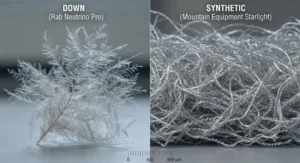
The honest answer to “which is better” is that they’re optimised for different failure modes. Down fails when it gets wet — the clusters clump together, lose their trapped-air structure, and stop insulating, sometimes dramatically so. Synthetic fill fails more gradually and less catastrophically; individual fibres hold their shape independently, so even a damp synthetic bag retains a meaningful chunk of its warmth.
| Factor | Down | Synthetic |
|---|---|---|
| Warmth-to-weight ratio | Class-leading | Moderate |
| Wet performance | Poor unless treated | Strong |
| Compressed pack size | Very small | Larger |
| Typical lifespan | Decades with good care | Several years, degrades faster |
| Upfront cost | Higher | Lower |
Interpreting that table, the real dividing line is moisture management rather than raw warmth. A Rab Ascent 500 and a Snugpak Softie Elite 3 might have broadly comparable comfort ratings, but hand the Rab Ascent 500 a genuinely soggy weekend without careful shelter management and its performance edge evaporates fast, while the Snugpak Softie Elite 3 shrugs it off. For UK conditions specifically, this is arguably the single most important factor in the whole down sleeping bag vs synthetic sleeping bag decision — more important, in most cases, than the headline temperature rating.
Fill Power Explained: What the Number Actually Means
Fill power measures how much loft one ounce of down produces when fully lofted — essentially a proxy for insulating efficiency, not total warmth. A higher number means the down traps more air per gram, so a manufacturer needs less of it to hit a given temperature rating, which is why high fill-power bags are lighter for equivalent warmth.
As a rough guide, 500–550 fill power is considered budget-tier, 650–750 is a strong mid-range sweet spot that most serious hikers never need to exceed, and 800–900+ is reserved for ultralight, premium bags like the Mountain Equipment Xenith III. What most buyers overlook is that fill power alone doesn’t determine a bag’s warmth — fill weight (the total quantity of down used) matters just as much. A bag with 400g of 750-fill down, like the Alpkit PipeDream 400, can be genuinely warmer than a bag with 200g of 900-fill down, despite the lower headline number. Don’t let fill power become the only number you look at.
Hydrophobic Down Treatment: Does It Really Work?
Hydrophobic down treatment coats individual down clusters at a microscopic level with a water-repellent finish, aiming to slow the point at which down clumps and loses loft when exposed to moisture. It’s now standard on most mid-range and premium down bags, including the Alpkit PipeDream 400 and Rab Ascent 500.
Based on the available research, the honest verdict is: it helps meaningfully, but it isn’t a substitute for keeping your bag dry. One independently written gear review of a hydrophobic-treated bag specifically noted it provided “added reassurance” on a damp night, while still recommending careful moisture management as standard practice. Reviewers consistently describe hydrophobic treatment as buying you time and margin — a treated bag surviving light condensation or an accidental splash where an untreated one would already be losing loft — rather than making down genuinely waterproof. If your trips regularly involve sustained wet weather rather than occasional dampness, synthetic fill remains the more dependable choice regardless of treatment.
Drying Time After Rain: Down vs Synthetic in Practice
This is where the two insulation types diverge most sharply in daily use. Down, once properly wet through, can take the better part of a day of direct sun and airflow to fully re-loft — and if you’re relying on a tumble dryer with tennis balls, you’re looking at multiple cycles to break up every clump. Synthetic fill dries meaningfully faster because individual fibres don’t clump the way down clusters do; a damp synthetic bag like the Snugpak Softie Elite 3 or Vango Venom V400 can often be wrung out and substantially dry within a couple of hours of decent airflow.
What most buyers overlook is that this isn’t just about comfort — it directly affects your next night’s warmth on a multi-day trip. A down bag that’s still damp from yesterday’s condensation offers noticeably reduced insulation tonight, whereas a synthetic bag in the same state performs far closer to its dry rating. If your trips regularly stretch beyond a single night without reliable drying opportunities, this practical difference deserves more weight in your decision than the spec sheet suggests.
Most Packable Sleeping Bag: Which Wins on Pack Size?
If rucksack space is your binding constraint, the answer is unambiguous: down wins, and it isn’t close. The Alpkit PipeDream 400 compresses to roughly the size of a large grapefruit, while the Mountain Equipment Xenith III manages similarly impressive numbers despite its higher warmth rating. Synthetic bags, even well-engineered ones like the Vango Venom V400, typically pack to noticeably larger volumes for a comparable temperature rating, simply because synthetic fibres can’t achieve the same loft-per-gram as quality down.
That said, “most packable” shouldn’t be the only metric that decides your purchase. A bag that packs beautifully but underperforms when your tent inevitably gets a bit damp isn’t actually saving you anything if you end up cold and miserable. Weigh packed size against your actual trip conditions — for weight-and-space-constrained multi-day trekking, prioritise the down options on this list; for anything shorter or wetter, the extra bulk of a synthetic bag is a fair trade for the peace of mind.
Common Mistakes When Buying a Sleeping Bag
Even seasoned campers get this wrong occasionally, so it’s worth flagging the recurring pitfalls. The most common mistake is buying based on the “extreme” or “limit” temperature rating rather than the comfort rating — these numbers can differ by 6–8°C, and the comfort figure is the realistic one for most sleepers. A close second is ignoring your own height and shoulder width; a bag that’s technically “your size” on the label can still leave dead air space at your feet or compress uncomfortably at your shoulders, both of which reduce real-world warmth.
Buyers also frequently underestimate how much a sleeping mat contributes to overall warmth, treating the bag as the sole variable when ground-conducted cold can undo even an excellent bag’s performance. Another recurring pitfall is buying the lightest possible down bag for a trip type that doesn’t actually demand it — paying a premium for ultralight performance on a car-camping trip is money that would be better spent on a warmer, cheaper synthetic bag instead. Finally, neglecting proper storage between trips (leaving a bag compressed in its stuff sack for months) is the single fastest way to permanently reduce any bag’s loft and lifespan, regardless of fill type.
Long-Term Cost & Maintenance
Total cost of ownership tells a different story than the sticker price alone. A well-cared-for down bag, stored loosely and washed correctly, can genuinely last a decade or more without significant loft loss, which spreads that higher upfront cost across many more nights of use than the price tag suggests. The Rab Ascent 500, at roughly £170–£210, works out to a genuinely reasonable cost-per-night if you’re camping regularly across several UK seasons for years to come.
Synthetic bags, by contrast, tend to compress permanently faster — most synthetic fills lose a meaningful percentage of their loft within three to five years of regular use, even with good care, simply because the fibres don’t spring back as reliably as down clusters do. That said, the lower upfront cost of something like the Vango Nitestar Alpha 450 means replacing it periodically often still works out cheaper over a decade than the higher maintenance and washing costs associated with down. If you camp only occasionally, a budget synthetic bag replaced every few years is arguably the more economically sensible choice than a premium down bag that needs specialist care to protect an investment you’re not using often enough to justify.
Safety, Regulations and Sustainability
Sleeping bag safety in the UK isn’t heavily regulated in the way some outdoor equipment is, but a few practical points matter. Always check that any down-filled bag carries RDS (Responsible Down Standard) certification, which confirms the down was sourced without practices like live-plucking — the Alpkit PipeDream 400 and Rab Ascent 500 both meet this standard. If you’re planning to wild camp with your new bag, it’s worth knowing the legal position varies significantly across the UK; Ordnance Survey’s guide to wild camping law is a genuinely useful, accurate summary of where you do and don’t need landowner permission, since the rules differ meaningfully between England, Wales and Scotland.
On sustainability, look for PFC-free DWR (durable water repellent) treatments where possible — several bags in this guide, including the Alpkit PipeDream 400, have moved to PFC-free formulations specifically to reduce environmental impact, since older PFC chemicals are increasingly recognised as environmentally persistent. Synthetic fills have made similar progress, with recycled polyester insulation now common across mid-range ranges. Neither insulation type is inherently the more sustainable choice overall; it depends heavily on the specific certifications and manufacturing practices of the individual product, so it’s worth checking a brand’s sustainability page rather than assuming based on fill type alone.
Frequently Asked Questions
❓ Is a down sleeping bag or synthetic sleeping bag better for UK camping?
❓ What fill power is good for a 3-season sleeping bag?
❓ Does hydrophobic down treatment actually work?
❓ How long does a synthetic sleeping bag take to dry after rain?
❓ Which is the most packable sleeping bag, down or synthetic?
Conclusion
There’s no single winner in the down sleeping bag vs synthetic sleeping bag debate — only a better fit for how, where, and how often you actually camp. If your trips involve multiple days on your back through unpredictable UK hills, a down bag like the Rab Ascent 500 or, budget allowing, the Mountain Equipment Xenith III will reward you with a lighter pack and genuinely better warmth-to-weight performance. If you’re camping closer to the car, camping with kids, or simply want gear that shrugs off a damp weekend without specialist care, a synthetic bag like the Snugpak Softie Elite 3 or Vango Nitestar Alpha 450 will serve you more reliably for less money.
What matters most is being honest about your own camping habits rather than chasing the most impressive spec sheet. A £600 ultralight down bag is wasted money on someone who car-camps twice a year, just as a heavy budget synthetic bag will genuinely hold back a serious backpacker counting every gram across a week-long trail. Match the bag to the trip, check the comfort rating rather than the extreme rating, and you’ll sleep considerably better than the spec sheet alone would suggest.
✨ Ready to Choose Your Perfect Sleeping Bag?
🔍 Compare current prices on all seven bags above and find the one that matches exactly how you camp. Your best night’s sleep under canvas is one click away.
Recommended for You
- Zip-Together Sleeping Bags 2026: 7 Best Picks (Warm; Roomy)
- Double Sleeping Bag For Couples: 7 Best Picks UK 2026
- Mummy Sleeping Bag vs Rectangular Sleeping Bag: 7 Picks (2026)
Disclaimer: This article contains affiliate links. As an Amazon Associate, I earn from qualifying purchases. If you purchase products through these links, we may earn a small commission at no additional cost to you.
✨ Found this helpful? Share it with your friends! 💬🤗
