
In This Article
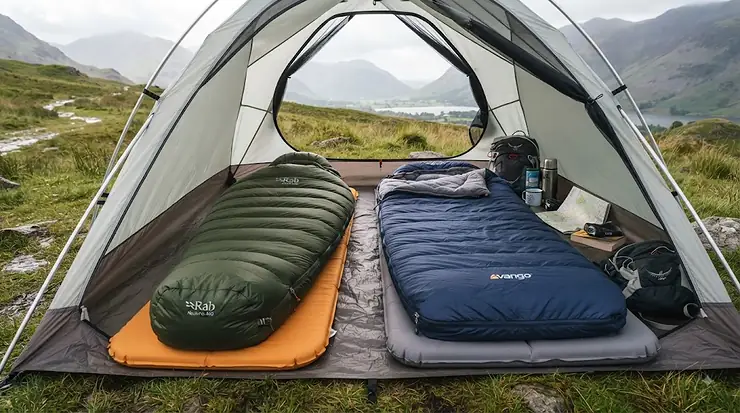
Somewhere around 2am, on a damp hillside in the Brecon Beacons, you will discover exactly which camp you belong to: the mummy sleeping bag campers, who sleep like sealed parcels and stay roasty regardless of the wind chill, or the rectangular sleeping bag campers, who’d rather starfish across a duvet-like expanse even if it costs them a degree or two of warmth. The mummy sleeping bag vs rectangular sleeping bag debate isn’t really about which shape is “better” — it’s about which trade-off suits your body, your trip and your tolerance for feeling like a caterpillar. Mummy bags taper sharply from shoulder to foot, hugging the body to minimise the air your metabolism has to heat, while rectangular bags keep a boxy, blanket-like cut that trades some thermal efficiency for elbow room. Both styles are sold in their thousands across amazon.co.uk every year, and both have a proper place in a UK camper’s kit list depending on the season, the site and how restlessly you sleep. This guide breaks down seven real, currently available bags — budget, mid-range and premium, mummy and rectangular — and explains, with genuine spec analysis rather than marketing fluff, which one deserves a space in your kit bag.
Quick Comparison Table
| Sleeping Bag | Shape | Comfort Rating | Weight | Best For |
|---|---|---|---|---|
| Rab Neutrino 400 | Mummy | Around 0°C | 780g | Serious three-season backpackers |
| Alpkit PipeDream 200 | Mummy | Around 7°C | 590g | Lightweight summer wild camping |
| Snugpak Sleeper Expedition | Mummy | -12°C | 2,600g | Cold-weather, scouting, DofE |
| Vango Nitestar Alpha 350 | Mummy | Around 5°C | 1,300g | Budget first-time campers |
| Outwell Campion | Rectangular | Around 10°C | 1,100g | Summer family camping on a budget |
| Outwell Campion Lux Double | Rectangular | 5°C | 2,760g | Couples wanting shared warmth |
| Outwell Constellation Lux | Rectangular | Around 3°C | 1,900g | Comfort-first solo campers |
Looking across the table, the clearest pattern is that mummy shapes dominate the lightweight and genuinely cold-rated end of the market, while rectangular bags cluster around family and couples’ camping where pack weight matters less than sprawling-out comfort. Weight and comfort rating tend to move together — the tighter the cut and the higher the fill quality, the less bag you’re carrying for the same warmth. If you only take one thing from this table, let it be that a rectangular bag’s generous cut usually costs you 3-5°C of comfort compared with a similarly filled mummy bag of the same weight.
💬 Just one click — help others make better buying decisions too!😊
Top 7 Mummy and Rectangular Sleeping Bags: Expert Analysis
1. Rab Neutrino 400 — best premium mummy bag for serious wild camping
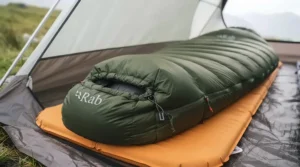
The standout here is the fill: 800-fill-power hydrophobic goose down, which is about as good as synthetic-averse backpackers get without stepping into four-figure mountaineering territory. That fill sits inside a heavily tapered mummy shape, and the combination is what lets a bag weighing well under a kilogram hold a genuine three-season comfort rating. In practice, this means the Rab Neutrino 400 shaves noticeably more grams per degree of warmth than anything else on this list — useful if you’re carrying it up a hill rather than driving it to a pitch. Based on the spec sheet, this bag is aimed squarely at hillwalkers, backpackers and wild campers who need genuine cold-weather performance without wrecking their pack weight, rather than campsite users who won’t notice the extra 400g of a cheaper bag. Reviewers consistently report that the tapered cut feels snug rather than restrictive for back sleepers, though several mention it’s noticeably tight for anyone who moves around a lot in the night. What most buyers overlook is that the recycled Pertex Quantum shell and PFC-free treatment also make this one of the more environmentally responsible premium bags currently sold in the UK, which matters if sustainability credentials factor into your buying decision.
Pros:
- ✅ Exceptional warmth-to-weight ratio for its class
- ✅ Hydrophobic down resists damp UK conditions
- ✅ Recycled, PFC-free shell fabric
Cons:
- ❌ Tapered fit feels restrictive for restless sleepers
- ❌ Premium price puts it out of reach for occasional campers
The Rab Neutrino 400 typically sits in the £350-£450 range, and at the time of research that price reflects genuinely premium materials rather than brand markup — it’s a strong long-term investment if you camp several times a season, but poor value if you’re only heading out once or twice a year.
2. Alpkit PipeDream 200 — best lightweight mummy bag for mild three-season trips
The standout advantage is the price-to-weight ratio: at under 600g, the Alpkit PipeDream 200 undercuts most rivals in its class while still using a proper mummy taper. The comfort rating hovers around 7°C, so on paper this is a warm-to-mild weather specialist rather than an all-rounder — don’t expect it to carry you through an autumn wild camp without a liner or extra layers. Based on the spec comparison with the Rab Neutrino above, the PipeDream trades some of that bag’s severe taper for a slightly roomier cut, which Alpkit pitch as more comfortable for side sleepers who still want a mummy-shaped bag rather than switching styles entirely. Aggregated review sentiment from outdoor gear publications consistently praises the PFC-free hydrophobic down and Alpkit’s B Corp credentials, while a recurring complaint is that the 20D shell fabric, while light, isn’t especially robust against groundsheet snags. This is the bag for a backpacker who wants to keep pack volume down on a route where nights won’t drop much below 5-7°C, and who’s happy to layer up on the rare cold snap rather than buy a heavier all-season bag they’ll only half-use most of the year.
Pros:
- ✅ Genuinely lightweight for a down-filled mummy bag
- ✅ Slightly roomier taper than ultra-technical rivals
- ✅ PFC-free hydrophobic down and B Corp sourcing
Cons:
- ❌ Comfort rating limits it to milder conditions
- ❌ Thin shell fabric needs careful handling
Expect to pay in the £150-£200 range at the time of research, and given the fill quality on offer, that price represents solid value for anyone whose camping calendar leans towards late spring through early autumn.
3. Snugpak Sleeper Expedition — best cold-weather mummy bag for scouting and DofE
The standout feature is the temperature range: a -12°C comfort rating and -17°C limit puts this firmly into genuine winter territory, which is unusual at this price point. That performance comes from Isofibre, a siliconised hollow-fibre synthetic fill that traps warm air between the fibre cavities rather than relying on down’s natural loft. In practice, this means the Snugpak Sleeper Expedition keeps working even if it gets slightly damp inside a leaking tent — synthetic fill doesn’t collapse the way down does when wet, which is exactly why it’s the default recommendation for Duke of Edinburgh expeditions and scout groups where gear gets treated roughly. Based on the spec comparison, the trade-off for that cold-weather resilience is weight: at 2.6kg, it’s more than three times heavier than the Alpkit PipeDream above, so this is not a bag for anyone counting grams on a long trek. Reviewers on retailer sites and forums consistently note the draught collar and insulated shoulder baffle genuinely reduce cold spots, with the recurring criticism being that fabric occasionally snags in the two-way zip during colder mornings when fingers are stiff.
Pros:
- ✅ Genuine cold-weather comfort rating down to -12°C
- ✅ Synthetic fill keeps insulating if it gets damp
- ✅ Draught collar and shoulder baffle cut cold spots
Cons:
- ❌ Bulky and heavy compared with down alternatives
- ❌ Zip can snag in cold conditions
At around £70-£100 at the time of research, this is genuinely strong value for cold-weather performance, and it’s a sensible pick for anyone who needs one dependable bag for scout camps, DofE expeditions or budget-conscious winter trips.
4. Vango Nitestar Alpha 350 — best budget mummy bag for first-time campers
The standout here is accessibility: this is a Duke of Edinburgh-recommended entry-level mummy bag designed to get new campers into a proper shaped bag without the price tag of a technical down model. The comfort rating sits around 5°C, meaning it covers most UK summer and late-spring nights on a standard campsite without needing extra layers underneath. On paper, this means the Vango Nitestar Alpha 350 trades some warmth-to-weight efficiency for affordability — the synthetic fill is bulkier per degree of warmth than the down bags higher up this list, but for a first purchase where you’re not yet sure how often you’ll camp, that’s a sensible compromise. What most first-time buyers overlook is that the mummy taper still delivers a meaningful thermal advantage over a same-price rectangular bag, simply because there’s less dead air space around the shoulders and feet for your body to heat overnight. Aggregated feedback consistently flags this range as reliable for DofE-style expedition use, with the main criticism being that at 1.3kg it isn’t especially packable compared with premium mummy bags.
Pros:
- ✅ DofE-recommended and widely trusted for beginners
- ✅ Solid mummy taper at an entry-level price
- ✅ Reliable warmth for UK spring and summer nights
Cons:
- ❌ Bulkier pack size than premium down bags
- ❌ Limited warmth margin for cooler autumn trips
Pricing typically sits in the under-£50 range, which makes this one of the most sensible first purchases for anyone testing whether camping is going to become a regular hobby.
5. Outwell Campion — best budget rectangular bag for summer family camping
The standout advantage is simplicity and price: this is a single-layer, two-season rectangular bag designed purely for warm-weather comfort rather than technical performance. On paper, the comfort rating sits around 10°C, so this is strictly a summer-nights bag — anyone expecting it to cope with a chilly shoulder-season campsite will be disappointed. What the spec sheet won’t tell you, but the rectangular shape makes obvious, is that this bag unzips fully into a flat blanket, which is genuinely useful for families who want a multi-purpose piece of kit for picnics, festivals and back-garden sleepovers as well as proper camping. Based on the spec comparison with the mummy bags above, the Outwell Campion sacrifices thermal efficiency for that flexibility — the boxy cut means more air space for your body to warm, which is precisely why rectangular bags rarely match a mummy bag’s comfort rating at the same weight. A small internal pocket for a torch is a thoughtful touch reviewers repeatedly mention, alongside consistent praise for the value at this price point, though several note the zip quality feels basic under repeated use.
Pros:
- ✅ Genuinely low price for a full-size rectangular bag
- ✅ Unzips flat into a usable blanket
- ✅ Internal pocket for small essentials
Cons:
- ❌ Comfort rating limited to warm summer nights
- ❌ Zip feels less robust than pricier alternatives
At around £25-£35 at the time of research, this is squarely a budget buy — excellent value for occasional summer camping and festivals, but not a bag to rely on once autumn sets in.
6. Outwell Campion Lux Double — best rectangular double bag for camping couples
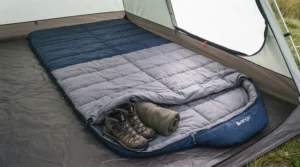
The standout feature is shared comfort: this is a genuine double sleeping bag with a soft rectangular cut and a brushed polyester lining designed to feel like a duvet rather than a technical bag. Key specs translate well into real use — a 5°C comfort and -1°C limit rating covers spring through autumn trips, while the 2.76kg total weight and roughly 50 x 28 x 27cm pack size keep it realistic for anyone travelling by car rather than on foot. Based on the spec comparison, sharing body heat inside one enclosed bag genuinely does improve perceived warmth compared with two singles zipped together, which is why aggregated reviewer sentiment consistently rates this among the more comfortable double options for cooler nights. What most buyers overlook is the L-shaped two-way zip, which opens the whole bag flat into a blanket — genuinely useful on warm nights when you’d rather sleep under it than inside it. Reviewers repeatedly single out the anti-snag zip as a rare claim that actually holds true in daily use, with the main criticism being that, like all rectangular shapes, it can’t match a mummy bag’s thermal efficiency gram-for-gram.
Pros:
- ✅ Genuinely cosy, duvet-like shared sleeping experience
- ✅ Anti-snag zip that reviewers confirm works well
- ✅ Compresses smaller than most double bags
Cons:
- ❌ Heavier and bulkier than two single mummy bags combined
- ❌ Less thermally efficient than a fitted mummy shape
Typical pricing sits in the £90-£130 range, and for couples who camp together regularly, the shared warmth and comfort generally justifies the premium over buying two separate budget singles.
7. Outwell Constellation Lux — best premium rectangular bag for comfort-first solo campers
The standout advantage is the “home bed” feel: this hooded rectangular bag adds a mummy-style hood and draught collar to an otherwise boxy, roomy cut, aiming to blend warmth retention with rectangular-bag freedom of movement. On paper, the comfort rating comes in around 3°C, which is unusually strong for a rectangular design and puts real distance between this bag and the more basic Outwell Campion above. That performance comes from a double-layer insulation structure that staggers the fill to reduce cold spots at the seams — a detail that matters more in practice than it sounds, since seam-aligned cold spots are one of the most common complaints about cheaper rectangular bags. Based on the spec comparison, this model essentially closes much of the thermal gap with entry-level mummy bags while keeping the wider shoulder and foot room rectangular sleepers specifically buy for. Forum discussions and long-term owner reports consistently describe this range as “warm and cosy” and easy to machine wash, which matters for a bag that will get more regular use than a technical backpacking bag.
Pros:
- ✅ Hood and draught collar boost warmth for a rectangular shape
- ✅ Roomy cut without sacrificing much thermal performance
- ✅ Reported as durable and easy to machine wash
Cons:
- ❌ Heavier than mummy bags with a similar comfort rating
- ❌ Still bulkier to pack than a fitted mummy design
Pricing typically falls in the £100-£140 range, and given how close it gets to mummy-bag warmth while keeping rectangular-bag space, it’s arguably the strongest all-round value pick for campers who refuse to compromise on comfort.
What Is a Mummy Sleeping Bag? Understanding Thermal Efficiency
A mummy sleeping bag is a tapered, body-hugging design that narrows from the shoulders down to the feet, minimising the empty air space your body has to warm and maximising thermal efficiency for its weight. This shape is why mummy bags dominate the lightweight and cold-weather end of the market — less air volume means less energy lost to heating unused space inside the bag. Thermal efficiency isn’t just marketing language; it’s measurable, and in Europe it’s standardised under EN 13537, the testing protocol that gives sleeping bags their comfort, lower-limit and extreme temperature ratings using a heated mannequin in a climate-controlled chamber. Understanding this standard matters because two bags with identical fill weights can carry very different comfort ratings purely based on shape — a mummy cut consistently outperforms a rectangular one of the same insulation type, which is exactly what you saw reflected across the comparison table above.
What Is a Rectangular Sleeping Bag? Freedom of Movement Explained
A rectangular sleeping bag keeps a boxy, blanket-like shape from top to bottom rather than tapering to the feet, prioritising freedom of movement while sleeping over raw thermal efficiency. This is the classic camping-shop sleeping bag most people picture, and it remains popular for good reason: side sleepers, restless sleepers and anyone who dislikes the confined feeling of a mummy taper generally find rectangular bags far more comfortable over a full night. The trade-off, as the product analysis above demonstrates, is that extra room means extra air space for your body to heat, which typically costs 3-5°C of comfort rating compared with a similarly filled mummy bag. Many rectangular bags — including the Outwell Constellation Lux covered above — now claw some of that warmth back by adding a hood and draught collar, borrowing mummy-bag features while keeping the roomier cut underneath.

Mummy Sleeping Bag vs Rectangular Sleeping Bag: The Real-World Difference
On paper, the mummy sleeping bag vs rectangular sleeping bag decision looks like a simple trade: warmth-per-gram against room-to-move. In practice, it’s shaped by three other factors that specs alone don’t capture. First, packed size matters enormously if you’re carrying gear rather than driving it — a mummy bag like the Alpkit PipeDream 200 compresses into a fraction of the volume of the Outwell Campion Lux Double, which is irrelevant for car camping but decisive for backpacking. Second, sleeping position changes everything: back sleepers tend to adapt to a mummy taper quickly, while side sleepers and anyone who changes position several times a night often find a rectangular shape, or a roomier mummy bag like the Alpkit above, genuinely more restful. Third, temperature swings matter more in the UK than the brochure ratings suggest — a mild UK summer night can still dip several degrees below forecast once damp air settles into a valley campsite, which is why most seasoned campers err towards a slightly warmer rating than they think they need, whichever shape they choose.
How to Choose Between a Mummy and Rectangular Sleeping Bag
- Work out your trip type first. Backpacking and wild camping favour mummy bags for their packed size and weight; car camping and festivals suit rectangular bags, where bulk barely matters.
- Check the comfort rating against realistic UK night temperatures, not just the season you’re camping in — shoulder-season nights regularly undercut daytime forecasts.
- Consider your sleeping position honestly. Restless or side sleepers should lean rectangular, or a roomier mummy cut like the Alpkit PipeDream 200.
- Weigh fill type against your conditions. Down performs best dry and packed small; synthetic fill like Isofibre keeps insulating even if it gets damp.
- Look for a hood and draught collar if buying rectangular, since these features close much of the thermal gap with mummy bags.
- Factor in whether you’ll share a bag. Double rectangular bags like the Outwell Campion Lux Double genuinely benefit from shared body heat.
- Set a realistic budget band — spending more buys warmth-per-gram, not necessarily comfort, so don’t overspend if you’re a fair-weather camper.
Best Sleeping Bag for Side Sleepers
Side sleepers are the group most likely to feel let down by a badly chosen bag, because the classic mummy taper is built around a back-sleeping posture and can feel genuinely constricting if you roll onto your side repeatedly through the night. That doesn’t rule mummy bags out entirely — the Alpkit PipeDream 200 deliberately uses a slightly less severe taper than a technical bag like the Rab Neutrino, and reviewers consistently note it’s noticeably easier to move around inside. For side sleepers who prioritise comfort over pack weight, though, a rectangular design is usually the safer bet, and the Outwell Constellation Lux is a strong middle ground, pairing genuine shoulder-room with a hood and draught collar that claws back much of the warmth a plain rectangular bag would lose. The Camping and Caravanning Club notes that a mummy shape reduces empty air space and improves heat retention, while rectangular styles allow extra room to move — which lines up precisely with what side sleepers report in practice: warmth is rarely the deciding factor for this group, freedom of movement is.
Hood and Draft Collar: Why These Small Features Matter
A hood and draft collar sound like minor add-ons, but they’re responsible for a disproportionate amount of a sleeping bag’s real-world warmth. Up to a quarter of body heat can escape through an uncovered head and neck, so a cinchable hood — standard on every mummy bag in this guide and increasingly common on premium rectangular models like the Outwell Constellation Lux — closes off one of the biggest heat-loss points in the whole system. The draft collar, a separate insulated tube around the neck and shoulders, stops warm air pumping out of the main zip opening every time you shift position; the Snugpak Sleeper Expedition and Rab Neutrino 400 both use this feature specifically to prevent the “bellows effect” that plagues cheaper bags without one. Reviewers consistently note that a well-fitted hood and draft collar can be worth several degrees of comfort rating, which is exactly why a mid-range bag with both features frequently outperforms a more expensive bag that skips them.
Practical Usage Guide: Getting the Most From Your Sleeping Bag
Getting a new sleeping bag warm-ready starts before your first trip. Unpack it from its stuff sack at least a day before you leave and let the fill fully loft — down and synthetic fill both compress in storage, and a bag that’s just been unpacked won’t reach its rated warmth for several hours. On your first night out, always sleep with a base layer rather than nothing, since manufacturers assume a thin layer of clothing when setting comfort ratings under EN 13537. A common first-30-days mistake is stuffing a down bag like the Rab Neutrino 400 or Alpkit PipeDream 200 back into its stuff sack while still slightly damp from condensation — always air a bag out fully before packing it away, hanging it if you can, to protect the loft long-term. For maintenance, wash sleeping bags sparingly using a specialist down or technical wash rather than regular detergent, and always store them loosely in a large breathable sack between trips rather than compressed in their travel stuff sack, since permanent compression is the single biggest cause of a bag losing warmth over its lifespan. One optimisation trick rarely mentioned on Amazon listings: pairing any bag, mummy or rectangular, with a closed-cell foam mat underneath a self-inflating mattress adds a meaningful thermal boost, because insulation crushed beneath your body weight does almost nothing on its own.
Real-World Scenarios: Which Bag Suits Which Camper
Consider a university student heading to a summer festival with mates: budget and pack size matter more than technical warmth, so the Outwell Campion at under £35 makes complete sense — it folds flat as a picnic blanket the rest of the year too. Now picture a couple in their thirties doing a week of relaxed campsite touring around the Lake District in a car: they don’t need to carry gear far, but they do want comfort and shared warmth on cooler nights, which is exactly the brief the Outwell Campion Lux Double is built for. Finally, picture a solo hillwalker planning a multi-day wild camping route through Snowdonia in early autumn: pack weight and genuine cold-weather performance are non-negotiable, making the Rab Neutrino 400 the obvious pick despite its higher price, with the Alpkit PipeDream 200 as a lighter, cheaper alternative if the forecast stays mild. Matching the bag to the actual trip, rather than buying the most impressive-sounding option, is consistently the difference between a good night’s sleep and a miserable one.
Common Mistakes When Buying a Mummy or Rectangular Sleeping Bag
The most frequent mistake is buying to the “extreme” or “limit” rating printed largest on the packaging rather than the comfort rating, which typically sits 5-10°C higher and reflects what you’ll actually experience on a normal night. A close second is underestimating UK night temperatures — even in summer, the Met Office’s long-term climate data shows how much overnight temperatures can swing from daytime highs, particularly at altitude or near water, catching out campers who packed for the forecast rather than the small hours. Buyers also frequently ignore fit: a mummy bag that’s too long wastes warmth heating empty foot space, while one that’s too short compresses insulation and creates cold spots — always check the manufacturer’s height range rather than assuming “regular” fits everyone. Finally, plenty of first-time buyers assume a higher price always means a warmer bag, when in fact price more often reflects weight savings and packed size rather than raw warmth; the budget Snugpak Sleeper Expedition actually out-warms several pricier bags on this list, it just does so at more than triple the weight.
Long-Term Cost & Maintenance
Sleeping bags aren’t a one-off purchase in the way a tent sometimes can be — proper care genuinely extends usable lifespan by years, which changes the real cost-per-use calculation significantly. A premium down bag like the Rab Neutrino 400 costs considerably more upfront than the Vango Nitestar Alpha 350, but with careful storage and occasional specialist washing, down bags routinely outlast synthetic-filled ones by a wide margin, since down fibres resist the permanent compression that eventually flattens synthetic fill. That said, synthetic bags like the Snugpak Sleeper Expedition are considerably more forgiving of imperfect care — they tolerate damp storage and rougher handling far better than down, which matters if the bag is destined for scout camps or family loans rather than careful solo use. Total cost of ownership should also factor in versatility: a bag that only performs in a narrow temperature band, like the Outwell Campion, may need replacing or supplementing with a liner sooner than a bag with a wider comfort range, even if its upfront price looks like the better deal.
Safety, Regulations & Temperature Rating Compliance
Sleeping bag temperature ratings sold across the EU and UK are generally tested under EN 13537 (now superseded in newer models by ISO 23537), a standard that uses a heated mannequin in a climate-controlled chamber to produce comparable comfort, lower-limit and extreme ratings across brands. It’s worth understanding what those numbers actually mean: the comfort rating reflects a relaxed sleeping position for a standard adult wearing a base layer on an insulated mat, while the lower-limit rating assumes a curled, more conservative position and shouldn’t be treated as your target temperature for a comfortable night. Getting this wrong isn’t just a comfort issue — it carries a genuine safety dimension. The NHS describes hypothermia as a dangerous drop in body temperature below 35°C that can develop from prolonged exposure to cold, and camping in a bag rated well below the night’s actual temperature is a recognised contributing factor. Practical safety steps include buying a bag rated several degrees colder than you expect to need, always sleeping on an insulated mat regardless of the bag’s own rating, and changing out of any damp clothing before getting into the bag for the night.
Problem → Solution: Fixing Common Sleeping Bag Complaints
Problem: waking up cold despite a “warm enough” rating. This is almost always a sleeping mat issue rather than a bag issue — insulation compressed beneath your body weight loses most of its effectiveness, so pairing any bag with a properly insulated mat solves it faster than buying a warmer bag.
Problem: feeling claustrophobic in a mummy bag. Step down to a roomier mummy cut like the Alpkit PipeDream 200, or switch to a hooded rectangular option like the Outwell Constellation Lux that keeps most of the warmth without the tight taper.
Problem: a bag that’s lost its loft and warmth over time. This is nearly always caused by long-term compressed storage — switch to storing it loosely in a large breathable sack between trips, and consider a specialist down or technical wash to restore loft.
Problem: overheating on unexpectedly mild nights. Choose a bag with a full-length two-way zip, such as the Outwell Campion Lux Double, which unzips flat into a blanket for exactly this situation.
Problem: cold spots around the shoulders and neck. Look specifically for a hood and draft collar — features present on the Rab Neutrino 400 and Snugpak Sleeper Expedition — since these close the two biggest heat-loss points a plain rectangular bag lacks.
Frequently Asked Questions
❓ Is a mummy sleeping bag warmer than a rectangular sleeping bag?
❓ Can side sleepers use a mummy sleeping bag comfortably?
❓ What temperature rating do I need for UK camping?
❓ Do rectangular sleeping bags work for backpacking?
❓ How often should I wash a sleeping bag?
Conclusion
The mummy sleeping bag vs rectangular sleeping bag question doesn’t have a single right answer — it has a right answer for your trip. If you’re carrying your kit on your back, sleeping mostly on your side, or want the widest possible temperature range for the lowest weight, a mummy bag like the Rab Neutrino 400 or Alpkit PipeDream 200 earns its keep. If you’re car camping, sharing a bag with a partner, or simply hate the feeling of being zipped into a cocoon, a rectangular option like the Outwell Campion Lux Double or the hood-equipped Outwell Constellation Lux will get you a far better night’s sleep despite the modest warmth trade-off. Budget campers shouldn’t feel short-changed either — both the Vango Nitestar Alpha 350 and the Outwell Campion deliver honest, dependable performance for their price bracket, while the Snugpak Sleeper Expedition proves that genuine cold-weather protection doesn’t have to come with a premium price tag. Whichever shape you land on, match the comfort rating to realistic UK night temperatures rather than the season on the calendar, and you’ll get considerably more value out of whichever bag you choose.
Recommended for You
- Summer Sleeping Bag vs 3 Season Sleeping Bag: 2026 UK Guide
- Summer Sleeping Bag: 7 Brilliant UK Picks for 2026
- Winter Sleeping Bag: 7 Best Picks for Brutal UK Cold (2026)
Disclaimer: This article contains affiliate links. As an Amazon Associate, I earn from qualifying purchases. If you purchase products through these links, we may earn a small commission at no additional cost to you.
✨ Found this helpful? Share it with your friends! 💬🤗
