
In This Article
There’s a very specific kind of misery reserved for campers who got the sleeping bag decision wrong. Either you’re lying awake at 2am in June, damp with sweat inside a bag rated for Arctic bivvies, or you’re shivering through a September night in Snowdonia wrapped in what was basically a glorified bedsheet with a zip. The summer sleeping bag vs 3 season sleeping bag question sounds like a small one, but get it wrong and it defines whether your trip is remembered fondly or through gritted teeth.
Here’s the short version, before we go deep: a summer sleeping bag is built for warm nights, typically comfort-rated somewhere around 5-10°C and above, prioritising low weight and packability over raw warmth. A 3 season sleeping bag covers spring, summer and autumn, generally comfort-rated between roughly -2°C and 5°C, and is built to handle the genuine unpredictability of British weather rather than a single warm week. Neither is objectively “better” — they’re built for different jobs, and the right one depends entirely on when and how often you actually camp.
This guide breaks down seven real sleeping bags currently available on Amazon UK, spanning true budget picks under £50 through to premium recycled-fill options, plus honest analysis of foam depth, temperature ratings and where each bag genuinely earns its keep. We’ve also dug into how British spring and autumn nights actually behave, since UK “3 season” ratings need to work harder than they might in more predictable climates.
Quick Comparison Table
Here’s the shape of the market before we dig into specifics. Prices are indicative ranges only — always check the current listing, since Amazon pricing moves constantly.
| Bag | Season Rating | Comfort Temp | Price Range | Best For |
|---|---|---|---|---|
| Vango Nitestar Alpha 250 | 3 season | around 2°C | around £45-£65 | DofE expeditions, general UK camping |
| Rab Solar Eco 3 | 3 season | 0°C (limit -6°C) | around £155-£210 | Serious backpackers, cold-tolerant trips |
| Trespass Stuffy | 1 season / summer | roughly 10°C+ | around £15-£25 | Festivals, indoor use, warm nights only |
| Amazon Basics Lightweight Sleeping Bag | Marketed 4 season | variable by fill | around £25-£40 | Budget all-rounder, occasional camping |
| Voyager Sleeping Bag | 3-4 season | mild to cool | around £30-£45 | Taller campers, multi-trip versatility |
| MalloMe Sleeping Bag | 3-4 season | mild to cool | around £25-£40 | Ultralight backpacking on a budget |
| Sea to Summit Silk/Cotton Liner | Accessory | adds 2-5°C | around £35-£55 | Extending any bag’s range, hygiene |
Looking at this spread, the pattern that jumps out is how wide the “3-4 season” claim gets stretched across wildly different price points — from a £30 budget bag to a £200 premium one wearing broadly the same label. That gap exists almost entirely in fill quality, construction and genuine cold-weather testing, which we’ll unpack properly below.
💬 Just one click — help others make better buying decisions too!😊
Top 7 Sleeping Bags for British Camping: Expert Analysis
We’ve picked seven real, currently available bags spanning true summer designs through to premium 3-season builds, so whatever your typical trip looks like, there’s a genuine option below rather than a compromise.
1. Vango Nitestar Alpha 250 — DofE-recommended 3-season workhorse
The standout feature is Vango’s Alpha insulation, which compresses down small without sacrificing loft — a genuinely useful trait for anyone carrying their own kit rather than driving to a pitch. With a comfort rating around 2°C and a TOG rating of 10, this is squarely a 3-season bag: comfortable through spring, summer and autumn, but not intended for winter frost. The mummy shape tapers toward the feet to cut pack size and improve thermal efficiency, and the Polair lining is soft against skin while remaining fully machine washable.
Based on the spec comparison against everything else on this list, this is the sensible default for anyone doing regular UK camping rather than a single warm-weather trip — it’s the bag recommended within the Duke of Edinburgh’s Award expedition kit guidance, a scheme that has road-tested outdoor equipment across thousands of young people’s expeditions for decades. Reviewers consistently praise the warmth-to-weight ratio and the auto-lock zip, which stops the bag creeping open mid-sleep. The most common complaint in aggregated feedback concerns the stuff sack being slightly tight on the first few uses before the compression straps bed in.
Pros:
- ✅ Genuine 3-season comfort rating around 2°C
- ✅ DofE-recommended kit with a strong reputation for durability
- ✅ Compresses smaller than most bags in this price bracket
Cons:
- ❌ Not warm enough for genuine winter or frost conditions
- ❌ Stuff sack feels tight until it’s been used a few times
At around £45-£65, this sits comfortably as a mid-range pick — a strong first “proper” sleeping bag for anyone moving beyond festival-grade kit.
2. Rab Solar Eco 3 — premium recycled-fill performance for serious trips
The headline feature is genuine sustainability without compromising warmth: this bag uses 100% recycled Stratus synthetic insulation, made from post-consumer PET bottles, inside a 20-denier recycled ripstop shell with a fluorocarbon-free water-repellent coating. Rab rates it at a 0°C comfort limit with a -6°C lower limit, which pushes it beyond what most “3 season” bags genuinely deliver — this is a bag that shrugs off a properly cold shoulder-season night in the Cairngorms, not just a mild one in the Cotswolds.
What most buyers overlook about premium synthetic bags like this is that synthetic fill, unlike down, keeps insulating even when damp — a genuinely important trait given how often British trips involve condensation, drizzle, or a tent that isn’t quite as waterproof as advertised. Reviewers consistently describe the wide mummy cut as noticeably more comfortable than narrower competitors, with enough room to layer extra clothing on colder nights without feeling constricted. The clear trade-off is price, and a recurring theme in aggregated feedback is that casual campers feel the cost is hard to justify against beds they use only a handful of nights a year.
Pros:
- ✅ 100% recycled fill and fabric without sacrificing warmth
- ✅ Synthetic insulation stays warm even when damp
- ✅ Wide mummy cut allows comfortable layering
Cons:
- ❌ Premium price relative to genuine usage for occasional campers
- ❌ Bulkier and heavier than down-filled alternatives at this warmth
Expect to pay around £155-£210, positioning this firmly as an investment piece for regular backpackers rather than a once-a-summer camper — but for cold-tolerant, damp-prone British trips, the performance case is genuinely strong.
3. Trespass Stuffy — genuine budget summer bag, nothing more
The defining feature is simplicity: this is a true 1-season summer bag, lightweight and inexpensive, built for warm nights rather than pretending to be anything more. Trespass, a Glasgow-founded outdoor brand with decades of British weather experience, positions this squarely as entry-level kit — festival camping, warm summer evenings, or as a liner-style layer inside a tent during a heatwave.
Here’s what the price tag won’t tell you outright: at this level, you’re paying almost entirely for portability and low cost, not thermal engineering. Reviewers consistently note it’s fine for its stated purpose — genuinely warm nights only — and several mention using it successfully at summer festivals and indoor sleepovers. The honest caveat, and it’s an important one, is that this bag will leave you cold the moment a British “summer” night dips into typical shoulder-season territory, which happens more often than the season’s name suggests.
Pros:
- ✅ Genuinely lightweight and easy to pack for festivals
- ✅ Low price makes it accessible as a spare or backup bag
- ✅ Trusted, long-established UK outdoor brand
Cons:
- ❌ Only suitable for genuinely warm nights, nothing cooler
- ❌ Minimal insulation compared to any 3-season option here
At around £15-£25, this is about as cheap as a genuine branded sleeping bag gets — a sensible pick for its specific, narrow use case, but not a bag to rely on for anything beyond peak summer warmth.
4. Amazon Basics Lightweight Sleeping Bag — budget all-rounder with caveats
The standout feature is the price-to-versatility ratio: marketed to cover a broad temperature range, this bag aims to be a single, affordable option for owners who don’t want to buy separate bags for every season. It uses a synthetic fill with a lightweight polyester shell, and at 190 x 83cm it offers a reasonably roomy fit for a budget bag.
Based on the spec sheet, this is best treated honestly as a mild 3-season bag rather than a genuine year-round option — “4 season” branding on budget bags is applied loosely across this entire market, and it’s worth reading that claim with healthy scepticism rather than taking it at face value. Aggregated review sentiment is generally positive for the price point, with owners frequently describing it as adequate for spring and early autumn camping trips. A recurring theme in feedback is that the fill compresses somewhat after repeated washing, gradually reducing warmth over a season or two of regular use — a fairly typical trade-off at this price bracket.
Pros:
- ✅ Genuinely low price for a reasonably roomy bag
- ✅ Lightweight enough for casual backpacking
- ✅ Machine washable synthetic construction
Cons:
- ❌ “4 season” marketing overstates real-world warmth
- ❌ Fill compresses and loses warmth after repeated washing
At roughly £25-£40, this is a sensible budget all-rounder provided expectations are realistic — treat it as a solid 3-season bag for mild UK nights, not a genuine winter option.
5. Voyager Sleeping Bag — roomy 3-4 season option for taller campers
The defining feature is length: at 220cm, this bag comfortably accommodates taller adults who find themselves cramped in standard-length mummy bags, without needing to size up to an expensive long-fit premium option. It carries a 3-4 season rating with a water-resistant shell designed to deflect light rain and tent condensation, which matters more than it sounds during a typically damp British trip.
What most buyers overlook about roomier bags like this is that the extra internal space, while great for taller sleepers, does slightly reduce thermal efficiency compared with a snugger mummy cut — more air volume for your body to heat means marginally less warmth-per-gram than a closer-fitting bag of similar fill weight. Reviewers consistently highlight the machine-washable, quick-drying polyester as a genuine time-saver after muddy trips, and the level of packability relative to the price is frequently mentioned as better than expected. The main criticism in aggregated feedback concerns the zip occasionally snagging on the inner lining during use.
Pros:
- ✅ Genuinely roomy 220cm length suits taller campers
- ✅ Water-resistant shell handles light rain and condensation
- ✅ Machine washable and quick-drying
Cons:
- ❌ Extra internal volume slightly reduces thermal efficiency
- ❌ Zip occasionally snags on the inner lining
Priced around £30-£45, this is a strong pick specifically for taller campers who’ve struggled with standard-length budget bags elsewhere on this list.
6. MalloMe Sleeping Bag — ultralight backpacking pick on a budget
The standout feature is weight relative to price: this is marketed as an ultralight backpacking bag with a 3-4 season rating, using 3D synthetic fibre fill designed to pack down small without the premium cost of down insulation. A double-layered water-resistant shell adds a further line of defence against damp ground and light rain, and it ships with a compression sack to shrink pack size for longer hikes.
This one suits owners prioritising trail weight over maximum thermal performance — think multi-day hiking routes where every gram in the rucksack matters, rather than car camping where bulk is less of a concern. Aggregated review sentiment is broadly positive on portability, with several reviewers specifically praising how much smaller it compresses compared to similarly priced competitors. A recurring complaint concerns sizing running slightly snug for larger-framed adults, which is worth checking against the listed dimensions before buying.
Pros:
- ✅ Genuinely compact when packed into its compression sack
- ✅ Double-layered shell adds useful damp-weather protection
- ✅ Strong value for a dedicated ultralight-style budget bag
Cons:
- ❌ Runs snug for larger-framed adults
- ❌ Less roomy overall than the Voyager on this list
At around £25-£40, this is one of the better ultralight-oriented budget picks currently available — a sensible choice for hikers who care more about pack weight than sprawling out.
7. Sea to Summit Silk/Cotton Liner — the layering accessory that changes everything
The standout feature isn’t a sleeping bag at all — it’s the accessory that quietly extends the usefulness of every bag on this list. This liner blends 30% silk with 70% cotton for a feel close to a high thread-count sheet, and it genuinely adds a useful few degrees of warmth on cooler nights while keeping the inside of your main bag cleaner between washes.
Based on the spec comparison with buying an entirely separate warmer bag, a liner is by far the more cost-effective route to extending a single bag’s usable season. Reviewers consistently highlight the “Traveller” style’s built-in pillow slip as a small but genuinely appreciated comfort touch, and the machine-washable, colourfast fabric holds up well to repeated trips without fading. The honest trade-off is that a liner adds warmth incrementally rather than transforming a summer bag into a genuine 3-season one — it’s a boost, not a substitute for the right bag in the first place.
Pros:
- ✅ Adds several degrees of warmth to any existing bag
- ✅ Keeps the sleeping bag interior cleaner between washes
- ✅ Machine washable and genuinely colourfast over repeated use
Cons:
- ❌ Won’t turn a summer bag into a genuine cold-weather bag alone
- ❌ Silk-cotton blend costs more than basic polyester liners
At around £35-£55, this is one of the most cost-effective upgrades on this entire list — buy the right bag for your typical trip, then use a liner to stretch it further at either end of the season.
Practical Usage Guide: Getting the Most From Your Sleeping Bag
A sleeping bag’s real-world performance depends heavily on how it’s used, not just its spec sheet. Before the first trip, always let a compressed bag loft fully overnight — most synthetic and down fills need several hours out of their stuff sack to regain their full insulating thickness, and a bag pitched straight from a tightly packed stuff sack will sleep noticeably colder than the rating suggests. On the trip itself, always use a sleeping mat underneath; a sleeping bag’s underside insulation gets compressed flat by body weight, so ground-side warmth comes almost entirely from the mat, not the bag.
In the first month of ownership, watch for two common mistakes. The first is over-tightening the hood drawcord in an attempt to trap more warmth, which can restrict airflow and actually trigger uncomfortable condensation build-up inside the bag. The second is machine washing too aggressively or too often — most manufacturers recommend a gentle, cold cycle, and repeated hot washes are the single biggest cause of premature fill compression across every bag on this list.
For maintenance, always store a sleeping bag loose or in a large breathable cotton storage sack between trips rather than leaving it compressed in its stuff sack for months at a time — sustained compression is what gradually kills loft and warmth. Air the bag out fully after every trip before storage, even if it looks dry, since trapped moisture from body heat and condensation is a common cause of mildew and odour over time.
Real-World Scenarios: Which Bag Fits Your Trips?
The regular weekend camper doing spring through autumn trips. Someone camping roughly once a month from April through October needs genuine 3-season reliability without premium pricing. The Vango Nitestar Alpha 250 is the obvious fit — DofE-tested, reasonably priced, and built for exactly this kind of repeated, moderate-conditions use.
The festival-goer who camps twice a year in summer. For someone whose only camping is a couple of warm summer festivals, spending £150 on a premium 3-season bag is genuinely unnecessary. The Trespass Stuffy covers the actual use case at a fraction of the cost, freeing up budget for a decent airbed instead.
The serious hiker tackling multi-day autumn routes. A hiker planning proper shoulder-season backpacking trips into October, where nights regularly drop close to freezing in higher terrain, needs a bag that won’t let them down. The Rab Solar Eco 3 offers the cold-weather margin and damp-resistant synthetic fill that genuinely matters when the forecast turns.
Problem → Solution: Common Sleeping Bag Buying Mistakes
Problem: bought a summer bag, then froze on a September trip. Solution — check the actual comfort temperature rating, not just the word “summer” or “3 season,” and remember British shoulder-season nights regularly dip below what a true 1-season bag can handle; step up to something like the Vango Nitestar Alpha 250.
Problem: bought a premium 3-season bag but only camp twice a year. Solution — match spend to actual usage frequency. Occasional campers are usually better served by a budget option like the MalloMe Sleeping Bag plus a liner for extra warmth on the rare colder night.
Problem: bag feels cold despite a good comfort rating. Solution — check what’s underneath. A thin or missing sleeping mat is one of the most common causes of a “cold” sleeping bag, since ground contact draws heat away far faster than air does.
Problem: bag has lost noticeable warmth after a year or two. Solution — this is almost always down to fill compression from over-washing or long-term compressed storage; a Sea to Summit Silk/Cotton Liner can help restore a little lost warmth without replacing the whole bag.
Problem: bag is too tight to move or too big to stay warm. Solution — check listed dimensions carefully before buying rather than relying on “one size fits most” marketing; the Voyager Sleeping Bag‘s longer 220cm length solves this specifically for taller campers.
✨ Ready to Sort Your Sleep System Once and For All?
🔍 Click through to any highlighted bag above to check current pricing and availability. Getting this one decision right changes every trip that follows.
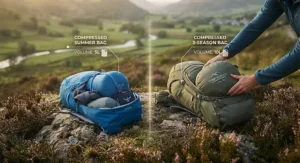
What Is a Summer Sleeping Bag vs a 3 Season Sleeping Bag?
A summer sleeping bag is a lightweight bag comfort-rated roughly 5-10°C and above, built for warm nights with minimal insulation and low pack weight. A 3 season sleeping bag is rated to handle spring, summer and autumn, typically comfort-rated between around -2°C and 5°C, offering more insulation to cope with genuinely variable temperatures rather than consistent warmth alone.
How to Choose Between a Summer and 3 Season Sleeping Bag
- Check when you actually camp, not when you hope to. If most trips fall between May and September with occasional cooler nights, a 3-season bag is the safer default.
- Look at the comfort rating, not just the season label. “Season” branding is inconsistently applied across brands; the numerical comfort temperature tells the real story.
- Factor in where you camp, not just when. Higher ground, exposed coastal sites and northern England or Scotland all run noticeably colder than sheltered southern campsites at the same time of year.
- Weigh pack size against warmth if you’re hiking in. Car campers can prioritise warmth and comfort; backpackers need to balance both against genuine weight limits.
- Consider buying one 3-season bag rather than two seasonal ones. For most UK campers, a mid-range 3-season bag covers more of the calendar than a dedicated summer bag alone.
- Add a liner before upgrading the whole bag. A liner is a cheaper, lighter way to extend a bag’s comfortable range than replacing it outright.
- Match your budget to your camping frequency. Frequent campers justify premium spend; occasional campers are usually better served by a solid budget pick.
Best 3 Season Sleeping Bag: What to Look For
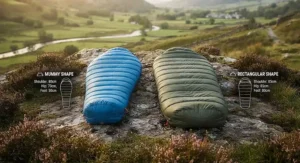
The best 3 season sleeping bag for most UK campers balances a genuine comfort rating around 0-3°C with reasonable weight and a fair price — not the deepest possible warmth, but reliable performance across the actual range of British spring, summer and autumn nights. Look specifically for a mummy or semi-mummy shape, which improves thermal efficiency by reducing dead air space compared with a rectangular design, and a hood with a drawcord closure, since a huge amount of heat loss happens through an uncovered head on a cold night.
On this list, the Vango Nitestar Alpha 250 represents the clearest “best 3 season” pick for general use — it’s specifically DofE-recommended kit, a scheme whose expedition kit guidance reflects years of real-world testing across thousands of young people’s outdoor expeditions. For campers who regularly push into colder, damp shoulder-season conditions, the Rab Solar Eco 3 offers a genuine step up in cold-weather margin, at a correspondingly higher price.
Best Sleeping Bag Under £50
Budget doesn’t have to mean a poor night’s sleep. Of the seven products above, four currently sit comfortably under the £50 mark, and each does a specific job well rather than compromising across the board.
| Bag | Typical Price | Season Rating | Best For |
|---|---|---|---|
| Trespass Stuffy | around £15-£25 | 1 season / summer | Festivals, warm nights only |
| MalloMe Sleeping Bag | around £25-£40 | 3-4 season | Ultralight backpacking on a budget |
| Amazon Basics Lightweight Sleeping Bag | around £25-£40 | Marketed 4 season | Casual, occasional camping |
| Voyager Sleeping Bag | around £30-£45 | 3-4 season | Taller campers, multi-trip use |
Looking at this table, the MalloMe Sleeping Bag and Voyager Sleeping Bag offer the strongest genuine 3-season value under £50, both delivering real spring-through-autumn usability rather than the narrower warm-nights-only performance of the Trespass Stuffy. If your budget is fixed under £50 and you camp across more than just peak summer, either of those two beats a true summer bag for overall usefulness.
British Spring/Autumn Temperatures: What Your Bag Needs to Handle
This is where UK camping diverges from a lot of generic sleeping bag advice written for more predictable climates. According to Met Office UK climate data, British spring typically runs from around 7°C to 16°C, while autumn evenings commonly sit between roughly 7°C and 14°C — but those are daytime averages, and overnight temperatures, particularly away from urban heat and at any elevation, regularly fall several degrees below that range, sometimes close to freezing even in what’s technically “spring” or “autumn” by the calendar.
What most buying guides overlook about British spring/autumn temperatures specifically is the unpredictability rather than the average — a mild, sunny April afternoon can still deliver a genuinely cold, clear night, since clear skies let heat radiate away faster than cloud cover does. This is precisely why a 3-season bag comfort-rated around 0-3°C makes more sense for UK shoulder-season camping than one rated purely around the “average” daytime temperature might suggest; you’re buying margin for the cold, clear nights, not just the mild, cloudy ones.
Versatility for Multi-Trip Use
Versatility for multi-trip use is arguably the single biggest practical argument in favour of a 3-season bag over a dedicated summer one, especially for anyone who doesn’t camp often enough to justify owning multiple bags. A genuine 3-season bag comfortably covers a May bank holiday trip, a July festival, and an October woodland weekend without needing to be swapped out — whereas a true summer bag leaves you exposed the moment autumn arrives, and a heavy winter bag is genuinely uncomfortable and overkill through the height of summer.
Here’s what most buying guides won’t spell out plainly: for anyone doing fewer than roughly ten camping nights a year, one well-chosen 3-season bag almost always beats owning two seasonal bags, both financially and in terms of storage space. The Vango Nitestar Alpha 250 and Voyager Sleeping Bag both illustrate this well — neither is the lightest or warmest option on this list, but both cover the widest practical slice of the UK camping calendar for a single, reasonable outlay.
Layering with a Liner
Layering with a liner is the most cost-effective way to extend any sleeping bag’s usable range without buying a second one outright. A liner sits inside the main bag, adding a genuine few degrees of warmth on cooler nights, wicking moisture away from skin on warmer ones, and — just as importantly — keeping the expensive insulated core of your main bag cleaner, which reduces how often it needs washing and therefore how quickly its fill compresses.
Silk and silk-cotton blend liners, such as the Sea to Summit Silk/Cotton Liner featured above, add noticeable warmth for very little extra pack weight, making them a favourite among backpackers layering up for an unexpectedly cold night. Cotton-only liners are heavier and bulkier but considerably cheaper, and are a genuinely sensible choice for car campers who aren’t carrying kit on their back. Either way, a liner turns a single sleeping bag into a more flexible system — warm enough for a summer night used alone, and noticeably more capable when a colder night calls for the extra layer underneath.
Summer Sleeping Bag vs 3 Season Sleeping Bag: Full Comparison
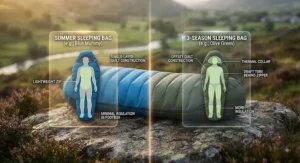
The core difference comes down to insulation volume and the temperature range each is engineered to cover, not just marketing language. A summer sleeping bag uses a thinner fill layer, prioritising low weight and pack size on the assumption that outside temperatures will do most of the work for you. A 3 season sleeping bag uses noticeably more fill, a fuller hood, and often a draught baffle along the zip specifically to handle the wider, less predictable temperature swings of a full UK camping season.
| Factor | Summer Sleeping Bag | 3 Season Sleeping Bag |
|---|---|---|
| Typical comfort rating | 5-10°C+ | around -2°C to 5°C |
| Weight & pack size | Lightest, most compact | Moderate, larger packed size |
| Best for | Festivals, warm nights, indoor use | Spring, summer, autumn camping |
| Price range | Usually cheapest | Moderate to premium |
Looking at this comparison, the practical takeaway is straightforward: a summer bag wins decisively on weight and price for genuinely warm-only use, but a 3-season bag wins on real-world flexibility for anyone camping across more than a narrow summer window. Most UK campers, given unpredictable weather across the actual camping season, get more genuine value from the 3-season option — with a liner in reserve for the rare properly cold night, and a lighter summer bag reserved specifically for guaranteed warm-weather trips like festivals.
Common Mistakes When Buying a Summer or 3 Season Sleeping Bag
The most frequent mistake is buying based on season labelling alone rather than checking the actual comfort temperature rating — as covered above, this labelling is applied inconsistently across brands and price points. A close second is underestimating how much colder British nights run compared with daytime temperatures, particularly on clear nights or at any elevation, leading campers to under-buy warmth for supposedly mild trips.
A third common error is assuming synthetic and down fill are interchangeable when comparing warmth-to-weight — down generally offers better warmth for its weight but performs poorly when damp, while synthetic fill like that used in the Rab Solar Eco 3 keeps insulating even if it gets wet, which matters considerably more in typically damp British conditions. Finally, many buyers skip checking the packed size against their actual rucksack or car boot space, only to discover the bag they’ve bought is considerably bulkier than expected once compressed.
Long-Term Cost & Maintenance
Thinking in cost-per-trip rather than upfront price changes the maths considerably. A £20 summer bag used exclusively for two festivals a year works out to roughly £10 per trip in its first year alone, which is genuinely excellent value if that’s the full extent of its use. A £180 premium 3-season bag used across fifteen or twenty nights a year, and lasting five-plus years with proper care, works out closer to £2-£3 per night over its lifespan — cheaper per use than it first appears, provided it’s actually used that regularly.
Maintenance costs are modest across the board. Occasional gentle machine washing, proper airing after every trip, and loose storage between uses cost nothing beyond a bit of care, but skipping them is the single biggest driver of premature fill compression and lost warmth across every bag on this list. A replacement liner, where one is used, typically costs £15-£55 depending on material, considerably cheaper than replacing an entire sleeping bag once the original fill has flattened.
Safety & Practical Considerations for UK Camping
There’s no UK regulation governing sleeping bag temperature ratings in the way there is for some other outdoor equipment, though many reputable brands test to the EN 13537 standard, which provides a broadly comparable comfort and lower-limit rating across manufacturers — worth checking for on any listing, since it offers more reliable ground truth than season branding alone. Genuine hypothermia risk from an under-rated sleeping bag is real, particularly for children, older campers, or anyone camping at altitude or near water where temperatures drop faster after dark.
Practically, always pack a sleeping bag in a dry bag or waterproof liner separate from the rest of your kit — a wet sleeping bag loses much of its insulating capacity regardless of fill type, and this single piece of advice appears consistently across expedition guidance, including the Duke of Edinburgh’s Award’s own packing recommendations for young people undertaking multi-day hikes. If you’re camping somewhere genuinely remote or at elevation, always check a proper mountain or overnight forecast rather than a general daytime weather app reading, since UK hill and valley temperatures can differ by several degrees even a short distance apart.

FAQ
❓ Is a 3 season sleeping bag warm enough for British summer camping?
❓ Can I use a summer sleeping bag in early autumn?
❓ What's the best 3 season sleeping bag for UK camping?
❓ Does a liner really make a noticeable difference?
❓ Is it worth buying two sleeping bags, one for summer and one for 3 season?
Conclusion
The summer sleeping bag vs 3 season sleeping bag decision really comes down to being honest about how and when you actually camp, rather than chasing the lightest or cheapest option on the shelf. If your trips are genuinely limited to warm summer nights — festivals, indoor sleepovers, guaranteed heatwave camping — a true summer bag like the Trespass Stuffy is lighter, cheaper and entirely adequate. For almost everyone else navigating Britain’s genuinely unpredictable spring, summer and autumn weather, a proper 3-season bag earns its keep across far more of the calendar.
Budget-conscious campers should look hard at the MalloMe Sleeping Bag or Voyager Sleeping Bag, both offering real 3-season usability under £50. Regular campers and DofE participants are well served by the Vango Nitestar Alpha 250, while serious backpackers tackling colder, damp shoulder-season trips should weigh up the Rab Solar Eco 3‘s genuine cold-weather margin. Whichever bag you choose, a Sea to Summit Silk/Cotton Liner is a small, worthwhile addition that stretches its usable range further in either direction.
✨ Sort Your Sleeping Bag Before Your Next Trip
🔍 Browse the full lineup above and pick the bag that matches how — and how often — you actually camp. Getting this right pays off on every trip that follows.
Recommended for You
- Summer Sleeping Bag: 7 Brilliant UK Picks for 2026
- Winter Sleeping Bag: 7 Best Picks for Brutal UK Cold (2026)
- Sleeping Bag Under £100: 7 Best UK Picks Tested for 2026
Disclaimer: This article contains affiliate links. As an Amazon Associate, I earn from qualifying purchases. If you purchase products through these links, we may earn a small commission at no additional cost to you.
✨ Found this helpful? Share it with your friends! 💬🤗
