

In This Article
A compressible pillow for car camping is a foam- or fibre-filled pillow that squashes into a stuff sack or sleeve for the journey, then springs back to something close to a bed pillow once unpacked. Because your boot has room to spare, you can chase comfort rather than grams.

Here’s what most camping advice glosses over. A bad pillow doesn’t wreck a trip in one dramatic moment. It does it slowly. A crick in the neck on night one, a lumpy cheek on night two, and by Sunday you’re shuffling around the campsite like a retired bouncer.
So why not just nick the pillow from your bed? You can, and plenty of people do. But home pillows are bulky, hard to keep dry, and a disaster the moment a tent seam leaks or the dog claims squatters’ rights. Purpose-built options pack smaller, cope better with damp and often come with covers you can chuck in the wash. Many rely on polyurethane foam, and memory foam, the slow-recovery variety that softens with body heat and moulds to your head, is the headline act in the plusher ones.
This guide goes beyond the spec sheet. I’ve compared manufacturer data, retailer listings and published 2026 test results to narrow the field to seven pillows, from budget to premium. Each spec is translated into what it actually means once your head is on it. You’ll also find dedicated sections on oversized camping pillows, family camping comfort and a caravan and campervan sleep setup, plus packable options for travel and hiking when the car isn’t doing the carrying. Prices are shown as ranges only, so check current price on the listing before you buy.
Quick Comparison: Compressible Pillow for Car Camping at a Glance
| Pillow | Type | Weight | Size (L × W × H) | Price range | Best For |
|---|---|---|---|---|---|
| Therm-a-Rest Compressible Pillow Cinch | Foam-filled, cinch cord | c. 295-420g (Regular-Large) | 46×33×15cm (Reg) / 56×38×18cm (Large) | £25-£45 | All-round car camping |
| Nemo Fillo King | Air + foam hybrid | 385g | 43×36×15cm | £50-£75 | Side sleepers, broad shoulders |
| Zempire Chill Pill DLX | Memory foam | 664g | 43×29×12cm | £25-£35 | Maximum plushness |
| Exped Deepsleep Pillow L | Foam-chip fill | 249g | 47×26×13cm | £30-£40 | Car camping plus occasional hikes |
| Sea to Summit Aeros Ultralight Pillow Regular | Inflatable | c. 69g | 35×25×9.5cm | £30-£40 | Hiking and travel |
| Trekology ALUFT Ultra | Inflatable, oversized | 265g | 60×38×12cm | £20-£30 | Big-pillow width, light weight |
| HIKEMAN Camping Memory Foam Pillow | Memory foam | 320g | Check listing | Under £20 | Tight budgets |
Looking at the comparison above, the weight spread tells the story. The foam-heavy Zempire Chill Pill DLX weighs nearly ten times the Sea to Summit Aeros Ultralight Pillow Regular, yet for a boot-loaded trip that penalty is invisible. If you want loft without the heft, the Nemo Fillo King gets there with air rather than foam, at a higher price. Budget buyers should note that the HIKEMAN Camping Memory Foam Pillow lacks verified dimensions, so read the listing carefully.
💬 Just one click — help others make better buying decisions too!😊
Top 7 Compressible Pillows for Car Camping: Expert Analysis
Everything below draws on maker specifications, retailer data and published tests, notably Live for the Outdoors’ 2026 camping pillow test. Review comments are summarised as aggregated sentiment, not as hands-on experience.
1. Therm-a-Rest Compressible Pillow Cinch — best all-round foam comfort
The standout trick is the cinch cord. Pull the sleeve tight and the foam squashes down for the boot; loosen it and you dial in your preferred firmness.
The Regular measures roughly 46 × 33 × 15cm and weighs around 295-300g, while the Large stretches to 56 × 38 × 18cm at about 420g. In practice, the Regular’s 15cm loft suits most back sleepers and plenty of side sleepers. The Large gives restless sleepers room to roll without losing the pillow. The fill is upcycled foam beneath a brushed polyester cover that’s around 60% recycled, so it feels like a bed pillow rather than a balloon with ambitions.
Based on the spec comparison, this is the pick for campers who want something quiet, valve-free and dependable, and who have the boot space to forgive its bulk. It’s the sensible default if you can’t decide.
Reviewers consistently praise the comfort and the machine-washable cover. Criticism centres on weight and bulk: one UK test calls it heavier and less compact than hybrid rivals, and another notes it needs regular fluffing to keep its shape. It also placed third among 17 pillows in OutdoorGearLab’s 2026 test.
Pros:
- ✅ Plush, quiet foam feel with no crinkle
- ✅ Cinch cord adjusts firmness easily
- ✅ Washable, partly recycled cover
Cons:
- ❌ Heavier and bulkier than hybrid pillows
- ❌ Needs regular fluffing after packing
Expect roughly £25-£45 depending on size and colour; check current price. For this much comfort, it’s good value.

2. Nemo Fillo King — best for side sleepers and broad shoulders
Where most camping pillows are polite, the Nemo Fillo King is generous. It’s squarer and far taller than the standard Nemo Fillo.
It measures about 43 × 36 × 15cm and weighs 385g at minimum, packing to roughly 32 × 12cm. Inside is an air cell topped with upcycled open-cell foam, under a soft, removable, machine-washable jersey cover. That 15cm loft means side sleepers needn’t stuff a fleece underneath, and the 36cm width stops your head wandering off mid-night. Because air does much of the work, it’s roughly 280g lighter than the Zempire Chill Pill DLX while offering more height.
What most buyers overlook is the packed size. It’s noticeably bigger than the standard model’s, and one buyer notes it packs larger than expected. It’s brilliant for a boot, less so for a rucksack. For comparison, Live for the Outdoors rates the smaller Nemo Fillo Elite as its best camping pillow overall.
Retailer reviews are warm. At one US retailer it averages 4.5 stars across 11 reviews, with buyers describing a big, supportive pillow that feels like a real one, and some use it at home.
Pros:
- ✅ Six inches of loft suits side sleepers
- ✅ Air-adjustable firmness
- ✅ Soft, removable, washable cover
Cons:
- ❌ Premium price versus foam rivals
- ❌ Packs larger than the standard version
Expect around £50-£75; check current price. It’s worth it if you sleep on your side, and hard to justify if you don’t.
3. Zempire Chill Pill DLX — most plush for the money
If comfort were an Olympic event, the Zempire Chill Pill DLX would be doing victory laps. A memory foam base gives a sink-in feel without the bounce of air pillows.
It measures 43 × 29 × 12cm and weighs 664g, rolling to roughly a third of its size, with a packed size around 25 × 19 × 17cm. The 12cm thickness works well for side sleeping, and the 43cm width gives your head a real landing zone. As the Wikipedia entry on memory foam explains, denser foam softens with body heat. On a cold dawn it may feel firmer for the first few minutes.
On paper, 664g rules it out for backpacking. For car camping, a van or a festival field, that doesn’t matter. This is the pillow for people who’d rather feel at home than feel “outdoorsy”.
Verified customer-review data is thin, so treat this as one expert tester’s verdict. Live for the Outdoors’ reviewer found it so comfortable that they used it at home, praised the large surface and washable cover, and flagged only the weight and bulk.
Pros:
- ✅ Memory foam comfort without any bounce
- ✅ Generous surface area for head movement
- ✅ Soft, removable, washable cover
Cons:
- ❌ Too heavy for backpacking
- ❌ Foam may feel firm when cold
Expect around £25-£35; check current price. It’s a comfort bargain.
4. Exped Deepsleep Pillow L — foam comfort you can still carry
The Exped Deepsleep Pillow L is the compromise candidate. It’s foam-filled but surprisingly svelte.
At 249g, with dimensions of 47 × 26 × 13cm and a packed size of 21 × 16 × 13cm, it’s the lightest and most packable of the non-inflatable pillows in Live for the Outdoors’ test. The cushioning is an upcycled foam-chip core, which feels plush rather than bouncy. It lofts to about 13cm, ideal for side sleepers yet compressible enough for back sleepers. A strap on each side lets you tie it to your sleeping mat.
Here’s what the spec sheet won’t tell you. Right after being unpacked, the pillow can feel uneven, but it recovers if left alone for a few minutes. Unpack it before you brush your teeth, not after.
That test rated it 4 out of 5, praising comfort and loft, with the price and the extra bulk over inflatables as the only grumbles. It’s the best pick here for car campers who occasionally sneak in a wild-camping night.
Pros:
- ✅ Plush foam-chip feel with good side-sleeper loft
- ✅ Wider than many rivals
- ✅ Side straps secure it to a mat
Cons:
- ❌ Pricier than basic foam pillows
- ❌ Heavier and bulkier than inflatables
Expect the £30-£40 range; check current price. It’s a solid dual-purpose buy.
5. Sea to Summit Aeros Ultralight Pillow Regular — satsuma-sized when packed
Strictly speaking, this is an inflatable, but it earns its place for the day your trip includes a hike-in night.
Live for the Outdoors recorded about 69g (some retailers quote less) and 35 × 25 × 9.5cm when inflated. It packs to roughly 9 × 6 × 5cm, no bigger than a satsuma, and inflates in two breaths. The 9.5cm loft suits most side sleepers, while the contoured shape and valve let you let air out for a softer feel without turning the pillow into a trampoline.
Based on the spec comparison, this is the fix for packing-space panic: a car-camping pillow that disappears into a coat pocket on the way to a summit bivvy. The compromise is width. It’s narrower than any foam option here, and it needs puncture care, as inflatable mats do.
Testers rate it 4.5 out of 5, praising value and the valve system, while noting that it isn’t as wide as some rivals and that the face fabric isn’t quite as luxurious as the Nemo Fillo Elite‘s. Lighter still, the Exped Ultra Pillow M weighs 56g.
Pros:
- ✅ Packs to roughly satsuma size
- ✅ Contoured to keep your head still
- ✅ Valve allows precise firmness tuning
Cons:
- ❌ Narrower than foam pillows
- ❌ Needs care to avoid punctures
Expect around £30-£40, often discounted; check current price. It’s superb value for its niche.

6. Trekology ALUFT Ultra — bed-pillow width at a light weight
The Trekology ALUFT Ultra inflates to 24 × 15 × 4.5in, roughly 60 × 38 × 12cm, yet weighs about 265g. That’s a wide platform for very little weight.
It packs to around 19 × 10cm and comes with a removable pillowcase plus an attachment strap that stops it sliding off an inflatable mat. In practice, 60cm of width means you can roll over without your ear hitting the mat. At 12cm loft, it suits side sleepers if you don’t over-inflate it.
I couldn’t find independent tests of the Ultra specifically, so expectations should be cautious. The sibling Trekology ALUFT Pro drew mixed comfort verdicts in one backpacking review, though its strap and removable cover were praised. Live for the Outdoors called Trekology’s smaller pillow a great budget buy, but less comfortable than rivals owing to the lack of insulation and its simpler fabric. Expect similar trade-offs: pillow-like dimensions, not pillow-like feel.
Pros:
- ✅ About 60cm of sleeping width
- ✅ Removable pillowcase and mat strap
- ✅ Light for its size at 265g
Cons:
- ❌ Air feels bouncier than foam
- ❌ Little independent testing on this model
Expect roughly £20-£30; check current price. It’s decent value if width is your priority.
7. HIKEMAN Camping Memory Foam Pillow — budget memory foam
If you want foam comfort without the premium price tag, the HIKEMAN Camping Memory Foam Pillow is where to look.
The listing quotes about 320g and a storage bag, and pitches it for camping, car, beach and office use. That weight makes it fine for a boot but hardly “ultralight” by hiking standards, whatever the marketing says. I couldn’t verify its dimensions or loft from independent sources, which is the main risk with budget foam. A thin pillow won’t suit side sleepers however soft it feels.
Honest advice: check the stated size against the Zempire Chill Pill DLX‘s 43 × 29 × 12cm benchmark, and scan the three-star reviews for comments on thickness and odour. For context, the Quechua Camping Pillow Comfort Blue is a rock-bottom price benchmark at under £10. Live for the Outdoors found it excellent value but lumpy in places. It’s sold mainly through Decathlon, so check availability.
I couldn’t locate tested reviews, so sentiment can’t be summarised responsibly. Read recent buyer comments on the listing before committing.
Pros:
- ✅ Memory foam at a budget price
- ✅ Storage bag included
- ✅ Light enough for the odd short hike
Cons:
- ❌ Little independent testing available
- ❌ Dimensions and loft need checking
Expect under £20; check current price. It’s a reasonable gamble if funds are tight.
✨ Don’t Miss These Exclusive Deals!
🔍 Take your campsite sleep to the next level with these carefully selected pillows. Click on any highlighted item to check current pricing and availability. These picks will help you create authentic, restful nights your whole family will love! 🌙
Setting Up and Caring for Your Camping Pillow: A First-30-Days Guide
A good pillow can be undone by bad habits. Here’s how to get the best from yours.
- Unpack early. Foam needs time to recover. As noted, the Exped Deepsleep Pillow L can feel uneven straight after compression, so unpack it before you do anything else at camp.
- Fluff, then tune. Give foam pillows a shake, then adjust the Therm-a-Rest Compressible Pillow Cinch with its cord until your neck sits level.
- Anchor it. Use the side straps on the Exped Deepsleep Pillow L or the mat strap on the Trekology ALUFT Ultra so the pillow stays put, even if you fidget.
- Use a spare pillowcase. A T-shirt over any pillow cuts down on skin oils, makes cleaning easier and adds warmth.
- Dry before packing. Never compress a damp pillow. Condensation on tent walls can dampen edges, so air it in sun or wind each morning.
- Avoid long-term compression. Most makers suggest storing foam pillows loose between trips. Keep them out of a cold garage or damp shed.
- Wash covers sensibly. The covers on the Nemo Fillo King and Zempire Chill Pill DLX are removable. Check the label, use a gentle cycle and dry fully.
Common first-month mistakes include over-inflating air pillows, so let some air out until your head stops wobbling, and dragging a pillow across a wet groundsheet.

Real-World Scenarios: Which Compressible Pillow Fits Which Camper?
Specs only matter when they meet real life. Here are three profiles.
The weekend couple. A hatchback, a tent and about eight nights a year, with £60 to spend on pillows. Two Zempire Chill Pill DLX pillows fit the budget, and 664g each is irrelevant when you’re driving. If they’d rather save packing space, two Therm-a-Rest Compressible Pillow Cinch Regulars compress tighter.
The broad-shouldered side sleeper. A van conversion and around 20 nights a year, with comfort the priority. The Nemo Fillo King‘s 15cm loft and 36cm width suit this person far better than any standard pillow. The extra outlay works out cheaper per night than a chiropractor.
The occasional wild camper. Mostly campsites, plus two or three hike-in nights a year. The Exped Deepsleep Pillow L covers both situations. If weight matters more than plushness, add a Sea to Summit Aeros Ultralight Pillow Regular to the backpacking kit.
In each case, notice the pattern: boot-loaded trips reward foam, while any carry-in trip rewards compactness. Buy for the trip you do most often, not the one you daydream about.
Caravan and Campervan Sleep Setup: Common Problems and Fixes
A caravan or campervan solves half the comfort problem. The Camping and Caravanning Club notes that caravans, motorhomes and trailer tents generally come with comfortable mattresses. That leaves the pillow as the variable you control. Here’s a problem-and-solution guide for a caravan and campervan sleep setup.
Problem: the pillow slides off a narrow bunk. Solution: pick a pillow with straps or grip, such as the Exped Deepsleep Pillow L or the Trekology ALUFT Ultra.
Problem: storage is tight. Solution: compress foam pillows into their sleeves each morning. A Therm-a-Rest Compressible Pillow Cinch Regular tucks into a locker, and the Aeros Ultralight fits a coat pocket.
Problem: the mattress feels firm or lumpy. Solution: caravan guides note that converted sofas often use standard foam rather than the memory foam of fixed beds. A plush pillow and a 2-3 inch topper can transform comfort.
Problem: cold, damp walls. Solution: keep pillows away from external walls, use a washable cover and air bedding regularly.
Problem: two sleepers, different needs. Solution: mix and match, with a Nemo Fillo King for the side sleeper and a flatter pillow for the back sleeper.
Treat your pillows as a “sleep kit” that lives in one storage bag, so setting up becomes routine rather than a nightly scramble.
How to Choose a Compressible Pillow for Car Camping
Start with these seven steps:
- Match loft to your sleep position. Side sleepers generally need 10cm or more; back sleepers can go lower. Live for the Outdoors found a 6.5cm loft fine for back sleepers but short for side sleepers.
- Check the width. If you roll over, aim for 40cm or more, so your head stays on the pillow.
- Choose your fill. Foam is quiet and plush, memory foam moulds to you, and air-foam hybrids save weight.
- Weigh pack size against boot space. A big boot forgives bulk; a hatchback with four people doesn’t.
- Insist on a removable cover. You’ll appreciate it after the first muddy weekend.
- Look for anti-slip features. Straps, grippy bases or mat attachments stop midnight chases.
- Spread the cost over your nights. Frequent campers should spend more; occasional ones can economise.
Oversized Camping Pillows: When Bigger Really Is Better
Oversized camping pillows divide opinion. Some campers dismiss them as glamping nonsense. Then they wake up with a neck that feels like a rusty gate.
A typical UK bed pillow is about 74 × 48cm, so even the largest camping options sit well below it. The Trekology ALUFT Ultra at about 60 × 38cm, the Therm-a-Rest Compressible Pillow Cinch Large at 56 × 38cm and the Nemo Fillo King at 43 × 36 × 15cm are the roomiest here. Live for the Outdoors also tested the Outwell Constellation, which measures 55 × 38cm and weighs 420g. It was tester-approved for home-like comfort, but lofts only to 6.5cm. The tester found it can be folded over for extra height.
Who benefits? Restless sleepers, broad-shouldered people, and anyone who dislikes having their ear squeezed against a mat. The catches are packed size and sleeping-bag hoods: wide pillows generally sit outside the hood, not in it.
Based on the spec comparison, the best compromise is width plus controllable loft. That’s the Nemo Fillo King‘s formula, and a reason the Trekology ALUFT Ultra is tempting at lower cost.
Family Camping Comfort: Pillows for Kids, Teens and Grown-Ups
Family camping comfort is about more than one great pillow. It’s about getting four or five people to sleep through the night so you can all enjoy the next day.
Kids (toddlers and over): Go smaller. The Therm-a-Rest Compressible Pillow Cinch Small is about 38 × 28 × 13cm and 210g, so it suits children and costs less than the Large. Check the NHS safe-sleep guidance before using any pillow with babies, as pillows aren’t recommended for infants.
Teens: They’ll likely claim the plushest option. Hand over the Zempire Chill Pill DLX and enjoy the peace.
Adults: Use sleep position as your guide. Side sleepers get the Nemo Fillo King, and back sleepers can have the Exped Deepsleep Pillow L.
Practical tips: choose washable covers, because campsites mean mud and spilled hot chocolate. Colour-code pillows so nobody swaps. And consider a family “pillow bag” so they travel together and dry together.
On cost, a family of four doesn’t need four premium pillows. Two adult-comfort pillows plus two smaller or budget ones, perhaps the HIKEMAN Camping Memory Foam Pillow after checking dimensions, keeps spending sensible.
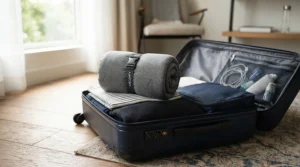
Packable Compressible Pillow for Travel and Compact Compressible Pillow for Hiking
Packable Compressible Pillow for Travel
Travel changes the maths. Hotels, trains, planes and borrowed sofa beds reward a pillow that disappears into a bag. The Sea to Summit Aeros Ultralight Pillow Regular is the obvious fit at c. 69g, and the Exped Deepsleep Pillow L is a nice step up in plushness at 249g. Neither takes much suitcase space. A packable compressible pillow for travel earns its keep on long train journeys too, where a sagging neck pillow loses to a proper head rest every time.
Compact Compressible Pillow for Hiking
For hiking, grams rule. The Exped Ultra Pillow M weighs 56g and packs to about 10 × 5.5cm, while the Sea to Summit Aeros Ultralight Pillow Regular is similarly tiny. Live for the Outdoors says the Exped Deepsleep Pillow L is “just about” small enough for a single wild-camping night, which is honest framing. If even that’s too much, a stuff-sack pillow such as the Rumpl Stuffable Pillowcase lets you pad a bag with clothing.
The rule of thumb: a compact compressible pillow for hiking should vanish into your pack, because you’ll carry it far more than you’ll lie on it.
Compressible Pillow vs Inflatable vs Home Pillow: What You Actually Gain
| Feature | Compressible foam | Inflatable | Home pillow |
|---|---|---|---|
| Examples | Therm-a-Rest Compressible Pillow Cinch, Zempire Chill Pill DLX | Sea to Summit Aeros Ultralight Pillow Regular, Trekology ALUFT Ultra | Your bed pillow |
| Typical weight | Heavier (c. 250-660g) | Lightest (c. 55-265g) | Varies, often bulky |
| Pack size | Medium | Smallest | Largest |
| Feel | Quiet, plush | Can feel bouncy or crinkly | Most familiar |
| Washability | Often removable covers | Some covers | Usually machine washable |
| Best For | Car camping, vans | Hiking, travel | Short, dry trips |
Looking at the comparison above, foam wins on feel and noise, inflatables win on weight and pack size, and home pillows win on price, though not on convenience when it rains. Live for the Outdoors also describes hybrids, such as the Nemo Fillo King, as the middle path with decent loft at a lower weight. If you’re only ever car camping, foam makes the most sense. If you sometimes walk in, a hybrid or compact inflatable earns its keep.
Long-Term Cost of a Compressible Pillow for Car Camping
A pillow’s real price isn’t what you pay at the till. It’s cost per night. Assume 15 nights a year over four years, or 60 nights.
| Pillow | Price range | Est. cost per night (60 nights) | Best For |
|---|---|---|---|
| Therm-a-Rest Compressible Pillow Cinch | £25-£45 | c. 42p-75p | Everyday car camping |
| Nemo Fillo King | £50-£75 | c. 83p-£1.25 | Side sleepers |
| Zempire Chill Pill DLX | £25-£35 | c. 42p-58p | Maximum plushness |
| Exped Deepsleep Pillow L | £30-£40 | c. 50p-67p | Dual-purpose use |
| Sea to Summit Aeros Ultralight Pillow Regular | £30-£40 | c. 50p-67p | Hiking and travel |
| Trekology ALUFT Ultra | £20-£30 | c. 33p-50p | Wide, light sleeping surface |
| HIKEMAN Camping Memory Foam Pillow | Under £20 | Under c. 33p | Tight budgets |
These are estimates based on price ranges, not exact prices. Even the priciest option, the Nemo Fillo King, costs about a pound a night, and the Zempire Chill Pill DLX and Therm-a-Rest Compressible Pillow Cinch sit well below that. For frequent campers, the maths favours spending a bit more on a pillow you’ll actually enjoy. Maintenance costs almost nothing beyond washing covers and avoiding long-term compression.
Common Mistakes When Buying a Compressible Pillow for Car Camping
- Chasing packed size. If you drive to the pitch, don’t sacrifice loft for a tiny sack.
- Ignoring width. A great pillow your head slides off is a bad pillow.
- Skipping removable covers. Fixed covers mean awkward cleaning, and cleaning is inevitable.
- Forgetting recovery time. Foam such as the Exped Deepsleep Pillow L needs minutes to re-expand.
- Buying blind on dimensions. Budget listings, including some for the HIKEMAN Camping Memory Foam Pillow, can be vague, so verify size before relying on them.
- Mixing up thickness and firmness. A thick pillow isn’t automatically supportive. Check how it feels when fully loaded.
- Storing compressed. Long spells squashed in a sack can age foam. Store loosely where you can.

FAQ
❓ Can I use my normal bed pillow for car camping?
❓ How do I wash a compressible camping pillow without ruining the foam?
❓ Are memory foam camping pillows too warm in summer?
❓ Will an oversized camping pillow fit inside a sleeping bag hood?
❓ How much should I spend on a compressible pillow for car camping?
Conclusion
Choosing a compressible pillow for car camping comes down to three questions: how do you sleep, how much boot space do you have, and how often do you camp? Side sleepers will love the Nemo Fillo King. Plushness-seekers should look at the Zempire Chill Pill DLX, while the Therm-a-Rest Compressible Pillow Cinch is the dependable all-rounder. If you sometimes carry your kit, the Exped Deepsleep Pillow L and Sea to Summit Aeros Ultralight Pillow Regular stretch further. The Trekology ALUFT Ultra and HIKEMAN Camping Memory Foam Pillow serve those who prioritise width or budget, as long as you check their limits.
Pillows matter because sleep does. The NHS Every Mind Matters sleep guidance stresses a regular routine and a comfortable sleep environment, and a decent pillow is the cheapest upgrade to both. Whatever you pick, unpack it early, fluff it, keep it dry and let it recover.
Recommended for You
- Compressible Camping Pillow: 7 Best UK Picks, Honestly Ranked (2026)
- Memory Foam Pillows: 7 Best Budget Camping Picks For 2026
- Memory Foam Camping Pillow: 7 Best Picks For UK Trips (2026)
Disclaimer: This article contains affiliate links. As an Amazon Associate, I earn from qualifying purchases. If you purchase products through these links, we may earn a small commission at no additional cost to you.
✨ Found this helpful? Share it with your friends! 💬🤗
