
In This Article
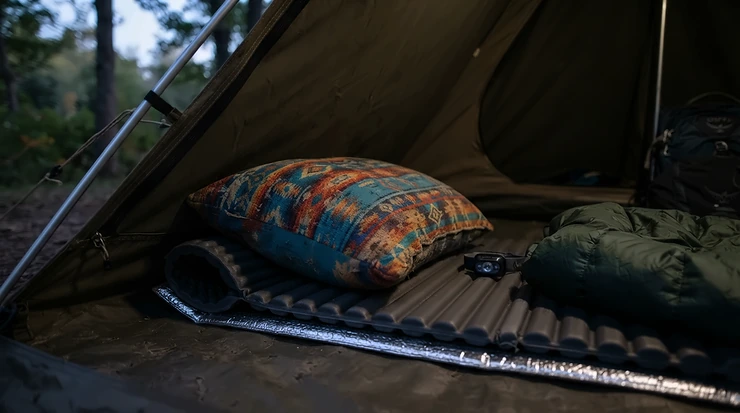
What is a compressible camping pillow? It is a foam- or fibre-filled pillow built to squash into a small roll or stuff sack, then spring back to full loft when you let go. There is no lung work, no pump and no valve, just soft support that packs far smaller than a bed pillow.

Anyone who has spent a night with a hoodie bunched under one ear knows the problem. Your neck twists, your shoulder goes numb and 3 a.m. arrives early. Sleep specialists consistently treat a comfortable sleeping setup, pillow included, as the foundation of proper rest. Harvard Health’s sleep hygiene guide is a good primer on why that matters outdoors too. A well-chosen compressible camping pillow is the cheapest sleep upgrade in most camping kits.
A quick note on how this guide was built. I haven’t slept on any of these pillows, and I won’t pretend otherwise. Everything below comes from manufacturer specifications, published tests by outdoor reviewers and aggregated customer feedback. I flag it wherever the data is thin. Prices appear as ranges only because they shift constantly, so check current price before you buy.
You’ll find seven picks across budget, mid-range and premium, from plush car-camping foam to an 80 g hybrid. The guide also covers compressible pillow vs inflatable pillow, hybrid foam-fill pillows, stuff-sack packability and self-compressing camping gear. There is a best compressible pillow for backpacking review too, written for a damp British hillside rather than a California trail.
Compressible Camping Pillow Quick Comparison: 7 Picks at a Glance
| Pillow | Type | Approx. weight | Best for |
|---|---|---|---|
| Therm-a-Rest Compressible Pillow Cinch | Foam offcuts + polyester | 210-415 g by size | All-round value, short trips |
| HEST Camp Pillow | Shredded memory foam | About 540 g (small) to 1.4 kg (large) | Vans, rooftop tents, comfort-first |
| Klymit Drift | Shredded memory foam | Roughly 540 g to 980 g by size | Car campers who love big pillows |
| LUNO Packable Camp Pillow | Memory foam | About 450 g | Mid-budget front-country camping |
| Wise Owl Outfitters Camping Pillow | Memory foam | About 300-460 g by version | Budget, kids, spare pillow |
| NEMO Fillo Elite | Hybrid (air + PrimaLoft) | About 80 g | Backpackers who want comfort |
| Sea to Summit Aeros Ultralight | Inflatable | About 57-60 g (regular) | Ultralight, bikepacking |
The weight spread is the story here. The heaviest pillow weighs roughly twenty times the lightest, and that gap decides everything else: comfort, packed size and who each one suits. If you drive to your pitch, the foam trio of the HEST Camp Pillow, the Klymit Drift and the Therm-a-Rest Compressible Pillow Cinch gives the most bed-like feel. If you carry everything on your back, the NEMO Fillo Elite and the Sea to Summit Aeros Ultralight are the realistic contenders. Budget buyers should note that the Wise Owl Outfitters Camping Pillow trades some support for its low price.
💬 Just one click — help others make better buying decisions too!😊
Top 7 Compressible Camping Pillows: Expert Analysis
These seven were chosen to cover foam, hybrid and inflatable construction. Each entry turns the spec sheet into real-world meaning and summarises what reviewers report, without invented quotes or hands-on claims.
1. Therm-a-Rest Compressible Pillow Cinch — best all-round foam comfort
The standout feature is the cinch cord. It lets you squeeze the filling into a firmer, taller shape instead of settling for a floppy one. According to OutdoorGearLab’s testers, the fill is foam offcuts left over from making sleeping pads. That explains the lumpy look when freshly unpacked and the soft, shaggy feel once it lofts.
It comes in three sizes: Small at 38 × 28 × 13 cm (210 g), Regular at 46 × 33 × 15 cm (295 g) and Large at 56 × 38 × 18 cm (415 g). In practice the Regular is close to a small bed pillow, the Small tucks into a mummy-bag hood and the Large is pure car-camping luxury. The cover is machine washable, which matters after a wet week in the Lakes.
Based on the spec comparison, this is the sensible default for car campers and short overnighters who want something that feels like a pillow. Ultralight hikers should look elsewhere, as several reviewers call it too heavy and bulky for that job.
On Amazon UK it averages about 4.5 out of 5 across more than 10,000 ratings at the time of research. Reviewers consistently praise the soft cover and generous loft. The recurring complaints are flattening overnight and needing regular fluffing, and a few long-term owners say it compresses less willingly with age.
Pros:
- ✅ Cinch cord adjusts firmness and height
- ✅ Soft, machine-washable cover
- ✅ Three sizes from 210 g to 415 g
Cons:
- ❌ Can flatten overnight without fluffing
- ❌ Bulkier than any hybrid or inflatable
Expect around £25-£40 depending on size and retailer. That is strong value for a foam pillow of this quality, though prices may vary.
2. HEST Camp Pillow — plushest, most home-like feel
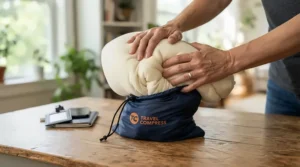
Shredded memory foam blended with polyester gives the HEST Camp Pillow a sink-in softness that testers keep comparing to a bedroom pillow. OutdoorGearLab’s camping pillow test scored its comfort 9.8 out of 10 and its weight 2 out of 10. That pairing sums up the whole product.
The large size measured around 1.4 kg (51 oz) in their testing. CleverHiker found the small version, at roughly 1.2 lb (about 540 g), still weighed more than twice their heaviest recommended backpacking pillow. The cover is water- and dirt-resistant, which adds weight but also practicality, and testers note you can ask the company for extra foam to firm it up.
On paper, that makes it a vehicle-based pillow. It suits campervans, caravans, rooftop tents and anyone with spare boot space. It does not suit anyone counting grams.
Across the tests I found, reviewers place it at or near the top for comfort and support. The common grumbles are price, weight and bulk, and one test noted it won’t fit inside a sleeping bag. A retail reviewer also felt the large size seemed to have proportionally less filling than the smaller ones.
Pros:
- ✅ Top comfort scores in published tests
- ✅ Water- and dirt-resistant washable cover
- ✅ Firmness can be adjusted with extra foam
Cons:
- ❌ Heavy, and large packed size
- ❌ Premium price and US-brand availability
It sits in the premium bracket, broadly £65-£110 where stocked in the UK (US list prices run roughly $79-$129). Check current price and delivery options.
3. Klymit Drift — big, squishy shredded-foam loft
The Klymit Drift follows the same shredded memory foam recipe as the HEST Camp Pillow, and reviewers treat the two as rivals. Published weights vary by size, from the high teens of ounces to well over 2 lb. OutdoorGearLab’s tested sample weighed 34.6 oz (about 980 g), second heaviest in their roundup. One buying guide lists the packed size at roughly 11 × 5 × 5 inches.
Shredded foam is the key spec. Unlike a solid foam block it moulds around your head and can be fluffed back into shape, which suits restless sleepers. The price of that is mass. You’ll want a car boot, roof box or van locker rather than a rucksack lid.
Based on the spec comparison, it suits people who find standard camp pillows too thin and want a deep, forgiving surface at campsite or caravan level. OutdoorGearLab’s testers put the large size alongside the HEST Camp Pillow at the top of their comfort list.
Reviewer sentiment follows the usual pattern for heavyweight foam: praise for softness, complaints about weight and bulk. I couldn’t verify a large pool of UK customer reviews, so treat that as a summary of expert tests rather than a verdict from thousands of owners.
Pros:
- ✅ Shredded foam moulds to head and neck
- ✅ Among comfort leaders in published tests
- ✅ Deep, soft loft for big-pillow fans
Cons:
- ❌ Second-heaviest pillow in one roundup
- ❌ Needs car-boot space to pack
Expect a mid-to-premium bracket, indicatively £40-£70 depending on size. Check current price, as it varies by retailer.
4. LUNO Packable Camp Pillow — mid-priced memory-foam comfort
The LUNO Packable Camp Pillow is the middle path between budget foam and premium foam. GearJunkie describes it as a memory-foam design that undercuts several premium pillows on price while beating a few in comfort. It comes in two sizes, and the regular measures about 11 × 16.5 inches, which makes it a properly generous camp pillow.
CleverHiker’s comparison lists it at around 1 lb. That’s in the same weight class as the Wise Owl Outfitters Camping Pillow but with more width. Their side-by-side testing found the HEST Camp Pillow and Therm-a-Rest Compressible Pillow Cinch slightly more supportive than the LUNO Packable Camp Pillow. So you’re buying “very comfortable” rather than “best in class”.
The honest analysis is that its packed size is bigger than a hybrid’s, so it’s a front-country pillow. Think campsites with a car nearby, festivals, glamping and van trips. The value argument is strongest if you want a quality memory foam feel without paying HEST money.
Review data is thinner than for the market leaders, so I’m leaning on professional roundups here rather than large customer pools. Both roundups I found rate it as a comfortable, car-camping-friendly option.
Pros:
- ✅ Memory-foam feel at mid-range money
- ✅ Generous 11 × 16.5 inch regular size
- ✅ Two sizes to match your boot space
Cons:
- ❌ Slightly less supportive than top foam rivals
- ❌ Larger packed size than hybrids
Expect roughly £40-£55 (US pricing sits around $60), so check current price.
5. Wise Owl Outfitters Camping Pillow — cheapest way into memory foam
Outdoor Life’s table lists the Wise Owl Outfitters Camping Pillow as foam only, about 4 inches thick and 15 × 11 inches. Reported weights range from roughly 10 to 16 oz depending on the version, so confirm the exact variant before ordering. One buying guide says it stays under 12 oz and works for adults and kids alike.
What that means in practice is a small, soft, travel-sized pillow. It’s compact enough for a kid’s bed roll or a spare for guests. It is less supportive than the pricier foam pillows, though. CleverHiker’s testers found the HEST Camp Pillow and Therm-a-Rest Compressible Pillow Cinch slightly more supportive than the Wise Owl “Snoozy” model.
Outdoor Life rated its comfort and support as fair, and its guide makes an honest point that applies here too. If you have the space, a pillow from your own bed is the truest budget option. This pick is for those who don’t.
Reviewers broadly agree it’s good value for occasional use, with the main trade-off being a flatter feel on long trips. Think of it as the pillow you buy for a first festival or a child’s first campout.
Pros:
- ✅ Lowest-cost foam option on this list
- ✅ Light enough to share between kids
- ✅ Simple memory foam, no valve to fail
Cons:
- ❌ Fair comfort scores in published tests
- ❌ Less supportive than premium foam
It typically sits at around £20-£30. Great as an entry-level pick, but prices may vary.

6. NEMO Fillo Elite — hybrid comfort at 80 g
The standout is the combination. The NEMO Fillo Elite uses an I-beam baffled air cell to give the pillow shape and avoid a beach-ball feel. A layer of recycled PrimaLoft insulation on top supplies the cushion. It weighs about 80 g (2.8 oz), measures 39 × 27 × 8 cm inflated and packs to roughly 10 × 8 cm in an integrated stuff sack that can’t go missing.
The twist-and-pull valve allows fine firmness adjustments, and the cover is machine washable. In practice, you get something that feels softer than a plain air pillow while adding almost nothing to your pack. The NEMO Fillo is the bulkier sibling; the Elite is less than half its weight and packed size, according to CleverHiker.
Reviewers largely agree. A long-distance walker’s review calls it the most comfortable backpacking pillow they’ve carried, and UK-based Thrifty Hiker rates it the comfiest they’ve owned. The critique is thickness. At around 3 inches it can feel low for side sleepers. Retailer listings average between roughly 4.2 and 4.8 out of 5, from fairly small review pools.
Pros:
- ✅ Roughly 80 g with tiny packed size
- ✅ Insulated top avoids the balloon feel
- ✅ Washable cover, micro-adjustable valve
Cons:
- ❌ Only about 3 inches thick for side sleepers
- ❌ Air chamber means puncture risk
Expect around £35-£45, a fair price for this level of engineering. Check current price.
7. Sea to Summit Aeros Ultralight — lightest option, smaller than a golf ball
Honesty first: this is an inflatable, not a foam compressible camping pillow. I’ve included it because it’s the packed-size benchmark every compressible pillow gets measured against. The regular size weighs about 57-60 g and packs to roughly 5.5 × 7 cm. Inflated it measures about 34 × 26 × 11 cm, and the large adds about 25 g.
That tiny packed size is the whole point. The regular fits inside a mummy-bag hood, and the PillowLock patches grip compatible Sea to Summit mats so the pillow stays put. The contoured, scalloped shape cradles the head better than most basic air pillows.
Reviews are warm but not blind. A UK outdoor magazine rates it among the best wild-camping pillows it has used, and the manufacturer lists 4.9 out of 5 from a small review pool. Packstack scored it 8 out of 10 and noted it can slip out from under your head. It also says the durability record is spottier than the brand’s other gear. A trail reviewer’s complaint that it didn’t last is worth weighing.
Pros:
- ✅ About 57-60 g, golf-ball packed size
- ✅ Contoured shape fits sleeping-bag hoods
- ✅ Fast, adjustable valve
Cons:
- ❌ Can slip without compatible mat patches
- ❌ Inflatable durability record is mixed
Expect around £30-£40, so check current price. It’s superb value if weight is your religion.
Top 7 at a Glance: Specs, Price Ranges and Reviewer Verdicts
| Pillow | Fill | Approx. weight | Price range | Reviewer verdict | Best for |
|---|---|---|---|---|---|
| Therm-a-Rest Compressible Pillow Cinch | Foam offcuts | 210-415 g | £25-£40 | About 4.5/5 on Amazon UK | Therm-a-Rest Compressible Pillow Cinch for value |
| HEST Camp Pillow | Shredded memory foam | 540 g-1.4 kg | £65-£110 | Top comfort in tests | HEST Camp Pillow for vans |
| Klymit Drift | Shredded memory foam | 540-980 g | £40-£70 | Comfort leader, heavy | Klymit Drift for big-pillow fans |
| LUNO Packable Camp Pillow | Memory foam | About 450 g | £40-£55 | Comfortable, slightly less supportive | LUNO Packable Camp Pillow for mid-budget |
| Wise Owl Outfitters Camping Pillow | Memory foam | 300-460 g | £20-£30 | Fair comfort, low cost | Wise Owl Outfitters Camping Pillow for kids |
| NEMO Fillo Elite | Air + PrimaLoft | About 80 g | £35-£45 | Roughly 4.2-4.8/5 | NEMO Fillo Elite for backpackers |
| Sea to Summit Aeros Ultralight | Inflatable | 57-60 g | £30-£40 | 8/10 (Packstack) | Sea to Summit Aeros Ultralight for UL |
Look at the table sideways and a pattern emerges. Every step down in weight costs you foam, and every step up in comfort costs you grams. The Therm-a-Rest Compressible Pillow Cinch is the only pillow that sits comfortably in the middle on both price and weight. For hill-based trips, the NEMO Fillo Elite justifies its premium over the Sea to Summit Aeros Ultralight if you’re a side sleeper, since it has more cushion. Pure bargain hunters will find the Wise Owl Outfitters Camping Pillow hard to argue with.
✨ Ready to Upgrade Your Camp Sleep?
🔍 Click any highlighted pillow above to check current pricing and availability. A better pillow won’t change your tent, but it will change your morning!
Practical Usage Guide: Setting Up and Caring for Your Compressible Camping Pillow
Amazon listings tell you what a pillow is. They rarely tell you how to get the best from it. Here’s what the reviews and specs suggest, in the order you’ll need it.
First 30 minutes at the pitch: Unpack the pillow as soon as you arrive, not at bedtime. Foam needs ten to fifteen minutes to loft fully, and reviewers of the Therm-a-Rest Compressible Pillow Cinch note the filling looks lumpy until it recovers. Give it a firm shake and a squeeze to redistribute the fill.
Tuning firmness: If your pillow has a cinch cord, tighten it for more height. If it feels too low, stuff a spare fleece into the cover or a stuff sack under it.
Maintenance schedule:
- After each trip: shake it out and air it fully before storage.
- Once a season: machine wash if the care label allows (the Therm-a-Rest Compressible Pillow Cinch is listed as machine washable). One owner reports washing noticeably increased the loft.
- Between trips: store it uncompressed. Months in a tight stuff sack is the likeliest cause of the “doesn’t compress or loft like it used to” complaints.
Common mistakes in the first month: packing it damp (foam holds moisture and smells), leaving it compressed for weeks, and skipping the home trial. Test any pillow in your bedroom first.

Real-World Scenarios: Matching Compressible Camping Pillow Picks to Your Trips
Spec sheets mean little until they meet a real trip. Here are three profiles matched to the best fit, with budget, environment and frequency spelled out.
The family weekender (budget £25-£40, six to eight trips a year). You pitch near the car at a Lake District campsite and nobody is counting grams. The Therm-a-Rest Compressible Pillow Cinch in Regular suits adults. The Wise Owl Outfitters Camping Pillow can cover the kids at roughly half the price.
The Highlands wild camper (budget £35-£45, two to three nights, 12-15 kg pack). Scottish access rules favour lightweight camping, and every gram earns its place. The NEMO Fillo Elite at about 80 g gives hybrid comfort without bulk. If you sleep on a Sea to Summit mat, the Sea to Summit Aeros Ultralight with its PillowLock patches is the lighter alternative.
The campervan couple (budget £65-£110 each, 30+ nights a year). Storage isn’t a constraint and sleep quality is the priority. The HEST Camp Pillow or the Klymit Drift repay their weight with a proper bedroom feel. Over a year of regular use, the cost per night is small.
Problem → Solution: Fixing the Most Common Camp Pillow Complaints
Most pillow problems are fixable without buying a second pillow. Here are the five that come up most in reviews.
- It flattens overnight. Fluff it before bed and cinch it if possible. Layer a folded jacket underneath for extra support.
- My neck feels too low. Side sleepers often need 10-15 cm of loft. A hybrid like the NEMO Fillo Elite can feel low at 3 inches, so stack it on a rolled fleece.
- It slides off my mat. Compatible mat patches help, such as those used by the Sea to Summit Aeros Ultralight. Otherwise, tuck the pillow into a hood or a stuff sack with grippy fabric.
- It’s damp or smells. Air it daily on dry days and wash it seasonally.
- My neck is cold. UK reviewers note foam pillows run warmer than air-filled ones, so foam like the Therm-a-Rest Compressible Pillow Cinch is a good shoulder-season choice.
Compressible Pillow vs Inflatable Pillow: Which Suits UK Camping?
The compressible pillow vs inflatable pillow debate boils down to two questions: how much space can you spare, and how much do you value softness over weight?
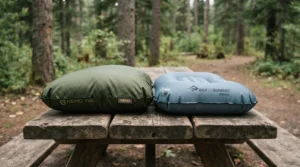
Foam wins on feel. It doesn’t need inflating, it’s warmer in cold conditions, and a pinprick can’t ruin it. Reviewers who dislike inflatables describe them as sleeping on a balloon. Inflatables win on packed size and weight. Basic models like the Trekology ALUFT 2.0 weigh about 3.9 oz and the budget Alpkit Dozer is listed at around 95 g, while good foam rarely drops below 200 g.
My view: if the pillow lives in a car boot, choose foam. If it lives in a rucksack, choose a hybrid or inflatable. That is the whole compressible pillow vs inflatable pillow decision, with everything else being refinement.
| Option | Comfort | Weight | Packed size | Best for |
|---|---|---|---|---|
| Foam (Therm-a-Rest Compressible Pillow Cinch) | High | 210-415 g | Medium | Car camping |
| Inflatable (Sea to Summit Aeros Ultralight) | Moderate | About 57 g | Tiny | Ultralight |
| Hybrid (NEMO Fillo Elite) | High | About 80 g | Very small | Backpacking |
| Stuff sack of clothes | Variable | Free | None | Emergencies |
| Home pillow | Highest | 400 g+ | Large | Car camping only |
Take the table as a rule of thumb. Hybrids are the only row that scores well on both comfort and weight, which is why the NEMO Fillo Elite keeps appearing in recommendations. A stuff sack of clothes costs nothing but depends on what you packed. A home pillow gives the best comfort but eats boot space and doesn’t enjoy damp.
Hybrid Foam-Fill Pillows: Air Structure, Foam Comfort
Hybrid foam-fill pillows combine an air chamber for shape with a thin foam or insulation layer where your head rests. The idea is to dodge the balloon feel of pure inflatables without carrying a full foam block.
The best-known example here is the NEMO Fillo Elite, which pairs a baffled air cell with PrimaLoft. Others in the category include the larger NEMO Fillo and the Exped Mega Pillow, which one US comparison lists as an air-and-foam design at roughly 9 oz. I couldn’t verify detailed test data for the Exped, so treat it as a shortlist candidate.
What do hybrid foam-fill pillows mean in practice? You get adjustable firmness, because you set it by letting air in or out. You get a softer surface than a bare inflatable. And you get packed sizes close to an inflatable’s. The trade-off is thickness. Most hybrids top out around 3-4 inches, so side sleepers may need to stack a jacket underneath.
If you want hybrid foam-fill pillows for UK conditions, look for a removable, washable cover and an integrated stuff sack, as both appear on the NEMO Fillo Elite.

Stuff-Sack Packability: What Packed Size Really Means in Your Pack
Stuff-sack packability is more than a number on a listing. It tells you whether a pillow will disappear into the gaps in your pack or demand its own pocket.
Foam compresses less willingly than air. Reviewers describe the Therm-a-Rest Compressible Pillow Cinch as squashing to roughly shoe size, and one owner says it fits in a compression sack alongside a sleeping bag. An older OutdoorGearLab review measured the HEST Camp Pillow at about 11.4 litres packed, five to ten times larger than any other pillow they’d seen.
At the other end, the NEMO Fillo Elite packs to about 10 × 8 cm and the Sea to Summit Aeros Ultralight to 5.5 × 7 cm. The Hyperlite Mountain Gear Stuff Sack Pillow weighs just 1.7 oz and doubles as a waterproof dry bag for spare clothes.
Here’s the practical tip. Compare packed volume in litres, not grams. Rucksack space is usually the scarcer resource, and a 300 g pillow that fills a corner of the lid can annoy you more than a 500 g one that squashes flat.
Best Compressible Pillow for Backpacking Review: Weight, Bulk and Honest Trade-offs
This best compressible pillow for backpacking review rests on one question: how many grams of comfort will you carry?
CleverHiker’s camping pillow roundup draws a useful line. Camping pillows tend to be more comfortable than backpacking pillows, which sacrifice cushion to cut weight and packed size. Foam options like the Therm-a-Rest Compressible Pillow Cinch are, by general consensus, the most comfortable but also the heaviest.
For backpackers, three verdicts emerge from the data. The Sea to Summit Aeros Ultralight wins on raw weight. The NEMO Fillo Elite wins on comfort per gram. The small Therm-a-Rest Compressible Pillow Cinch at 210 g is the compromise for short overnighters who prefer foam to air.
Do the sums. The Regular Therm-a-Rest Compressible Pillow Cinch at 295 g is roughly 215 g heavier than the NEMO Fillo Elite. Over a five-day trip that is about as much as two energy bars. If your pack is already under 10 kg, that is a luxury many walkers happily make. If you’re chasing an ultralight base weight, it isn’t.
Self-Compressing Camping Gear: Where Compressible Pillows Fit in Your Kit
Self-compressing camping gear isn’t a formal product category. It’s a useful shorthand for kit that shrinks when you squash it and recovers when released: foam pillows, synthetic quilts, down jackets and compression-sack bundles.
A foam pillow sits at the heavy end of that family. It’s less efficient than down at compressing, but it’s immune to leaks and works fine damp. That’s why many walkers pair a small foam pillow with a compression sack, packing it alongside the sleeping bag. One owner reports exactly that arrangement works with the Therm-a-Rest Compressible Pillow Cinch.
When thinking about self-compressing camping gear as a system, spread the compression. Put the pillow in the same sack as a quilt and it will squash flatter. Keep foam out of damp stuff sacks, and pack it last so it isn’t crushed for the entire trip.
The wider lesson is that a compressible camping pillow is part of your sleep system, alongside mat, bag and liner. Choose it with the rest in mind.

How to Choose a Compressible Camping Pillow
Here is the short answer first. Match the pillow to how you travel, then to how you sleep, then to your budget.
- Decide your carry method. Car, van or rucksack? This single choice narrows the field faster than anything else.
- Set a weight ceiling. Under 100 g means hybrid or inflatable. Up to 300 g allows small foam. Beyond that you’re in car-camping territory.
- Check loft against your sleep position. Side sleepers need more height, often 10 cm or more, while back sleepers manage with less.
- Prefer a washable cover. Muddy hair and damp weather are the norm in UK camping, so a removable cover extends life.
- Compare packed volume, not just weight. See the stuff-sack packability section above.
- Consider the mat. Some pillows grip specific mats, which matters if you toss and turn.
- Set a realistic budget. Around £20-£40 buys decent foam, and £65 or more buys the premium feel.
Common Mistakes When Buying a Compressible Camping Pillow
Buying on weight alone. A 57 g pillow that slips off your mat by midnight is a false economy. Sleep quality is the whole point.
Ignoring packed size. A 300 g foam pillow can take more rucksack space than a 450 g one that squashes flatter.
Assuming bigger is better. The HEST Camp Pillow won’t fit in a sleeping bag, according to testers, so size can work against you.
Skipping the home trial. CleverHiker recommends trying pillows indoors in daylight before a trip. A pillow that feels wrong at home won’t improve at 2 a.m. in a tent.
Forgetting the season. Foam runs warmer than air-filled pillows, so it’s the better shoulder-season choice. In summer, a breathable cover matters more.
Believing review scores blindly. Some pools are small. The Sea to Summit Aeros Ultralight shows 4.9 out of 5 on the manufacturer’s site, but that comes from a small sample, and independent testers report mixed durability.
Safety, Regulations and Wild Camping: Sleeping Light Without Leaving a Trace
Pillows aren’t regulated camping products, but where you pitch affects what you carry. In Scotland, access rights under the Land Reform (Scotland) Act 2003 cover lightweight wild camping, and the official Scottish Outdoor Access Code guidance describes small tents, small numbers and no more than two or three nights in one place. England and Wales are different, and wild camping generally needs landowner permission outside specific areas.
That “lightweight” definition shapes your kit. A pillow that packs small keeps your load honest, and a hybrid like the NEMO Fillo Elite fits the spirit of the code far better than a 1.4 kg foam pillow.
Two practical safety points. First, keep foam pillows well away from stoves and open flames, since most foam burns readily. Second, take everything home with you. Foam pillows that get left behind aren’t biodegradable.
If you’re camping at a campsite, none of this applies. Bring whichever compressible camping pillow gives you the best night’s sleep.
FAQs
❓ Is a compressible camping pillow worth it for UK camping?
❓ How much should I pay for a good compressible camping pillow?
❓ Can I machine wash a compressible camping pillow?
❓ Is a compressible pillow vs inflatable pillow better for side sleepers?
❓ Which hybrid foam-fill pillows are lightest for backpacking?
Conclusion
A compressible camping pillow is the rare bit of kit where a small spend changes how you feel every morning. The right pick depends on how you travel. For car campers and vans, the HEST Camp Pillow and the Klymit Drift deliver the closest thing to bedroom comfort, and the Therm-a-Rest Compressible Pillow Cinch does it for far less money. Mid-range buyers should look at the LUNO Packable Camp Pillow, and anyone on a tight budget has the Wise Owl Outfitters Camping Pillow.
For backpackers, the NEMO Fillo Elite offers the best comfort per gram and the Sea to Summit Aeros Ultralight wins on pure lightness. Whatever you choose, weigh packed size as seriously as grams, test the pillow at home and store it uncompressed.
I haven’t slept on any of these, so use this guide as an informed shortlist rather than a verdict. Read the latest reviews, check current price and availability, and pick the pillow that fits your trips.
Recommended for You
- Memory Foam Pillows: 7 Best Budget Camping Picks For 2026
- Memory Foam Camping Pillow: 7 Best Picks For UK Trips (2026)
- Lightweight Inflatable Pillow For Hiking: 7 Best Picks (2026)
Disclaimer: This article contains affiliate links. As an Amazon Associate, I earn from qualifying purchases. If you purchase products through these links, we may earn a small commission at no additional cost to you.
✨ Found this helpful? Share it with your friends! 💬🤗
