

In This Article
There’s a very specific kind of misery reserved for 3am in a tent, when the ground has somehow found every single one of your pressure points and turned itself into a geological grudge against your spine. A self-inflating sleeping mat exists to solve exactly that problem, and it’s one of the few bits of camping kit where “just add a bit of your own breath” genuinely works better than any battery-powered gadget. Unlike a pure air mat, which is basically a fancy balloon, a self-inflating mat has an open-cell foam core that expands the moment you crack the valve open, drawing air in on its own before you top it up with a few lungfuls to get the firmness just right.
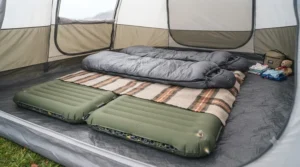
This guide is built on real product research rather than guesswork — genuine specifications, aggregated review sentiment from UK retailers and outdoor publications, and honest comparative analysis of what actually matters once you’re lying on the thing at 11pm in a Welsh drizzle. We’ve dug into thickness, R-value insulation, weight, and price across seven real, currently available mats, from budget-friendly backpacking options to the sort of plush double mats that make car camping feel faintly indulgent. Whether you’re chasing the thickest self-inflating sleeping mat you can find for a dodgy back, or you just want something reliable for a Duke of Edinburgh expedition, there’s a genuine, evidence-based recommendation here rather than a rehashed spec sheet. According to the Camping and Caravanning Club, choosing the right mat is one of the most overlooked decisions in a camper’s kit list — and after reading the comparisons below, you’ll understand why.
Quick Comparison Table
Here’s the shape of the market before we go deep on each mat. Thickness and R-value insulation vary enormously across this category, and as you’ll see, the “best” mat really does depend on whether you’re carrying it eight miles up a hill or three metres from the boot of the car.
| Mat | Thickness | R-value | Weight | Best For |
|---|---|---|---|---|
| Alpkit Dozer | 7.5cm | ~6.8 (third-party estimate) | Heavy | Car camping & bad backs |
| Vango Comfort 10 Double | 10cm | Warmth rating 16 (own scale) | Very heavy | Family car camping |
| Therm-a-Rest ProLite | 2.5cm | 2.4 | Ultralight | Backpacking classic |
| Therm-a-Rest ProLite Plus | 3.8cm | 3.2 | Light | 3-season balance |
| Outwell Dreamcatcher Single 12cm | 12cm | Not independently rated | Heavy | Side sleepers & back support |
| Sea to Summit Camp Plus | Mid-depth | Moderate | Moderate | Packable all-rounder |
| Vango Trek Pro | 3cm | Entry-level | Light | Budget & DofE trips |
Looking at the spread here, the story is really about a trade-off between thickness and portability: the mats that feel most like a bed at home (the Alpkit Dozer, the Vango Comfort 10 Double, and the Outwell Dreamcatcher) are also the ones you’ll be cursing when you try to cram them back into their stuff sacks. Meanwhile, the Therm-a-Rest ProLite trades some plushness for a pack size that barely dents your rucksack. If back pain is your main concern rather than pack weight, thickness and foam density matter more than raw R-value insulation, which is really a temperature metric rather than a comfort one — a distinction we’ll unpack properly in a moment.
💬 Just one click — help others make better buying decisions too!😊
✨ Compare Prices Before You Decide!
🔍 Every mat below links through to its current listing so you can check availability and pricing at the time of research. Prices on outdoor gear fluctuate constantly, so it’s always worth a quick look before you commit to your favourite.
Top 7 Self-Inflating Sleeping Mats: Expert Analysis
We’ve deliberately spread this list across budget, mid-range and premium price points, and across the full thickness spectrum, so there’s a genuinely useful match here whether you’re a gram-counting backpacker or someone who considers “roughing it” to mean a mattress under 10cm thick.
1. Alpkit Dozer — thickest comfort pick for car camping and bad backs
At 7.5cm thick, the Alpkit Dozer is built for people who have entirely given up on the idea that camping needs to be uncomfortable. This is a mat for the boot of the car, not the depths of a rucksack.
The die-cut, tapered foam core is engineered to shave weight from the less load-bearing sections while keeping full depth under your hips and shoulders, and the heavier, soft-touch polyester face fabric is noticeably plusher against skin than most backpacking-focused mats. Alpkit doesn’t publish an official R-value for the Dozer, though some independent reviewers have measured figures as high as 6.8 — a healthy number for spring and autumn UK trips, even if you should treat it as an estimate rather than a lab-certified spec. What most buyers overlook about a mat this thick is that it isn’t really competing with lightweight self-inflating pads at all; it’s competing with a proper mattress, and for anyone who struggles with lower back discomfort on hard surfaces, that extra depth genuinely changes how you sleep. Reviewers consistently report that the single-valve design inflates with minimal top-up breath required, and that the foam has held its loft well over repeated use, with occasional seam or valve issues on older units resolved quickly through Alpkit’s customer service.
Pros:
- ✅ Genuinely bed-like 7.5cm depth for side and back sleepers
- ✅ Tough polyester shell resists punctures better than air-only mats
- ✅ Strong third-party support reputation for repairs and spares
Cons:
- ❌ Too heavy and bulky for anything beyond car-adjacent camping
- ❌ No official R-value published, so cold-weather performance is an estimate
At the time of research, the Alpkit Dozer typically sits in the low-to-mid £90s, and given how much thickness and durability you get for that outlay, it represents strong value for anyone prioritising comfort over portability.
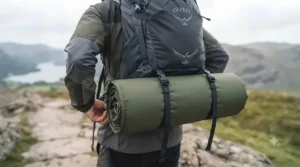
2. Vango Comfort 10 Double — plushest double mat for family car camping
If the Alpkit Dozer is a comfortable mattress, the Vango Comfort 10 Double is a full-blown bed — 10cm of foam-backed comfort designed for two, with a soft-touch flocked top surface that wouldn’t feel wildly out of place in a spare room.
The Cyclone Flip Valve is the standout mechanical feature here: rather than the fiddly twist-valves found on cheaper mats, it flips open for genuinely fast inflation and deflation, cutting a chore that used to take ten frustrating minutes down to something closer to five. Vango rates this mat with its own “warmth rating” of 16 rather than a standard R-value, which makes direct comparison with other brands trickier, but real-world reports from UK campers suggest it performs comfortably into the shoulder seasons. Based on the spec comparison with rival double mats, the trade-off is size: packed dimensions hover around 67cm x 35cm, and getting it back into that shape after first use is, by widespread agreement among owners, something between a challenge and a running joke. Aggregated customer feedback repeatedly praises the flatness of the sleeping surface for couples who don’t want to roll into each other overnight, though a handful of reviewers note that the packed bulk makes it a poor fit for anything but car boots or campervans.
Pros:
- ✅ Full 10cm double-width comfort rivals a home mattress
- ✅ Cyclone Flip Valve makes inflation genuinely fast for its size
- ✅ Non-slip flocked top surface stays put inside the tent
Cons:
- ❌ Packed size is famously difficult to squeeze back into its bag
- ❌ Far too heavy and bulky for backpacking or even light touring
At the time of research, expect this one to sit somewhere in the mid-£100s to high-£100s range, positioning it firmly as a premium car camping purchase rather than a casual buy.
3. Therm-a-Rest ProLite — the lightest true self-inflating classic
The Therm-a-Rest ProLite is arguably the mat that popularised the entire category, and it remains the yardstick against which lighter self-inflating pads are measured.
At just 2.5cm thick and around 510g for a regular-length mat, this is self-inflation stripped back to its lightweight essentials, with an R-value of 2.4 that Therm-a-Rest itself pitches at genuine three-season use rather than winter expeditions. The WingLock valve is a small but meaningful upgrade over older Therm-a-Rest designs, offering noticeably higher airflow so you spend less time huffing and puffing at the end of a long walking day. Here’s what to weigh: this mat won’t deliver the plush, bed-like feel of the thicker options on this list, and back sleepers tend to get on with it better than committed side sleepers, since 2.5cm doesn’t leave much room to cushion a hip. What most buyers overlook is that the open-cell foam core makes this mat significantly more puncture-resistant than a fully inflatable pad, which matters enormously if you’re regularly pitching on stony ground. Reviewers consistently note the quick, reliable inflation and the reassuring durability, with many long-term owners reporting a decade or more of use without a single repair.
Pros:
- ✅ Genuinely ultralight for a self-inflating (not just inflatable) mat
- ✅ Foam core is far more puncture-resistant than air-only pads
- ✅ WingLock valve speeds up both inflation and deflation
Cons:
- ❌ Thin 2.5cm profile isn’t ideal for committed side sleepers
- ❌ R-value of 2.4 limits it to three-season rather than winter use
At the time of research, this one typically retails a little over £100, which for a mat with this pedigree and durability record represents solid long-term value.
4. Therm-a-Rest ProLite Plus — the best balance of warmth and pack size
Think of the Therm-a-Rest ProLite Plus as the ProLite’s slightly warmer, slightly plusher older sibling — same DNA, noticeably more insulation.
At 3.8cm thick with an R-value of 3.2, the diagonal-cut foam core is specifically engineered to trap more warmth than the vertical-cut foam used in the standard ProLite, without adding much weight. On paper this means you get a meaningful jump in cold-ground protection for a relatively modest increase in pack size — useful if you camp into early spring or late autumn and don’t want to invest in a dedicated winter mat. The same WingLock valve carries over, with triple the airflow of Therm-a-Rest’s older classic valve, and the extra 1.3cm of thickness makes a genuine difference for anyone whose hips complain on the thinner ProLite. Based on the spec comparison, this is the mat we’d point toward if bad backs are a genuine concern but you still need to carry your kit any real distance; it isn’t as forgiving as the 7.5–10cm car-camping mats, but it’s dramatically more supportive than anything under 3cm.
Pros:
- ✅ Noticeably warmer than the standard ProLite for modest weight gain
- ✅ Extra 1.3cm of depth meaningfully improves hip and back comfort
- ✅ Diagonal-cut foam construction is a genuine engineering upgrade
Cons:
- ❌ Costs meaningfully more than the standard ProLite
- ❌ Still not thick enough to satisfy dedicated car campers
At the time of research, expect a price somewhere in the £130–£150 range, which sits comfortably as a mid-to-premium purchase for serious three-season backpackers.
5. Outwell Dreamcatcher Single 12cm — deepest zoned foam for side sleepers
At 12cm thick, the Outwell Dreamcatcher Single is, on paper, the deepest mat on this entire list, and it leans hard into that with an “Elite Zoned” memory foam layer designed to contour under hips and shoulders.
The Flat High-Flow (FHF) valve is a genuine practical upgrade over older Outwell designs — the vertical side panels don’t bow under pressure the way older cylindrical baffles do, which means less huffing to reach full firmness and a flatter sleeping surface once you’re settled. What the spec sheet won’t tell you, but reviewers note, is that zoned foam mats like this one tend to feel noticeably different from uniform-foam competitors: the extra give under pressure points is exactly what side sleepers with back or hip discomfort tend to ask for. Here’s what to weigh: at this thickness, the mat is unmistakably a car-camping product rather than a backpacking one, and its bulk when packed reflects that. Outwell doesn’t publish an independently verified R-value for this model, so cold-weather claims should be treated cautiously rather than taken at face value — a good example of where honest hedging beats an inflated marketing number.
Pros:
- ✅ 12cm depth is genuinely among the thickest on the market
- ✅ Zoned memory foam specifically targets hip and shoulder pressure points
- ✅ FHF valve system speeds up inflation and deflation noticeably
Cons:
- ❌ No independently verified R-value makes cold-weather claims uncertain
- ❌ Considerable bulk rules out anything beyond car or van camping
At the time of research, this mat generally sits in the low-to-mid £90s, making it a genuinely competitive option against the thicker premium mats on this list.
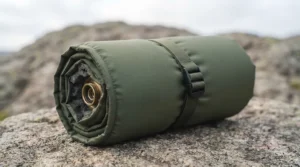
6. Sea to Summit Camp Plus Self-Inflating — the most packable premium all-rounder
The Sea to Summit Camp Plus Self-Inflating occupies a useful middle ground: noticeably more compact than the car-camping mats above, but plusher and more forgiving than ultralight backpacking pads.
Sea to Summit’s broader mat range is known for its Air Sprung Cell construction and high-flow valve technology, and the Camp Plus brings a version of that engineering down to a self-inflating format aimed at campers who want comfort without hauling a double-mat-sized bundle. Reviewers consistently note that Sea to Summit’s mats hold their shape well over repeated use and that the brand’s after-sales puncture repair support — including clear guidance and 3M adhesive patches on some models — is genuinely reassuring compared with own-brand budget alternatives. Based on the spec comparison with the thicker Alpkit and Outwell options, the Camp Plus won’t match their outright depth, but for campers who want one mat that works reasonably well for both a weekend at a festival and an occasional overnight hike, it’s a sensible compromise rather than a mat that excels at either extreme.
Pros:
- ✅ Genuine middle ground between backpacking and car-camping comfort
- ✅ Strong brand reputation for puncture repair kits and after-sales support
- ✅ Holds shape and firmness well over repeated seasons of use
Cons:
- ❌ Not thick enough to rival dedicated car-camping mats
- ❌ Premium brand pricing compared with similarly specced own-brand mats
At the time of research, this mat generally sits in the mid-to-high £80s to low £100s, which feels fair given the brand’s reliability record.
7. Vango Trek Pro Self-Inflating Mat — best budget pick for Duke of Edinburgh trips
The Vango Trek Pro is the mat we’d point a cash-strapped student or a Duke of Edinburgh participant toward, and it’s genuinely Duke of Edinburgh-recommended rather than just marketed that way.
At 3cm thick, it sits in similar territory to the Therm-a-Rest ProLite in terms of profile, but at a noticeably friendlier price point, using Vango’s recycled TrekEco fabric to keep both weight and environmental impact down. The Fast-Flow valve isn’t quite as sophisticated as the Cyclone or FHF systems on Vango’s and Outwell’s pricier mats, but it does the job reliably, and reviewers consistently describe the inflation process as straightforward even for first-time campers. What most buyers overlook about budget self-inflating mats is that the category has genuinely improved in recent years — a decade ago, a mat at this price point would have meant compromised foam quality and unreliable valves, but the Trek Pro’s recycled construction and DofE endorsement suggest a level of quality control that budget mats didn’t always deliver in the past. It won’t rival the thicker options here for pure comfort, but for a first mat, or a mat you’re not precious about getting muddy on a school expedition, it’s a sound, honest choice.
Pros:
- ✅ Genuinely affordable entry point into self-inflating comfort
- ✅ Recycled TrekEco fabric construction is a meaningful sustainability plus
- ✅ Officially Duke of Edinburgh recommended for expedition use
Cons:
- ❌ 3cm profile offers limited cushioning for side sleepers or bad backs
- ❌ Fast-Flow valve is less refined than premium Cyclone or FHF systems
At the time of research, this mat typically sits under £60, making it comfortably the most affordable genuinely self-inflating option on this list.
What Is a Self-Inflating Sleeping Mat?
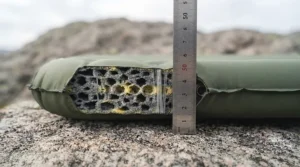
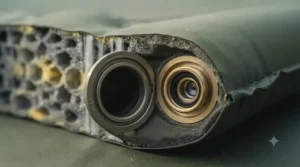
A self-inflating sleeping mat is a camping pad built around an open-cell foam core wrapped in an airtight fabric shell; opening the valve lets the foam expand and draw in air automatically, and a few extra breaths fine-tune the firmness. Unlike pure air mats, the foam core also provides genuine thermal insulation from the ground, not just cushioning.
That combination — insulation plus cushioning plus (relative) puncture resistance — is exactly why self-inflating mats have remained popular for decades even as ultralight air mats have taken over parts of the backpacking market. The foam core means a small puncture rarely leaves you sleeping flat on the ground the way it would with a fully inflatable pad, since the compressed foam still provides some support even with reduced air pressure. It’s a genuinely different engineering approach from a straightforward air-only mat, and understanding that difference is the key to picking the right one for your trips.
How to Choose a Self-Inflating Sleeping Mat
Picking the right mat comes down to weighing a handful of genuinely competing priorities rather than chasing a single “best” spec. Here’s the reasoning we’d walk a friend through:
- Decide how you’re actually transporting it. If it’s travelling in a rucksack, thickness and weight matter enormously; if it’s going in a car boot, they barely matter at all.
- Match R-value insulation to your camping season. Anything under 3 is fine for summer; you’ll want 4+ for shoulder seasons and considerably more for genuine winter use.
- Think honestly about your sleeping position. Side sleepers generally need more thickness than back sleepers to keep hips comfortably cushioned.
- Factor in your body weight and build. Heavier campers compress foam further, so a mat that feels plush for one person can feel thin for another.
- Check the valve type before you buy. Faster-flow valves like Cyclone or FHF systems save genuine time and frustration at both ends of a trip.
- Consider puncture repair kits and brand support. A mat that’s easy to patch, with a manufacturer known for good spares, saves headaches down the line.
- Set a realistic budget band rather than chasing the cheapest option. The jump from a genuinely budget mat to a mid-range one often buys a meaningfully better night’s sleep.
Understanding R-Value Insulation: What the Numbers Actually Mean
R-value insulation is a measurement of thermal resistance — put simply, how well a mat stops your body heat draining straight into the cold ground beneath you. The higher the number, the warmer the mat, and the scale is internationally standardised so that (in theory, at least) a 4.0 from one brand should perform similarly to a 4.0 from another.
As a rough rule of thumb, an R-value of 1.0–2.0 is fine for summer camping, while genuine three-season use calls for something in the 3.0–4.5 range, and dedicated winter camping wants 5.0 or higher. It’s worth knowing that the international standard used to certify sleeping bag temperature ratings, ISO 23537, actually assumes a mattress with a fixed thermal resistance value as part of its testing methodology — which is a useful reminder that your mat and your sleeping bag work as a single system rather than in isolation. A brilliant three-season bag on top of a thin, low R-value mat will still leave you shivering, because a huge proportion of heat loss on the ground happens through conduction rather than through the air around you. One genuinely useful piece of expert commentary worth repeating: not every brand publishes a directly comparable R-value, as we’ve flagged honestly throughout this guide for mats like the Alpkit Dozer and Outwell Dreamcatcher, so treat unpublished or third-party estimated figures as a rough guide rather than gospel.
Mat Thickness in cm: How Thick Is Thick Enough?
Mat thickness in cm is the single most reliable predictor of comfort for anyone who struggles with hips, shoulders or a bad back on hard ground — arguably more reliable than R-value, which measures warmth rather than cushioning.
Broadly speaking, anything under 3cm (like the Vango Trek Pro or the standard Therm-a-Rest ProLite) is built for pack weight first and comfort second, and tends to suit back sleepers better than side sleepers. The 3.5–5cm bracket, occupied by mats like the Therm-a-Rest ProLite Plus, offers a genuine step up in comfort without abandoning portability entirely. Beyond that, the 7.5cm-plus territory of the Alpkit Dozer, the Vango Comfort 10 Double and the Outwell Dreamcatcher starts to genuinely rival a spare-room mattress — at the cost of pack size and weight that make them entirely unsuitable for anything beyond car-adjacent camping. Here’s what to weigh: thickness in isolation doesn’t guarantee comfort, since foam density and zoning matter too, but as a first filter when browsing, it’s a remarkably good proxy for how forgiving a mat will feel after the first hour of lying on it.
Best Comfort Self-Inflating Mat for Car Camping
If pack weight genuinely isn’t a factor — because your “hike” to the pitch is a fifteen-metre walk from the car boot — the calculus around the best comfort self-inflating mat for car camping changes completely, and thickness, width and surface texture matter far more than grams.
Based on the spec comparison across this guide, the Vango Comfort 10 Double stands out for couples thanks to its genuinely bed-sized 10cm profile and non-slip flocked surface, while the Alpkit Dozer edges ahead for solo or single-mat car campers thanks to its combination of thickness, tougher fabric, and comparatively better packability for something this comfortable. The Outwell Dreamcatcher Single 12cm deserves a mention too, particularly for anyone who specifically wants zoned foam support rather than uniform cushioning. What most buyers overlook about this category is that a “comfort” mat is really a different product from a backpacking mat wearing the same name — the foam density, fabric weight and construction techniques are chosen for feel rather than for shaving grams, and comparing their pack size against a lightweight pad is a bit like comparing a sofa bed to a camp chair.
Thickest Self-Inflating Sleeping Mat: Our Pick Explained
Among the seven mats compared here, the Outwell Dreamcatcher Single 12cm technically wins on raw depth at 12cm, narrowly ahead of the Vango Comfort 10 Double and the Alpkit Dozer at 10cm and 7.5cm respectively.
But “thickest” and “best for you” aren’t automatically the same thing, and here’s what to weigh before assuming bigger is always better: extreme thickness genuinely helps with pressure-point relief and back support, but it also increases pack size, weight, and — in windy conditions — the amount the mat can shift or wobble compared with a lower-profile pad. Reviewers consistently note that ultra-thick mats feel most transformative for side sleepers and anyone recovering from injury, while committed back sleepers sometimes report diminishing returns past around 7–8cm. If genuine maximum thickness is your priority, the Outwell Dreamcatcher is the technical winner on paper; if you want nearly all of that comfort with slightly better packed dimensions and fabric durability, the Alpkit Dozer is the more balanced real-world choice.
Best Self-Inflating Mat for Bad Backs
There’s genuine crossover between good sleep hygiene and good camping kit — the NHS notes that people with back pain usually benefit from firmer support rather than a surface that lets the body sink too deeply, which maps fairly directly onto sleeping mat choice.
Based on that principle, a mat that’s too thin (letting hips and shoulders press through to the ground) and a mat that’s inconsistently supportive (uneven foam density, or an old mat that’s lost its loft) are both likely culprits behind a rough night for anyone prone to back discomfort. Among the mats compared here, the Alpkit Dozer and the Outwell Dreamcatcher Single 12cm stand out specifically for back-pain sufferers, thanks to genuinely substantial foam depth and, in the Dreamcatcher’s case, zoned support engineered around hip and shoulder pressure points. For backpackers who can’t justify carrying either of those, the Therm-a-Rest ProLite Plus is a sensible middle path — its extra 1.3cm over the standard ProLite, combined with denser diagonal-cut foam, provides noticeably more support than ultralight pads without the bulk of the car-camping mats. What most buyers overlook is that mat age matters here too: foam degrades and loses loft over years of use and storage, so even a genuinely good mat can start contributing to a bad night’s sleep once it’s a decade old.
Self-Inflating Mats vs Air Mats vs Foam Mats
Self-inflating mats occupy a genuinely useful middle ground between the two other main categories of camping mat, and understanding the trade-offs helps explain why this category has survived the rise of ultralight air pads.
| Mat Type | Comfort | Insulation | Weight | Puncture Risk |
|---|---|---|---|---|
| Self-Inflating Mats | High | Good (foam-based) | Moderate–heavy | Low–moderate |
| Air Mats | Very high | Variable (needs added insulation) | Very low | High |
| Foam Roll Mats | Low | Moderate | Low | None |
Looking at this comparison, the appeal of self-inflating mats becomes obvious: they combine genuine insulation with genuine cushioning in a single product, without the total puncture vulnerability of an air-only mat or the thin, unforgiving surface of a basic foam roll mat. Air mats generally win on outright pack size and can feel plusher when new, but they rely entirely on trapped air for insulation, so cheaper models often need a reflective layer or an added foam mat underneath to perform well in cold conditions. Foam roll mats, meanwhile, remain popular as a cheap, indestructible backup layer — plenty of experienced campers actually use one underneath a self-inflating or air mat for extra insurance against both punctures and cold ground.
Common Mistakes When Buying a Self-Inflating Sleeping Mat
Even careful shoppers tend to fall into a handful of predictable traps in this category, and most of them come down to optimising for the wrong metric.
The single biggest mistake is buying purely on thickness without checking pack size and weight against how you’ll actually be transporting the mat — a 12cm mat is glorious in a tent and genuinely miserable strapped to a rucksack on a multi-day hike. A close second is ignoring R-value insulation entirely and assuming “self-inflating” automatically means “warm,” when in reality the foam core’s thickness and density do most of the insulating work, and thin self-inflating mats can still leave you cold on frosty ground. Reviewers consistently flag a third mistake too: skipping the first-inflation instructions and assuming the mat is faulty when it doesn’t reach full firmness within minutes, when in fact most mats need several hours — sometimes their first full night — to reach maximum loft after being compressed for shipping. Finally, plenty of buyers underestimate how much valve quality matters day to day; a slow, fiddly valve turns what should be a two-minute job into a genuinely irritating end to a long walking day, every single day of the trip.
Practical Usage Guide: First Use, Inflation & Maintenance
Getting the most out of a self-inflating mat is less about luck and more about a handful of habits that most manufacturers bury in the small print rather than the marketing copy.
On first use, open the valve and leave the mat to expand somewhere flat and roomy for a good hour or two before you try to use it — the foam has usually been compressed tightly for shipping and needs time to properly recover its loft, and some mats genuinely benefit from an overnight rest before their first camping trip. Once it’s mostly self-inflated, add a handful of breaths to bring it up to your preferred firmness; overfilling makes the surface feel more like an air mat and less like the supportive foam-backed surface you paid for. For ongoing maintenance, always store the mat loosely rolled with the valve open rather than tightly compressed in its stuff sack for long periods, since prolonged compression is one of the main causes of foam losing its loft over time. A common mistake in the first 30 days of ownership is leaving a mat inflated and exposed to direct sun for extended periods, which can degrade the fabric coating faster than normal use ever would — a shaded pitch or a quick move under the tent’s fly is a small habit that meaningfully extends a mat’s lifespan.
Real-World Scenarios: Which Mat Suits Your Trip?
Matching a mat to a specific type of trip is often more useful than comparing spec sheets in the abstract, so here are three realistic profiles.
The weekend car camper with a dodgy back: if you’re driving to a campsite, unpacking the boot, and prioritising a genuinely good night’s sleep over pack weight, the Alpkit Dozer or the Outwell Dreamcatcher Single 12cm are the obvious picks — both deliver serious thickness and pressure-point support without you ever having to carry them further than the pitch. The Duke of Edinburgh participant on a tight budget: here, weight, reliability and price matter more than plushness, making the Vango Trek Pro the sensible default, backed by its official DofE recommendation and genuinely affordable price point. The three-season backpacker who still wants a decent night’s sleep: this is where the Therm-a-Rest ProLite Plus earns its keep, offering meaningfully more warmth and cushioning than an ultralight pad while remaining light enough to carry comfortably over multiple days on the trail.
Puncture Repair Kits: Problem → Solution Guide
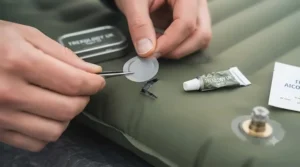
Punctures happen — sharp stones, an overlooked twig, an overenthusiastic dog — and knowing how to use puncture repair kits properly turns a potential trip-ending disaster into a five-minute fix.
Problem: you can’t find where the mat is leaking. Solution: inflate the mat fully and submerge sections in a bath or paddling pool, watching for bubbles, or use a soapy water spray across the surface and look for foaming at the puncture site, as recommended by BBC Countryfile’s repair guide. Problem: you’re on the trail with no repair kit. Solution: duct tape provides a genuinely effective temporary fix to get you through a night, though it should always be replaced with a proper patch once you’re home. Problem: the patch won’t stick. Solution: clean the area thoroughly with isopropyl alcohol and ensure the mat is completely dry before applying any adhesive, since residual moisture or oils are the most common cause of a failed repair. Problem: you’ve lost your original puncture repair kit. Solution: most manufacturers, including Sea to Summit and Alpkit, sell official spare patch kits separately, and a generic outdoor gear repair kit with adhesive-backed fabric patches will work across most mat brands in a pinch.
Long-Term Cost & Maintenance
Thinking in terms of cost-per-use rather than upfront price paints a genuinely different picture of value across this category.
A budget mat like the Vango Trek Pro, priced under £60, looks like the obvious value pick on price alone, but a premium mat like the Therm-a-Rest ProLite, priced a little over £100, has a well-documented reputation for lasting a decade or more of regular use without significant degradation — which, spread across dozens of camping trips, can work out cheaper per night than replacing a budget mat every few seasons. The thicker car-camping mats sit somewhere in between: the Alpkit Dozer and Vango Comfort 10 Double cost more upfront, but their heavier-duty fabric genuinely reduces puncture risk, and manufacturer support for puncture repair kits and spare parts extends their usable life considerably. Total cost of ownership should also factor in storage: mats that are compressed too tightly for years lose foam loft prematurely, effectively shortening their useful life regardless of how much you originally paid, so proper storage habits are arguably as important to long-term value as the purchase price itself.
| Price Band | Typical Mat | Long-Term Value Verdict |
|---|---|---|
| Budget (under £60) | Vango Trek Pro | Great entry point; foam may degrade faster with heavy use |
| Mid-range (£85–£150) | Therm-a-Rest ProLite / ProLite Plus / Sea to Summit Camp Plus / Outwell Dreamcatcher | Strong balance of durability and comfort per pound spent |
| Premium/thick (£90–£180+) | Alpkit Dozer / Vango Comfort 10 Double | Higher upfront cost, but genuine comfort and durability gains |
The overall lesson from this table is that the cheapest mat and the best-value mat are rarely the same product; durability, warranty support and puncture repair kit availability all quietly compound into meaningful savings over a mat’s realistic lifespan.
🔍 Ready to Upgrade Your Sleep System?
✨ Take your camping comfort to the next level with a mat that actually matches how and where you camp. Click through on any highlighted pick above to check current availability and pricing — a genuinely better night’s sleep might be one click away.
FAQ
❓ What's the difference between a self-inflating mat and an air mat?
❓ What R-value do I need for UK camping?
❓ How thick should a self-inflating sleeping mat be for back pain?
❓ Can you repair a puncture in a self-inflating mat yourself?
❓ How long do self-inflating sleeping mats last?
Conclusion
Choosing the right self-inflating sleeping mat really comes down to being honest with yourself about how you camp, rather than chasing the single “best” spec on a listing page. If you’re driving to a pitch and comfort is king, the Alpkit Dozer, Vango Comfort 10 Double or Outwell Dreamcatcher Single 12cm will transform your nights far more than any ultralight pad ever could. If you’re carrying your kit on your back and every gram counts, the Therm-a-Rest ProLite remains a genuinely excellent, durable baseline, with the Therm-a-Rest ProLite Plus as a worthwhile step up if warmth and back support matter more than shaving weight. Budget-conscious campers and DofE participants are well served by the Vango Trek Pro, while the Sea to Summit Camp Plus offers a sensible, well-supported middle ground for anyone who wants one mat that does a bit of everything reasonably well.
Whichever you choose, remember that R-value insulation and mat thickness in cm answer two different questions — one about warmth, one about comfort — and that a genuinely great night’s sleep outdoors usually means paying proper attention to both. Keep a puncture repair kit in your bag regardless of which mat you pick, store it properly between trips, and you’ll get years of reliable, comfortable service out of whichever option ends up under your sleeping bag.
Recommended for You
- Sleeping Bag for School Camping Trips: 7 Top Picks (2026)
- 7 Best Character Sleeping Bag for Kids Picks (2026 UK Guide)
- Kids Sleeping Bag: 7 Best Junior Picks for UK Camping 2026
Disclaimer: This article contains affiliate links. As an Amazon Associate, I earn from qualifying purchases. If you purchase products through these links, we may earn a small commission at no additional cost to you.
✨ Found this helpful? Share it with your friends! 💬🤗
