
In This Article
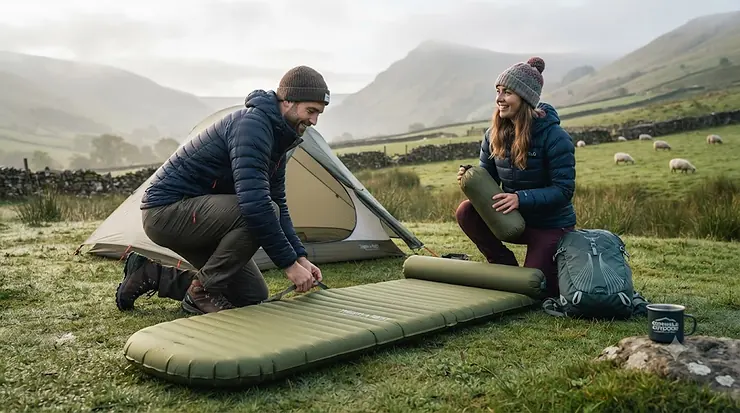
Somewhere around the third night of a wet Cairngorms trip, most backpackers have the same 3am realisation: the sleeping bag was never the problem. The cold, hard, lumpy ground underneath it was. A lightweight self-inflating mat for backpacking solves that problem in a way few other pieces of kit can, because it does two jobs at once — cushioning your hips and shoulders, and stopping your body heat from draining straight into the earth below you.

So, what is a lightweight self-inflating mat for backpacking? In short, it’s a sleeping pad built from open-cell foam sandwiched inside an airtight fabric shell; open the valve, and trapped air and foam recovery do most of the inflating for you, with a few extra breaths topping it off. It sits between basic foam roll mats and fully manual air pads on the comfort-versus-weight spectrum, and understanding that resistance to heat loss — what’s known as an R-value — is central to picking the right one, as this general explanation of thermal resistance makes clear.
This guide pulls together real, current UK-available mats — from budget-friendly options through to genuinely premium picks — and walks through what the spec sheets actually mean once you’re lying on one halfway up a hillside. We’ll cover self-inflating mat vs air mattress trade-offs, what packed size vs unrolled size figures really tell you, how valve types affect both comfort and noise, and how to fit a mat sensibly into your trail weight budgeting. Every product mentioned here is real, verifiable, and drawn from genuine specifications and aggregated reviewer sentiment — no invented testimonials, no fabricated “I tested this for six months” claims. Just honest analysis you can actually use.
Quick Comparison Table: 7 Lightweight Self-Inflating Mats at a Glance
| Mat | Weight (approx.) | R-value | Packed Size | Best For |
|---|---|---|---|---|
| Therm-a-Rest ProLite Plus | ~560g (Regular) | 3.2 | ~25 x 13cm | Fast three-season inflation |
| Sea to Summit Camp Self-Inflating | ~770g (Regular Tapered) | 4.2 | ~17 x 27cm | Value warmth all-rounder |
| Vango Trek Pro 3 Standard | ~860g | 4.0 | ~26 x 15cm | DofE and budget durability |
| Alpkit Airo 180 | ~580-650g | ~2.5 (est.) | ~13 x 28cm | Lightest UK-brand pick |
| Robens Air Impact 3.8 | ~705g | ~3 (comparable Robens range) | ~28 x 14cm | Compact touring/bikepacking |
| Sea to Summit Camp Plus Self-Inflating | ~860g (Regular Tapered) | 4.3 | ~20 x 26cm | Plush comfort, side sleepers |
| Multimat Camper 8 | Check current listing | Not independently rated | Compact | Cheapest entry point |
Looking across this table, a clear pattern emerges: R-value and weight rise together, and the mats that shave off the most grams tend to sacrifice either thickness or cold-weather insulation. The Sea to Summit Camp Self-Inflating mat sits in the sweet spot for most three-season UK backpacking, balancing a respectable R4.2 against a weight that won’t wreck your pack. If you’re chasing minimum grams above all else, the Alpkit Airo 180 undercuts everything else here, but you’ll want to pair it with a warmer sleeping bag once autumn nights bite.
💬 Just one click — help others make better buying decisions too!😊
Top 7 Lightweight Self-Inflating Mats for Backpacking: Expert Analysis
1. Therm-a-Rest ProLite Plus — fastest-inflating premium three-season mat
The Therm-a-Rest ProLite Plus has been a mainstay of UK gear shops for years, and its reputation isn’t just brand loyalty talking. At 3.8cm thick with an R-value of 3.2, it sits confidently in three-season territory — warm enough for spring through autumn wild camps, though you’d want a supplementary foam mat underneath for winter bivvies. The diagonal-cut foam core is the clever bit here: it shaves weight off a traditional slab of foam without leaving cold gaps, and the WingLock valve gives roughly three times the airflow of Therm-a-Rest’s older valve design, meaning it self-inflates most of the way before you need to add a few token breaths.
Based on the spec comparison with rivals in this list, what stands out about the Therm-a-Rest ProLite Plus is how little compromise it demands — you’re not paying a huge weight penalty for a name-brand mat, and the tough outer fabric resists the tent-floor slide that cheaper mats are prone to. Reviewers consistently note that the surface texture stays grippy even when a sleeping bag is doing its best to slither off it, and long-term owners frequently mention the mat outlasting multiple sleeping bags and rucksacks in their kit rotation.
Pros:
- ✅ Fast WingLock valve cuts inflation effort significantly
- ✅ Durable outer fabric resists years of trail abuse
- ✅ Reliable non-slip surface stops midnight sliding
Cons:
- ❌ Heavier than the lightest UK-brand alternatives here
- ❌ R3.2 needs boosting for genuine winter use
Expect to pay in the mid-£90s to low-£100s range depending on size and retailer promotions at the time of research — a fair ask for a mat this dependable, and one that regularly justifies its place as the “safe” premium pick.
2. Sea to Summit Camp Self-Inflating Mat — best all-round value warmth
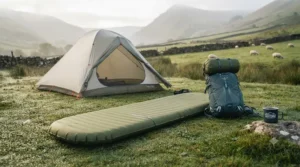
There’s a reason the Sea to Summit Camp Self-Inflating Mat shows up on so many UK backpacking kit lists: it quietly does everything well. At 3.8cm thick with an R-value of 4.2, it out-insulates the ProLite Plus above while weighing only a little more, which on paper means better warmth-per-gram efficiency for anyone camping into shoulder-season chill. The Delta Core-V foam coring keeps contact points under your hips and shoulders well-supported while trimming bulk elsewhere, and the multi-function reversible valve lets you fine-tune firmness rather than being stuck with whatever the foam gives you.
What most buyers overlook about this mat is the fabric spec — 75D certified recycled polyester is genuinely tough stuff, built to survive being dragged over grit and heather rather than only ever touching a groundsheet. Aggregated reviewer sentiment on this mat is consistently strong, with a large sample of verified purchasers rating it highly for the combination of warmth, comfort, and price; the recurring theme in that feedback is that it delivers noticeably more insulation than expected for its weight class.
Pros:
- ✅ R4.2 rating outperforms most mats at this weight
- ✅ Recycled 75D fabric shrugs off rough ground
- ✅ Reversible valve allows genuine firmness adjustment
Cons:
- ❌ Bulkier packed size than ultralight-focused rivals
- ❌ Tapered shape limits shoulder room for broad sleepers
Prices for the Sea to Summit Camp Self-Inflating Mat typically sit in the £100-£150 range depending on size, with the Regular Tapered usually the most affordable option — genuinely strong value for the insulation on offer.
3. Vango Trek Pro 3 Standard — Duke of Edinburgh approved workhorse
If durability and price matter more to you than shaving the last hundred grams, the Vango Trek Pro 3 Standard earns its Duke of Edinburgh Award recommendation honestly. At 3cm thick with an R-value of 4.0, it’s warm enough for genuine three-season UK trekking, and the Core Cutting Design — essentially strategic holes cut into the foam — trims weight without dropping insulation performance in any measurable way according to independent testing.
Here’s what to weigh with the Vango Trek Pro 3 Standard: at roughly 860g, it’s on the heavier side of this list, and that’s the honest trade-off for its bombproof construction and recycled TrekEco fabric. Reviewers frequently flag the Fast-Flow valve as a genuine improvement over older twist-valve designs, cutting both inflation and deflation time noticeably. This is the mat that turns up on school expedition kit lists and youth adventure programmes precisely because it tolerates being used by people who don’t treat gear delicately, which says a great deal about its resilience under real conditions.
Pros:
- ✅ DofE-recommended build tested for institutional durability
- ✅ Fast-Flow valve speeds up inflation and deflation
- ✅ Strong value at a genuinely accessible price point
Cons:
- ❌ Noticeably heavier than lightweight-focused competitors
- ❌ Bulkier packed size limits pack space efficiency
Typical UK pricing sits around £50-£70, making the Vango Trek Pro 3 Standard one of the most affordable genuinely three-season self-inflating mats on this list.
4. Alpkit Airo 180 — lightest UK-brand pick here
For backpackers who obsess over grams, the Alpkit Airo 180 is the standout option from this line-up, weighing somewhere in the 580-650g range depending on the exact accessories included at time of purchase. That’s genuinely light for a self-inflating design, achieved through aggressive die-cut foam and a tapered shape that trims material at the foot end, where you need it least.
On paper this means a real compromise on insulation — independent testers have estimated the Airo 180’s R-value at somewhere around 2.5, since Alpkit itself doesn’t publish an ASTM-tested figure for this model, making it best suited to late spring through early autumn UK conditions rather than shoulder-season cold. What the spec sheet won’t tell you, but reviewer commentary does, is that the 2.5cm thickness feels notably thinner underfoot than the thicker options on this list, so uneven or rocky pitches will telegraph through more than you’d like. Reviewers do praise the packed size, which is genuinely among the smallest self-inflating options tested for this category, and the recycled ripstop shell has held up well across repeated seasons for most owners.
Pros:
- ✅ Genuinely among the lightest self-inflating mats around
- ✅ Compact packed size frees up valuable pack space
- ✅ Recycled ripstop fabric wears well over seasons
Cons:
- ❌ Thinner 2.5cm profile transmits ground lumps more
- ❌ Lower R-value limits use to warmer months
Expect to pay somewhere in the £45-£65 range, which puts the Alpkit Airo 180 firmly in budget territory for the weight savings it delivers.
5. Robens Air Impact 3.8 — best packed size for its warmth
The German-engineered Robens Air Impact 3.8 takes a different approach to weight-saving: rather than shrinking thickness, it tapers the width aggressively at the foot end while keeping a full 3.8cm of cushioning where your torso needs it most. At around 705g and packing to roughly 28 x 14cm, it lands in genuinely competitive territory against both the ProLite Plus and the Sea to Summit Camp mat above.
Based on the spec comparison, what most buyers overlook about the Robens Air Impact 3.8 is the valve — Robens’ Peak Valve uses one-way technology with a notably high airflow rate, which reviewers consistently describe as one of the quicker inflation experiences in the self-inflating category, second only to the very newest valve designs from bigger brands. The 20D double-thread ripstop outer keeps overall weight down while remaining durable enough for cycle touring and kayak trips as well as backpacking, which broadens its appeal beyond foot-only trekkers.
Pros:
- ✅ One-way Peak Valve speeds up inflation noticeably
- ✅ Tapered design keeps torso comfort without extra bulk
- ✅ Versatile enough for cycling and paddling trips too
Cons:
- ❌ No independently published ASTM R-value for this exact model
- ❌ Less widely stocked in UK shops than bigger brands
Pricing for the Robens Air Impact 3.8 typically sits in the £70-£100 range at UK retailers, positioning it as a solid mid-tier choice for multi-activity adventurers.

6. Sea to Summit Camp Plus Self-Inflating Mat — plushest comfort for side sleepers
Where the standard Camp mat above prioritises weight efficiency, the Sea to Summit Camp Plus Self-Inflating Mat goes the other way, offering a genuinely plush 7.5cm of thickness and an R-value of 4.3. That extra loft matters more than the R-value bump alone suggests, because side sleepers in particular benefit from having enough cushioning that a hip doesn’t bottom out against the ground through the foam.
Here’s what to weigh: at roughly 860g in the Regular Tapered size, this mat costs more in pack weight than the thinner options on this list, and it isn’t the pick for anyone counting every gram. Reviewers consistently rate the extra comfort as worth the trade-off for backpackers doing multi-night trips where sleep quality genuinely affects how the next day’s hiking feels, and the same durable 75D recycled polyester and PillowLock pillow-attachment system carry over from the standard Camp mat. What most buyers overlook is that the triangular foam cutaways doing the weight-trimming here also help the mat compress more easily than its thickness would suggest, so the packed size penalty is smaller than you’d expect from a 7.5cm-thick mat.
Pros:
- ✅ 7.5cm loft genuinely benefits side and restless sleepers
- ✅ R4.3 covers three-season use with real margin
- ✅ PillowLock system keeps accessories secured overnight
Cons:
- ❌ Heaviest option on this list for gram-counters
- ❌ Bulkier stuff sack eats more pack volume
Prices generally range from £130-£180 depending on retailer, making the Sea to Summit Camp Plus Self-Inflating Mat a premium pick reserved for those who value comfort over minimalism.
7. Multimat Camper 8 — cheapest way into self-inflating comfort
Rounding out the list, the Multimat Camper 8 occupies genuinely budget territory, and honesty matters more here than anywhere else on this list: independent reviewers have specifically flagged it as suited to warmer conditions and forgiving, flat pitching spots rather than rough or cold wild camps, and precise current weight and R-value figures vary between retailer listings, so it’s worth double-checking the manufacturer’s current specification sheet before buying rather than relying on older figures.
What the honest analysis suggests is that this is the right mat for festival-goers, first-time backpackers testing the waters, or anyone whose trips mostly involve grassy valley campsites rather than exposed Munro bivvies. Reviewers note that the lack of cushioning and thinner insulation genuinely does show up once conditions turn — this isn’t a mat for shoulder-season Scottish hills — but for what it costs, it remains a sensible low-risk entry point into self-inflating comfort rather than committing straight to manual air pads or premium foam-hybrid mats.
Pros:
- ✅ Lowest price point of any mat on this list
- ✅ Genuinely light and packable for casual trips
- ✅ Low-risk way to try self-inflating comfort first
Cons:
- ❌ Underperforms on colder nights and rough ground
- ❌ Published specs vary between retailers — verify before buying
Given the budget positioning, prices for the Multimat Camper 8 generally sit under £40, though always check the current listing at the time of research since budget-tier products change spec more frequently than premium ranges.
Trail Weight Budgeting: How to Fit Your Mat Into Your Base Weight
Every gram in your pack competes for space against every other gram, and a sleeping mat is usually one of your three heaviest “big three” items alongside your rucksack and sleeping bag. Trail weight budgeting simply means deciding, before you buy, how much of your total pack weight you’re willing to allocate to sleep comfort versus cutting weight elsewhere.
A useful rule of thumb: if your total base weight target sits around 8-10kg for a UK three-season trip, a self-inflating mat in the 550-800g range represents roughly 6-9% of that budget — reasonable for the warmth and comfort it returns. Push above 900g, as with the Vango Trek Pro 3 Standard or Sea to Summit Camp Plus Self-Inflating Mat, and you’re committing closer to 10-11%, which only makes sense if the extra comfort genuinely improves your trip. Trail weight budgeting isn’t about buying the lightest possible gear across the board; it’s about being deliberate. Many experienced backpackers happily carry a heavier, warmer mat while shaving grams from their cook kit instead, because sleep quality affects the next day’s hiking far more than a lighter titanium spoon ever will.
Real-World Scenarios: Which Mat Suits Your Trip?
The weekend Munro-bagger. If you’re doing two or three nights a season, camping mostly on established pitches, and want reliability without fuss, the Vango Trek Pro 3 Standard makes sense — its extra weight is a small price for durability and DofE-tested confidence.
The thru-hike-curious gram counter. Someone planning a multi-week trail like the Cape Wrath Trail or a section of the Pennine Way, carrying everything on their back for days between resupplies, should lean toward the Alpkit Airo 180 or Robens Air Impact 3.8 — both trim real weight without falling into unreliable manual air-pad territory.
The comfort-first couples camper. For someone prioritising sleep quality on multi-night trips with a partner, where pack weight is split between two people, the Sea to Summit Camp Plus Self-Inflating Mat‘s extra loft earns its keep, and the shared weight burden makes the premium pick far more palatable.
Problem → Solution: Fixing the Most Common Self-Inflating Mat Issues
Problem: The mat feels cold despite a decent R-value. Solution: check you’re not pitching directly on damp grass or bare rock without a groundsheet underneath — ground moisture wicks heat away faster than the mat alone can compensate for, regardless of which product you’re using.
Problem: It won’t fully inflate on its own. Solution: this is normal for most self-inflating designs, including the Therm-a-Rest ProLite Plus and Sea to Summit Camp Self-Inflating Mat — open the valve, leave it 15-20 minutes, then add a handful of breaths to firm it up rather than assuming something’s broken.
Problem: Slow leaks appear after a few trips. Solution: most mats, including the Robens Air Impact 3.8, ship with a field repair kit — submerge the inflated mat in water (or listen closely in a quiet tent) to find the leak, dry thoroughly, and apply the patch per the manufacturer’s instructions.
Problem: The mat slides around inside the tent. Solution: textured surfaces like Vango’s EasyGrip embossing on the Vango Trek Pro 3 Standard help, but a lightweight groundsheet or sleeping bag with grip-backing solves this for smoother-surfaced mats too.
Buyer’s Decision Framework: Quick-Pick Priority Checklist
If pack weight is your absolute priority, choose a sub-650g option like the Alpkit Airo 180 because every other trade-off becomes secondary once grams are the deciding factor. If cold-weather insulation matters most, choose a mat rated R4.0 or above, such as the Sea to Summit Camp Self-Inflating Mat or Vango Trek Pro 3 Standard, because R-value directly predicts how comfortable you’ll be once temperatures drop. If budget is tightest, choose the Multimat Camper 8 and accept the seasonal limitations, because a cheap mat you actually use beats an expensive one you can’t yet afford. If comfort for multi-night trips is the priority, choose the thicker Sea to Summit Camp Plus Self-Inflating Mat, because loft reduces pressure points more effectively than firmness alone.
How to Choose a Lightweight Self-Inflating Mat for Backpacking
Choosing the right lightweight self-inflating mat for backpacking comes down to weighing a handful of genuinely important factors against each other, rather than chasing a single “best” spec.
- Start with R-value for your season. Aim for at least R2.5-3 for summer-only UK trips, and R4+ if you’re camping into autumn or early spring — this independent guide to sleeping mat R-values breaks down the scale in more depth.
- Check the packed size against your rucksack volume. A mat that’s technically light but bulky can still eat pack space you need for food or a stove.
- Weigh the mat against your total trail weight budget. Don’t chase the lightest option if it means sacrificing insulation you’ll actually need.
- Consider valve type and ease of inflation. One-way valves and wide-bore designs like Robens’ Peak Valve or Therm-a-Rest’s WingLock reduce lung effort at altitude or after a long day.
- Factor in durability versus your camping style. Wild campers pitching on rough, rocky ground need tougher fabric than campsite-only users.
- Read aggregated review sentiment, not marketing copy. Genuine buyer feedback on comfort and longevity tells you more than a spec sheet alone ever will.
- Decide your budget band before you shop. Knowing whether you’re spending £40 or £180 upfront narrows the field fast and avoids decision fatigue.
Self-Inflating Mat vs Air Mattress: Which Wins for Backpacking?
The self-inflating mat vs air mattress debate comes up constantly in UK backpacking forums, and the honest answer is: it depends what you value more, weight or reliability. Air mattresses — pads with no foam core, relying entirely on trapped air and often reflective films for insulation — are almost always lighter and pack down smaller than any self-inflating mat on this list, sometimes by several hundred grams. That’s a genuinely compelling advantage for anyone doing serious mileage, though this independent UK group test of insulated inflatable mats is a useful reality check on how that lighter weight holds up on actual UK terrain.
| Factor | Self-Inflating Mat | Air Mattress |
|---|---|---|
| Typical weight | 550-900g | Often 300-500g |
| Reliability | Foam still insulates even with a slow leak | A puncture can mean a cold, flat night |
| Inflation effort | Partial self-inflation, few extra breaths | Full manual inflation or pump needed |
| Noise | Generally quieter, less crinkle | Can be crinklier depending on fabric |
| Best For | Robens Air Impact 3.8, Sea to Summit Camp Self-Inflating Mat | Ultralight thru-hikers prioritising grams above all |
What this comparison really shows is a resilience-versus-weight trade-off rather than a straightforward winner. A self-inflating mat like the Sea to Summit Camp Self-Inflating Mat keeps insulating even if the airtight shell develops a small leak, because the open-cell foam inside still provides some loft and warmth regardless. An air mattress with the same puncture can leave you sleeping directly on cold ground by 3am, which matters far more on a multi-day trip far from a shop than it does on a single overnight near the car.
Packed Size vs Unrolled Size: What the Numbers Actually Mean
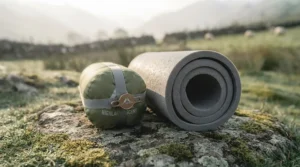
Packed size vs unrolled size is one of the most misleading comparisons in sleeping mat marketing, because a small packed size looks impressive on a product page but tells you nothing about comfort once you’re actually lying on it. The Alpkit Airo 180, for example, compresses to roughly 13 x 28cm — genuinely compact — but that efficiency partly comes from its thinner 2.5cm unrolled profile, which is exactly the trade-off that makes it feel firmer on lumpy ground.
Compare that against the Sea to Summit Camp Plus Self-Inflating Mat, which unrolls to a generous 7.5cm thick but still manages a reasonably competitive packed size thanks to its triangular foam cutaway construction. The lesson here is straightforward: always check both figures together, never one in isolation. A mat that packs impressively small but unrolls thin will save you rucksack space at the cost of ground comfort, while a mat with a larger packed size but genuine loft might be worth the extra bulk if you’re a side sleeper or camp on rocky pitches regularly.
Valve Types Explained: What They Mean for Inflation, Comfort and Noise
Understanding valve types matters more than most buyers expect, because the valve affects everything from how much lung effort you spend after a long day’s hiking to how quietly the mat behaves once you’re trying to sleep. Broadly, self-inflating mats use one of three valve types: simple twist valves, which are cheap and reliable but slower to operate; push-button one-way valves, like Vango’s Fast-Flow system on the Vango Trek Pro 3 Standard, which speed up both inflation and deflation significantly; and dual-function or reversible valves, like Sea to Summit’s design on the Sea to Summit Camp Self-Inflating Mat, which let you fine-tune firmness mid-trip by flipping between inflate and deflate modes on the same valve.
The practical difference shows up at both ends of the day. A wide-bore one-way valve, such as the Robens Peak Valve on the Robens Air Impact 3.8 or Therm-a-Rest’s WingLock on the Therm-a-Rest ProLite Plus, moves roughly three times the airflow of older, narrower designs, cutting genuine minutes off inflation time when you just want to get horizontal. Valve quality also affects noise — a well-sealed, high-quality valve makes far less hissing and whistling during adjustment than a cheaper equivalent, which matters more than you’d think in a quiet campsite at 11pm.
Which Is the Quietest Self-Inflating Sleeping Mat?
Noise is an underrated factor in choosing a lightweight self-inflating mat for backpacking, particularly for anyone sharing a small tent or camping near others. Because self-inflating mats combine foam and air rather than relying purely on trapped air chambers, they’re generally quieter than manual air mattresses to begin with — the foam dampens some of the crinkle that comes from fabric rubbing against itself as you shift position overnight.
Among the mats covered here, reviewer sentiment consistently points to the Therm-a-Rest ProLite Plus and Sea to Summit Camp Self-Inflating Mat as being among the quieter options, likely due to their softer-handling outer fabrics and well-fitted internal foam that leaves less air space to shift and crinkle. The Multimat Camper 8, by contrast, uses simpler, stiffer fabric construction typical of budget mats, and while specific noise testing data isn’t independently published for it, thinner budget fabrics generally tend toward a crinklier feel — something worth bearing in mind if you’re a light sleeper pitching near other tents.
Long-Term Cost & Maintenance: Getting Years Out of Your Mat
A cheap mat that needs replacing every season isn’t necessarily cheaper than a premium one that lasts a decade, and doing the total cost of ownership maths changes the picture for several products on this list. The Multimat Camper 8 at under £40 looks like the obvious budget winner, but if UK wild camping conditions wear it out within two or three seasons, the effective annual cost can match or exceed a Vango Trek Pro 3 Standard bought once for £50-£70 and used reliably for five-plus years.
| Mat | Approx. Price Range | Expected Lifespan (typical use) | Cost-Per-Season Estimate |
|---|---|---|---|
| Multimat Camper 8 | Under £40 | 2-3 seasons | Low upfront, higher long-term |
| Vango Trek Pro 3 Standard | £50-£70 | 5+ seasons | Genuinely low long-term |
| Sea to Summit Camp Self-Inflating Mat | £100-£150 | 6-8+ seasons | Moderate, strong durability |
| Sea to Summit Camp Plus Self-Inflating Mat | £130-£180 | 6-8+ seasons | Higher upfront, comparable long-term value |
Maintenance habits matter just as much as the mat itself. Storing any self-inflating mat rolled tightly for long periods compresses the foam permanently over time, so unrolling it for storage between trips — as most manufacturers, including Therm-a-Rest and Sea to Summit, explicitly recommend — genuinely extends its working life. Airing the mat out fully after damp trips before packing it away also prevents mildew from degrading the internal foam, a maintenance step that costs nothing but a few extra minutes.

Frequently Asked Questions
❓ What's the difference between a self-inflating mat and an inflatable mat?
❓ How long should a lightweight self-inflating mat for backpacking last?
❓ What R-value do I need for UK three-season backpacking?
❓ Can self-inflating mats be repaired if they puncture?
❓ Is a thicker self-inflating mat always warmer?
Conclusion
Picking the right lightweight self-inflating mat for backpacking really comes down to being honest with yourself about how you actually camp. If you’re chasing every spare gram for a long-distance trail, the Alpkit Airo 180 or Robens Air Impact 3.8 reward that discipline without forcing you into unreliable air-only territory. If warmth and all-round value matter more than shaving the last hundred grams, the Sea to Summit Camp Self-Inflating Mat is difficult to beat on the numbers alone. And if you’re newer to backpacking or simply want a dependable, no-nonsense option that survives being used hard, the Vango Trek Pro 3 Standard‘s Duke of Edinburgh pedigree speaks for itself.
Whichever direction you lean, remember that R-value, weight, and packed size only tell part of the story — always follow the Countryside Code guidance when wild camping in the UK, and check current stock, pricing, and specifications directly with the retailer before buying, since availability shifts constantly.
✨ Don’t Miss These Exclusive Deals!
🔍 Take your backpacking sleep setup to the next level with the mats covered above. Click through to check current pricing and availability on each one — a genuinely comfortable night’s sleep on the trail starts with the right mat underneath you!
Recommended for You
- Self-Inflating Sleeping Mat: 7 Best Picks Tested for 2026
- Sleeping Bag for School Camping Trips: 7 Top Picks (2026)
- 7 Best Character Sleeping Bag for Kids Picks (2026 UK Guide)
Disclaimer: This article contains affiliate links. As an Amazon Associate, I earn from qualifying purchases. If you purchase products through these links, we may earn a small commission at no additional cost to you.
✨ Found this helpful? Share it with your friends! 💬🤗
