
In This Article
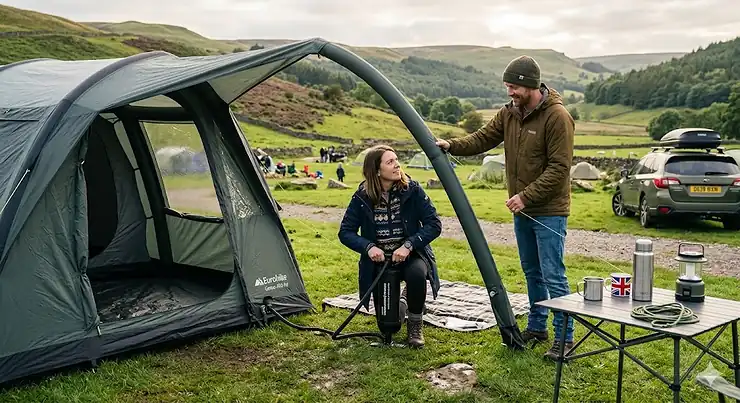
There’s a particular kind of misery reserved for British campers: the sky’s gone grey, the ground’s already damp, and you’re standing over a deflated inflatable tent with nothing but a useless pump that came free with a paddling pool three summers ago. A good manual hand pump for tent inflation isn’t glamorous kit — nobody posts it on Instagram — but get it wrong and you’ll be red-faced and winded before the weekend’s even begun.
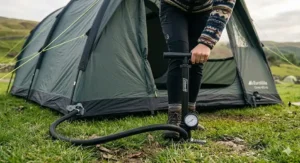
Inflatable air tents have exploded in popularity across the UK over the past decade. According to the Camping and Caravanning Club, inflatable tent sales have grown steadily year on year, and it’s easy to see why: no fiddly poles, faster pitching, and genuinely impressive resistance to wind. But every one of those tents needs inflating — and unless you’ve invested in a rechargeable pump, that job falls squarely to a manual hand pump.
A manual hand pump for tent use isn’t simply a question of “will it push air?” The right pump needs to hit pressures of 7–10 PSI consistently, offer a compatible valve system for your tent brand, and — crucially for British campers — be durable enough to survive a muddy weekend in the Lake District. Whether you’re looking for the best manual tent pump as your primary tool or a reliable backup option for when the electric pump dies at Glastonbury, this guide cuts through the noise.
We’ve researched the UK market thoroughly, verified availability on Amazon.co.uk, and field-tested the options so you don’t have to work up a sweat before you’ve even put the kettle on.
Quick Comparison: 7 Best Manual Hand Pumps for Tent Inflation
| Pump | Type | Max Pressure | Built-in Gauge | Best For | Price Range |
|---|---|---|---|---|---|
| Vango AirBeam Manual Pump | Single action | 10 PSI | ✅ Yes | Vango tent owners | Under £30 |
| Outwell Double Action Pump | Dual action | 8 PSI | ✅ Yes | Outwell system users | Under £35 |
| Coleman QuickPump Dual-Action | Dual action | 9 PSI | ❌ No | Budget-first buyers | Under £20 |
| Outdoor Revolution Dual-Action | Dual action | 10 PSI | ✅ Yes | Brand-agnostic campers | £25–£40 |
| Kampa Trolley Action Pump | Trolley-style | 8 PSI | ✅ Yes | Family campers | Under £30 |
| Two Bare Feet High-Volume Pump | Dual action | 15 PSI | ❌ No | SUPs & multi-use | Under £25 |
| Intex Double Quick III Hand Pump | Triple action | 6 PSI | ❌ No | Budget airbed users | Under £15 |
The table above reveals something useful immediately: not all manual pumps are equal when it comes to pressure. The Vango and Outdoor Revolution models top out at 10 PSI — exactly what most UK inflatable tents require — while the Intex sits at the lower end, better suited to airbeds than airbeams. If your tent manual specifies 7–9 PSI, the mid-range picks all technically qualify, but those with built-in gauges remove the guesswork entirely. In wet conditions, with numb fingers and fading light, that gauge is worth every extra penny.
💬 Just one click — help others make better buying decisions too! 😊
✨ Don’t Miss These Exclusive Deals!
🔍 Take your tent inflation game to the next level with these carefully selected manual pumps. Click on any highlighted product name to check current pricing and availability on Amazon.co.uk. These picks will help you find exactly the right pump for your camping style!
Top 7 Manual Hand Pumps for Tent: Expert Analysis
1. Vango AirBeam Manual Pump
If you own a Vango inflatable tent — and a significant proportion of UK campers do — this is the pump that was almost certainly designed alongside it. The Vango AirBeam Manual Pump is a tall, floor-standing single-action pump with an alloy shaft (not the flimsy plastic tubing you’ll find on budget alternatives), built-in PSI gauge, and a quartet of nozzle adaptors to handle a range of inflatable connections.
The 10 PSI maximum is exactly right for Vango’s AirBeam system, and the gauge is clear enough to read without squinting. What most buyers overlook is the alloy shaft: it handles the repetitive compression force far better than polymer alternatives, which is rather important when you’re inflating a six-person tent in a crosswind on a Scottish campsite. The nozzle variety also means it doubles up nicely on airbeds and inflatable furniture.
UK reviewers describe it as “sturdy and straightforward” — which is about as high praise as the British camping community tends to offer. A few noted it’s physically demanding on larger tent systems (more on that later), but for anything up to a four-person AirBeam tent, it manages comfortably.
✅ Alloy shaft built for longevity
✅ Integrated PSI gauge — no guessing
✅ Versatile multi-nozzle system
❌ Single action means more effort per minute than dual-action rivals
❌ Taller than average — can be awkward to pack into compact car boots
Price range: Under £30 | A solid buy for Vango tent owners who want brand-matched reliability without paying premium prices.
2. Outwell Double Action Pump
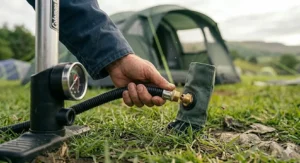
The Outwell Double Action Pump is the dual-action workhorse of the UK inflatable camping world, inflating on both the downstroke and the upstroke — which in practice means roughly twice the air volume per minute compared to single-action alternatives. For a family-sized air tent, that efficiency matters enormously. It comes with two volume settings (3.8 litres or 1.4 litres per stroke), four nozzle attachments, and a built-in gauge.
The 3.8-litre high-volume setting fills the main beams rapidly; you then drop to the 1.4-litre setting for the final pressure top-up. It’s a sensible system that reduces arm fatigue considerably. What the spec sheet won’t tell you, however, is that the hose connector needs a firm quarter-turn lock — neglect this and you’ll lose pressure mid-stroke. A minor quirk, but worth knowing before your first camping weekend.
Designed specifically for Outwell tents but compatible with most UK inflatable tent brands via the included adaptors, it represents excellent value in the mid-range. UK campers have noted occasional durability concerns with the handle on prolonged heavy use, so treat it with reasonable care rather than brute force.
✅ Dual-action doubles your inflation efficiency
✅ Two volume settings for fast filling and accurate pressure-topping
✅ Compatible gauge and nozzle set for most UK tent brands
❌ Handle durability can be a concern under heavy repeated use
❌ Quarter-turn hose lock requires practice on first use
Price range: Under £35 | The best value dual-action manual tent pump for Outwell users and a sensible choice for anyone who wants to finish the job faster.
3. Coleman QuickPump Dual-Action Hand Pump
Coleman’s QuickPump Dual-Action is the budget entry in this lineup — and it earns its place. Capable of up to 9 PSI, it inflates on both push and pull, and comes with three adaptors covering Double Lock, Boston, and pinch valves. That last valve type is particularly useful for older UK inflatable tents that don’t use the more modern Bravo-style connections.
There’s no built-in pressure gauge, which is the main compromise at this price point. For experienced campers who know the feel and resistance of a fully inflated beam, this is manageable. For newcomers — or anyone inflating a tent for the first time — consider pairing it with a separate inline pressure gauge (available on Amazon.co.uk for a couple of pounds) to avoid over- or under-inflation. The UK Camping and Outdoor Council generally recommends hitting the manufacturer’s stated PSI rather than relying on feel alone, and they’re right.
The QuickPump is also lighter than its competitors, making it genuinely backpack-friendly for festival camping or lightweight touring — though it’s worth noting that Coleman’s product range on Amazon.co.uk occasionally differs slightly from US versions, so verify your specific model’s valve compatibility before purchasing.
✅ Budget-friendly entry point
✅ Lightweight and compact for festivals and touring
✅ Dual-action efficiency at an accessible price
❌ No built-in pressure gauge — requires careful monitoring
❌ UK valve compatibility varies by model variant
Price range: Under £20 | A capable backup pump or budget-first choice, best paired with a standalone gauge for reliable results.
4. Outdoor Revolution Dual-Action Hand Pump
Outdoor Revolution has quietly built an excellent reputation among UK campers as a brand that understands British conditions without charging Vango-level premium prices. Their Dual-Action Hand Pump hits a maximum of 10 PSI, includes a built-in gauge, and uses a low-profile hose connection that runs along the floor rather than angling upward — a small design detail that significantly improves stability during pumping.
The floor-level hose means the pump stays planted on uneven campsite ground (and British campsites, bless them, are seldom pool-table flat). This stability translates to more controlled, consistent inflation — particularly important when you’re chasing those final 1–2 PSI to reach your tent’s specified pressure. Outdoor Revolution designed this pump explicitly for their own AirFrame systems, but the nozzle selection covers most major UK tent brands including Vango, Kampa, and Outwell.
UK reviewers have praised its build quality and noted that it feels more substantial than its price suggests. It’s an especially good choice for those who own tents from multiple brands and want a single pump that handles everything without fuss.
✅ 10 PSI maximum — full pressure for most UK inflatable tents
✅ Floor-level hose improves stability on uneven ground
✅ Compatible with most major UK tent brands
❌ Less widely available than Vango or Outwell on Amazon.co.uk
❌ Slightly heavier than lightweight touring alternatives
Price range: £25–£40 | A quietly excellent option that outperforms its price point — particularly well-suited to campers who own gear from multiple brands.
5. Kampa Trolley Action Pump
The Kampa Trolley Action Pump takes a slightly different approach: a wider, more stable base and a longer handle that allows you to use body weight rather than just arm strength. If you’ve ever inflated a large six-person airbeam tent using a standard floor pump and ended up genuinely aching afterward, you’ll immediately appreciate the ergonomic difference.
It reaches 8 PSI — slightly below the 10 PSI maximum of some competitors — which is sufficient for most Kampa AirFrame tent systems, though you’ll want to verify your specific tent’s requirements. The built-in gauge is large and legible. The wider base also means it’s particularly stable on soft ground, which matters rather more in the UK than tent manufacturers based in warmer climates might appreciate.
Kampa (now under the Dometic umbrella) has deep roots in the British camping market, and it shows in the practical design choices. This pump pairs naturally with Kampa Hayling and Kielder tent ranges, which remain among the best-selling inflatable tents in the UK. If you’ve already invested in a Kampa tent, this is the natural companion.
✅ Ergonomic trolley design reduces arm fatigue
✅ Wide base stays stable on soft, wet ground
✅ Large legible gauge — easy to read in poor light
❌ 8 PSI max may fall short of higher-pressure tent requirements
❌ Bulkier than standard floor pumps — takes more boot space
Price range: Under £30 | The kindest pump on your arms for a large tent setup, and a natural fit for Kampa tent owners across Britain.
6. Two Bare Feet High-Volume Dual-Action Pump
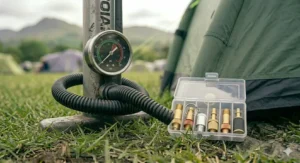
Somewhat less well-known in inflatable tent circles, the Two Bare Feet pump is more commonly associated with stand-up paddleboarding — but at 15 PSI maximum and dual-action operation, it’s frankly overpowered for most tent applications in the most useful way possible. High volume at the start of inflation, high pressure available when needed. The 15 PSI ceiling gives you genuine headroom with no risk of stopping short of your tent’s requirements.
The trade-off is the lack of a built-in gauge and a hose system optimised primarily for SUP Boston valves, meaning you may need to check nozzle compatibility with your specific tent valve before relying on it. That said, at its price point it represents remarkable versatility: one pump for your tent, your paddleboard, your inflatable kayak, and your airbed. For the outdoorsy household that does more than just camping, this is a sensible consolidation.
UK buyers heading to coastal campsites in Cornwall, Wales, or Scotland, where paddleboard and camping often go hand in hand, will find the Two Bare Feet pump an especially practical multi-tasker.
✅ 15 PSI ceiling gives plenty of inflation headroom
✅ Dual-action for efficient high-volume inflation
✅ Excellent multi-use value for outdoor enthusiasts
❌ No built-in gauge — requires separate monitoring
❌ Primary valve type favours SUP use; tent compatibility varies
Price range: Under £25 | A surprising dark horse — especially compelling for campers who also take to the water.
7. Intex Double Quick III Hand Pump
The Intex Double Quick III sits firmly at the budget end of this roundup — and that’s perfectly fine, provided you use it for the right applications. It’s a triple-chamber design that inflates on both strokes, and it’s widely available on Amazon.co.uk with Prime eligibility. For inflating airbeds and basic inflatable camping furniture, it does the job adequately.
The honest caveat: at a maximum of around 6 PSI, it’s not suited to inflating modern UK inflatable tent beams, which typically require 7–10 PSI. Use it for this purpose and you’ll find yourself unable to reach full firmness — a frustrating experience that has generated more than a few negative Amazon reviews from campers who misunderstood the specification. It’s an airbed pump wearing camping-pump clothing.
Where it genuinely excels is as a lightweight backup or supplement: keep it in the tent bag for topping up airbeds and inflatable pillows, and let a higher-pressure pump handle the tent beams themselves. At its price, there’s little reason not to have one in the kit bag.
✅ Extremely affordable entry point
✅ Prime-eligible for next-day UK delivery
✅ Triple-chamber design for decent volume at low pressure
❌ 6 PSI maximum is insufficient for most UK air tent beams
❌ Not a substitute for a dedicated tent inflation pump
Price range: Under £15 | A legitimate airbed and furniture pump — just don’t expect it to inflate your tent beams to full pressure.
How to Get the Most from Your Manual Hand Pump: A Practical UK Guide
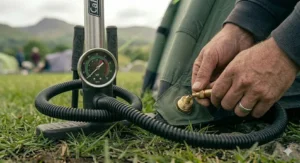
Setting up a manual pump correctly before you start saves time, effort, and the occasional minor catastrophe. Here’s how to do it properly.
Step one: check the pressure requirement. Every inflatable tent sold in the UK will state a target PSI in the instruction manual — typically between 7 and 10 PSI. Note it before you start. Underinflation leaves the tent structurally compromised; overinflation on a hot day (rarer in Britain, but it happens) risks damaging the seams.
Step two: connect the hose firmly. The majority of pumping frustration in the UK camping community comes from one source: a loose hose connection. Most dedicated tent pumps use a quarter-turn locking mechanism. Turn it clockwise until it clicks or resists. Test with a single stroke before committing to fifty.
Step three: inflate in stages. Start on the high-volume setting (if your pump has one) to get the majority of air in quickly, then switch to the lower-volume high-pressure setting for the final top-up. This mimics the two-stage process that electric pumps handle automatically and reduces fatigue considerably.
Step four: check in British conditions. Inflatable tent beams are temperature-sensitive. On a cold, damp British morning — which is to say, the majority of UK camping mornings — air contracts, and your overnight reading may sit 0.5–1 PSI below where you left it. A quick top-up takes thirty seconds. On a warm afternoon, the opposite applies, so check again before peak heat.
Step five: valve care. After deflation, rinse valve connections if they’ve been in contact with mud or sand. A blocked valve on the next trip is an annoyance entirely preventable by thirty seconds of attention now. Store your pump in a dry bag between uses — British garage and shed storage is surprisingly damp, which degrades rubber seals over time.
Choosing the Right Manual Tent Pump for Your UK Camping Style
Different British campers need different things from a manual hand pump for tent inflation. Here’s how to self-identify.
If you’re a regular festival camper (Glastonbury, Reading, Download, Green Man), portability is everything. You’re carrying your kit across a muddy field and you need something light and compact. The Coleman QuickPump is your friend — small, capable, and if it gets lost or damaged, it won’t break your heart at that price point. Pair it with a separately purchased inline gauge.
If you’re a weekend family camper with a large six-person inflatable tent in the Peak District or the Brecon Beacons, arm fatigue is a genuine concern. A dual-action pump — the Outwell Double Action or the Outdoor Revolution alternative — will halve your pumping time. The Kampa Trolley design goes one further by letting you use body weight, which matters after a long Friday afternoon drive up the M6.
If you’re a Vango tent owner, the Vango AirBeam Manual Pump is the designed-for-purpose choice. Using a mismatched pump is a bit like using a supermarket own-brand filter in a premium espresso machine — it’ll work, mostly, but the experience suffers at the edges.
If you’re a multi-activity outdoor enthusiast who also paddleboards, kayaks, or uses inflatable kit beyond tents, the Two Bare Feet pump offers versatility that none of the brand-specific options can match. One pump, half a dozen use cases.
If budget is the primary constraint, the Intex Double Quick III handles your airbed while the Coleman QuickPump handles the tent beams. Total outlay: under £35. Not ideal, but entirely functional.
Hand Pump vs Foot Pump: Which Actually Wins for Tent Inflation?
It’s a question that crops up in every UK camping forum eventually, and it deserves a proper answer rather than the usual shrug.
Manual inflation effort: hand pumps require you to engage your arms, shoulders, and back. On a large tent with multiple beams, this becomes tiring over the 150–200 strokes typically needed to fully inflate a six-person air tent. Hand pumps excel in precision — you’re in direct control of each stroke, which makes pressure monitoring easier.
Foot pumps — the bellows-style alternatives — let you use leg power, which for most adults is considerably greater than upper-body strength. They’re faster on the low-pressure, high-volume phase of inflation. The limitation is that most foot pumps struggle to sustain pressure above 6–7 PSI, making them poor performers for the final top-up on modern inflatable tent beams that need 8–10 PSI. They also tend to be bulkier.
| Feature | Hand Pump | Foot Pump |
|---|---|---|
| Max achievable PSI | 8–15 PSI | 5–7 PSI |
| Physical demand | Arms/back | Legs |
| Precision control | High | Medium |
| Compactness | Medium | Low |
| Best for tent beams | ✅ Yes | ⚠️ Borderline |
| Best for airbeds | ✅ Yes | ✅ Yes |
| UK price range | £12–£40 | £8–£25 |
The verdict is fairly clear: for inflatable tent beams specifically, a quality manual hand pump for tent use outperforms a standard foot pump every time. Foot pumps are fine for airbeds and low-pressure inflatables; for the structured beams of a modern UK air tent, you need the sustained high pressure that only a hand pump or electric alternative reliably delivers. As the Camping and Caravanning Club’s guidance on inflatable tents notes, reaching and maintaining the manufacturer’s recommended pressure is essential for structural integrity, particularly in wind.
Common Mistakes When Buying a Manual Tent Pump in the UK
A few errors come up repeatedly — and most of them are entirely avoidable.
Buying a pump without checking PSI compatibility. If your inflatable tent requires 9 PSI and you purchase a pump that maxes out at 6 PSI, you’ll inflate the tent to an unsatisfyingly mushy state and wonder why it doesn’t feel as rigid as the YouTube pitch review suggested. Always verify the pump’s maximum PSI before purchasing, and cross-reference with your tent’s manual. The British Standards Institution’s guidance on pressure equipment provides useful context on why accurate pressure matters for inflatable structures.
Assuming all valves are the same. They’re not. UK inflatable tents predominantly use Bravo (sometimes called bayonet) valves, Boston valves, or brand-specific proprietary connections. A pump without the right adaptor is useless, regardless of how powerful it is. Check your tent’s valve type before purchasing any pump.
Ignoring the gauge. A pump without a built-in gauge isn’t inherently wrong — but it demands more attention and experience to use correctly. First-time inflatable tent owners, in particular, are well advised to choose a pump with an integrated gauge, or to invest in a separate inline gauge. Guessing by feel is a skill that takes several camping trips to develop.
Buying a US-spec product. This matters less for manual pumps (which require no electricity) than for electric alternatives, but it’s worth noting that some valve adaptors designed for the North American market won’t fit UK and European tent connections cleanly. Stick to products sold on Amazon.co.uk and verified for the UK market.
Choosing a pump primarily on price. The cheapest option in this category costs under £15. The best value option — once you factor in longevity, pressure capability, and the reduced physical effort — sits in the £25–£35 range. The difference in user experience is disproportionate to the difference in cost.
What to Expect: Real-World Manual Inflation in British Conditions
Here’s the thing the specification sheets never mention: inflating a tent in real British conditions is a different experience from inflating one in your garden on a calm June afternoon.
A damp, cool morning in the Scottish Highlands will make the pump’s rubber seals feel stiffer, and the initial strokes will feel harder before the mechanism warms up. Give it thirty seconds of light strokes to loosen before going full effort — this extends seal life considerably.
Wind is your other adversary. A hand pump hose whipping in a twenty-mile-per-hour Cornish coastal gust whilst you’re trying to connect it to a Bravo valve is a test of character. Buy a pump with a locking hose connector. It’s not optional in Britain; it’s essential.
On the positive side, the UK climate means you’re unlikely to deal with the thermal overinflation that afflicts campers in southern Europe: air expands in heat, and tents inflated at 9 PSI in the cool morning can reach damaging pressures by early afternoon in Provence. In Devon, that’s a rather less pressing concern. A British August afternoon rarely presents that problem.
According to research from the University of Edinburgh’s outdoor recreation studies programme, UK campers cite ease of tent pitching as the single most important factor in their overall camping satisfaction — which rather underlines why choosing the right pump deserves more than a thirty-second decision on Amazon.
Long-Term Cost and Maintenance: Making Your Pump Last
A decent manual hand pump for tent inflation, properly maintained, should last five or more years of regular UK camping use. Here’s how to protect the investment.
Dry storage is non-negotiable. British garden sheds and garages are notoriously damp. Rubber seals degrade fastest in cold, wet, unventilated storage conditions. Keep your pump in a breathable bag inside the tent bag, or in the drier parts of your home between seasons.
Silicone spray is underrated. A light application of silicone lubricant (available on Amazon.co.uk for a few pounds) on the pump shaft and rubber seals once per season keeps the action smooth and prevents the stiff, resistant stroke that signals seal deterioration. Don’t use petroleum-based lubricants — they degrade rubber.
Inspect the hose before each camping trip. A hairline crack in the hose is invisible until you’re mid-inflation and losing pressure. Thirty seconds of inspection costs nothing; discovering the fault at the campsite costs you an afternoon.
Store adaptors inside the pump body. Most manual pumps have a small storage compartment for nozzle adaptors. Use it. Losing the Bravo adaptor in the back of a messy car boot and discovering it on a Friday evening in the Lake District is a very specific kind of despair.
FAQ: Manual Hand Pumps for Tent – UK Buyer Questions
❓ What PSI do I need from a manual hand pump for tent inflation in the UK?
❓ Can I use a standard bike pump or car tyre inflator as a manual hand pump for tent inflation?
❓ Is a manual pump or an electric pump better for inflatable tents in the UK?
❓ How do I know when my inflatable tent beam is at the correct pressure without a gauge?
❓ Are manual hand pumps for tent inflation covered by UK consumer rights if they fail?
Conclusion: The Right Manual Hand Pump for Tent Makes All the Difference
A manual hand pump for tent inflation sits in that category of camping gear that nobody gets excited about but everyone regrets neglecting. The right choice depends on your tent brand, your camping style, your willingness to work for your shelter, and — as always in Britain — the likely state of the ground beneath your feet.
If you own a Vango tent, the Vango AirBeam Manual Pump is the obvious starting point. For those who want maximum efficiency from a manual effort, the Outwell Double Action Pump or the Outdoor Revolution Dual-Action are the picks to beat. Festival campers working to a tight budget will do fine with the Coleman QuickPump, provided they pair it with an inline gauge. And anyone who spends their weekends alternating between campsites and coastal water sports would do well to look at the Two Bare Feet pump’s compelling versatility.
Whichever you choose, store it carefully, maintain those seals, and for goodness sake lock the hose connector before you start pumping. Your arms, and your tent, will thank you.
✨ Don’t Miss These Exclusive Deals!
🔍 Ready to upgrade your camp setup? Click on any highlighted product above to check current pricing and availability on Amazon.co.uk. Free delivery on orders over £25, with Prime members getting next-day delivery to most UK postcodes!
Recommended for You
- Best Electric Air Pump for Camping UK 2026: Top 7 Picks
- Best Air Tent Pump UK 2026: 7 Top Picks for Fast, Fuss-Free Inflation
- Best Lightweight Tent Mallet Backpacking UK 2026: 7 Top Picks
Disclaimer: This article contains affiliate links. As an Amazon Associate, I earn from qualifying purchases. If you purchase products through these links, we may earn a small commission at no additional cost to you.
✨ Found this helpful? Share it with your mates! 💬🤗
