

In This Article
There’s a very specific misery that only tent campers know: lying awake at 2am, sleeping bag kicked off, listening to your tent-mate breathe like they’re personally trying to heat the whole campsite. A clip on fan for tent use fixes about eighty percent of that problem for the price of a decent pub round, and yet it’s one of the most overlooked items on most packing lists — squeezed out by the tent itself, the stove, the airbed, and whatever inflatable pool toy someone insisted on bringing. That’s a shame, because a good clip on fan genuinely changes how a hot night in canvas or nylon feels.
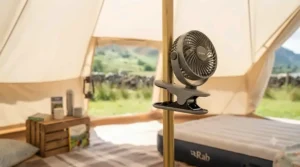
This guide compares seven real, currently available clip on fans built or marketed specifically for tent use, based on actual product specs and aggregated customer sentiment rather than invented five-star gushing. We’ll cover battery life in the numbers that matter, clip strength on actual tent poles, noise levels for light sleepers, and — because a fan is only half the story — how to organise it into your kit without it becoming another loose item rolling around the footwell. Prices are given as ranges only since retail pricing shifts constantly; always check the current price before buying.
By the end you’ll know exactly which of these seven fans suits your tent, your family, and your camping style — plus the practical setup, safety and packing knowledge that turns “brought a fan” into “actually used the fan properly all week.”
Quick Comparison Table
Here’s the fast version before we get into individual reviews — useful if you’re stood in an aisle with limited signal and a toddler pulling at your sleeve.
| Fan Type | Battery Life | Clip Strength | Best For |
|---|---|---|---|
| Basic budget clip fan | 3-10 hours | Light, small poles/straps | Solo campers, occasional use |
| Mid-range multi-speed fan | 15-30 hours | Moderate, most tent poles | Couples, weekend trips |
| Hook-and-clip combo fan | 20-40 hours | Strong clip plus ceiling hook | Family tents, awnings |
| High-capacity power bank fan | 40-65+ hours | Strong sprung clamp | Festivals, extended trips |
The core trade-off across nearly every clip on fan for tent use is battery capacity versus size and weight — the bigger the mAh figure, the longer it runs, but also the bulkier and heavier the unit sits on your tent pole. A basic budget fan is genuinely fine for a single warm night or two, but if you’re planning a full week at a festival or a family fortnight in the New Forest, the extra capacity of a high-mAh model pays for itself many times over in one less thing to think about each evening.
💬 Just one click — help others make better buying decisions too!😊
Top 7 Clip On Fans for Tents: Expert Analysis
We’ve mixed budget, mid-range and premium options here, and deliberately included both simple clip-only designs and hook-and-clip hybrids, since the right mounting style depends heavily on your specific tent’s pole layout.
1. Warmco 15000mAh Portable Clip on Fan — LED lantern and hook in one unit
The Warmco 15000mAh Portable Clip on Fan earns its spot at the top of this list by doing something most rivals don’t: combining a genuinely usable LED lantern with the fan and hook in a single 8-inch unit. The 15000mAh battery is a meaningfully large capacity for this category, and paired with four selectable speeds and full 360° rotation, it means you can angle strong airflow directly at a sleeping bag rather than just stirring the general air of the tent. What most buyers overlook about lantern-fan combos is the packing-weight saving — one item doing two jobs means one less thing crammed into an already-full kit bag. Based on the spec comparison with single-function fans in this price bracket, the trade-off is a slightly bulkier housing, though the included hook largely offsets that by giving you flexible mounting whether you’re clipping to a pole or hanging from a tent’s internal loop. Aggregated review sentiment for this model consistently praises the dual lantern-fan function and strong airflow on higher speeds, with a smaller number of owners noting the unit runs warm to the touch during extended top-speed use.
Pros:
- ✅ Combined LED lantern reduces kit to carry
- ✅ 15000mAh capacity suits multi-night trips
- ✅ Hook and clip give flexible mounting options
Cons:
- ❌ Bulkier housing than clip-only rivals
- ❌ Runs warm on extended top-speed use
Sitting in the mid-range bracket, typically in the £20-£30 range depending on retailer, it represents strong value for anyone wanting genuine two-in-one functionality.
2. gaiatop Portable Clip on Fan — compact budget pick with a child-safe grille
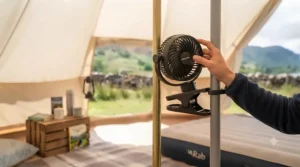
The standout feature of the gaiatop Portable Clip on Fan is its genuinely tight safety grille — just 5.5mm gaps, specifically engineered to keep small fingers out, which matters enormously if you’re pitching a family tent with toddlers underfoot. With a modest 2000mAh battery delivering between roughly 3.5 and 10 hours depending on speed selected, key specs here mean something specific in practice: this isn’t a fan for a week-long festival, but for a single warm night or a nap-time cooling boost, it’s more than adequate. The clip itself uses a sponge-padded clamp designed not to scratch tent poles or pram frames, and here’s what to weigh: the low battery capacity is a genuine limitation, but the compact size and low price make it an easy “throw it in just in case” addition to a family kit bag rather than a considered primary cooling solution. Reviewers consistently note the quiet operation as a strength, particularly appreciated by parents cooling a sleeping baby, with a recurring theme that the shorter runtime means it’s best paired with a power bank or a second fan for longer trips.
Pros:
- ✅ Child-safe 5.5mm grille suits family tents
- ✅ Genuinely quiet even on higher speeds
- ✅ Compact and light for minimal packing space
Cons:
- ❌ Short 3.5-10 hour runtime limits longer trips
- ❌ Not powerful enough for a large family tent
Priced firmly in the budget tier, typically under £15, it’s a sensible low-commitment addition rather than a standalone solution for extended camping.
3. KIMMOO Portable Clip on Fan — 100-speed precision control
Where most clip on fans offer three or four fixed speeds, the KIMMOO Portable Clip on Fan takes a different approach entirely with 100 individually selectable speed levels via touch control and an LED display showing exactly where you’ve landed. In practice, this granular control matters more than it sounds — the difference between “slightly stuffy” and “properly cold” in a tent can be a handful of speed increments, and fixed-speed fans often force an uncomfortable jump between “too gentle” and “too loud.” Battery life reaches up to 17 hours on a full charge, comfortably covering an overnight camp with charge to spare for the following evening if you’re not running it constantly. Based on the spec comparison with simpler rivals, the extra electronics driving the LED display and speed dial add a small premium to the price, but for anyone sharing a tent with someone who runs cold while they run hot, precise speed matching genuinely resolves the nightly thermostat argument. Aggregated feedback highlights the fine speed control and clear display as standout strengths, with occasional comments that the touch controls can be slightly fiddly to adjust in the dark without fumbling.
Pros:
- ✅ 100-speed control suits mismatched sleeping preferences
- ✅ Up to 17 hours runtime on a single charge
- ✅ Clear LED display shows speed and battery level
Cons:
- ❌ Touch controls fiddly to adjust in the dark
- ❌ Premium over simpler fixed-speed alternatives
Expect mid-range pricing, generally in a similar bracket to the Warmco above, reflecting the added electronics for speed precision.
4. Wudyfei 12000mAh Portable Clip on Fan — remote control for hands-free adjustment
The genuinely useful trick up the sleeve of the Wudyfei 12000mAh Portable Clip on Fan is its included remote control and timer — a small addition that solves a real annoyance, since reaching up to a fan clipped near the tent roof to change speed or switch off usually means sitting up and fumbling in the dark. With a 12000mAh battery, three speeds, and an integrated light, it’s built as a genuinely rounded night-time companion rather than a daytime-only cooling tool. What most buyers overlook about remote-equipped fans is battery drain from the remote’s own receiver circuit sitting idle — Wudyfei’s unit manages this reasonably well according to aggregated feedback, without a dramatic runtime penalty versus remote-free rivals of similar capacity. The timer function is a genuine transformation-level feature for tent use specifically: setting it to run for two or three hours as you fall asleep, rather than draining the battery all night, stretches usable nights per charge considerably on a longer trip. Reviewers consistently praise the silent operation and remote convenience, while a handful note the plastic clip mechanism feels less robust than the metal-reinforced clamps on pricier rivals.
Pros:
- ✅ Remote control avoids reaching up in the dark
- ✅ Built-in timer extends usable nights per charge
- ✅ Genuinely quiet operation for light sleepers
Cons:
- ❌ Plastic clip feels less robust than metal designs
- ❌ Remote adds a small extra item to lose
Mid-range pricing applies, broadly comparable to other 12000mAh remote-equipped fans in this category.
5. ELZO 12000mAh Camping Fan — dedicated hanging hook for awnings and porches
If your priority is a genuine tent fan with hook mounting rather than clip-only, the ELZO 12000mAh Camping Fan is built specifically around that use case, pairing a sturdy hanging hook with an LED light and full 360° rotation, plus remote control for hands-free adjustment. In practice, a proper hanging hook matters enormously for awning and porch areas where there’s often no accessible pole to clip onto, only a loop or guy-line to hang from — this is precisely where clip-only fans fall short and a hook-first design earns its place in the kit bag. The 12000mAh battery delivers a genuinely solid multi-night runtime on moderate speed settings, and the combined LED light means one less head torch fumbled for during a 3am toilet run. Based on the spec comparison with clip-only alternatives, the hook mechanism does add a small amount of bulk and swing-weight when the fan is running at higher speeds, so it’s worth checking your hanging point can bear a bit of gentle motion without pulling loose. Aggregated review sentiment consistently flags the hook design as the standout feature for awning and gazebo use specifically, with occasional notes that the remote’s range is shorter than advertised in practice.
Pros:
- ✅ Genuine hanging hook suits awnings and porches
- ✅ Combined LED light doubles as a mini lantern
- ✅ Remote control works well for bedside adjustment
Cons:
- ❌ Hook adds swing-weight at higher fan speeds
- ❌ Remote range shorter than advertised in practice
Sitting in the mid-range price bracket, it’s a strong pick specifically for anyone whose main tent setup includes a porch, awning or gazebo extension.
6. Koonie 10000mAh Clip on Fan — sturdy clamp built for repeated use
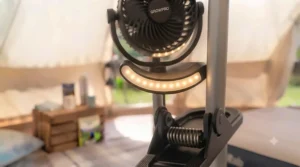
The Koonie 10000mAh Clip on Fan leans hard into durability, with a sturdy metal-reinforced clamp designed to survive repeated clipping and unclipping across a full camping season rather than a single trip. At 8 inches with four speeds and 360° rotation, key specs here translate directly into everyday reliability: a weak clip that slowly loosens over a summer of use is one of the most common failure points in this product category, and a genuinely strong clamp addresses that directly rather than relying on plastic tension alone. Here’s what to weigh: this isn’t the fan with the most bells and whistles on this list — no lantern, no remote — but for buyers who want a fan that will still clip firmly onto a tent pole in year three, that focus on mechanical durability is arguably the more valuable investment. Reviewers consistently note the strong clip and airflow as genuine strengths versus flimsier budget alternatives, with a smaller number commenting that the absence of a light or remote feels like a missed opportunity at this price point.
Pros:
- ✅ Metal-reinforced clamp built for repeated use
- ✅ Strong airflow across all four speed settings
- ✅ 10000mAh battery comfortably covers a weekend
Cons:
- ❌ No integrated light or lantern function
- ❌ No remote control for bedside adjustment
Mid-range pricing applies here, positioning it as a durability-first alternative to the more feature-heavy fans on this list.
7. Sumairs 5.5″ Clip on Fan with Power Bank — the long-trip, multi-role premium pick
Rounding out the seven is the Sumairs 5.5″ Clip on Fan with Power Bank, which solves the single biggest limitation of every fan above it: what happens when your phone dies three days into a festival with no mains power in sight. Its 10000mAh battery delivers up to 55 hours of fan runtime on lower speeds, and doubles as a genuine power bank via USB output, meaning the same unit that’s cooling your tent overnight can top up a phone or head torch during the day. In practice, this dual-purpose design changes the calculation for longer trips specifically — rather than packing a separate power bank and a separate fan, you’re carrying one device that covers both jobs, which matters when every gram in a festival rucksack is contested space. The included remote and LED light round out a genuinely well-specified unit, and the desk-or-hanging design means it adapts equally well to a tent pole, a festival gazebo hook, or a bedside table once you’re home. Based on the spec comparison with single-purpose alternatives, the trade-off is a higher upfront price, but for anyone doing multiple long trips a year rather than one weekend, the maths on carrying one device instead of two works out favourably. Aggregated feedback highlights the power bank function and long runtime as the clear standout, with occasional comments that charging the unit itself back up to full takes noticeably longer given its larger capacity.
Pros:
- ✅ Doubles as a genuine phone power bank
- ✅ Up to 55 hours runtime on lower speeds
- ✅ Works as clip, hanging, or desk fan
Cons:
- ❌ Higher upfront price than single-purpose fans
- ❌ Longer recharge time given its larger capacity
Premium pricing applies, generally the highest of the seven, but justified for anyone doing regular multi-day trips where dual fan-and-power-bank function genuinely earns its keep.
Best Clip On Camping Fan by Trip Type: A Quick Decision Guide
Working out the best clip on camping fan for your situation genuinely comes down to trip length and tent type more than any single spec. For a single overnight or occasional weekend camper, the gaiatop Portable Clip on Fan covers the need without over-spending on capacity you won’t use. For a couple sharing a two-to-three-person tent on a standard weekend break, the KIMMOO Portable Clip on Fan or Wudyfei 12000mAh Portable Clip on Fan strike a sensible balance of runtime and useful extras like remote control. For a family tent with a porch or awning area, the ELZO 12000mAh Camping Fan‘s dedicated hook makes it the natural pick for cooling communal space rather than just a sleeping pod. And for festival-goers or anyone doing extended multi-day trips without reliable mains access, the Sumairs 5.5″ Clip on Fan with Power Bank genuinely earns its higher price through dual fan-and-charging function.
✨ Don’t Miss These Exclusive Deals!
🔍 Ready to stop tossing and turning on your next camping trip? Compare current prices on any of the seven clip on fans above and check availability before your next getaway — a cool night’s sleep starts with the right kit!
Practical Usage Guide: Setting Up Your Tent Fan for the First Few Trips
Getting genuine benefit from a clip on fan for tent use comes down to positioning as much as the fan itself. Clip it high, near the apex of the tent or on a cross-pole close to the roof, rather than low near the groundsheet — warm air rises and pools near the ceiling first, so positioning the fan there lets it circulate that trapped warm layer down and out through a partially open door or vent, rather than simply stirring already-cool air near the floor. Angle the fan slightly toward a ventilation point rather than directly at a sleeping bag if you’re using it to actively clear stuffy air rather than just create a personal breeze; for direct cooling on a specific person, angle it more toward the sleeping area instead.
Charge fully before you leave home, and where possible bring the fan’s specific charging cable rather than assuming a generic USB-C lead will work at full speed — mismatched cables can dramatically slow charging without throwing an obvious error. In the first few trips, get a feel for realistic runtime at the speed you actually use, rather than trusting the maximum-hours figure on the box, since that number is almost always measured on the lowest speed setting rather than the “actually moving air” setting you’ll use on a genuinely hot night. Finally, wipe down the clip and blades after a dusty or sandy trip — grit in the pivot mechanism is one of the most common causes of a clip fan’s motor wearing out early, and it takes thirty seconds with a damp cloth to prevent.
Tent Fan with Hook: When You Need More Than a Clip
A tent fan with hook mounting solves a specific problem that a clip-only design simply can’t: what to do when there’s no accessible pole, only a loop, guy-line, or awning frame to hang from. Family tents with a separate porch area, bell tents with a central hanging loop, and gazebo-style awnings all favour a hook far more than a clamp, since the mounting point in these structures is frequently a fabric loop rather than a rigid pole. The ELZO 12000mAh Camping Fan on our list above is purpose-built around this exact scenario, and it’s worth checking your own tent’s internal structure before assuming a clip-only fan will find somewhere secure to attach.
Hooks do introduce one consideration clips don’t: swing and sway at higher fan speeds, since a hanging fan has more freedom of movement than one rigidly clamped to a pole. For genuinely windy pitches or a fan run consistently on its highest setting, a shorter hanging drop reduces this considerably, keeping the unit closer to its anchor point and less prone to knocking against tent fabric overnight.
Space Saving Camping Gear: Where a Clip On Fan Genuinely Wins
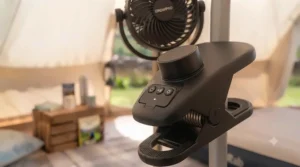
Compared to a standalone pedestal or box fan, a clip on fan for tent use is a genuine space saving camping gear win, and it’s worth being specific about why. A typical clip fan packs down to roughly the size of a large mug, clips flat against gear during transport, and needs zero dedicated floor space once pitched — it simply attaches to structure you’re already bringing. A box fan, by contrast, demands its own footprint on already-limited tent floor, competes with sleeping mats and bags for space, and often needs mains power that most tents simply don’t have access to.
This space efficiency compounds when you’re already tight on room — family tents with multiple sleeping pods, festival setups where every item has to fit in one rucksack, or motorbike touring where panniers dictate hard limits on what comes at all. Choosing gear that mounts to existing structure rather than needing its own dedicated space is a principle worth applying beyond fans too: collapsible items, stackable containers, and anything that clips or hangs rather than sits on the floor consistently earns its place in a genuinely space-conscious kit list.
Family Tent Accessories: Building a Cooling System, Not Just a Fan
A single clip on fan rarely fully solves a family tent’s cooling needs on its own, and the more useful approach is thinking of it as one piece of a broader family tent accessories cooling system. Reflective sunshades or a light-coloured rain fly reduce how much heat the tent absorbs during the day in the first place, which matters more than any fan’s cooling power once temperatures climb — a tent that’s absorbed hours of direct sun starts several degrees hotter than the outside air regardless of what’s circulating inside it. Ground-level cooling mats, designed to draw heat away from a sleeping body through contact rather than airflow, work well alongside a fan rather than instead of one, particularly for younger children who kick off bedding regardless of how carefully you tuck them in.
For families specifically, positioning matters as much as equipment: pitching with the tent door facing away from prevailing sun and toward any regular evening breeze does more for genuine cooling than a second fan ever will. The Camping and Caravanning Club’s advice for staying cool while camping in hot weather covers useful pitching and ventilation strategies worth reading alongside any fan purchase, available via their camping tips advice hub, and it’s a genuinely good habit to check general hot-weather health guidance too — the NHS’s advice on coping with a heatwave, including guidance specifically relevant to children and vulnerable family members, is worth a read before any summer trip, available on the NHS heatwave advice page.
Tent Organisation Tips: Where the Fan Actually Lives in Your Kit
Good tent organisation tips make the difference between a fan that gets used every single night and one that ends up buried under a pile of jumpers by day three. Assign the fan a fixed “home” position on the tent pole or hook from the moment you pitch, rather than repositioning it nightly — consistency means everyone in the tent knows exactly where it is in the dark, and it reduces the temptation to unclip it during the day “just to move it out of the way,” which is precisely when these small items go missing at a campsite.
Keep the charging cable, any remote control, and spare batteries together in a single small pouch rather than loose in a bag — a fan with a flat battery and a cable buried somewhere in the boot is functionally useless at 11pm on a hot night. If you’re travelling with more than one fan across a family tent’s separate sleeping pods, label them or use different coloured units if available, since generic black clip fans are remarkably easy to mix up between compartments. Finally, build the fan into your pack-down routine the same way you would a torch or first aid kit — a five-second mental checklist item at both ends of a trip prevents it becoming the one thing left clipped to a pole at an empty campsite on Monday morning.
How to Choose a Clip On Fan for Tent Use
- Check your tent’s mounting points first. Poles suit a standard clip; loops, guy-lines and awning frames need a genuine hook — confirm which your tent actually offers before choosing a fan style.
- Match battery capacity to trip length. A single overnight needs only 2000-5000mAh; multi-night trips or festivals justify 10000mAh or higher for genuine peace of mind.
- Prioritise noise level if you’re a light sleeper. Aggregated reviews consistently flag which models run quieter — worth checking specifically if sharing close quarters.
- Decide whether extra functions genuinely help you. A remote, timer, or built-in light are all useful, but each adds cost and a small amount of bulk — only pay for what you’ll actually use.
- Consider dual-purpose value for longer trips. A power bank function, like on the Sumairs model above, can offset a higher price if you’re regularly away from mains power for days at a time.
- Check clip strength and build quality, not just speeds. A weak clip is the single most common failure point in this category regardless of how many speed settings a fan offers.
- Factor in charging speed alongside runtime. A fan with a huge battery but painfully slow charging can be less practical day-to-day than a smaller, faster-charging alternative.
Common Mistakes When Buying a Clip On Fan for Camping
The most common mistake is buying based purely on the highest advertised runtime figure without checking what speed that figure was measured at — a “65 hours” claim almost always refers to the lowest, weakest setting, not the speed you’ll actually run on a genuinely hot night. A close second is assuming any clip will fit any tent pole; oversized or particularly slim poles can defeat a clip that works fine on a standard diameter, so checking maximum clip opening width against your specific tent’s poles avoids a frustrating surprise at the campsite. Buyers also frequently overlook noise level entirely, focusing on airflow strength and speed count while ignoring that a genuinely loud fan can undermine the very sleep quality it’s meant to protect.
Charging cable compatibility catches people out too — arriving at a festival with a fan that needs a specific proprietary cable you didn’t pack renders even the best unit useless for the whole trip. Finally, many buyers skip checking the actual dimensions and weight of a fan against their existing pack list, only to find at the campsite that “small and portable” on the listing still meant carving out space that wasn’t really there.
Long-Term Value: Charging, Storage and Battery Care
Lithium-ion batteries, which power essentially every fan on this list, have specific care requirements worth understanding rather than ignoring. Charging on a hard, non-flammable surface, never leaving a fan charging unattended overnight, and using the charger originally supplied rather than a mismatched generic one are all genuinely important safety practices rather than overcautious box-ticking — full guidance on safe charging and storage is available from the UK charity Electrical Safety First’s lithium-ion battery guidance, and it’s worth a genuine read before your first trip with a new fan, not just a skim.
For storage between camping seasons, keep any clip on fan partially charged — roughly 40-60% — rather than fully depleted or left at 100% for months at a time, since both extremes accelerate long-term battery degradation. Store it somewhere dry and at a moderate, stable temperature; a fan left in a hot car boot or a damp shed over winter will noticeably underperform by the following summer compared with one stored indoors. A quick top-up charge before each new season, rather than assuming last year’s charge level has held, takes minutes and avoids the classic first-night-of-the-trip disappointment of a fan that won’t switch on.
Frequently Asked Questions
❓ What is the best clip on camping fan for a family tent?
❓ How long does a clip on fan for tent use actually last on one charge?
❓ Can a clip on fan attach to any tent pole?
❓ Is it safe to charge a camping fan overnight in a tent?
❓ Do clip on fans work well in humid or damp tents?
Conclusion
A clip on fan for tent use is one of those small purchases that punches well above its price in actual comfort delivered — the difference between a genuinely restful night’s sleep and a sweaty, restless one often comes down to little more than moving the air around you. Whether you land on the budget-friendly gaiatop Portable Clip on Fan for occasional weekends, the hook-equipped ELZO 12000mAh Camping Fan for a family setup with an awning, or the power-bank-equipped Sumairs 5.5″ Clip on Fan for genuinely long trips off-grid, the right choice comes down to matching runtime, mounting style, and extra features to how you actually camp rather than chasing the flashiest spec sheet.
Pair whichever fan you choose with sensible pitching, a proper tent organisation system, and basic battery care, and you’ll get years of reliable use rather than a single hot-weekend rescue purchase that dies quietly in a drawer by autumn. Stay hydrated, keep an eye on genuine heat safety guidance for anyone vulnerable in your group, and treat a good fan as one part of a broader cooling strategy rather than a single magic fix.
✨ Don’t Miss These Exclusive Deals!
🔍 Take your next camping trip from sweaty to comfortable. Click through on any of the seven clip on fans above to check current pricing and availability, and pack a genuinely cool night’s sleep this season! 🌬️
Recommended for You
- Rechargeable tent fan UK 2026: 7 Best Picks That Won’t Die at 3am
- Battery Powered Tent Fan: 7 Best Cordless Picks for 2026
- Best Tent Fan UK 2026: 7 Camping Fans That Actually Cool You
Disclaimer: This article contains affiliate links. As an Amazon Associate, I earn from qualifying purchases. If you purchase products through these links, we may earn a small commission at no additional cost to you.
✨ Found this helpful? Share it with your friends! 💬🤗
