
In This Article
If you’ve ever woken at 3 AM to the sound of your tent flysheet flapping like a distressed seagull in a Welsh valley gale, you’ll know the stakes are rather high when it comes to choosing proper ground anchors. The screw pegs vs straight pegs debate isn’t just academic chitchat for camping forums — it’s the difference between sleeping soundly through a Lake District squall and spending the night clutching tent poles whilst praying to the weather gods.
After testing dozens of tent pegs across every conceivable British ground condition — from the waterlogged meadows of Somerset to the granite-hard pitches of Scottish campsites — I’ve learned that the “best” peg depends entirely on where you’re pitching. Screw pegs twist into compacted soil like a corkscrew through cheese, whilst straight pegs excel in softer conditions where surface area matters more than penetration depth. The trick is knowing which design matches your camping style, and more importantly, the temperamental British ground beneath your feet.
What most campers overlook is this: the thin wire pegs that come free with budget tents are essentially decorative. They’ll hold down a groundsheet on a calm Tuesday in July, but ask them to secure a family tent during an October storm and they’ll bend faster than a politician’s promise. According to WildBounds’ comprehensive guide to tent pegs, the right pegs — whether spiral augers or hardened steel stakes — are the unsung heroes of outdoor comfort, yet they’re often the last thing people upgrade in their kit. Rather foolish, when you consider they’re literally the foundation of your temporary home.
Quick Comparison Table
| Feature | Screw Pegs | Straight Pegs |
|---|---|---|
| Best Ground Type | Hard, compacted, stony | Soft to medium, grass |
| Installation | Twist/drill (slower) | Hammer (faster) |
| Holding Power | Excellent in hard ground | Excellent in soft ground |
| UK Weather Suitability | Superior in wind/wet | Good in moderate conditions |
| Typical Price Range | £15-£35 for 10-20 pegs | £8-£20 for 20 pegs |
| Weight | Medium (15-25g each) | Light to heavy (8-30g) |
| Removal Effort | Moderate (twist out) | Easy to moderate |
| Best For UK Campers | Year-round, exposed sites | Summer, sheltered sites |
From the comparison above, screw pegs emerge as the more versatile choice for unpredictable British camping. Their spiral design grips compacted soil and stony ground far better than straight alternatives, which is precisely what you need when pitching on a hardstanding at a Peak District campsite in February. That said, straight pegs — particularly Y-beam or V-profile designs — offer superior surface area in softer conditions, making them brilliant for those rare weekends when British soil actually behaves itself. The real winners carry both types and deploy strategically: screw pegs for main guy lines facing prevailing winds, straight pegs for secondary attachment points in less critical positions.
💬Just one click — help others make better buying decisions too!😊
Top 7 Screw Pegs vs Straight Pegs: Expert Analysis
1. Blue Diamond Heavy Duty Screw Tent Pegs — Workhouse for Harsh British Ground
The Blue Diamond Heavy Duty Screw Tent Pegs have earned their reputation as the go-to choice for British campers who refuse to faff about with flimsy hardware. These 20cm galvanised steel augers feature a proper corkscrew design that bites into compacted soil, gravel pitches, and even moderately stony ground with the determination of a terrier after a rabbit. The rotating plastic cap at the top allows you to twist them in by hand or use the included socket adapter with a cordless drill — the latter method transforms what would be a knuckle-scraping ordeal into a 30-second job.
What sets these apart in British conditions is their rust-resistant galvanised coating, rather important when you’re camping in a climate where “dry weather” means it’s only drizzling. The 20cm length provides sufficient bite in most UK campsite soil without being so long that you’ll struggle to get them fully seated. At around £20-£25 for a pack of 20, they represent excellent value compared to premium alternatives that cost twice as much for marginal improvements. UK reviewers consistently praise their performance on hardstanding pitches — the sort of compacted gravel surfaces common at motorhome-friendly campsites where traditional straight pegs simply bounce off the ground.
Customer feedback from British buyers highlights two consistent themes: they actually work in stony ground where nothing else will penetrate, and they’re heavy enough to feel confidence-inspiring without turning your camping kit into a gym workout. Several Lake District wild campers report using them for critical guy lines on exposed ridges, pairing them with lighter straight pegs for less wind-stressed attachment points.
Pros:
✅ Excellent grip in hard, compacted, and stony UK ground
✅ Rust-resistant galvanised steel coating — essential for damp British climate
✅ Socket adapter included for power drill installation
Cons:
❌ Heavier than ultralight alternatives (not ideal for long-distance backpacking)
❌ Plastic caps can crack with aggressive hammering (use twisting motion instead)
Price & Verdict: Around £20-£25 for 20 pegs. Best value for UK campers who frequently encounter hardstanding or compacted pitches. Particularly well-suited to coastal sites, moorland camping, and winter use when ground freezes solid.
2. Adventure Peaks Screw Tent Pegs Set — Drill-Ready for Quick Pitching
The Adventure Peaks Screw Tent Pegs Set takes the hassle out of installing screw pegs with its clever 13mm hex head and rotatable cap design. These steel spiral stakes are specifically engineered for British camping conditions, where you might pitch on anything from waterlogged Pennine peat to sun-baked chalk downs within the same summer holiday. The package includes 12 rust-resistant pegs and a hex drill adaptor, making them ideal for campers who value speed over the satisfaction of manual labour.
In practical UK terms, these excel on the sort of ground that makes traditional pegs weep — those horrible compacted gravel hardstandings at family campsites, stony coastal pitches in Cornwall, or the packed earth you’ll find at popular wild camping spots after thousands of previous visitors have trampled the soil into concrete. The rotatable head means you can still adjust tension on guy lines without unscrewing the entire peg, a thoughtful detail that becomes rather useful when fine-tuning your pitch after the tent fabric has settled overnight. They’re particularly popular with caravan owners and large tent users who need serious holding power for awnings and extensions.
British reviewers note these perform brilliantly in wet conditions — the spiral design actually grips better in damp soil than dry, which is convenient given our national weather patterns. The £25-£30 price point sits in the middle ground between budget and premium, offering professional-grade performance without the eye-watering cost of titanium alternatives.
Pros:
✅ Hex head design works perfectly with cordless drills — fast installation
✅ Rotatable caps allow guy line adjustment without removal
✅ Rust-resistant coating handles perpetually damp British conditions
Cons:
❌ Slightly heavier than non-rotating alternatives
❌ Drill adapter magnetic grip could be stronger for very hard ground
Price & Verdict: Around £25-£30 for 12 pegs with hex adapter. Perfect for car campers, families, and anyone camping on established UK sites with compacted pitches. The drill-ready design makes them worth every penny if you’re setting up large tents or awnings regularly.
3. Vango Groundbreaker Glow Peg Set — Visibility Meets Performance
Vango Groundbreaker Glow Peg Set addresses a problem every British camper has encountered: trying to locate tent pegs in the dark whilst stumbling back from the toilet block. These 20.5cm steel pegs combine serious holding power with reflective caps that catch torchlight, turning potential ankle-twisting hazards into visible markers. They’re designed specifically for rougher UK ground and heavier tents — think family-sized domes and large awnings rather than ultralight backpacking shelters.
The straight V-profile design provides good surface area for grip whilst maintaining sufficient strength to hammer through moderately stony soil without bending. In the typically wet British camping season, these perform admirably in waterlogged grass and muddy conditions where wider surface area helps prevent the peg from pulling straight through saturated soil. The included storage case and peg extractor are genuinely useful additions rather than marketing gimmicks — the extractor particularly earns its keep when removing pegs from clay-heavy ground after several days of rain have created a vacuum seal.
What British campers appreciate most is the brand reliability; Vango has been supplying UK outdoor enthusiasts for over 50 years and their products are designed with local conditions in mind. These aren’t trying to be the absolute lightest or strongest — they’re optimised for the middle ground most UK family campers actually need. At around £15-£18 for the complete set, they represent solid value for occasional campers who want quality without bankrupting themselves.
Pros:
✅ Reflective glow caps prevent trips and make pegs easy to find at night
✅ Strong enough for family tents and awnings in British weather
✅ Included peg extractor and storage case add genuine convenience
Cons:
❌ Not ideal for extremely hard or rocky ground (bend easier than screw types)
❌ Slightly bulkier storage compared to minimalist peg sets
Price & Verdict: Around £15-£18 for 20 pegs with extractor and case. Excellent for family camping, festival-goers, and anyone who camps on grass or moderately firm UK pitches. The visibility feature alone justifies the modest premium over basic steel stakes.
4. TIMBER RIDGE Spiral Thread Steel Tent Pegs — Budget-Friendly Screw Design
The TIMBER RIDGE Spiral Thread Steel Tent Pegs prove you don’t need to spend a fortune to get decent screw peg performance on British campsites. These 10 galvanised steel augers feature a classic spiral thread design that grips hard ground effectively, though they lack some of the refinements found on pricier alternatives. At roughly £12-£15 for a pack of 10, they’re positioned perfectly for campers who want the advantages of screw pegs without the investment required for premium brands.
In real-world UK conditions, these perform surprisingly well considering their modest price. They handle typical campsite hardstanding adequately, twist into compacted moorland soil without excessive struggle, and show decent rust resistance after exposure to our enthusiastically damp climate. The steel construction means they’re heavier than aluminium alternatives, but for car campers and weekend warriors who aren’t counting every gram, the extra weight translates to reassuring solidity. Several British reviewers note they’ve used the same set for multiple seasons without significant degradation — rather impressive longevity at this price point.
Where they show their budget roots is in the finishing details. The caps aren’t as smoothly rotating as more expensive options, meaning installation requires a bit more elbow grease. They also lack the drill adapter that higher-end sets include, so you’re committed to manual installation unless you fabricate your own solution. For occasional campers or those building up their first proper peg collection, these represent sensible value — you can always upgrade to premium pegs later for critical applications whilst keeping these as reliable backups.
Pros:
✅ Affordable entry point into screw peg performance (around £12-£15)
✅ Adequate rust resistance for UK weather conditions
✅ Solid steel construction won’t fail in moderate use
Cons:
❌ Manual installation only — no drill adapter included
❌ Cap rotation less smooth than premium alternatives
Price & Verdict: Around £12-£15 for 10 pegs. Best for budget-conscious campers, beginners building their first kit, or experienced hands wanting reliable backup pegs. They won’t win design awards but they’ll keep your tent anchored through a British summer without complaint.
5. Trail 20 Screw Tent Pegs with Magnetic Adaptor — Complete Hardstanding Solution
The Trail 20 Screw Tent Pegs with Magnetic Adaptor arrive as a comprehensive package designed specifically for the challenge of hard, stony ground and gravel pitches — exactly what you’ll encounter at countless UK campsites. These 22cm steel screws come with a magnetic bolt head adaptor, compact mallet, and bright orange storage bag with carabiner clip. The magnetic adaptor is genuinely well-designed; it grips the hex head firmly enough for power drill installation whilst releasing cleanly when you need to remove it.
What makes these particularly suited to British camping is their length and thread design. At 22cm, they’re long enough to provide excellent holding power once seated, but not so extended that you’ll struggle to drive them fully into the ground. The thread pattern is aggressive enough to bite into compacted soil and gravel without being so coarse that it requires excessive force to install. For campers who frequent coastal sites where gravel hardstanding is standard, or moorland locations where centuries of sheep grazing have compacted the soil into something resembling concrete, these are rather brilliant.
The inclusion of a compact mallet means you’re covered for softer ground where twisting installation isn’t practical — a genuine advantage in variable British conditions where your pitch might have pockets of both hard and soft soil. UK reviewers particularly appreciate the bright orange storage bag, which proves far more practical than the rigid plastic cases many manufacturers provide. You can easily clip it to your belt whilst moving around the pitch, accessing pegs as needed without returning to your car.
Pros:
✅ Complete kit includes magnetic adaptor, mallet, and practical storage
✅ 22cm length provides excellent holding power in UK ground
✅ Bright orange bag prevents loss and makes pegs visible
Cons:
❌ Slightly heavier complete package (consider if backpacking long distances)
❌ Magnetic adaptor grip could be stronger for extremely compacted ground
Price & Verdict: Around £18-£22 for complete 20-peg set with accessories. Outstanding value for car campers and families who regularly encounter hardstanding pitches. The complete package approach means you won’t need to hunt for compatible accessories separately.
6. Smith & Barker Heavy Duty Galvanised J Pegs — Classic Straight Stakes Done Right
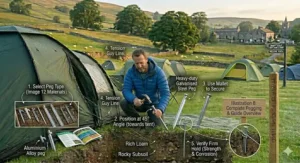
Sometimes you don’t need clever spiral designs or high-tech coatings — you just need a properly made straight peg that won’t bend, rust, or let you down. The Smith & Barker Heavy Duty Galvanised J Pegs deliver exactly that proposition. These traditional J-shaped steel stakes measure 23cm and feature thick 8mm diameter construction that can take a proper hammering without deforming. They’re the sort of pegs your grandfather might recognise, updated with modern galvanised coating to handle British weather.
In soft to medium UK ground — the loamy soil of English campsites, the peaty earth of Scottish highlands, or the clay-heavy pitches of Wales — these straight pegs offer excellent performance. Their J-hook design provides a secure anchor point for guy lines whilst the thick steel construction drives through moderately firm soil without bending. Where screw pegs excel in hard ground, these dominate in conditions where surface area matters more than thread penetration. They’re also considerably faster to install than spiral alternatives; a few confident mallet strikes and you’re done, no twisting required.
British campers value their simplicity and reliability. Unlike complicated designs with moving parts or special installation requirements, these are utterly straightforward: hammer in at 45 degrees, attach your guy line, job done. They’re particularly popular with groups and families who camp together regularly, as everyone instinctively knows how to use them without instruction. At around £12-£15 for a pack of 8, they represent traditional British value — paying for quality materials and construction rather than marketing gimmicks.
Pros:
✅ Thick 8mm steel construction resists bending in normal use
✅ Fast installation with standard camping mallet
✅ Galvanised coating handles perpetually damp British conditions
Cons:
❌ Struggle in extremely hard or stony ground (screw pegs perform better)
❌ Heavier than modern ultralight alternatives
Price & Verdict: Around £12-£15 for 8 pegs. Ideal for traditional campers, scout groups, and families who value proven designs over innovation. Particularly well-suited to established UK campsites with prepared grass pitches rather than hardstanding.
7. MSR Groundhog Tent Stakes — Premium Y-Beam Performance
The MSR Groundhog Tent Stakes represent the premium end of straight peg design, utilising a Y-beam aluminium construction that maximises strength whilst minimising weight. These 19cm stakes are engineered to an almost obsessive degree, with 7075-series aluminium providing exceptional durability and a profile designed for optimal holding power across varied ground conditions. At around £18-£22 for a pack of 6, they’re definitely not budget pegs — but for serious UK backpackers and wild campers, they’re worth every penny.
What makes the Y-beam design clever is how it distributes forces. Traditional round or flat pegs concentrate stress in limited areas, leading to bending or failure. The Y-profile spreads loads across three planes, creating remarkable resistance to deformation whilst maintaining relatively light weight (11g each). In practical British terms, this means they’ll penetrate woodland soil and pine needle ground effectively, grip well in peaty Scottish highlands, and hold firm in the sort of wet, sloppy conditions that plague UK camping from October through March.
British wild campers particularly appreciate their versatility. Unlike specialised screw pegs that excel in one condition but struggle elsewhere, these perform admirably across the full spectrum of UK ground types except pure rock. The bright colour and reflective cord attachment mean you’ll actually be able to find them again after dark — a genuine concern when wild camping in remote locations. American-made but thoroughly proven in harsh UK conditions, they’re the peg serious outdoor folk reach for when failure simply isn’t acceptable.
Pros:
✅ Y-beam design provides exceptional strength-to-weight ratio
✅ Versatile performance across most UK ground conditions
✅ Reflective cord and bright colour aid visibility
Cons:
❌ Premium pricing (around £3-£4 per peg)
❌ Still struggle in extremely hard or stony ground compared to screw types
Price & Verdict: Around £18-£22 for 6 pegs. Best for dedicated backpackers, wild campers, and outdoor enthusiasts who demand professional-grade equipment. The weight savings and reliability justify the premium cost if you’re carrying pegs up Scottish mountains or across Pennine moorland.
Installation Guide: Maximising Holding Power in British Conditions
Getting tent pegs to actually stay put in British ground requires more than simply bashing them into the soil and hoping for the best. The difference between a secure pitch and a midnight tent collapse often comes down to technique rather than equipment quality.
Screw Peg Installation for UK Ground
Start by assessing the ground hardness with a test peg before committing to your full pitch. British soil varies wildly — you might encounter compacted gravel on one side of your pitch and waterlogged peat three metres away. For genuinely hard ground, a cordless drill with hex adapter transforms screw peg installation from knuckle-scraping torture into a 20-second job. Position the peg at your desired angle (typically 45-60 degrees away from the tent), engage the drill at medium speed, and let the auger do the work. Don’t force it — if you hit solid resistance, you’ve probably encountered a buried rock, so shift position slightly rather than risk stripping the threads.
In moderately firm soil without drill assistance, the two-hand twist method works brilliantly. Grasp the peg firmly with both hands, position at your desired angle, and rotate steadily whilst applying downward pressure. The spiral thread should bite and pull itself into the ground — if it’s just spinning without penetrating, the ground is too hard for manual installation. For wet, peaty conditions common in Scottish highlands and Welsh valleys, screw pegs actually grip better than in dry soil as the moisture helps compact the peat around the threads. Drive them slightly deeper than you’d think necessary; settling overnight often means guy lines need re-tensioning come morning.
Straight Peg Installation Best Practices
Straight pegs demand respect for basic physics: they work by friction and surface area, not mechanical thread grip. The cardinal sin is hammering them vertically into the ground — whilst this looks tidy, it provides minimal resistance to the pulling force of tensioned guy lines. Instead, position at 45-60 degrees away from the tent, with the peg angled back towards the structure you’re securing. This angle means any pulling force drives the peg deeper rather than levering it out.
Use a proper camping mallet, not a rock or boot heel. Those expedient alternatives work until they don’t, usually leaving you with bent pegs or bruised feet. Strike firmly but not frantically — three or four confident blows should seat a straight peg properly in most UK soil. In clay-heavy ground after rain (common across much of southern England), you’ll feel the peg seat with a satisfying ‘thunk’ as it reaches purchase. Leave 3-5cm of the peg above ground for the guy line attachment and future extraction. Too deep and you’ll struggle to remove them; too shallow and they’ll work loose under tension.
UK Weather Considerations
British weather adds complications American camping guides never mention. In waterlogged conditions — which describes roughly half the UK camping calendar — standard installation depth isn’t enough. Saturated soil loses structural integrity, meaning pegs can pull through softened ground like a knife through butter. Drive pegs 2-3cm deeper than usual and consider repositioning critical guy lines to use two pegs in a V-pattern for main wind-facing attachment points. After heavy rain, re-check all pegs before retiring for the night; settlement and ground movement can slacken tensions significantly.
Winter camping presents the opposite challenge. Frozen ground becomes remarkably similar to concrete, and attempting to hammer straight pegs through frost-hardened soil is an exercise in futility and peg destruction. This is where screw pegs truly earn their keep — you can drill through frozen top layers into more forgiving soil beneath. If you’re committed to straight pegs in winter, choose spots where afternoon sun has warmed the ground, or pour warm water on installation points to temporarily soften the surface layer (caveat: this creates ice patches overnight, so mark them clearly).
Common Mistakes When Choosing Between Screw Pegs vs Straight Pegs
Mistake 1: Buying Based on Price Rather Than Ground Conditions
The cheapest tent pegs on Amazon.co.uk usually cost around £5 for 50 pieces of wire rubbish that’ll bend if you look at them sternly. Seasoned British campers have all made this false economy at some point, convinced that “a peg is a peg” and spending proper money on ground anchors is somehow excessive. Then you pitch at a windy coastal site, watch those bargain pegs bend like paperclips, and end up driving to the nearest camping shop at 9 PM to buy replacements at inflated tourist prices.
The truth is this: investing £15-£30 in quality pegs appropriate for your typical camping conditions saves money long-term and prevents the special misery of watching your tent transform into a parachute. If you predominantly camp at established UK sites with compacted or gravelly pitches, screw pegs are non-negotiable. If you’re a fair-weather camper visiting grassy summer sites, quality straight pegs suffice. Trying to save a tenner by buying the wrong type for your conditions is what accountants call “penny wise, pound foolish” and what experienced campers call “learning the hard way.”
Mistake 2: Using Identical Pegs for Every Attachment Point
Your tent doesn’t experience uniform forces across all guy lines and attachment points. The windward side takes a battering whilst leeward pegs might be almost relaxed. The corners bear significant load from fabric tension whilst intermediate points along the sides do relatively little work. Yet most campers hammer in identical pegs at every location, treating a nuanced engineering problem like a one-size-fits-all scenario.
Smart British campers carry a mixed arsenal: heavy-duty screw pegs for the 4-6 critical points facing prevailing winds (typically southwest in most of the UK), quality straight pegs for corners and secondary guy lines, and lighter pegs for less critical applications like groundsheet edges. This approach saves weight compared to using premium pegs everywhere whilst maintaining security where it actually matters. It also means you’re not trying to twist screw pegs into soft ground where straight pegs would work better, or hammering straight pegs into hardstanding where they’re destined to fail.
Mistake 3: Ignoring UK-Specific Ground Realities
American camping guides wax lyrical about sandy desert pitches and Rocky Mountain granite — neither of which bears much resemblance to British camping ground. Our soil is fundamentally different: wetter, often clay-heavy, prone to waterlogging, and frequently compacted from centuries of use. Recommendations designed for Colorado don’t necessarily translate to Cumbria.
British campers need to think about moorland peat (which can be deceptively soft on top and rock-hard beneath), coastal chalk (which may look firm but crumbles under certain pegs), clay-heavy soil that becomes almost concrete when dry but turns to sticky porridge when wet, and the compacted gravel hardstanding common at family campsites. Screw pegs generally outperform straight alternatives in our conditions, but only if you choose designs that won’t rust within one damp season — which, given our climate, means almost immediately.
Mistake 4: Inadequate Angle and Depth
This fundamental error spans both screw and straight pegs: people install them too vertically and too shallow because it looks neater and takes less effort. Physics doesn’t care about aesthetics. A peg driven straight down might as well be a lollipop stick for all the holding power it provides against lateral forces.
The optimal angle is 45-60 degrees away from whatever you’re anchoring, positioned so the guy line pull drives the peg deeper rather than levering it out. Depth matters too — that final extra push that seats a peg properly makes the difference between holding through a storm and pulling loose at 3 AM. In British soil, which often has distinct layers (turf, topsoil, subsoil), you want to penetrate through the loose surface material into more compacted layers beneath. This frequently means driving pegs deeper than feels necessary, especially in autumn and winter when ground moisture increases.
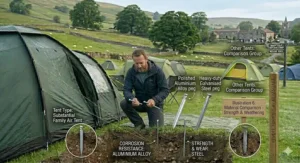
Screw Peg vs Straight Peg Performance: UK Ground Conditions
Compacted Gravel and Hardstanding (Winner: Screw Pegs)
Compacted gravel hardstanding pitches are ubiquitous at family-friendly UK campsites, caravan parks, and coastal locations. These surfaces are specifically designed to prevent motorhomes and caravans from churning grass into mud during wet weather — which in Britain means approximately 200 days per year. For tent campers, they represent a proper challenge. Straight pegs simply bounce off or bend on impact; even heavy-duty steel stakes struggle to penetrate more than a few centimetres before hitting immovable resistance.
Screw pegs transform this scenario completely. The auger design allows them to work their way between gravel particles, finding purchase in the compacted soil beneath. With a cordless drill and hex adapter, you can install them in seconds per peg rather than minutes of frustration. The thread pattern grips the gravel matrix, creating excellent holding power even in shallow installation (though you should still aim for full depth where possible). British coastal campers who regularly pitch on shingle or compacted sand report screw pegs as essential equipment, not optional extras.
Waterlogged Grass and Peaty Soil (Winner: Screw Pegs)
Anyone who’s camped in Scotland, the Lake District, or Welsh valleys during autumn knows that “waterlogged” isn’t a warning — it’s a baseline description. British peat and saturated grass present unique challenges: soft enough that pegs slide in easily, but so lacking in structural integrity that they pull straight out under moderate tension. Straight pegs, even quality V-beam designs, struggle to find purchase in ground that’s essentially porridge consistency.
Screw pegs excel here because their spiral threads compact soggy material as they twist in, creating their own grip rather than relying on the soil’s natural friction. The threading essentially wrings water out of the immediate vicinity, improving hold even in conditions that seem impossible. They also resist the “corkscrew effect” that plagues straight pegs in wet soil — where peg rotation under guy line tension gradually unscrews them from the ground. UK mountain rescue teams and outdoor instructors operating in perpetually damp conditions almost universally prefer screw designs for critical shelter guy lines.
Firm Grass and Loamy Soil (Tie: Both Perform Well)
This represents the ideal British camping ground — the sort of pitch you encounter at well-maintained campsites during the brief window of summer when the ground is neither frozen solid nor waterlogged. Both screw and straight pegs perform admirably here, which is fortunate because it’s the condition most recreational British campers encounter during peak season (roughly June through August in good years).
Straight pegs have a slight edge in installation speed — a few confident mallet strikes versus the twisting motion required for screw types. Quality Y-beam or V-profile straight pegs provide excellent surface area and holding power in these conditions. However, screw pegs aren’t notably inferior; they’re just slightly slower to install without meaningful performance benefits. The deciding factor becomes personal preference and what you already own. If you’re building a kit from scratch, screw pegs make sense because they’ll handle both ideal and challenging conditions. If you exclusively camp during summer on established grass pitches, quality straight pegs are perfectly adequate and somewhat lighter.
Rocky and Stony Ground (Winner: Depends on Rock Type)
This requires nuance that most guides overlook. British “rocky” ground comes in wildly different varieties. Scattered stones embedded in compacted soil — common on moorland and mountain pitches — actually favours screw pegs, which can navigate around obstacles by finding paths of least resistance as they spiral. Extremely hard-packed stony ground like you’ll encounter on some Scottish campsites responds better to screw pegs with drill assistance; manual installation becomes an exercise in frustration.
However, fractured shale or limestone with significant gaps and voids is where both designs struggle. Screw pegs can bottom out in void spaces without achieving proper purchase, whilst straight pegs can’t find enough solid material to grip. In genuinely rocky terrain — think Lake District mountain pitches or Scottish cairn sites — you’re better off looking for natural anchors (boulders, rock features) or carrying proper pitons and rock anchors rather than relying on soil-based pegs at all.
How to Choose Between Screw Pegs vs Straight Pegs in the UK
Assess Your Typical Camping Locations
Start with an honest audit of where you actually camp, not where you aspire to camp. If 80% of your nights under canvas occur at family-friendly campsites with compacted pitches, buy predominantly screw pegs regardless of your occasional wild camping fantasies. Conversely, if you’re genuinely a fair-weather camper who only ventures out during summer and pitches exclusively on grass, the weight and cost premium of screw pegs provides limited benefits.
British camping patterns tend towards predictability. Car campers using established sites benefit enormously from screw pegs. Wild campers and backpackers need to match pegs to their specific terrain — screw pegs for exposed mountain pitches and moorland, a mix of designs for varied conditions. Coastal campers almost universally need screw pegs to handle shingle and compacted sand. Festival-goers camping on grass fields do fine with straight pegs unless the site turns to mud, at which point even screw pegs struggle and you’re better off investing in wellies and a positive attitude.
It’s worth noting that UK camping regulations vary across regions, with Scotland offering more lenient wild camping rights under the Land Reform (Scotland) Act 2003 compared to England and Wales where landowner permission is generally required.
Consider Weight vs. Performance Tradeoffs
This decision tree is straightforward: if you’re driving to your pitch and parking within 50 metres, weight is essentially irrelevant. Choose the peg that performs best in your conditions without concerning yourself with grams. Premium screw pegs might weigh 20-25g each versus 11g for ultralight straight alternatives, but when you’re car camping, those 100-150g of total difference matter approximately not at all.
For backpackers and wild campers who count grams obsessively, the calculation shifts. Every peg represents weight you’re carrying up hills, and a full set of 10-12 pegs can add 200-300g to your pack. Here, the MSR Groundhog style Y-beam straight pegs make sense for their versatility-to-weight ratio, with perhaps 3-4 heavier screw pegs for critical guy lines on exposed sites. British long-distance trails like the Pennine Way or West Highland Way traverse varied enough terrain that a mixed approach serves best — acknowledge you’ll occasionally encounter conditions where your peg choice isn’t optimal, but overall you’ve balanced weight against capability reasonably.
Evaluate Your Installation Preference
Some campers genuinely enjoy the ritual of methodically hammering pegs, finding it meditative after a day’s hiking. Others view it as tedious labour to be minimised. If you own a cordless drill (and you’re car camping where weight doesn’t matter), screw pegs with hex adapters transform peg installation from 20-minute chore into 3-minute task. The time savings compound when you’re pitching large family tents or awnings with 20+ peg points.
Manual screw peg installation requires reasonable hand strength and patience — not ideal if you have arthritis or limited grip strength. Straight pegs are more forgiving in this regard; a mallet provides mechanical advantage that human hands twisting cannot match. Consider also your typical camping companions. If you camp with young children who want to “help,” straight pegs are easier to supervise safely. Handing a 10-year-old a mallet and showing them the 45-degree angle is simpler than teaching the two-hand twist technique for screw pegs.
Budget Allocation Across Your Kit
Here’s uncomfortable truth: most campers would benefit more from spending £30 on quality pegs than another fleece or fancy torch. Yet pegs are persistently the forgotten component, receiving whatever budget remains after sexier purchases. This is backwards. Your tent is only as good as its anchoring system — a £500 tent secured with £5 worth of wire pegs performs worse than a £150 tent with £30 of quality ground anchors.
For British campers building a kit on budget, prioritise a core set of 12-15 good quality pegs (screw type if you’ll encounter varied conditions, quality straight pegs if you’re exclusively grass camping). This investment — roughly £20-£35 — provides better returns than almost any other small upgrade. You can then supplement with cheaper pegs for less critical applications, gradually building a comprehensive collection as budget allows. Think of pegs as insurance: you’re paying to prevent the relatively rare but utterly miserable experience of tent failure during a storm.
Long-Term Value: Durability and Maintenance
Rust Resistance in British Climate
Let’s address Britain’s superpower: making metal things rusty at impressive speed. Our combination of high humidity, frequent rain, and salt-laden coastal air creates an environment where rust isn’t a possibility but a certainty for unprotected steel. This reality separates pegs that’ll last multiple seasons from those destined for the scrap pile after one damp summer.
Galvanised steel pegs — whether screw or straight design — provide adequate rust protection for most British camping. The zinc coating sacrifices itself to protect the underlying steel, providing several years of service if you store pegs dry between trips. Stainless steel offers superior corrosion resistance but costs significantly more; it’s worth considering for coastal campers who store gear in damp conditions. Aluminium pegs don’t rust (they oxidise, which looks different and doesn’t weaken the structure meaningfully), making them attractive for wet-weather camping despite generally being softer than steel alternatives.
The practical reality for most British campers: even galvanised pegs will show some surface rust after a season or two. This surface oxidation is largely cosmetic and doesn’t significantly compromise strength. However, pegs stored wet in poorly ventilated bags can develop destructive rust that weakens the metal. Always dry pegs before storage, even if that means spreading them on newspaper for a day. Coastal campers should rinse pegs with fresh water after beach trips to remove salt deposits — 60 seconds of effort that extends peg life by years.
Bending Resistance and Repair
British ground contains rocks. Lots of them. Buried stones that’ve been lurking beneath seemingly innocent grass for centuries, waiting to ambush your tent pegs. Even quality pegs encounter obstacles that cause bending — the question is whether they bend slightly and can be straightened, or deform permanently into uselessness.
Premium screw pegs made from hardened steel or quality aluminium alloy generally resist bending better than budget alternatives, though even the finest peg can meet an immovable rock. Straight pegs, particularly thinner wire designs, bend more easily but are often simpler to straighten. A bent screw peg is effectively ruined because the thread deformation prevents proper installation. The practical solution isn’t avoiding bending entirely (impossible), but buying pegs that’ll mostly survive encounters with buried rocks.
When pegs do bend, assessment is simple: if you can straighten them by hand and they hold that shape, they’re serviceable. If they immediately bend back or the metal feels weak, retire them. Never use severely bent pegs for critical guy lines — demote them to less important duties like groundsheet edges where failure won’t collapse your tent. Several British campers report maintaining a “good peg” and “bent but functional” collection, using the latter for supplementary attachments whilst reserving pristine pegs for structural applications.
Cost Per Use Over Five Years
Initial sticker shock at paying £25 for a set of quality pegs fades rapidly when you calculate cost per use. Budget pegs at £8 might seem appealing until they bend or rust after one season, requiring replacement. Premium pegs at £30 that survive five years of regular camping represent better value despite triple the upfront cost.
Consider a realistic British camping scenario: you camp 10 weekends per year (optimistic for British weather). Quality screw pegs at £25 for 12 pieces work out to roughly £0.02 per peg per use over five years. Budget pegs at £10 for 20 that need replacing every season cost £0.05 per peg per use. The premium product is actually cheaper in the long run, ignores the frustration value of pegs that don’t fail when you need them most.
This calculation shifts further when you factor replacement difficulty. If bargain pegs fail during a camping trip, you’re buying emergency replacements at inflated campsite shop prices or outdoor retailer tourist pricing. Quality pegs purchased thoughtfully at competitive online prices from Amazon.co.uk save money compared to panic buying at tourist rates. The peace of mind knowing your ground anchors won’t let you down during a Lake District squall? Frankly priceless.
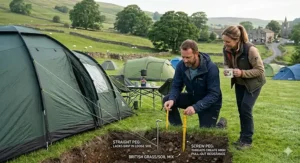
FAQ
❓ Are screw pegs better than straight pegs for UK camping?
❓ Can I use a cordless drill to install screw tent pegs in the UK?
❓ How deep should tent pegs go into British ground?
❓ Will galvanised tent pegs rust in British weather?
❓ What's the best tent peg angle for UK ground?
Conclusion: Making Your Choice for British Camping
The screw pegs vs straight pegs debate ultimately resolves into a simple question: what British ground will you actually camp on? If your typical pitch involves compacted surfaces, stony ground, or year-round camping when soil freezes or waterlog, screw pegs aren’t optional extras — they’re essential equipment. Their superior holding power in challenging conditions justifies the modest premium over straight alternatives, and the time-saving benefits of drill installation (for car campers) make them even more appealing.
That said, British summer camping on established grass pitches doesn’t necessarily demand screw pegs. Quality straight pegs — particularly Y-beam or V-profile designs like the MSR Groundhog — perform admirably in these conditions at lower weight and cost. The pragmatic British camper often settles on a mixed approach: screw pegs for critical guy lines facing prevailing winds, quality straight pegs for corners and secondary attachments, basic straight pegs for groundsheet edges and less vital applications.
What’s non-negotiable is this: abandon the wire pegs that came with your tent. They’re essentially ornamental. Investing £20-£35 in quality pegs appropriate for your camping style transforms tent security and dramatically reduces that special 3 AM anxiety when wind picks up and rain hammers down. Your tent is only as secure as its weakest link, and for most British campers, that weak link is lurking in the peg bag. Fix it, sleep better, camp happier. Rather simple when you think about it.
Recommended for You
- 7 Best Beach Tent Pegs UK 2026 | Tested for Sand & Wind
- Best Tent Pegs for Rocky Ground UK: 7 Options That Won’t Bend 2026
- Best Shock Cord for Tent Poles: 7 UK Options 2026
Disclaimer: This article contains affiliate links. As an Amazon Associate, I earn from qualifying purchases. If you purchase products through these links, we may earn a small commission at no additional cost to you.
✨ Found this helpful? Share it with your mates! 💬🤗
