
In This Article
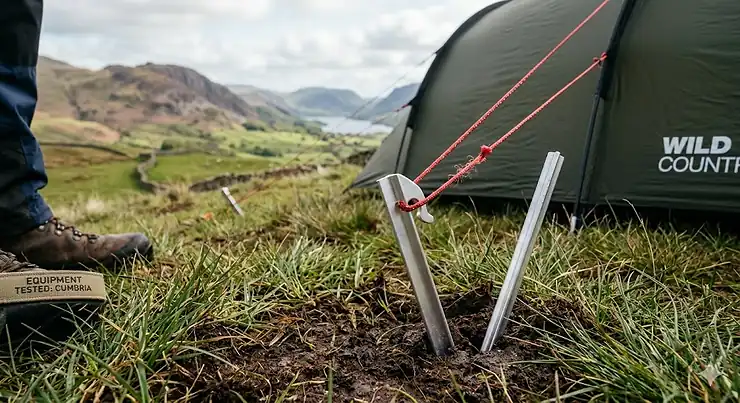
Picture this: you’ve driven three hours to a gorgeous campsite in the Lake District, spent forty minutes wrestling your tent into submission, and settled in for a peaceful evening. Then the wind picks up. By midnight, you’re awake, listening to guylines slapping against fabric as your tent pegs slowly surrender to the soggy British soil beneath you.
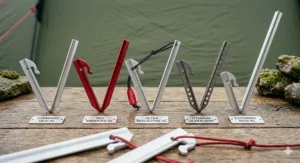
If you’ve been there, you already know the truth most casual campers learn the hard way: the pegs that come bundled with your tent are rarely fit for purpose. Those flimsy wire affairs might hold on a calm summer’s day in your garden, but the moment you encounter proper British weather—wind, rain, and the stubborn mix of clay, chalk, and gravel that passes for ground across much of England, Scotland, and Wales—you need something considerably more robust.
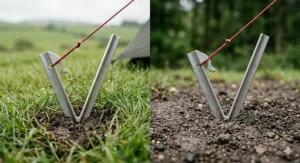
V shaped tent pegs represent one of the most popular upgrades amongst UK campers, and for good reason. The distinctive V-profile design offers a sensible balance between penetration in harder ground and holding power in softer conditions. Unlike basic wire pegs that bend at the first hint of resistance, or chunky Y-shaped alternatives that can be overkill for weekend camping, V pegs sit in that practical middle ground that suits the variable terrain most British campers encounter. According to camping equipment specialists at WildBounds, the V-profile cross-section provides an optimal balance between surface area for holding power and ease of penetration across varying ground conditions.
What most buyers overlook about V shaped tent pegs is how dramatically ground conditions affect their performance. A peg that holds beautifully in the soft grass of a Norfolk campsite might struggle mightily with the compacted chalk of the South Downs, whilst something engineered for rocky Scottish mountainsides could prove excessive—and unnecessarily heavy—for a family weekend in the Cotswolds. Understanding which V peg suits your typical camping conditions makes the difference between a secure, restful pitch and a midnight scramble to re-peg your shelter.
This guide examines seven genuine V shaped tent pegs currently available on Amazon.co.uk, ranging from budget-friendly steel options around £10 for a pack to premium titanium stakes in the £40-60 bracket. We’ve considered weight, material durability, ground compatibility, and real-world performance in British weather conditions to help you choose pegs that actually stay put when it matters.
Quick Comparison Table: V Shaped Tent Pegs at a Glance
| Product | Material | Weight Per Peg | Length | Price Range (Pack) | Best For |
|---|---|---|---|---|---|
| Gelert Steel V Pegs | Galvanised Steel | ~25g | 22.5cm | £10-15 (50 pack) | Budget car camping, families |
| Hilleberg V-Peg | Hardened Aluminium | 11g | 16cm | £40-50 (10 pack) | Four-season backpacking |
| TOAKS Titanium V Pegs | Titanium Alloy | 15g | 16.5cm | £35-45 (6 pack) | Ultralight wild camping |
| Vango Steel V-Peg | Steel | ~22g | 23cm | £8-12 (10 pack) | General camping, mixed ground |
| OLPRO V Shaped Pegs | Lightweight Steel | ~20g | 23cm | £6-10 (10 pack) | Soft ground, beach camping |
| Sierra Designs V Stake | Aluminium Alloy | 6g | 15.5cm | £10-15 (6 pack) | Lightweight backpacking |
| iBasingo Titanium V Pegs | Titanium | 14g | 16.5cm | £30-40 (6 pack) | Weight-conscious hikers |
The comparison reveals a clear pattern: steel pegs dominate the budget segment (under £15 per pack), offering solid performance for car campers who aren’t concerned about carrying weight. Aluminium represents the middle ground, balancing weight reduction with affordability, whilst titanium commands premium prices but delivers unmatched strength-to-weight ratios for backpackers counting every gram.
What’s particularly interesting is the weight variation—at 6g, the Sierra Designs aluminium stakes weigh barely a third of the budget steel options at 20-25g each. Over ten pegs, that’s a difference of 140-190g, roughly the weight of a spare pair of socks. For weekend car camping, that’s negligible. For a five-day wild camp across the Scottish Highlands where you’re carrying everything on your back, it’s the difference between comfort and unnecessary suffering.
💬 Just one click — help others make better buying decisions too! 😊
Top 7 V Shaped Tent Pegs: Expert Analysis
1. Gelert 22.5cm V Shaped Secure Steel Tent Pegs
If you’re after dependable tent pegs that won’t demolish your budget, the Gelert Steel V Pegs represent exactly the sort of no-nonsense kit that gets the job done without fuss. Sold in generous packs of 50, these galvanised steel pegs are what you’ll see at family campsites across Britain—and there’s good reason for their popularity.
At 22.5cm in length and roughly 25g per peg, these aren’t ultralight backpacking stakes. They’re proper car-camping workhorses designed to handle family tents, awnings, and the sort of British weather that sends casual campers scurrying back to their vehicles. The galvanised coating provides essential rust resistance—rather important given how much time British tent pegs spend sitting in waterlogged grass and clay.
What makes these particularly suitable for UK camping is their length. A 22.5cm peg driven at the proper 45-degree angle sinks deep enough to find purchase even in relatively soft ground, which matters enormously on the grass pitches common across British campsites. The V-profile provides adequate surface area for grip without the bulk of Y-shaped alternatives, making them easier to hammer through the top layer of compacted earth or turf you often encounter on well-used pitches.
Customer feedback from UK reviewers consistently mentions these pegs holding firm in moderate winds and rain. One Cub Scout leader noted they replaced bent wire pegs with these during tent setup and the difference was immediately apparent—the tent stopped moving entirely. That real-world validation from someone wrangling multiple tents full of energetic children speaks volumes about reliability.
Pros:
✅ Excellent value at around £10-15 for 50 pegs—barely 20-30p each
✅ Galvanised coating resists British weather and damp ground conditions
✅ Sufficient length (22.5cm) for secure hold in grass and soft soil
Cons:
❌ Weight makes them impractical for backpacking or long-distance hiking
❌ May bend if repeatedly hammered into very rocky or stony ground
Price-wise, you’re looking at the £10-15 range for a pack of 50, which makes these absurdly economical. For families, festival-goers, or anyone setting up larger tents where you need fifteen or twenty pegs at a time, the Gelert pack offers tremendous value whilst delivering perfectly adequate performance for typical British camping.
2. Hilleberg V-Peg (10 Pack)
The Hilleberg V-Peg occupies that interesting space where serious outdoor kit crosses over into investment-grade equipment. These are the pegs supplied as standard with Hilleberg’s Red Label tents—their four-season range designed to withstand genuinely harsh conditions—which immediately tells you something about their capabilities.
Made from hardened aluminium with a specifically engineered thick spine and sides to prevent bending, these 16cm pegs weigh just 11g each. That’s less than half the weight of budget steel alternatives whilst maintaining superior strength. The V-profile cross-section has been optimised to balance penetration in harder ground with holding power in looser soil, making them genuinely versatile across the variable terrain British wild campers encounter—from peaty Scottish moorland to chalky South Downs.
What you’re actually paying for with Hilleberg pegs is reliability under pressure. The hardened aluminium won’t bend when you encounter rocks or roots partway through driving the peg—frustratingly common when camping in British uplands where soil depth varies dramatically. The anodised gold finish isn’t merely aesthetic; it makes pegs vastly easier to spot in long grass when you’re packing up camp, which saves considerable fumbling about on damp mornings. The integrated string loop serves double duty: easier extraction from stubborn ground, and attachment points if you need to mark peg locations.
UK backpackers and mountaineers consistently rate these amongst the best all-round V pegs available. They’re particularly popular with folk tackling multi-day routes like the West Highland Way or Coast to Coast, where gear needs to perform reliably without adding unnecessary weight. The price reflects this quality—expect to pay £40-50 for a pack of 10—but these are genuinely buy-once pegs that’ll last years of regular use.
Pros:
✅ Excellent strength-to-weight ratio at 11g per peg
✅ Hardened aluminium resists bending in rocky or root-filled ground
✅ Gold anodising and string loops make extraction and location easier
Cons:
❌ Premium pricing (£40-50 per 10-pack) puts them beyond casual camping budgets
❌ 16cm length may be marginal in very soft or sandy conditions
For serious wild campers and backpackers who regularly encounter challenging British weather and terrain, the Hilleberg V-Peg represents money well spent. You’re purchasing reliability and longevity rather than disposable kit—exactly the philosophy that makes sense for equipment your safety might depend upon.
3. TOAKS Titanium Tent Pegs Ultralight V-shaped
The TOAKS Titanium V Pegs sit at the intersection of weight obsession and genuine durability—a combination that commands premium prices but delivers tangible benefits for specific types of camping. At 15g per peg and 16.5cm in length, these represent what happens when material science meets outdoor equipment design.
Titanium’s appeal lies in its exceptional strength-to-weight ratio combined with natural corrosion resistance. Unlike aluminium, which requires anodising for weather protection, titanium simply doesn’t rust or corrode—rather handy for pegs that spend hours in damp British soil. The V-shaped profile provides that familiar balance between ground penetration and holding power, whilst the triangular rope hole makes securing guylines straightforward and reliable.
What the spec sheet won’t tell you is how titanium performs in British conditions specifically. The material’s hardness means these pegs can be hammered into surprisingly firm ground without bending, yet they’re light enough that carrying a full set for a week-long wild camp won’t leave you resenting every uphill stretch. For context: six titanium pegs total 90g versus six steel pegs at 120-150g—a difference of roughly 30-60g, or about the weight of a chocolate bar. Multiply that across all your gear choices and suddenly you’re carrying a kilo less, which transforms long-distance hiking comfort.
UK reviewers consistently mention these pegs holding firm on Peak District moorland, Scottish mountainsides, and Welsh coastal paths—environments where weather can deteriorate rapidly and your tent anchoring becomes genuinely critical. The 60-degree installation angle recommendation (with top 3cm above ground) might seem fussy but it’s actually proper technique that dramatically improves holding power in variable soil.
Pros:
✅ Titanium construction eliminates corrosion concerns in perpetually damp British conditions
✅ Excellent strength allows use in rocky upland terrain without bending
✅ Weight savings accumulate significantly over multiple pegs for backpackers
Cons:
❌ Premium pricing (£35-45 for 6 pegs) reflects titanium material costs
❌ Not particularly cost-effective for car camping where weight isn’t critical
You’re looking at £35-45 for a six-pack, which positions these firmly in the specialist backpacking category. For weekend car campers, they’re overkill—perfectly functional, but you’re paying for weight reduction you don’t need. For long-distance hikers and serious wild campers tackling Britain’s more challenging terrain, they’re a worthwhile investment in reliable, lightweight kit.
4. Vango Steel V-Peg Pack
The Vango Steel V-Peg represents that reliable middle ground British outdoor companies excel at producing—nothing fancy, nothing exotic, just solid gear that works consistently across typical UK camping conditions. Vango’s long history in British camping and outdoor equipment means these pegs reflect decades of understanding what actually matters on British campsites.
At 23cm in length and around 22g per peg, these steel V pegs are fractionally lighter than some budget alternatives whilst maintaining the strength and durability steel provides. The extra centimetre over some competitors might seem trivial, but it provides noticeably better holding power in softer ground—exactly the sort of waterlogged grass you encounter after British summer rain has been pelting down for three days solid.
What makes the Vango pegs particularly suitable for UK conditions is their straightforward design philosophy. No unnecessary complexity, no features that’ll fail after a season’s use, just properly galvanised steel shaped into an effective V-profile that penetrates ground reliably and holds firm under tension. They’re the tent peg equivalent of a decent pair of walking boots: unglamorous but dependable.
Customer reviews from UK buyers consistently mention using these for family tents, car camping, and festival setups where you need a decent number of pegs that’ll perform adequately without requiring a second mortgage. One reviewer specifically noted replacing their tent’s original wire pegs with these and experiencing immediate improvement in stability—precisely the upgrade most campers should be making.
Pros:
✅ Sensible pricing (£8-12 for 10 pegs) balances cost with performance
✅ 23cm length provides secure anchoring in grass and moderately soft soil
✅ Vango’s UK heritage means design suited to British camping conditions
Cons:
❌ Steel construction adds weight compared to aluminium or titanium alternatives
❌ May require replacement if repeatedly used in very rocky ground
Expect to pay £8-12 for a pack of 10, positioning these as excellent value for money. They’re ideal for campers who want a proper upgrade from basic wire pegs without spending premium prices on ultralight materials they don’t particularly need. For car camping, family holidays, and general British campsite use, the Vango Steel V-Peg hits that sweet spot of affordability and reliability.
5. OLPRO V Shaped Tent Pegs (Pack of 10)
The OLPRO V Shaped Pegs target a specific niche: lightweight steel pegs designed primarily for softer ground conditions like grass, sand, and beach camping. At 23cm in length and approximately 20g per peg, they’re fractionally lighter than traditional heavy-duty steel alternatives whilst maintaining the V-profile design that provides surface area for grip.
What distinguishes these from heavier steel pegs is their design optimisation for British coastal and softer-ground camping. The UK’s beach camping scene—from Cornwall to Norfolk to the Scottish islands—requires pegs that can penetrate sand and loose soil whilst resisting the pull forces that come with coastal winds. The V-shape provides considerably more holding power than thin wire or nail-style pegs in these conditions, distributing load across a larger surface area rather than simply cutting through soft substrate.
The lightweight steel construction means these won’t last forever if you’re regularly hammering them into rocky Welsh mountainsides, but that’s not their intended purpose. For families visiting beach campsites, festival-goers on grassy fields, or caravan owners needing awning pegs for soft pitches, they represent sensible value. The 23cm length is particularly useful in sand, where you want deeper penetration to find firmer substrate below the loose surface layer.
UK customer feedback mentions these performing well for securing tents and awnings in camping fields and beach locations, with the caveat that they’re not suitable for hard or stony ground. One reviewer noted using them successfully on soft ground during wet weather when heavier pegs might have been overkill—exactly the sort of conditions British campers encounter frequently.
Pros:
✅ Budget-friendly pricing (£6-10 for 10 pegs) makes them accessible for casual campers
✅ Lightweight steel construction balances weight reduction with adequate strength
✅ 23cm length performs well in soft soil, grass, and sandy beach conditions
Cons:
❌ Not designed for rocky or hard ground—expect bending or failure
❌ May not provide sufficient holding power in severe wind on exposed sites
You’re looking at £6-10 for a pack of 10, making these amongst the most economical V pegs available on Amazon.co.uk. They’re ideal for beach camping, summer festival tents, and general use on softer British campsites where ground conditions are forgiving. Just don’t expect them to survive regular hammering into Peak District moorland or Scottish granite.
6. Sierra Designs V Stake Tent Pegs
The Sierra Designs V Stake represents American ultralight design adapted for British backpacking. At just 6g per peg and 15.5cm in length, these high-strength aluminium stakes are amongst the lightest V-profile pegs available on Amazon.co.uk—genuinely impressive weight reduction that makes a tangible difference when you’re carrying everything on your back.
The California-based brand describes these as “rugged yet sleek,” which is marketing speak, but the underlying truth holds: these pegs punch well above their weight class in terms of durability. The tapered point aids penetration into firm soil—useful on British upland terrain where topsoil can be surprisingly compacted—whilst the pre-attached pull loop simplifies extraction when you’re breaking camp with cold, wet fingers on a drizzly morning.
What makes the 6g weight particularly significant is cumulative effect. If you’re carrying eight pegs for a solo tent, that’s 48g total for Sierra Designs versus 176g for steel alternatives—a saving of 128g, or roughly the weight of a small power bank. For multi-day hikes where every gram counts, those savings accumulate rapidly across all your gear choices. The trade-off is cost: at £2.08 per peg (approximately £12.45 for a six-pack), you’re paying considerably more per peg than budget steel options.
British backpackers particularly value these for long-distance routes and wild camping trips where weather can deteriorate unexpectedly. The aluminium construction handles British conditions well—it won’t rust in perpetually damp ground, and the strength-to-weight ratio means they’ll hold firm in moderate to strong winds provided you’ve chosen reasonably firm ground for your pitch.
Pros:
✅ Exceptional weight reduction at 6g per peg—ideal for ultralight backpacking
✅ Pre-attached pull loops simplify extraction with gloves or cold fingers
✅ High-strength aluminium balances light weight with adequate durability
Cons:
❌ 15.5cm length may be marginal in very soft or sandy conditions
❌ Higher per-peg cost compared to budget steel alternatives
Pricing sits around £12.45 for a six-pack (approximately £2.08 per peg), which represents good value in the ultralight category even if it’s considerably more expensive than budget steel. For backpackers tackling Britain’s long-distance trails—Pennine Way, West Highland Way, Coast to Coast—the weight savings justify the investment. For car camping, they’re unnecessary luxury.
7. iBasingo Titanium V-shaped Tent Stakes
The iBasingo Titanium V Pegs sit in that competitive space between premium brands like Hilleberg and budget alternatives, offering titanium construction at slightly more accessible prices whilst delivering similar performance characteristics. At 14g per peg and 16.5cm in length, they’re fractionally lighter than some titanium competitors whilst maintaining the material’s inherent advantages.
Titanium’s appeal for tent pegs lies in its unique combination of properties: exceptional strength-to-weight ratio, complete corrosion immunity, and sufficient hardness to resist bending when encountering rocks or roots. For British wild camping where you might be pitching on peaty Scottish moorland one night and chalky South Downs the next, that versatility matters enormously. The V-shaped profile provides familiar ground penetration and holding characteristics whilst the triangular rope hole makes guyline attachment straightforward.
What you gain with the iBasingo pegs compared to budget alternatives is peace of mind under challenging conditions. When you’re wild camping in the Lake District and weather forecasts predict Force 7 winds with driving rain, knowing your tent pegs won’t corrode, bend, or fail becomes genuinely comforting. The 16.5cm length strikes a reasonable balance—long enough for secure anchoring in most British ground types, short enough to keep weight minimal.
UK customer feedback mentions these performing well across varying terrain types, from Peak District moorland to Welsh coastal paths. The titanium construction means they’ll last indefinitely without maintenance—no rust, no corrosion, no degradation from repeated wet-dry cycles. That longevity justifies the premium pricing for campers who use their gear regularly rather than occasional summer weekenders.
Pros:
✅ Titanium construction eliminates corrosion entirely—ideal for perpetually damp British conditions
✅ Competitive pricing (£30-40 for 6 pegs) undercuts premium brands whilst maintaining quality
✅ Lightweight enough (14g) for long-distance backpacking without compromising strength
Cons:
❌ Still premium-priced compared to steel or basic aluminium alternatives
❌ May be overkill for casual car camping where weight and corrosion aren’t concerns
You’re looking at £30-40 for a six-pack, positioning these as mid-range within the titanium category—cheaper than Hilleberg or TOAKS, but still considerably more expensive than steel or aluminium alternatives. For regular wild campers and backpackers who value durability and weight reduction, they represent sensible investment. For occasional campers, the premium over steel pegs is harder to justify.
How to Choose V Shaped Tent Pegs for British Conditions
Understanding which V shaped tent pegs suit your needs requires considering three interconnected factors: the ground conditions you typically encounter, your camping style, and your budget constraints. What works brilliantly for a family car camping in the Cotswolds will be entirely unsuitable for a solo backpacker tackling the Scottish Highlands, and vice versa.
Ground Type Assessment
British camping terrain varies dramatically depending on geography and time of year. Soft grass pitches dominate commercial campsites across England and Wales during summer months, requiring pegs with adequate length (20cm+) to penetrate deep enough for secure holding. The V-profile excels here because it provides surface area for grip without the bulk of Y-shaped alternatives.
Conversely, upland camping in Scotland, the Lake District, or Peak District often involves shallow peaty soil over bedrock, interspersed with rocks and roots. Here, shorter hardened aluminium or titanium V pegs (15-17cm) perform better because they’re less likely to hit immovable obstacles partway through driving, and their material strength resists bending when you do encounter resistance.
Coastal and beach camping presents unique challenges. Sand requires longer pegs (23cm+) to reach firmer substrate below the surface, whilst the corrosive salt environment makes galvanised steel or aluminium preferable to basic steel. The V-shape provides considerably more holding power than thin wire pegs in loose sand by distributing load across a larger surface area.
Material Selection Strategy
Steel pegs represent the economical workhorse choice for car camping and family holidays. They’re heavy (20-25g per peg), but weight doesn’t matter when you’re driving to the campsite. Galvanised coating provides adequate rust resistance for British weather, and prices around £0.20-1.00 per peg make buying sufficient quantities painless. The downside is bulk and weight for backpacking, plus potential bending in very rocky ground. According to materials engineering studies, galvanised steel offers excellent corrosion resistance in typical UK soil pH levels (5.5-7.5), making it ideal for our climate.
Aluminium alloy pegs balance weight reduction (6-12g per peg) with reasonable pricing (£1-2.50 per peg depending on brand). They won’t rust, they’re considerably lighter for backpacking, and quality brands use hardened alloy that resists bending better than you might expect. The trade-off is slightly higher cost and potentially shorter lifespan if repeatedly used in harsh conditions.
Titanium pegs occupy the premium category (£5-8 per peg) but deliver tangible benefits: exceptional strength-to-weight ratio (14-16g per peg), complete corrosion immunity, and longevity measured in decades rather than seasons. For serious wild campers and long-distance hikers, they’re worthwhile investment. For occasional weekend campers, they’re expensive overkill.
Length and Quantity Considerations
Peg length directly affects holding power, particularly in softer ground. A 15cm peg driven at 45 degrees penetrates roughly 10.5cm vertically—adequate in firm soil but marginal in waterlogged grass or sand. A 23cm peg reaches 16cm vertical penetration, providing noticeably better security in challenging conditions.
Most tents require 8-12 pegs for basic setup, plus additional pegs for guylines if weather deteriorates. Carrying 20-30% more pegs than your tent theoretically needs provides insurance against loss, bending, or encountering ground where some peg positions simply won’t work. For a tent requiring 10 pegs, carrying 13-15 total makes sense. Steel pegs make this economical; titanium pegs make it expensive.
British Weather Reality Check
UK camping involves dealing with rain, wind, and variable conditions far more frequently than Mediterranean camping. Your pegs need to perform in saturated ground, resist corrosion from constant damp exposure, and hold firm when unexpected squalls arrive at 3am. This reality favours galvanised or stainless steel for car camping (where rust resistance matters more than weight), or aluminium/titanium for backpacking (where both rust resistance and weight reduction are priorities).
The ground conditions after three days of British rain differ dramatically from summer sunshine. Soft ground becomes waterlogged and loses holding power, whilst previously firm ground can turn boggy. Longer pegs (20-23cm) and wider V-profiles provide more surface area to distribute load, reducing the likelihood of pegs pulling free under tension.
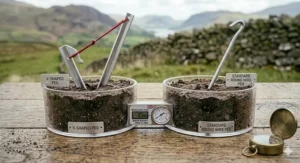
V Pegs vs Standard Pegs: Understanding the Profile Design Benefits
The V-shaped cross-section represents a deliberate engineering compromise between competing requirements: ease of insertion, holding power, weight, and durability. Understanding why the V-profile performs differently from alternatives helps you choose appropriate pegs for specific situations.
Penetration Characteristics
V-shaped pegs present a relatively narrow leading edge to the ground during insertion, making them easier to drive through the compacted surface layer common on well-used British campsites. The profile widens gradually behind the tip, providing progressive resistance that helps you feel when the peg has reached adequate depth. This matters more than you might think when dealing with variable soil—particularly upland terrain where thin topsoil overlays bedrock.
Wire pegs, by comparison, offer minimal penetration resistance but equally minimal holding power. They slide through soft ground easily but provide almost no surface area for grip. Y-shaped pegs present more initial resistance due to their wider profile but offer superior holding power once fully inserted. The V-shape sits between these extremes: easier insertion than Y-pegs, better holding than wire.
Holding Power Analysis
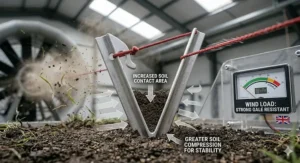
The V-profile’s effectiveness derives from how it distributes load across two angled surfaces rather than a single plane. When a guyline pulls on a properly installed V-peg (at 45 degrees to the ground), forces compress soil against both internal faces of the V-shape. This creates friction across a larger surface area than nail-style pegs, which rely primarily on friction along a single shaft. Research from outdoor equipment testing organizations demonstrates that V-shaped profiles can provide up to 40% more holding power than equivalent round-section pegs in medium-density soils.
In softer ground like waterlogged grass or sand, this distributed loading becomes particularly important. A nail peg might simply cut through soft substrate under load, whilst a V-peg’s wider profile engages more material and resists pullout. The trade-off is bulk and weight compared to thin nail pegs—exactly why ultralight backpackers often carry a mix of peg types for different anchor points.
Material Stress Distribution
The V-cross-section also provides inherent structural strength against bending forces. When you hammer a V-peg into ground containing rocks or roots, the angled sides help deflect the peg around obstacles rather than transmitting full impact force to a single weak point. This reduces the likelihood of catastrophic bending compared to flat pegs, which concentrate stress along their thin profile.
However, the V-shape’s open profile makes it more vulnerable to deformation at the head compared to solid nail pegs. Repeated hammering, particularly with unsuitable tools like rocks rather than proper mallets, can gradually splay the V-shape outward and weaken the peg. This explains why premium V-pegs like Hilleberg’s use hardened aluminium with reinforced heads—addressing the profile’s primary structural weakness.
Weight and Packing Efficiency
V-shaped pegs generally pack less efficiently than flat pegs because their profile creates void space when stacked. For car camping, this matters not at all. For backpacking, it becomes another consideration alongside weight. Some backpackers nest V-pegs inside each other to reduce pack volume, though this risks scratching anodised finishes and creating noise during transport.
The material choice interacts with profile design here. Titanium V-pegs can use thinner wall sections than steel whilst maintaining strength, producing lighter pegs that pack almost as compactly as wire alternatives. Budget steel V-pegs tend toward bulkier profiles that add both weight and pack volume—acceptable trade-offs for car camping, problematic for multi-day hikes.
Best V Pegs for Grass: Optimising for British Campsites
Grass pitches dominate British campsites, from family-friendly sites in the Lake District to festival fields across the country. However, “grass” encompasses surprising variation in ground conditions depending on soil type, drainage, and recent weather. Understanding these differences helps you choose V pegs that perform reliably rather than frustrating you at setup.
Identifying Grass Types and Underlying Soil
Well-maintained campsite grass typically grows over either clay-rich or sandy soil, each presenting distinct challenges. Clay soil becomes sticky and adhesive when wet, providing excellent holding power for properly installed pegs but making extraction a muddy ordeal. Sandy soil drains rapidly and resists waterlogging but offers less friction and holding power, particularly for shorter pegs.
The grass coverage itself affects peg performance. Thick, healthy turf with substantial root systems provides additional holding power beyond the underlying soil alone—roots create a fibrous mat that resists peg pullout under tension. Sparse grass or bare patches remove this advantage, leaving you relying entirely on soil characteristics. Many British campsites show varying grass quality across different pitch areas, with popular spots becoming worn and compacted whilst quieter areas maintain healthier turf.
Optimal Peg Length for Grass Conditions
For typical British campsite grass over clay or loam soil, 20-23cm V-shaped pegs provide the ideal balance. This length penetrates through the turf layer and root mat into underlying soil, ensuring the peg engages enough material for secure holding. Shorter pegs (15-17cm) work adequately in very firm ground but become marginal after prolonged rain when the top soil layer softens and loses cohesion.
After heavy British rainfall—which can mean three days of persistent drizzle rather than a single storm—waterlogged grass loses considerable holding power. Longer pegs help by reaching deeper into soil layers that drain better than the saturated surface. The V-profile’s increased surface area compared to wire or nail pegs becomes particularly valuable here, distributing load across more material even when that material has reduced grip strength.
Installation Technique for Maximum Hold
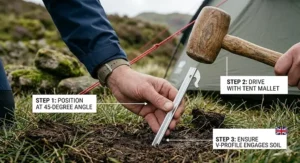
The often-repeated “45-degree angle” advice exists for sound physics reasons. A peg driven vertically provides minimal resistance to horizontal pulling forces from guylines—it simply rotates in the ground and pulls free. A peg angled at 45 degrees toward the tent resists both vertical and horizontal components of load, maximising holding power from the peg’s embedded length.
In soft grass, leaving the top 3-5cm of peg above ground (the “proper depth” guideline) prevents the peg head from sinking into soft ground under load, which can cause the peg to rotate and loosen. However, this exposed portion creates a trip hazard—one of British camping’s most reliable sources of stubbed toes and colourful language. Some experienced campers mark peg locations with small flags or bright tape, particularly on family sites where children run about.
Seasonal Considerations
British grass campsites vary dramatically between dry summer conditions and soggy autumn/spring camping. Summer-hard ground requires more hammering force and may defeat softer steel pegs, whilst waterlogged winter pitches demand longer pegs to reach firmer soil below the saturated surface layer. Carrying a modest selection of peg types—say, 8-10 standard V-pegs plus 3-4 longer options—provides flexibility without excessive weight or bulk for car camping.
The spring mud season, when frost-damaged ground thaws and drainage systems cope poorly with snowmelt and rain, represents peak difficulty for British campsite pegging. Ground can be simultaneously soft enough to require minimal hammering yet provide pathetic holding power. Here, crossing two pegs in an X-pattern at critical stress points (tent corners, main guylines) doubles holding power at the cost of using twice as many pegs.
Lightweight V Pegs: Balancing Weight and Performance
For backpackers and wild campers tackling Britain’s long-distance trails, every gram carried represents energy expended over potentially hundreds of kilometres. Lightweight V-shaped pegs must balance weight reduction against adequate strength and holding power—compromise too far toward lightness and you’re carrying expensive stakes that bend or fail when conditions deteriorate.
The Weight-Strength Calculation
A complete tent pegging system for a solo backpacking tent might require 8-10 pegs, plus 2-3 spares for insurance. At 25g per steel peg, that’s 250-325g total. Switch to 11g hardened aluminium pegs and you’re carrying 110-143g—a saving of 140-182g, roughly the weight of a phone power bank. Switch again to 6g ultralight aluminium stakes and total weight drops to 60-78g—saving an additional 50-65g but with reduced durability margins.
These savings accumulate across all gear choices. Lightweight pegs, ultralight tent, minimal sleeping bag, compact stove—suddenly you’re carrying 2-3kg less than conventional backpacking loads, transforming your hiking experience on challenging British terrain like the Pennine Way or Cape Wrath Trail. The question becomes where to compromise: pegs must function reliably regardless of weather, so they’re poor candidates for extreme weight reduction compared to, say, luxury items like camp chairs.
Material Performance in British Conditions
Lightweight aluminium alloy pegs, particularly 7000-series variants, offer impressive strength-to-weight ratios that work well across most British terrain. They won’t rust during prolonged exposure to damp ground, they resist bending surprisingly well when encountering rocks or roots, and their reduced weight makes carrying spares painless. The downside is durability—aluminium fatigues over time, particularly if repeatedly bent and straightened, eventually failing where steel might merely deform.
Titanium represents the ultimate lightweight-yet-durable material, though it commands premium prices that put it beyond many backpackers’ budgets. A titanium peg at 14-16g offers strength comparable to heavier steel whilst eliminating corrosion concerns entirely. For year-round wild camping in challenging British weather, particularly Scottish winter conditions, that combination of low weight and bombproof reliability justifies the cost. For summer-only backpacking in gentler southern English countryside, it’s probably unnecessary luxury.
Strategic Peg Distribution
Experienced British backpackers rarely carry a single peg type. Instead, they’ll take 4-6 lightweight V-pegs (aluminium or titanium) for the main tent corners where strength matters most, 3-4 ultralight stakes for less critical mid-points and guylines, and perhaps 1-2 specialist options like rock pegs or snow stakes depending on expected terrain and season.
This mixed approach optimises the weight-performance trade-off. You’re not carrying heavy-duty pegs for every anchor point, but neither are you relying entirely on marginal ultralight stakes when weather deteriorates and your tent’s security becomes genuinely important. Total weight might be 80-120g—heavier than an all-ultralight approach but with considerably more security margin.
Knowing When Lightweight Isn’t Light Enough
On genuinely extreme lightweight trips—say, attempting the Pennine Way as fast as possible with minimal gear—every gram receives scrutiny. Here, some backpackers accept compromised peg performance in exchange for weight savings, gambling on favourable weather and using rocks or hiking poles as improvised anchors if conditions deteriorate. This represents advanced technique requiring good judgment about when such compromises become dangerous rather than merely uncomfortable.
For most British backpacking, particularly multi-day routes through changeable weather country like the Lake District or Scottish Highlands, carrying adequate pegs remains wise insurance. The extra 50-100g of proper V-pegs over minimal wire stakes becomes trivial compared to the misery of a collapsed tent during a Force 8 gale at 2am on a Munro.
V Peg Ground Grip: Understanding Soil Mechanics
The holding power of any tent peg depends fundamentally on soil mechanics—how ground materials respond to penetration and loading forces. British soil types vary dramatically from chalky South Downs to peaty Scottish moorland to sandy Norfolk coastline, each presenting unique challenges for V-shaped pegs.
Clay Soils and Adhesive Holding
Clay-rich soils, common across much of southern and central England, provide excellent holding power when properly engaged. Clay particles create strong adhesive bonds with peg surfaces, particularly when moisture content sits in the ideal range—damp enough for adhesion but not so waterlogged that the soil loses cohesion entirely. The V-profile’s increased surface area compared to wire pegs maximises contact with clay soil, enhancing grip.
The challenge with clay lies in installation and extraction. Dry clay can be remarkably hard, requiring substantial hammering force to drive pegs and risking bending in softer steel pegs when you encounter stones. Saturated clay turns sticky and adhesive, making peg extraction an exercise in muddy frustration—one reason why pegs with integrated pull loops command premium prices amongst campers who regularly deal with clay campsite pitches.
Sandy and Free-Draining Soils
Sandy soils, prevalent in coastal regions and parts of East Anglia, drain rapidly and resist waterlogging but offer reduced friction and holding power. Individual sand grains lack the adhesive properties of clay particles, instead relying on friction and mechanical interlocking for grip. V-shaped pegs perform better than thin wire alternatives because their profile compresses more sand particles, increasing frictional contact area.
However, sand poses unique challenges. Pegs must be driven deeper than in clay soil to compensate for reduced holding power per centimetre of depth—hence the preference for 23cm+ pegs when beach camping or pitching on sandy ground. The installation angle becomes even more critical; a peg driven vertically into sand may simply pull straight out under load, whilst a 45-degree angle encourages sand particles to lock against the peg faces and resist pullout.
Peaty and Organic Soils
Peat and organic-rich soils dominate Scottish Highlands, Pennine moorland, and Welsh upland areas. These materials behave unpredictably—sometimes providing surprising holding power from fibrous root mats and dense vegetation, other times offering almost no resistance as pegs slip through waterlogged mush. The V-profile helps by engaging more material width, but peat’s inherent instability means you’re gambling on conditions.
Experienced wild campers in peat country often cross-peg critical stress points (two pegs in an X-formation sharing the load) or use natural anchors like boulders and vegetation alongside pegs. Relying solely on pegs in deep peat, particularly after prolonged rain, invites disappointment. The upside is that peat causes minimal wear on pegs—no rocks to bend them, no abrasive particles to scratch finishes—though the constant damp accelerates corrosion in non-galvanised steel.
Rocky and Mixed Substrates
British upland terrain frequently presents thin soil over bedrock, with variable depth and frequent embedded rocks. Here, peg performance becomes more about navigating obstacles than soil mechanics. The V-profile’s tendency to deflect around rocks helps, but hardened aluminium or titanium construction becomes essential—soft steel simply bends when encountering immovable resistance partway through driving.
The practical reality involves trial and error: you attempt to drive a peg, encounter rock at 8cm depth, relocate slightly and try again. Carrying a mix of peg lengths helps—if 20cm pegs keep hitting bedrock at 12cm, switch to 15cm pegs that can be fully inserted. This improvised approach works adequately for experienced campers but frustrates newcomers expecting consistent peg performance across a pitch.
Common Mistakes When Buying V Shaped Tent Pegs
British campers waste considerable money and endure unnecessary frustration by approaching tent peg purchases with assumptions that don’t survive contact with reality. Understanding these common pitfalls helps you make smarter decisions about which V-shaped pegs actually suit your needs.
Assuming All V-Pegs Perform Identically
The V-shaped profile represents a design category, not a performance guarantee. A £0.30 budget steel V-peg from a discount retailer functions entirely differently from a £6 hardened titanium Hilleberg peg, despite sharing the same basic cross-sectional shape. Material quality, manufacturing precision, heat treatment, and dimensional accuracy all affect real-world performance dramatically.
Budget pegs often use softer steel that bends easily when encountering rocks, whilst premium pegs specify hardened aluminium alloys or titanium that resist deformation. The V-angle itself varies between manufacturers—some produce narrow V-profiles optimised for hard ground penetration, others use wider angles that provide more surface area for soft soil grip. Treating “V-shaped peg” as a uniform category leads to poor purchasing decisions based on price alone rather than suitability for your typical camping conditions.
Prioritising Weight Over Durability for Car Camping
The ultralight backpacking movement has created an unfortunate tendency to obsess over peg weight even when it’s entirely irrelevant to camping style. If you’re driving to a campsite and setting up a family tent, carrying 200g of steel pegs versus 80g of titanium pegs makes precisely zero difference to your camping experience. The extra £30-40 you’d spend on titanium pegs could buy better sleeping mats, a decent camping stove, or fund another weekend trip entirely.
Weight reduction matters enormously when you’re carrying everything on your back across the Cairngorms. It matters not at all when gear travels in a car boot. Yet plenty of car campers buy expensive lightweight pegs because they’ve absorbed the message that lighter equals better, regardless of context. Save your money and buy robust steel pegs that’ll last decades of family camping without requiring replacement.
Underestimating Quantity Requirements
Most tents require 8-12 pegs for basic setup, but that assumes you’ll use every peg position and that ground conditions allow ideal placement for each peg. Reality differs: you’ll inevitably hit an immovable rock at one corner position, necessitate moving the peg 30cm to the left and running the guyline at a suboptimal angle. You’ll lose a peg in long grass during breakdown. You’ll bend one hammering into unexpected stony ground. You’ll discover your tent has 14 peg points but only came with 10 pegs because the manufacturer assumed you’d buy additional pegs.
Experienced British campers carry 20-30% more pegs than the theoretical minimum. For a tent requiring 10 pegs, that means 12-15 total. This provides insurance against loss, damage, and ground conditions that prevent ideal peg placement. The weight penalty is minimal for car camping, whilst for backpacking, carrying three extra 11g Hilleberg pegs adds just 33g—barely noticeable but potentially expedition-saving if conditions deteriorate and you need every available anchor point for security.
Ignoring British Weather Reality
Many campers purchase pegs based on summer camping assumptions: dry ground, moderate winds, generally pleasant conditions. Then they attempt autumn camping in the Lake District and discover their 15cm pegs pull free from waterlogged soil, or their lightweight aluminium stakes bend when hammered through frost-hardened ground, or their non-galvanised steel pegs emerge orange with surface rust after three days of persistent drizzle.
British camping involves dealing with damp conditions more often than not. Your pegs will spend hours or days in wet ground. They’ll be hammered into soil containing rocks, roots, and buried stones. They’ll face wind loading that tests their holding power repeatedly throughout a night. Choosing pegs that handle worst-case British weather rather than optimistic summer scenarios prevents disappointment and potential equipment failure when conditions deteriorate.
Neglecting Peg Extraction Tools
Purchasing excellent V-shaped pegs but lacking proper extraction tools creates foreseeable problems. Steel pegs driven into firm ground, particularly clay soil, can require substantial force to extract. Without a proper peg puller or mallet with integrated puller, you’re reduced to yanking guylines (risking damage to cord and tent attachment points) or improvising with whatever implement comes to hand.
A dedicated peg puller costs £5-10 and makes peg extraction dramatically easier, faster, and less likely to result in bent pegs or damaged equipment. Many modern pegs include integrated pull loops specifically to work with pullers, yet campers often ignore this ecosystem of compatible tools. The result is unnecessary wrestling with stubborn pegs and occasional broken guyline attachments—easily avoidable with £10 worth of proper kit.
Long-Term Cost & Maintenance in the UK
The true cost of tent pegs extends beyond initial purchase price to encompass longevity, replacement frequency, and maintenance requirements across years of British camping. Understanding these factors helps evaluate whether premium pegs represent value or unnecessary expense for your situation.
Steel Peg Lifecycle Economics
Budget galvanised steel V-pegs costing £0.20-0.50 each will typically last 3-5 years of regular family camping before rust, bending, or loss necessitates replacement. That assumes proper care: drying pegs before storage, avoiding prolonged submersion in standing water, and not using them as improvised tent stakes for violent hammering into concrete-hard ground. For a family doing 4-6 camping trips annually, a £15 investment in 50 pegs might last the entire period from children being toddlers to teenagers—arguably excellent value.
However, steel pegs require modest maintenance to maximise lifespan. Wiping off mud before storage prevents soil acids from attacking galvanised coating. Storing pegs dry rather than damp prevents rust formation in the inevitable scratches and coating damage that occur during use. Inspecting pegs before each trip identifies bent or damaged examples that need replacing before they fail mid-camp. This maintenance burden isn’t onerous but it does require some attention—unlike premium materials that tolerate neglect better.
Aluminium and Titanium Durability
Hardened aluminium pegs from quality manufacturers (Hilleberg, MSR, etc.) typically last 5-10+ years of regular backpacking use, eventually failing through fatigue cracking rather than rust or gross deformation. The upfront cost might be £40-50 for ten pegs, but amortised across a decade of use, that’s £4-5 annually—arguably better value than replacing cheaper pegs every few years.
Titanium pegs represent buy-once, use-forever investment. Properly maintained (which primarily means “don’t lose them in long grass”), titanium pegs will outlast your camping career. The material simply doesn’t corrode, fatigue resistance exceeds aluminium dramatically, and hardness prevents the gradual deformation that eventually defeats softer materials. At £5-8 per peg, the upfront cost stings, but you’ll never buy tent pegs again.
Hidden Costs of Inadequate Pegs
The false economy of cheap pegs becomes apparent when they fail at inconvenient moments. A bent peg at home represents minor annoyance—you replace it before your next trip. A bent peg on day three of a five-day wild camp across the Scottish Highlands, with deteriorating weather forecast, represents genuine equipment failure that compromises trip safety and comfort. Carrying spares mitigates this, but you’re still dealing with reduced security and potential need to retreat from planned routes.
Similarly, pegs that rust rapidly require frequent replacement, negating their initial cost advantage. If £0.30 budget pegs last one season whilst £1.50 galvanised pegs last five seasons, the premium pegs deliver better long-term value despite higher upfront cost. British campers who calculate cost-per-year-of-use rather than merely purchase price often conclude that mid-range quality represents the sweet spot—not budget trash that fails quickly, not premium exotica that costs more than necessary, but solid middle-ground kit that performs reliably for years.
Replacement Parts Availability in the UK
Mainstream brands selling through Amazon.co.uk and UK outdoor retailers benefit from straightforward replacement parts availability. Lose four pegs from your Hilleberg set? Order a replacement pack. Discover your cheap steel pegs rusting after one season? Buy another 50-pack for £10. Specialist or imported brands sometimes present availability challenges—discontinued models, UK distribution ceasing, or replacement parts unavailable separately from complete sets.
This argues for choosing brands with established UK presence: Vango, Hilleberg, MSR, Gelert, and similar companies that maintain UK distribution and parts availability. Saving £5 on an obscure imported brand sounds appealing until you need replacement pegs in three years and discover the company no longer exports to the UK or the product has been discontinued. Buying from mainstream suppliers provides insurance against this frustration.
Environmental and Disposal Considerations
Quality pegs that last decades produce less waste than cheap alternatives requiring frequent replacement. However, eventual disposal presents challenges. Steel pegs can be recycled with scrap metal, aluminium pegs likewise, but most local recycling centres won’t accept individual tent pegs—you’re expected to accumulate sufficient metal for collection minimums.
Titanium pegs, whilst effectively immortal during use, become problematic at end-of-life. Titanium recycling requires specialist facilities not widely available for consumer waste, meaning these premium pegs often end up in landfill despite their intrinsic value. The environmental calculus of “one titanium peg lasting forever” versus “five steel pegs over the same period” favours titanium during use-phase but complicates end-of-life. For most campers, this remains theoretical—pegs get lost in fields and moorland long before requiring formal disposal.
UK Regulations, Safety Standards & Legal Requirements
Unlike some camping equipment, tent pegs face minimal direct regulation in the UK. However, several standards and safety considerations affect their design, use, and sale through British retail channels including Amazon.co.uk.
Product Safety and Consumer Protection
Tent pegs sold in the UK fall under general product safety regulations requiring they’re not unreasonably dangerous for their intended purpose. This primarily affects design features like sharp points (necessary for ground penetration but requiring reasonable care during handling) and head design (should resist shattering when struck with mallets). The Consumer Rights Act 2015 protects buyers if pegs prove defective or unsuitable for their described purpose.
For British buyers purchasing through Amazon.co.uk, these protections apply regardless of where the product originates. If imported Chinese tent pegs prove dangerous—for example, shattering when struck and launching metal fragments—you’re entitled to refund and the product should be withdrawn from sale. This regulatory backstop provides confidence when buying from unfamiliar brands, knowing basic safety standards must be met for UK market access.
Campsite and Wild Camping Regulations
Tent pegs themselves aren’t regulated, but where and how you use them certainly can be. Wild camping in Scotland operates under different frameworks than England and Wales, with Scotland’s Land Reform Act 2003 providing responsible access rights whilst England and Wales require landowner permission for wild camping outside designated areas like Dartmoor.
Campsite regulations often specify peg types or prohibit certain designs. Some sites ban rock pegs or screw pegs that could damage underground services or drainage systems. Others restrict peg placement to avoid root damage on trees or compaction of already-stressed areas. Premium campsites occasionally mandate specific peg types for groundsheet protection—Y-pegs with blunt tips rather than sharp V-pegs that could puncture groundsheets from below.
Environmental and Access Considerations
Responsible camping in Britain includes minimising ground damage from pegging. On protected sites, national trust properties, or ecologically sensitive areas, this might mean using longer pegs to avoid disturbing topsoil, or positioning pegs to avoid rare plants and established vegetation. The principle of “leave no trace” applies—peg holes should be minimal and recover naturally within days rather than creating permanent scarring.
Scotland’s Outdoor Access Code provides specific guidance on responsible wild camping, including tent placement and ground protection. Whilst it doesn’t explicitly regulate peg type, the underlying philosophy encourages choices that minimise environmental impact. For Scottish wild camping, this might mean selecting pegs that minimise peg hole size or using natural anchors (rocks, vegetation) alongside pegs to reduce overall ground disturbance.
Trading Standards and Retailer Obligations
UK Trading Standards enforce requirements for accurate product descriptions, particularly regarding performance claims. If tent pegs are marketed as “suitable for all ground types” but bend immediately in rocky terrain, that’s potentially misleading advertising subject to regulatory action. For consumers, this means you can reasonably expect products to perform as described, and Trading Standards provides recourse if they manifestly don’t.
Amazon.co.uk, as a marketplace hosting third-party sellers, maintains policies requiring compliance with UK regulations. Products that violate safety standards or consumer protection laws should be removed from sale, though enforcement relies partly on customer reports and reviews flagging problems. Reading UK customer reviews before purchase helps identify products with performance or safety issues that might not be apparent from descriptions alone.
Health and Safety During Use
Whilst tent pegs aren’t regulated for safety beyond general product requirements, sensible use prevents foreseeable injuries. Sharp peg points require care during handling and storage—carrying pegs loose in a pack risks puncture injuries to both gear and fingers. Hammering pegs generates trip hazards as they protrude from ground, particularly problematic on family campsites where children run about. Marking peg locations with bright cord loops or small flags reduces trip risk dramatically.
The 45-degree installation angle and 3cm exposed peg head recommendation serves dual purposes: maximising holding power and preventing pegs sinking into soft ground where they become invisible trip hazards. Following this guidance protects both your tent’s security and other campers’ safety—particularly important on crowded festival sites where your pitch borders others closely.
Frequently Asked Questions About V Shaped Tent Pegs
❓ What makes V shaped tent pegs better than standard wire pegs for UK camping?
❓ Are titanium V pegs worth the extra cost for occasional UK campers?
❓ How many V shaped tent pegs should I carry for wild camping in Scotland?
❓ Can V shaped tent pegs damage campsite grass or protected land?
❓ Do V shaped tent pegs work effectively on British beach and sand camping?
Conclusion: Choosing the Right V Pegs for Your British Camping
After examining seven distinct V shaped tent pegs across materials, prices, and performance characteristics, several clear patterns emerge for British campers. Budget galvanised steel pegs (£0.20-0.50 each) deliver perfectly adequate performance for car camping and family holidays where weight doesn’t matter, whilst premium hardened aluminium and titanium options (£4-8 each) justify their cost for regular wild campers and long-distance backpackers who value reliability and weight reduction.
The fundamental truth about tent pegs is this: they’re safety equipment masquerading as simple hardware. When British weather deteriorates—and it will, with remarkable predictability—your tent’s security depends entirely on whether pegs hold or fail. Saving £20 by choosing inadequate pegs seems penny-wise until you’re wrestling with a collapsing tent at 2am during a Lake District gale, wishing desperately you’d invested in proper kit.
For most British campers, the sweet spot lies in mid-range quality: galvanised steel or basic aluminium V pegs from established brands like Vango, Gelert, or OLPRO costing £0.80-2.00 each. These provide substantial upgrade over basic wire pegs bundled with tents, handle typical British campsite conditions reliably, and won’t bankrupt you when purchasing sufficient quantities for family camping. Car campers prioritise durability over weight, making robust steel attractive despite the extra grams.
Backpackers and wild campers face different calculations where weight directly affects hiking comfort and capability. Here, hardened aluminium pegs (Hilleberg, Sierra Designs) or titanium options (TOAKS, iBasingo) make genuine sense despite premium pricing. The cumulative weight saving across all gear choices transforms multi-day hiking from endurance test to enjoyable journey, whilst material quality ensures equipment performs reliably when you’re genuinely dependent on it for shelter in challenging conditions.
Ultimately, choosing V shaped tent pegs requires honest assessment of your camping style, typical ground conditions, and whether weight or cost represents your primary constraint. There’s no universal “best” peg—only pegs better or worse suited to specific situations. A £0.30 steel peg performs brilliantly for family camping. The same peg represents poor choice for ultralight backpacking where £6 titanium stakes make better sense. Match pegs to purpose rather than blindly pursuing lightest weight or cheapest price, and you’ll avoid the frustration of inadequate equipment when British weather tests your choices.
Recommended for You
- Delta Pegs vs V Pegs: 7 Best UK Tent Anchors 2026
- Screw Pegs vs Straight Pegs: 7 Best Options UK 2026
- 7 Best Beach Tent Pegs UK 2026 | Tested for Sand & Wind
Disclaimer: This article contains affiliate links. As an Amazon Associate, I earn from qualifying purchases. If you purchase products through these links, we may earn a small commission at no additional cost to you.
✨ Found this helpful? Share it with your mates! 💬🤗
