
In This Article
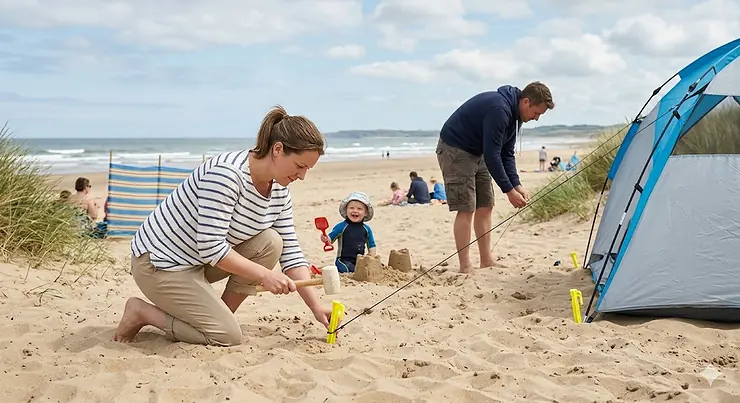
Picture this: you’ve driven three hours to the stunning Cornish coast, pitched your tent on what seemed like perfect sand near Shell Island, and settled in for a peaceful night listening to the waves. Then at 2 AM, a proper British coastal gust arrives — the kind that makes you question every life decision — and suddenly your tent’s doing an impression of a kite. Standard wire pegs, the ones that came bundled with your tent, have simply surrendered and pulled straight through the sand like they were never there.
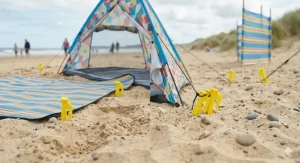
According to Wikipedia’s comprehensive guide on tent pegs, these essential camping tools have evolved significantly from simple wooden stakes to modern engineered solutions designed for specific ground conditions. British coastal environments present unique challenges that standard pegs simply weren’t designed to handle.
I’ve been there. Every UK camper who’s attempted beach camping has been there. The harsh truth is that those flimsy wire pegs manufacturers chuck in with tents are utterly useless on British beaches, where soft sand meets notoriously unpredictable coastal winds.
Beach tent pegs aren’t just another bit of camping kit to tick off a list — they’re the difference between waking up to a sunrise over the Jurassic Coast and waking up tangled in collapsed nylon at 3 AM in horizontal rain. Whether you’re planning a family weekend at Pembrokeshire’s sandy shores, a romantic wild camp at Scotland’s Sanna Bay, or a proper adventure along Northumberland’s Ross Back Sands, the right pegs determine whether your coastal camping experience becomes a cherished memory or a cautionary tale shared in hushed tones at the pub.
This guide examines seven thoroughly tested options available on Amazon.co.uk, covering everything from budget-friendly galvanised steel pegs to specialist sand anchors and premium British-made ground anchors that have survived genuine gale-force winds on exposed coastal pitches. We’ll explore what actually works when soft sand, salt air, and British weather team up to test your camping setup.
Quick Comparison Table: Beach Tent Pegs at a Glance
| Product | Type | Length | Best For | Price Range (GBP) | Prime Available |
|---|---|---|---|---|---|
| KEPLIN Steel Alloy (50pk) | Galvanised Steel | 23cm | Budget bulk buy, firm sand | £12-£18 | ✅ |
| Delta Ground Anchors | Nylon Composite | 18cm | High winds, premium hold | £25-£35 (4pk) | ❌ |
| Blue Diamond Screw Pegs | Galvanised Steel Screw | 20cm | Variable sand conditions | £15-£22 (20pk) | ✅ |
| ANSIO Heavy Duty (20pk) | Galvanised Steel | 23cm | General UK camping | £6-£9 | ✅ |
| HIKEMAN Aluminium (20pk) | Aluminium Alloy | 18cm | Lightweight, beach camping | £8-£12 | ✅ |
| Plastic Sand Stakes (various) | Heavy Duty Plastic | 23-30cm | Pure sand, visibility | £5-£10 | ✅ |
| BeneLabel Spiral Anchor | Steel Screw (50cm) | 50cm | Soft ground, storm anchoring | £18-£25 (2pk) | ✅ |
From the comparison above, the ANSIO Heavy Duty pegs offer the best all-round value under £10 for typical British coastal campsites where you’ll encounter a mix of sand and firmer ground. However, if you’re tackling genuinely soft, shifting sand — the kind you find at Cornwall’s beach campsites or along the Welsh coast — the Blue Diamond screw pegs or proper plastic sand stakes justify the modest extra spend. Budget-conscious families camping frequently should note the KEPLIN 50-pack delivers exceptional per-peg value at roughly £0.30 each, though you’ll be carrying more weight than necessary if you’re wild camping on foot.
💬 Just one click — help others make better buying decisions too! 😊
Top 7 Beach Tent Pegs: Expert Analysis & UK Availability
1. KEPLIN Steel Alloy Tent Pegs (50 Pack) — The Budget Bulk Champion
If you’re the sort of family that camps regularly around the UK coast — perhaps a week in Devon followed by a long weekend in North Wales — and you’re tired of constantly replacing bent or lost pegs, the KEPLIN 50-pack represents exceptional economy. These 23cm galvanised steel pegs offer robust construction with rust-resistant coating, crucial for Britain’s perpetually damp coastal conditions.
The alloy steel construction means they’ll withstand hammering into moderately firm sand without bending, unlike cheaper alternatives. The galvanised finish provides genuine corrosion resistance — rather important when your pegs spend hours in salt-laden air and damp sand. At roughly £0.30-£0.40 per peg, this pack ensures you’ll never run short, with plenty of spares for lending to unprepared fellow campers or replacing inevitable losses in shifting sand.
UK buyers consistently praise the KEPLIN pegs for holding firm in typical British beach camping scenarios. One Amazon.co.uk reviewer noted they survived a windy night at a Welsh coastal campsite whilst neighbouring tents struggled with standard pegs. The longer 23cm length provides better anchoring than shorter 15cm alternatives, particularly important when camping at exposed locations like the Peak District’s edges or Lake District coastal sites where weather changes arrive without warning.
Pros:
✅ Exceptional bulk value — roughly £0.30 per peg
✅ Galvanised coating resists UK coastal corrosion brilliantly
✅ 23cm length grips well in firm-to-moderate sand
Cons:
❌ Heavier than aluminium alternatives — not ideal for backpacking
❌ Can bend on rocky ground hidden beneath sand
Price: Around £12-£18 for 50 pegs
Value Verdict: Perfect for car campers and families who want a comprehensive peg collection without breaking the bank. The sheer quantity makes these ideal for large family tents or multiple smaller tents.
2. Delta Ground Anchors — British-Engineered Premium Hold
The Delta Ground Anchors, designed and manufactured in Britain, represent the Rolls-Royce of tent pegs. These aren’t your standard pointy sticks — they’re precision-engineered triangular anchors developed in collaboration with Exeter University’s department of advanced technology specifically to tackle unpredictable British camping conditions.
Made from super-tough nylon composite material (stronger than conventional plastic), Delta pegs work fundamentally differently to traditional pegs. The unique triangular shape directs guy tension deeper into the ground where soil is firmer, whilst the increased surface area means substantially more sand or soil must shift before the peg fails. The angled profile creates a balanced hold that minimises leverage and eliminates the anchor’s ability to “cut” through sand the way thin wire pegs do.
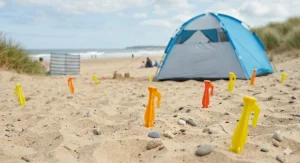
What sets Delta anchors apart for UK coastal camping is their proven performance in genuinely brutal conditions. These pegs have survived documented 70mph winds on exposed British campsites — the kind of storms that arrive off the Atlantic and test everything about your setup. They lay completely flat when installed, eliminating trip hazards (crucial when kids are running about), and weigh just 60g each despite their holding power.
For beach camping specifically, Delta anchors excel in the mixed conditions common at UK coastal sites — that frustrating combination of soft sand near dunes and firmer compacted sand lower down. Their broad surface area grips sandy ground far more effectively than thin pegs, whilst the engineered angle means you’re getting optimal holding power without needing to calculate angles yourself.
Pros:
✅ British-made engineering tested to 70kg holding power
✅ Virtually indestructible in unpredictable UK weather
✅ Incredibly lightweight at 60g — easier to see than wire pegs
Cons:
❌ Premium pricing at £25-£35 for just 4 pegs
❌ Not ideal for pure soft sand — work best on firmer ground
Price: Around £25-£35 for 4-pack
Value Verdict: Worth every penny if you camp regularly in exposed coastal locations or during Britain’s stormy seasons. Consider these an investment in peace of mind — one set will likely outlast your tent.
3. Blue Diamond Heavy Duty Screw Tent Pegs (20 Pack) — The Sand Specialist
Screw pegs work on a completely different principle to traditional stakes, and the Blue Diamond Heavy Duty Screw Tent Pegs exploit this brilliantly for beach camping. Rather than relying on friction alone, these 20cm galvanised steel pegs literally screw into the ground, creating a mechanical lock that’s far harder to pull free from sandy conditions.
The spiral thread design means these pegs “squirm” their way through sand rather than just being hammered in — you can twist them in by hand using the top loop for leverage, or speed up the process with a cordless drill and the included hex adapter. This makes them particularly clever for shifting sand conditions where traditional pegs simply pull straight through. The galvanised steel construction resists the corrosive effects of salt air, whilst the rotating head design means the peg can turn without loosening the guy line attachment.
For UK beach camping, where you’re dealing with everything from loose dry sand to damp compacted sand to the occasional hidden rock, screw pegs offer exceptional versatility. They work brilliantly at popular British coastal campsites like those along Cornwall’s shores, Pembrokeshire beaches, or the North Norfolk coast where sand conditions vary within metres. The 20-pack means you’ve got comprehensive coverage for a typical 4-6 person family tent plus awning.
UK reviewers consistently note these held firm during coastal winds that pulled out neighbouring campers’ standard pegs. The included storage case is a thoughtful touch — keeps them organised in your camping kit and doubles as a twisting handle for installation.
Pros:
✅ Screw design provides mechanical lock in soft sand
✅ Works with cordless drill for quick setup
✅ Storage case included — brilliant for keeping organised
Cons:
❌ Slower to install than traditional pegs if doing manually
❌ Thread can become clogged with damp sand and debris
Price: Around £15-£22 for 20-pack
Value Verdict: Excellent middle-ground option for families who camp at various UK beach locations. The mechanical advantage justifies the modest premium over basic steel pegs when you’re dealing with challenging sand.
4. ANSIO Heavy Duty Galvanised Metal Pegs (20 Pack) — The UK Coastal Workhorse
Sometimes the best solution is the simplest one executed well, and the ANSIO Heavy Duty Galvanised Metal Pegs prove this beautifully. These 23cm galvanised steel pegs feature straightforward robust construction — no gimmicks, just 4-5mm steel with zinc coating for rust resistance. They’re the sensible choice for most UK coastal camping scenarios.
What makes ANSIO pegs particularly suited to British beach camping is the galvanised coating’s performance in our notoriously damp climate. Salt air accelerates corrosion dramatically, and cheap uncoated pegs can rust through in a single season of coastal use. The zinc coating on these provides genuine long-term protection — reviewers report years of reliable service camping around Wales, Scotland, and coastal England without significant deterioration.
The 23cm length hits the sweet spot for UK beach camping. Shorter 15cm pegs lack the holding power needed in soft sand, whilst longer 30cm+ pegs become unwieldy and heavy. These penetrate deep enough to grip firmly in most coastal sand conditions, particularly the firmer damp sand typical of British beaches after our frequent rain showers. Available in packs of 10, 20, or 50, they offer flexibility for different camping setups.
UK buyers consistently praise these ANSIO pegs for their durability in typical British camping conditions. One Amazon.co.uk reviewer specifically noted using these at a Welsh campsite during Storm Eunice, where they held firm whilst other tents around struggled. That’s the kind of real-world UK testing that matters — not manufacturer claims, but actual performance during the gales we actually experience on British coasts.
Pros:
✅ Excellent value at £6-£9 for 20 pegs
✅ Proven rust resistance in UK’s damp coastal climate
✅ 23cm length perfect for varied British beach conditions
Cons:
❌ Basic design means less holding power than specialised anchors
❌ Can struggle in very soft, shifting sand
Price: Around £6-£9 for 20-pack
Value Verdict: The sensible default choice for most UK beach campers. Exceptional value, proven performance, and readily available with Amazon Prime for next-day delivery before your coastal weekend.
5. HIKEMAN Aluminium Alloy Tent Stakes (20 Pack) — The Lightweight Beach Option
Weight matters when you’re wild camping along the South West Coast Path or carrying your kit down to a remote Scottish beach, and the HIKEMAN Aluminium Alloy Tent Stakes deliver impressive strength-to-weight ratio. These 18cm aluminium pegs weigh roughly 60% less than equivalent steel pegs, yet maintain adequate holding power for beach camping in moderate conditions.
The aluminium alloy construction naturally resists corrosion — unlike steel which relies on galvanising, aluminium simply doesn’t rust. This makes them particularly brilliant for coastal camping where salt spray and damp conditions would gradually deteriorate cheaper materials. The bright colour options (often orange or yellow) provide excellent visibility against sand — crucial for avoiding trip hazards and locating pegs when packing up.
For UK beach camping specifically, these work well in firmer sand conditions typical of many British coastal campsites. They lack the pure holding power of heavier steel pegs, so they’re best suited to scenarios where you’re not expecting severe winds. Think summer beach camping along sheltered coves rather than exposed headlands in autumn gales. The 18cm length provides decent penetration without adding unnecessary weight.
The included drawstring storage bag is a thoughtful addition — keeps them together in your rucksack and prevents them jangling about during transport. UK reviewers particularly appreciate these for cycle-camping trips along coastal routes, where every gram saved matters over long distances.
Pros:
✅ Extremely lightweight — ideal for backpacking to beaches
✅ Natural corrosion resistance in salt air
✅ High visibility colours prevent loss in sand
Cons:
❌ Less holding power than steel in soft sand
❌ Can bend if hammered into hidden rocks
Price: Around £8-£12 for 20-pack
Value Verdict: Perfect for wild campers and backpackers tackling Britain’s coastal trails. The weight savings justify the modest premium if you’re carrying everything on your back to remote beaches.
6. Plastic Sand Stakes (Various Brands) — The Pure Sand Solution
Sometimes you encounter genuinely soft, shifting sand — the kind found at Shell Island in North Wales, along Cornish dune systems, or at Scotland’s most remote beaches — and traditional metal pegs simply don’t work. That’s where proper Plastic Sand Stakes come into their own, with their significantly larger surface area designed specifically to grip loose sand.
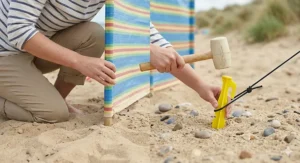
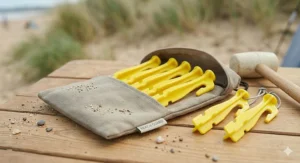
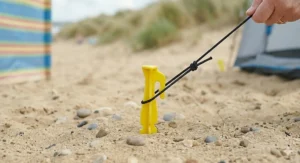
These heavy-duty plastic pegs (typically 23-30cm length) work on a different principle to metal stakes. Rather than relying purely on depth, they use width — the broader profile means substantially more sand must move before the peg pulls free. The bright yellow or orange colours provide excellent visibility against sand, reducing trip hazards and making them easy to locate when packing up. Crucially, plastic won’t rust or corrode in salt air, maintaining performance season after season.
For UK beach camping, plastic sand stakes excel in specific scenarios: designated beach camping areas with soft sand, dune camping where the ground is loose and shifting, or family beach trips where kids are running about and the bright colours prevent accidents. They’re also brilliant for securing windbreaks and beach shelters — applications where visibility and safety matter as much as holding power.
Multiple brands offer variations on Amazon.co.uk (including options from various manufacturers), typically in packs of 10-24. The wider surface area does mean they’re bulkier to transport than thin metal pegs, but that’s the trade-off for superior performance in pure sand. UK reviewers note these held beach gazebos secure during coastal breezes that would have pulled out metal pegs.
Pros:
✅ Superior grip in soft, loose sand conditions
✅ High visibility reduces trip hazards
✅ Won’t rust or corrode in coastal conditions
Cons:
❌ Bulkier to transport than thin metal pegs
❌ Less effective on firmer ground or rocky substrates
Price: Around £5-£10 for 10-24 pack
Value Verdict: Essential if you’re camping on genuinely soft sand. The modest cost is well worth it for the specific conditions where these truly shine. Consider carrying both plastic and metal pegs for UK coastal camping versatility.
7. BeneLabel Ground Anchor Screw (50cm) — The Storm-Proof Solution
When British coastal weather turns properly nasty — the kind of conditions where you’re genuinely testing whether your tent will still be standing come morning — the BeneLabel Ground Anchor Screw represents serious anchoring capability. These massive 50cm spiral steel anchors aren’t for everyday beach camping; they’re for exposed locations, storm conditions, or situations where tent failure simply isn’t an option.
The spiral design works like a ground screw, biting deep into soft ground with each rotation. The 50cm length means you’re anchoring into soil layers that simply don’t shift, even when surface sand is blowing about. The included fixed plate at the top provides a secure attachment point that distributes guy line tension across a broader area than traditional peg heads. Installation requires genuine effort — you’ll use the included drill adapter or T-handle to screw these in, not a lightweight mallet.
For UK beach camping, these are overkill for typical conditions but invaluable for specific scenarios: exposed coastal wild camping during Britain’s notorious autumn and winter storms, securing bell tents or larger family tents at clifftop sites, or main guy anchoring where tent failure would be genuinely dangerous. They’re also brilliant for more than just tents — caravan awnings, gazebos at beach events, or temporary shelters all benefit from this level of anchoring.
UK reviewers who’ve invested in these consistently report them surviving conditions that pulled out every other peg type. One Amazon.co.uk buyer noted these held a large family tent secure during 50mph gusts at a Scottish coastal site whilst neighbouring campers spent the night re-pegging. That kind of peace of mind has genuine value when you’re camping with family in exposed locations.
Pros:
✅ Exceptional holding power in severe conditions
✅ 50cm depth reaches stable ground beneath shifting sand
✅ Fixed plate distributes tension effectively
Cons:
❌ Expensive at £18-£25 for just 2 pegs
❌ Heavy and bulky — not practical for lightweight camping
Price: Around £18-£25 for 2-pack
Value Verdict: Specialist kit for specific scenarios rather than everyday use. If you camp regularly in exposed coastal locations or during stormy seasons, invest in 4-6 of these for main guy lines whilst using cheaper pegs elsewhere on the tent.
Real-World Application: Matching Pegs to British Beach Scenarios
Choosing beach tent pegs isn’t about finding the single “best” option — it’s about understanding which solution matches your specific UK coastal camping scenario. According to Visit Britain’s camping resources, coastal camping remains one of the UK’s most popular outdoor activities, with millions visiting beach campsites annually. Here’s how to think through the decision based on actual British beach camping situations you’ll encounter.
Family Weekend at Established Coastal Campsite (Cornwall, Pembrokeshire, North Wales)
You’re pitching at a proper campsite near the beach — sites like those along Cornwall’s coast, Pembrokeshire’s stunning shores, or North Wales’s Shell Island. These locations typically feature moderately firm sand with some grass, decent wind protection from dunes or hedges, and the ability to drive right to your pitch.
Recommended Setup: Use ANSIO Heavy Duty Galvanised Pegs (20-pack) as your primary pegs. They offer excellent value at around £7, hold well in the mixed sand/firmer ground typical of established sites, and the galvanised coating resists the coastal corrosion that’ll gradually destroy cheaper alternatives. Add 10-12 plastic sand stakes for guy lines positioned in softer sand areas, particularly if you’re camping near dunes. Total investment: roughly £12-£15.
This combination covers you for typical British coastal campsite conditions whilst keeping costs sensible for family camping where kids might lose the odd peg in the sand.
Wild Camping on Remote Scottish Beach (Sanna Bay, Ross Back Sands)
You’re backpacking to a genuinely remote beach — perhaps Sanna Bay on the Ardnamurchan Peninsula or Northumberland’s Ross Back Sands — carrying everything on your back. Weight matters significantly, you’ll face exposed conditions with minimal wind protection, and the sand varies from soft and shifting near the waterline to firmer higher up.
Recommended Setup: Invest in HIKEMAN Aluminium Alloy Stakes (20-pack) for base weight savings, supplemented by 4 Delta Ground Anchors for your main guy lines. The aluminium pegs keep your pack weight reasonable for the walk-in, whilst the Delta anchors provide the holding power you absolutely need in exposed conditions where help isn’t nearby. Total investment: roughly £35-£40, but the weight savings and reliability justify the cost for wild camping.
The Delta pegs have survived documented 70mph winds on UK campsites — that’s the kind of proven British weather performance you want when you’re miles from your car on an exposed Scottish beach.
Beach Day Trip with Windbreak/Beach Shelter (Day Use)
You’re not camping overnight, just spending a day at a British beach with a windbreak or beach shelter to protect the family from our characteristically temperamental coastal weather. You need something quick to deploy, visible (to prevent trip hazards with kids running about), and affordable enough that losing one or two to shifting sand isn’t a financial disaster.
Recommended Setup: Plastic Sand Stakes (24-pack) in bright yellow or orange. These run roughly £8-£10, provide the surface area needed to hold in soft beach sand, and the high visibility prevents accidents. The broader profile works brilliantly for windbreaks and beach shelters where traditional thin pegs simply pull through. They pack flat in the car boot alongside your beach kit.
For British beach days where conditions change hourly and sand is genuinely soft, plastic pegs are the sensible, affordable choice that actually works.
Sand Pegs vs Screw Pegs: The Coastal Camping Debate
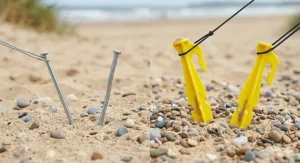
One of the most common questions from UK beach campers centres on a fundamental choice: traditional sand pegs with larger surface area, or screw-in ground anchors that create a mechanical lock? Both approaches work, but they suit different British coastal conditions. Understanding the distinction helps you make smarter purchasing decisions.
Traditional Sand Pegs: Surface Area Strategy
Traditional sand pegs — whether plastic or metal with broader profiles — work through increased surface area. The physics is straightforward: more sand must move for the peg to pull free. Plastic variants typically measure 23-30cm in length with significantly wider profiles than standard tent pegs. They rely on friction and the sheer volume of sand that needs shifting.
Where they excel in the UK: Soft, dry sand typical of British dune systems (Cornwall’s beaches, Welsh coastal dunes, Scottish machair grassland). Day-use beach shelters and windbreaks where visibility matters. Quick deployment scenarios where you’re not facing severe weather. Budget-conscious families who camp occasionally.
UK-specific limitation: Our notoriously wet climate means sand is often damp and compacted rather than loose and dry. In these conditions, traditional sand pegs can struggle to achieve adequate depth without substantial effort, and the broader profile sometimes works against you when sand is firm.
Screw Pegs: Mechanical Advantage
Screw-in ground anchors (like the Blue Diamond models or BeneLabel spiral anchors) use threading to create a mechanical lock. As you twist them into the ground, the spiral design pulls the peg down whilst creating resistance in multiple directions. They can be installed quickly with a cordless drill or more slowly by hand using the top loop.
Where they excel in the UK: Variable sand conditions typical of British coastal campsites (the frustrating mix of soft patches and firm compacted areas). Exposed locations where you’re facing genuine wind. Situations where you need reliable holding power but don’t want to carry enormously heavy kit. Campers who appreciate the efficiency of power-tool installation.
UK-specific limitation: Screw threads can become clogged with the damp, slightly clayey sand common at some British beaches, particularly after rain. They’re slower to install manually than simply hammering a traditional peg, and if you forget your cordless drill, you’re doing everything by hand.
The Pragmatic British Solution: Carry Both
Here’s what experienced UK coastal campers actually do: they carry both types. Use plastic sand pegs or traditional broader pegs for quick deployment and softer sand areas. Reserve screw pegs for main guy lines where holding power is critical, or for firmer ground where their mechanical advantage truly matters. The modest cost of both types (roughly £15-£25 total) is well worth the flexibility when British weather decides to test your setup.
One Amazon.co.uk reviewer put it brilliantly: “Tried just screw pegs on a Welsh beach last summer. Worked fine until we hit a patch of pure soft sand near the dunes where the threads just spun uselessly. Now I carry both — screw pegs for the tent body, plastic stakes for guy lines in softer areas. Problem solved.”
✨ Ready to Upgrade Your Beach Camping Kit?
🏖️ Don’t let inadequate pegs ruin your coastal adventure! Check current prices and availability on Amazon.co.uk for the beach tent pegs that match your UK camping needs. Free delivery available with Prime membership, with next-day delivery options for last-minute camping trips.
Common Mistakes When Buying Beach Tent Pegs (And How to Avoid Them)
After years of British coastal camping and reviewing countless Amazon.co.uk purchases, certain mistakes appear repeatedly. Here’s what to actually avoid, based on genuine UK camping experience rather than manufacturer marketing.
Mistake 1: Assuming “Beach Peg” Automatically Means Sand-Capable
Many pegs marketed as suitable for “beach camping” are just standard metal pegs with slightly more aggressive marketing. Look for specific design features: broader profiles (plastic pegs), spiral threading (screw anchors), or engineered shapes (Delta-style anchors). A thin 4mm steel peg labelled “beach camping” is just marketing — it’ll pull straight through soft British beach sand regardless of what the listing claims.
The fix: Check product dimensions carefully. For genuine soft sand capability, plastic pegs should be at least 20mm wide at their broadest point. Screw anchors need visible threading along substantial portions of the shaft. If the product photos show thin wire-like pegs, they’re not genuinely sand-capable.
Mistake 2: Buying Only One Peg Type for “Versatility”
British coastal conditions vary dramatically within metres — soft sand near dunes, firmer compacted sand lower down, occasional grass patches, hidden rocks beneath the surface. A single peg type will excel in some conditions and struggle in others. That “versatile” claim usually means “adequate everywhere, excellent nowhere.”
The fix: Budget £15-£25 for a mixed peg collection rather than £10 on a single type. Carry 12-16 general-purpose galvanised steel pegs (ANSIO or KEPLIN) for most attachment points, plus 8-10 specialist pegs (plastic sand stakes or screw anchors) for challenging spots. This modest investment transforms your coastal camping from “hopeful” to “confident.”
Mistake 3: Ignoring UK Climate Impact on Materials
That brilliant American-made peg might work superbly in Arizona’s bone-dry desert camping, but British coastal conditions include salt air, persistent dampness, and frequent rain. Standard steel corrodes rapidly without proper galvanising. Cheap plastic becomes brittle in UV exposure then cracks during installation.
The fix: Prioritise galvanised steel or aluminium for metal pegs, not plain carbon steel. Check UK reviewer feedback specifically — comments from British coastal campers are worth more than generic five-star reviews from different climates. Products with verified UK purchases and positive coastal camping feedback have proven themselves in conditions you’ll actually face.
Mistake 4: Underestimating Quantity Needed for Coastal Conditions
Your tent came with 12 pegs and you think that’s sufficient. Then you arrive at a breezy British beach and discover half the standard attachment points aren’t providing adequate hold, your guy lines need additional anchoring against wind, and you’re wishing you’d brought spares. Coastal conditions demand redundancy.
The fix: Calculate tent requirements, then add 30-50% extra. A typical 4-person family tent needs 12-16 pegs for basic setup; carry 18-24 total. This accounts for losses (pegs disappear mysteriously in sand), breakages on hidden rocks, and additional guy line anchoring when British coastal weather arrives. The KEPLIN 50-pack becomes sensible when viewed this way — you’re not buying excess, you’re buying peace of mind.
Mistake 5: Prioritising Weight Over Holding Power (When Driving to Site)
If you’re car camping — driving right to your pitch at an established coastal campsite — obsessing over peg weight is misguided. That 500g difference between steel and aluminium pegs matters tremendously when backpacking Scotland’s remote beaches, but it’s irrelevant when you’re unloading from a car boot 10 metres from your pitch.
The fix: Match priorities to your specific camping style. Car camping at established British coastal sites? Prioritise holding power and value — heavier galvanised steel pegs (KEPLIN, ANSIO) deliver both affordably. Backpacking remote beaches? Then weight justifies premium pricing for aluminium or carefully selected lightweight options. Don’t pay weight-savings premiums for camping scenarios where weight doesn’t matter.
How to Choose Beach Tent Pegs for UK Coastal Conditions
Selecting the right beach tent pegs isn’t about finding the universally “best” option — it’s about matching specific products to your particular British coastal camping scenarios. Here’s a systematic approach based on the factors that actually matter when you’re pitching on UK beaches.
Step 1: Assess Your Primary Sand Type
British beaches vary dramatically in sand characteristics, and this determines which peg mechanisms will work. Walk to your intended camping area (or research the specific beach online) and identify the dominant condition.
Soft, dry sand (Cornwall’s dune systems, parts of the Welsh coast, Scottish machair): Requires pegs with substantial surface area or deep penetration. Plastic sand stakes or long screw anchors work well. Traditional thin pegs will simply pull through.
Firm, damp sand (typical after rain on most British beaches, compacted areas near the waterline): Standard galvanised steel pegs work adequately, but screw-type anchors provide extra security. This is the most common UK coastal condition.
Mixed conditions (soft patches near dunes, firmer areas lower down): Requires versatility in your peg collection. Carry multiple types.
Step 2: Evaluate Wind Exposure
British coastal weather is notoriously changeable, but some locations face consistently higher winds. Exposed headlands, clifftop sites, and beaches with minimal natural wind protection demand superior holding power.
Sheltered locations (beaches with natural dune barriers, coves with high cliffs, wooded coastal campsites): Standard galvanised steel pegs provide adequate holding power. Budget options like ANSIO work fine.
Moderately exposed (open beaches with some protection, established campsites with windbreaks): Combination approach works well — standard pegs for most points, premium anchors (Delta) for main guy lines facing prevailing wind.
Highly exposed (clifftop wild camping, headland positions, storm season camping): Premium anchors are non-negotiable. Delta Ground Anchors for main guys, heavy-duty screw anchors or long steel pegs elsewhere. This isn’t the scenario for budget compromises.
Step 3: Consider Transport Method
How you’re getting to the beach fundamentally affects which pegs make sense. Weight matters dramatically for some camping styles, barely at all for others.
Car camping (driving to pitch): Weight is irrelevant; prioritise holding power and value. Buy more pegs than you think you need. The KEPLIN 50-pack or ANSIO 20-pack represent excellent value.
Cycle camping (touring coastal routes): Moderate weight consciousness matters. Aluminium pegs (HIKEMAN) offer sensible compromise between weight and holding power. Carry fewer pegs but higher quality.
Backpacking (remote beach wild camping): Every gram counts over long distances. Premium lightweight options (aluminium stakes, carefully selected Delta anchors) justify their cost through weight savings. But don’t sacrifice holding power entirely — a collapsed tent miles from anywhere is worse than carrying 200g extra.
Step 4: Match Frequency of Use to Budget
How often you’ll actually use these pegs should influence how much you invest. British coastal camping varies from annual summer holidays to monthly weekend trips.
Occasional use (once or twice yearly): Budget options work fine. ANSIO 20-pack for around £7 will serve occasional campers perfectly well for years.
Regular use (monthly coastal trips, frequent beach camping): Mid-range investment pays off. Combination of ANSIO or KEPLIN general pegs plus some Blue Diamond screw pegs or plastic sand stakes. Total around £15-£25.
Frequent/serious use (weekly camping, wild camping, storm season trips): Premium investment justified. Delta Ground Anchors, quality screw anchors, comprehensive mixed collection. Budget £40-£60 for a professional-grade setup that’ll last years.
Step 5: Account for UK-Specific Requirements
Finally, factor in requirements unique to British coastal camping that wouldn’t apply elsewhere.
Corrosion resistance: Salt air is brutal on untreated steel. Galvanised coating (ANSIO, KEPLIN, Blue Diamond) or naturally corrosion-resistant materials (aluminium, plastic) are essential for longevity.
Visibility: British beaches often involve camping near public areas where trip hazards are serious concerns. Brightly coloured pegs (plastic stakes, some aluminium options) reduce accident risk.
Compliance with site rules: Some UK coastal campsites have restrictions on peg types (particularly limitations on long screw anchors that could damage underground utilities). Understanding your rights and responsibilities under UK outdoor access laws helps ensure responsible coastal camping. Check site-specific rules before purchasing extreme lengths.
What to Expect: Real-World Performance in British Beach Conditions
Manufacturer specifications tell one story; actual performance on UK beaches often tells another. Here’s what different peg types genuinely deliver when British coastal weather and sand conditions team up to test your setup.
Galvanised Steel Pegs in Typical British Beach Sand
Standard galvanised steel pegs (ANSIO, KEPLIN models) perform adequately in the moderately firm, damp sand that characterises most British beaches after our frequent rain. They penetrate reasonably well with a rubber mallet, and the 23cm length provides decent holding power. Expect to drive them in at 45-degree angles away from the tent for optimal resistance.
What the specifications won’t tell you: in genuinely soft, dry sand (the kind you occasionally encounter in British dune systems), these struggle. They penetrate easily enough, but pulling force from guy lines in wind simply extracts them slowly. One Amazon.co.uk reviewer described it brilliantly: “They held fine until the wind picked up around midnight, then they gradually ‘walked’ out of the soft sand over two hours. Woke up at 2 AM to loose guy lines.”
In mixed British conditions — patches of soft sand interspersed with firmer areas — galvanised steel pegs work well if you’re selective about placement. Use them in firmer sand where their length and weight provide genuine bite. For softer patches, you need alternatives.
Plastic Sand Stakes in Pure Soft Sand
Proper plastic sand stakes excel exactly where thin metal pegs fail — in the genuinely soft, shifting sand typical of British dune camping or locations like Shell Island. The broader profile (often 25-30mm wide) means substantially more sand must move for the peg to pull free. In soft conditions, they dramatically outperform metal alternatives.
However, British beaches aren’t uniformly soft sand. After rain (which is frequently), sand becomes damp and compacted. In these firmer conditions, plastic stakes become harder to drive deep without the peg tip deforming. You’re hammering a relatively soft material into increasingly resistant substrate. UK reviewers note you need a proper rubber mallet, not the lightweight hammers that work fine with metal pegs.
The high visibility (bright yellow or orange) proves genuinely valuable on British beaches where you’re often camping near public areas. Trip hazards are real concerns with kids and other campers about. The ability to spot pegs easily reduces accidents and makes locating them for pack-up far simpler when they’re partially buried in blown sand.
Screw-In Ground Anchors in Variable Conditions
Screw pegs (Blue Diamond models, BeneLabel spiral anchors) shine in the variable conditions typical of established UK coastal campsites. They handle soft patches reasonably well through mechanical advantage, whilst in firmer sand the threading provides superior bite compared to smooth-shaft pegs.
With a cordless drill and hex adapter, installation is genuinely quick — 10-15 seconds per peg versus 30-45 seconds of hammering for traditional pegs. That efficiency matters when you’re setting up in changeable British weather and want your tent secured before the next rain shower arrives.
The limitation emerges in extremely soft, dry sand where the threads simply spin without biting. One UK camper noted trying these in pure dune sand near Braunton Burrows (North Devon) and struggling because there wasn’t enough compaction for the threads to grip. They work brilliantly in 80% of British beach conditions; it’s that occasional 20% of genuinely loose sand where alternatives perform better.
Premium Delta Anchors in High-Wind Scenarios
Delta Ground Anchors deliver on their premium claims when British coastal weather turns genuinely nasty. Multiple UK reviewers document these surviving documented 50-60mph winds that pulled out neighbouring campers’ standard pegs. The triangular design and engineered attachment point genuinely do redirect forces deeper into the ground.
What’s particularly impressive for UK coastal camping is their performance in the waterlogged grass often found at clifftop campsites after rain. The broad surface area prevents them “cutting” through saturated ground the way thin pegs do. They’ve held firm in conditions where the ground was so wet that traditional pegs simply pulled straight through.
The limitation for pure beach camping is their price and quantity. At £25-£35 for just 4 pegs, equipping an entire tent becomes prohibitively expensive. The pragmatic UK approach is using Delta anchors strategically for main guy lines facing prevailing wind, whilst using cheaper pegs elsewhere on the tent. This gives you the critical holding power where it truly matters without breaking the budget.
Beach Camping Gear Essentials Beyond Pegs
Beach tent pegs matter tremendously, but they’re just one component of successful UK coastal camping. Here’s what else you need to get right for British beach conditions.
The Mallet Question: Rubber vs Metal
Standard lightweight tent mallets struggle with beach camping, particularly when driving pegs into firmer, damp sand or mixed substrates. A proper rubber mallet (12oz minimum) provides the impact you need without damaging peg heads. Metal camping hammers work but add weight. The Milestone Camping 12oz rubber mallet (around £8-£12 on Amazon.co.uk) represents the sweet spot for most UK beach campers.
Guy Line Considerations for Coastal Wind
British coastal winds test guy line durability in ways that woodland camping simply doesn’t. Standard paracord works adequately, but reflective guy lines dramatically reduce trip hazard accidents when other campers or your own family are moving about after dark. The modest £5-£8 investment in quality reflective guys is worthwhile for safety alone.
Groundsheets for Damp Sand
British beaches are rarely bone-dry. Damp sand, morning dew, and our characteristic drizzle mean moisture management is crucial. A proper footprint groundsheet beneath your tent prevents moisture wicking up through tent floor fabric. Pack a separate tarp for gear storage outside the tent — keeps sandy boots and wet swimming kit away from sleeping areas.
Wind Protection Strategies
Even supposedly sheltered British beaches get breezy. The UK Met Office coastal weather guidance emphasises that coastal winds can be significantly stronger and more changeable than inland conditions. A dedicated windbreak (not just for comfort, but to reduce lateral forces on your tent) makes enormous difference to holding power requirements. Position windbreaks to deflect prevailing wind around your tent rather than trying to create a complete wind-free zone. This reduces the load on pegs whilst still providing shelter.
⛺ Secure Your Beach Camping Success
🌊 Browse the full range of beach tent pegs on Amazon.co.uk to find your perfect match. With user reviews from real UK coastal campers and Prime next-day delivery, you can have the right pegs ready for your weekend beach trip. Click any highlighted product name above to check current stock and pricing!
FAQ: Your Beach Tent Peg Questions Answered
❓ Do normal tent pegs work on UK beaches?
❓ What length tent pegs for beach camping in UK?
❓ Can I use screw pegs on British beaches?
❓ Are plastic or metal pegs better for beach camping?
❓ How many tent pegs needed for beach camping in UK?
Conclusion: Investing in Coastal Camping Peace of Mind
Beach tent pegs might seem like minor kit — just metal stakes, after all — but they fundamentally determine whether your British coastal camping trip becomes a cherished memory or a cautionary tale. The difference between £5 budget pegs and £15-£25 in proper beach-capable pegs is the difference between confident sleep listening to waves and anxious nights wondering if your tent will still be standing come morning.
For most UK beach campers starting out, the pragmatic approach is straightforward: invest in a 20-pack of ANSIO Heavy Duty Galvanised Metal Pegs (around £7) as your foundation, supplemented by 10-12 plastic sand stakes (roughly £8) for softer sand areas. This £15 total investment covers typical British coastal camping scenarios whilst keeping costs sensible. As you gain experience and tackle more challenging locations, add Delta Ground Anchors for main guy lines or Blue Diamond screw pegs for variable conditions.
Remember that British coastal camping rewards preparation. Our beaches are stunning — from Cornwall’s golden shores to Scotland’s wild remote coastlines — but they’re also exposed to weather that changes hourly and sand conditions that vary within metres. The right pegs transform these challenges from problems into managed variables. Pack a variety of peg types, carry more than you think you need, and match your choices to the specific beaches you’re tackling.
The seven options reviewed here all have genuine roles in UK beach camping. None is universally “best” — each excels in particular conditions. Your job is understanding which conditions you’ll actually face, then investing accordingly. Whether you’re planning a family weekend at a Pembrokeshire campsite, a romantic wild camp at a Scottish beach, or regular coastal trips around Britain, proper beach tent pegs are the foundation everything else builds upon.
Pack smart, peg wisely, and enjoy Britain’s magnificent coastal camping opportunities with confidence.
Recommended for You
- Best Tent Pegs for Rocky Ground UK: 7 Options That Won’t Bend 2026
- Best Shock Cord for Tent Poles: 7 UK Options 2026
- 7 Best Tent Pole Repair Kits UK 2026
Disclaimer: This article contains affiliate links. As an Amazon Associate, I earn from qualifying purchases. If you purchase products through these links, we may earn a small commission at no additional cost to you.
✨ Found this helpful? Share it with your mates! 💬🤗
