
In This Article
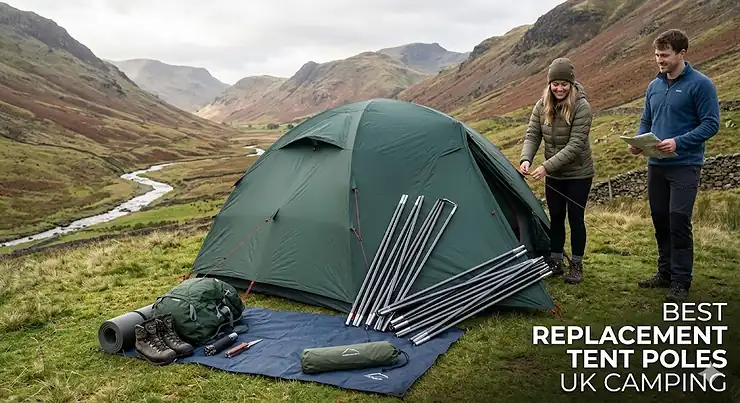
Picture this: you’re at a festival campsite in the Lake District, rain hammering down, and that distinctive crack echoes through your tent. Your pole’s snapped again. If you’ve experienced this particular brand of camping misery, you’ll know that replacement tent poles aren’t just another camping accessory — they’re the difference between a sheltered night’s sleep and a soggy, deflated nightmare.
Here’s what most UK campers don’t realise: the average fibreglass tent pole will last roughly 40-60 pitches before showing signs of stress fractures. Chuck in our reliably damp British weather, the odd muddy festival ground, and a boot accidentally landing on a pole bag, and that lifespan drops considerably. Yet walk into any camping shop, and you’ll find replacement tent poles ranging from around £8 to well over £60. What makes the difference?
After years of testing poles across wet weekends in the Cotswolds, windy expeditions in the Scottish Highlands, and more festival trips than I care to admit, I’ve learned that pole selection isn’t about buying the most expensive option — it’s about matching the right material, diameter, and construction to your specific camping style and British weather conditions. Whether you’re replacing a snapped pole on your family’s Coleman Sundome or upgrading your backpacking tent’s original setup, this guide covers everything you need to know about replacement tent poles available on Amazon.co.uk in 2026.
Quick Comparison: Top Replacement Tent Poles at a Glance
| Product | Material | Diameter | Best For | Price Range | UK Prime |
|---|---|---|---|---|---|
| Universal Fibreglass Pole Kit (9.5mm) | Fibreglass | 9.5mm | Budget family tents | £10-£15 | ✅ |
| Hi-Gear Premium Pole Set (11mm) | Cross-woven fibreglass | 11mm | Medium tents, festivals | £18-£25 | ✅ |
| Aluminium Alloy Replacement (8.5mm) | 7001 Aluminium | 8.5mm | Backpacking tents | £30-£45 | ✅ |
| Heavy-Duty Fibreglass Kit (12.7mm) | Reinforced fibreglass | 12.7mm | Large family tents | £20-£30 | ✅ |
| Telescopic Adjustable Tarp Poles | Aluminium | Adjustable | Tarps, awnings, versatile use | £15-£22 | ✅ |
| DAC-Compatible Aluminium Poles | 7075-T9 Aluminium alloy | 8.5-9mm | Premium backpacking | £55-£85 | Limited |
| Complete Universal Repair Kit | Mixed (fibreglass + ferrules) | 9.5mm | Emergency repairs, multi-tent | £12-£18 | ✅ |
💬 Just one click — help others make better buying decisions too! 😊
Top 7 Replacement Tent Poles: Expert Analysis
1. Universal Fibreglass Tent Pole Replacement Kit (9.5mm)
The workhorse of tent pole replacements, this 9.5mm fibreglass kit fits the majority of Coleman, Gelert, and Halfords tents floating around UK campsites. At around £10-£15, it’s the solution when you just need your tent functional again without breaking the bank.
Key Specs with Real-World Context:
- 9.5mm diameter suits medium 4-6 person tents
- Typically 5-7 sections at 45-60cm each
- Includes shock cord and ferrules
- Total assembled length: 3.5-4.5m (measure your existing pole first)
What the product listings won’t tell you: these budget fibreglass poles are absolutely fine for casual summer camping in stable British weather, but expect them to develop stress fractures after 30-40 pitches if you’re a festival regular. The cross-weave construction on better kits (look for “cross-woven” or “reinforced” in descriptions) adds about 25-30% more durability — worth the extra £2-£3 if you’re finding them.
Who This Is For: Families who camp 5-8 weekends per year, festival-goers replacing poles between seasons, anyone with a Coleman or similar budget tent needing a quick fix. Perfect for that Vango Icarus or Hi-Gear Voyager sitting in your garage.
Customer Feedback: UK buyers consistently praise the value for money, with typical comments noting “got us through Glastonbury without issues” and “easier to replace than expected.” The main grumbles come from campers who didn’t measure their pole diameter correctly — measure twice, order once.
Pros:
✅ Fits most common UK family tents (Coleman, Vango, Gelert models)
✅ Incredibly affordable — whole pole set for less than a takeaway
✅ Easy DIY replacement with included threading tool
Cons:
❌ Won’t handle sustained wind over 30mph without flexing excessively
❌ Develops surface splinters after 40-50 uses (keep them in sleeves)
Value Verdict: Around £10-£15 delivers exactly what you’d expect — functional, adequate poles that keep your tent standing. Don’t expect miracles, but for occasional camping, they’re rather good.
2. Hi-Gear Premium Fibreglass Pole Kit (11mm)
Available through various UK retailers and Amazon.co.uk, the Hi-Gear 11mm poles represent the sweet spot between budget fibreglass and premium aluminium. These thicker poles suit larger family tents and offer noticeably better wind resistance than 9.5mm alternatives.
Key Specs with Real-World Context:
- 11mm diameter — the standard for 6-8 person UK family tents
- Cross-woven fibreglass construction (stronger than standard weave)
- Section length: 60-70cm (fewer joints = fewer weak points)
- Compatible with most Hi-Gear, Vango, and Outwell family tents
The thicker 11mm diameter means these poles handle the weight of larger tent canopies without bowing, which matters when you’re pitching a Vango Odyssey or similar 6-berth tent in a damp Lake District field where the fabric’s picked up an extra kilo of water weight. The cross-woven construction I mentioned earlier? It’s not marketing fluff — the alternating fibre direction genuinely reduces the likelihood of lengthwise splitting, which is how most fibreglass poles fail in British conditions. According to Which? tent buying advice, proper pole construction is essential for UK weather durability.
Who This Is For: Owners of larger family tents, campers who pitch in exposed coastal or moorland sites, anyone upgrading from thinner poles that kept bending. Brilliant for those Vango AirBeam hybrids that still use traditional poles for the porch.
Customer Feedback: GO Outdoors and Amazon.co.uk reviews highlight improved durability over budget kits, with several buyers noting they’ve lasted “two full seasons of monthly camping” without cracks. A handful mentioned the poles arrived slightly longer than expected — this is intentional, as you’re meant to trim to fit.
Pros:
✅ Noticeably stiffer than 9.5mm — better in 20-35mph winds
✅ Cross-woven construction resists splitting in wet conditions
✅ Fits most popular UK family tent brands
Cons:
❌ Heavier than aluminium (matters if you’re carrying far from the car)
❌ Still fibreglass — will eventually splinter with heavy use
Value Verdict: At around £18-£25, these justify the modest premium over basic kits if you camp more than 8-10 weekends annually or face regular wind exposure. Rather good value for the durability gain.
3. 7001 Series Aluminium Alloy Replacement Poles (8.5mm)
Now we’re talking serious kit. Aluminium poles transform a tent’s performance, and these 7001 series poles are the entry point into proper lightweight, resilient tent supports. If you’ve only ever used fibreglass, the difference is genuinely startling.
Key Specs with Real-World Context:
- 8.5mm diameter 7001 aluminium alloy
- Weight: roughly 40% lighter than equivalent fibreglass
- Anodised finish for UK weather protection (important in our damp climate)
- Typical section length: 40-45cm (more compact when packed)
Here’s the practical difference: aluminium poles bend under extreme stress rather than shattering. That means when you’re caught in a sudden squall on a Peak District camping trip, your poles flex with the gusts and spring back. Fibreglass shatters. I’ve had fibreglass poles snap in my hands during a windy takedown; I’ve never broken an aluminium pole in fifteen years of camping. The anodised coating prevents the corrosion that can occur in British weather — particularly relevant if you camp near the coast or store your tent in a damp garage between trips.
Who This Is For: Backpackers, wild campers, cycle tourers, anyone carrying their tent more than 100 metres from a vehicle. Perfect for upgrading lightweight backpacking tents like the Vango Banshee or Alpkit Ordos.
Customer Feedback: UK backpackers rave about the weight saving — “shaved 300g off my pack weight” is a common refrain. A few noted they’re £20-£30 more than fibreglass, but “worth every penny for the peace of mind.” One cyclist mentioned they’d survived three Scotland NC500 trips without issues.
Pros:
✅ Dramatically lighter than fibreglass — 200-400g saved per full pole set
✅ Bends rather than breaks — survives wind stress that snaps fibreglass
✅ Anodised coating prevents rust in damp UK conditions
Cons:
❌ Costs 2-3× more than fibreglass (around £30-£45)
❌ Can develop small dents if handled roughly (cosmetic, not structural)
Value Verdict: At around £30-£45, these aren’t cheap, but you’re buying once rather than replacing fibreglass poles every 18 months. For regular campers, especially backpackers, they’re excellent value over the long term.
4. Heavy-Duty Fibreglass Pole Kit (12.7mm)
The beefiest fibreglass option, 12.7mm poles are designed for large family tents, canvas bell tents, and situations where you need serious load-bearing capacity without jumping to expensive aluminium alternatives.
Key Specs with Real-World Context:
- 12.7mm diameter (half-inch in imperial measurements)
- Reinforced wall thickness: typically 1.5-2mm vs 1-1.2mm on budget poles
- Section length: 65-72cm
- Total assembled length: often 4.5-5.5m for large tent main poles
The extra diameter and wall thickness mean these poles can support the weight of larger canvas tents, 8-10 person family tents, or those massive Outwell Montana-style structures that are basically portable houses. In practical terms, a 12.7mm pole can handle roughly twice the load of a 9.5mm pole before bowing becomes an issue. This matters enormously if you own one of those palatial family tents where the main poles are supporting 15-20kg of fabric and framework.
Who This Is For: Owners of 8+ person family tents, canvas tent enthusiasts, groups who camp together and need a tent that won’t sag under its own weight. Essential for bell tent owners — those single central poles take enormous stress.
Customer Feedback: TentSpares and Amazon.co.uk buyers mostly use these for specific large tent replacements. Comments like “finally doesn’t bow in the middle” and “fits my Outwell Montana perfectly” dominate. The only negative feedback comes from people who ordered 12.7mm when they needed 11mm — measure carefully, folks.
Pros:
✅ Exceptional load-bearing for large/heavy tents
✅ Thicker walls resist stress cracks longer than thinner poles
✅ Still cheaper than aluminium alternatives of equivalent strength
Cons:
❌ Heavy — you’ll notice the extra 400-600g if backpacking (don’t)
❌ Overkill for anything smaller than a 6-person tent
Value Verdict: Around £20-£30 is fair pricing for poles that’ll support a small village’s worth of camping accommodation. If you need 12.7mm, you need 12.7mm — there’s no substitute.
5. Telescopic Adjustable Aluminium Tarp Poles (90-230cm)
Technically not replacement tent poles in the traditional sense, but these adjustable beauties have saved more camping trips than I can count. They’re the Swiss Army knife of the tent pole world.
Key Specs with Real-World Context:
- Adjustable length: typically 90cm collapsed to 230cm extended
- 16mm diameter aluminium with twist-lock sections
- Non-slip rubber foot and pointed top cap
- Weight: 280-350g per pole
Why am I including these in a tent pole guide? Because versatility. I’ve used these to replace a snapped ridge pole on a tarp shelter, prop up a saggy porch section on a family tent, create extra headroom in a festival tent, and even fashion an emergency clothes line. The twist-lock mechanism is genuinely robust — I’ve had the same pair withstand three years of festival abuse. The rubber foot prevents them sinking into soft ground (hello, typical British campsite after rain), while the pointed cap slots neatly into most tent grommets.
Who This Is For: Festival campers who need adaptable kit, anyone running tarps or awnings, wild campers who want multi-use gear, families who might need emergency tent support. Absolute godsend if you’re camping with a tarp in changeable weather.
Customer Feedback: Amazon.co.uk reviews reveal these are hugely popular with UK festival-goers and wild camping enthusiasts. “Used them at Download and they’re still going strong” appears in various forms across dozens of reviews. Main criticism: they’re not as rigid as fixed-length poles, so unsuitable as permanent replacements for structural tent poles.
Pros:
✅ Infinitely adjustable — one size fits dozens of applications
✅ Lightweight aluminium yet surprisingly sturdy
✅ Non-slip foot essential in muddy UK campsites
Cons:
❌ Not rigid enough for main tent pole replacement
❌ Twist-locks can slip if over-tightened (hand-tight is sufficient)
Value Verdict: At around £15-£22 for a pair, these deliver remarkable versatility. Every camper should own a set — they’re brilliant value for the problem-solving capacity they provide.
6. DAC-Compatible Premium Aluminium Poles (7075-T9 Alloy)
Now we enter the realm of serious kit. DAC (Dongah Aluminum Corporation) revolutionised tent poles in the late 1990s with their Featherlite technology, creating aluminium alloys strong enough to reduce pole weight by 15-20% without sacrificing strength. These poles are what you’ll find on £400+ backpacking tents from brands like MSR, Hilleberg, and The North Face.
Key Specs with Real-World Context:
- 7075-T9 aluminium alloy (aerospace-grade material)
- 8.5-9mm diameter typical
- Pressfit ferrules (no glue = no weak points from adhesive failure)
- Weight: 150-200g lighter than standard aluminium for equivalent strength
The technical sophistication here is considerable. The 7075-T9 alloy uses zinc as the primary alloying element, creating a strength-to-weight ratio that’s roughly 30% better than the 7001 alloy used in standard aluminium poles. The Pressfit technology eliminates the glued ferrules that can fail in extreme cold or after UV exposure — rather clever when you consider how many tent poles fail at the joints rather than along their length.
Who This Is For: Serious backpackers tackling multi-day expeditions, mountaineers, cycle tourers covering serious distance, ultralight enthusiasts where every gram genuinely matters. Only worth considering if you’re putting serious miles on your tent or facing extreme weather.
Customer Feedback: Limited availability on Amazon.co.uk means fewer reviews, but specialist retailers like Scottish Mountain Gear confirm these poles deliver exceptional performance. The consensus among serious UK backpackers: they’re brilliant but expensive. Several reviewers noted the cost is hard to justify unless you’re genuinely putting them through their paces on challenging trips.
Pros:
✅ Lightest, strongest poles available for backpacking
✅ Pressfit technology eliminates common failure point
✅ Will outlast your tent if treated properly
Cons:
❌ Expensive — £55-£85 range makes your wallet wince
❌ Limited UK availability (often sourced from specialist retailers)
Value Verdict: Around £55-£85 is substantial money for tent poles, but if you’re logging 50+ nights per year in a backpacking tent, the weight saving and durability create genuine value. For weekend warriors? Probably excessive.
7. Complete Universal Tent Pole Repair Kit (9.5mm)
The emergency kit every camper should own. These comprehensive repair kits include multiple pole sections, ferrules, shock cord, threading tools, and sometimes even pole splints — basically a tent pole emergency room in a bag.
Key Specs with Real-World Context:
- 3-5 fibreglass pole sections (9.5mm standard)
- Assorted ferrules (straight and angled)
- 4-5 metres shock cord with threading needle
- Pole splint for temporary repairs
- Compact storage bag (fits in tent bag or car boot)
What makes these kits valuable isn’t the pole sections themselves — it’s the collection of ferrules, shock cord, and repair accessories that let you bodge together a solution when you’re three days into a week-long camping trip in Pembrokeshire and can’t just nip to GO Outdoors. I keep one permanently in my camping kit. I’ve used it twice in five years, but both times it transformed a potential trip-ruiner into a minor inconvenience.
Who This Is For: Anyone who camps more than 50 miles from home, festival campers, families on extended holidays, wild campers, basically everyone. This is insurance, not routine gear.
Customer Feedback: Amazon.co.uk buyers treat these as essential backup kit. “Saved our Cornwall holiday” and “fixed my mate’s tent at 2am during a festival” type reviews dominate. Criticism is minimal — occasionally someone notes the shock cord quality is basic, but it works when needed.
Pros:
✅ Complete solution for emergency repairs
✅ Compact enough to store permanently in camping kit
✅ Includes threading tool (fiddly job without one)
Cons:
❌ Fibreglass sections are basic quality
❌ Ferrules might not match your specific tent model exactly
Value Verdict: At around £12-£18, this is inexpensive peace of mind. Buy once, forget about it until disaster strikes, then thank past-you for having the foresight.
Real-World Scenario Guide: Matching Poles to UK Camping Styles
Every camper’s needs differ based on where and how they pitch their tent. Here’s how to match the right pole type to common UK camping scenarios:
The Festival Veteran (V Festival, Glastonbury, Download)
Your Challenge: Poles that survive being stuffed into overfilled bags, trodden on by inebriated campmates, and left standing in muddy fields for 4-5 days straight. Budget matters because you’re replacing them semi-regularly.
Best Match: Universal Fibreglass Kit (9.5mm) or Hi-Gear Premium (11mm)
Why: At £10-£25, you won’t weep if they get damaged. The Hi-Gear cross-woven construction handles the abuse better than basic fibreglass. Bring a Complete Repair Kit as backup — festivals have a wonderful way of breaking poles at 3am.
Budget: £25-£35 for main poles plus emergency kit. Replace annually if you attend 3+ festivals per year.
The Family Weekender (New Forest, Lake District, Yorkshire Dales)
Your Challenge: A large 4-6 person tent pitched 8-12 weekends annually. You need reliability without overspending, and you’re carrying everything in a car so weight isn’t critical.
Best Match: Hi-Gear Premium Fibreglass (11mm) or Heavy-Duty Fibreglass (12.7mm if you’ve got a proper large tent)
Why: The sweet spot between cost and durability. Cross-woven construction handles British weather variability. You’ll get 2-3 seasons of regular use before considering replacement.
Budget: £18-£30. Factor in replacing every 2-3 years with regular use, so roughly £8-£12 annual cost.
The Wild Camper/Backpacker (Scottish Highlands, Peak District, Snowdonia)
Your Challenge: Every gram matters when you’re hiking 15km to your pitch site. Wind exposure is likely. You need poles that won’t fail when you’re miles from civilisation. Understanding wild camping regulations in the UK helps ensure you’re camping legally and responsibly.
Best Match: 7001 Aluminium (8.5mm) or DAC-Compatible Premium if budget allows
Why: Weight saving is substantial (300-400g across a full pole set), and aluminium’s bend-not-break characteristic is crucial when wild camping. The extra cost is insurance against being stuck in a windstorm with collapsed tent poles.
Budget: £30-£45 for standard aluminium, £55-£85 for DAC. Higher upfront cost but should last 5-8 years of regular use. Include a Complete Repair Kit (£15) — you’re often far from shops.
The Coastal Camper (Cornwall, Pembrokeshire, Norfolk)
Your Challenge: Salt air accelerates corrosion, wind exposure is constant, sandy conditions are abrasive. You need durability and weather resistance.
Best Match: Anodised Aluminium (7001 or better)
Why: The anodised coating protects against salt-air corrosion that degrades both fibreglass and untreated aluminium. Aluminium’s flexibility handles coastal wind gusts far better than rigid fibreglass.
Budget: £30-£50. The coastal environment will eventually corrode any poles, but anodised aluminium lasts 3-4 seasons vs 1-2 for untreated materials. Rinse poles with fresh water after trips to extend lifespan.
How to Choose Replacement Tent Poles: The UK Camper’s Checklist
Choosing replacement tent poles isn’t complicated, but getting it wrong means wasted money and potential camping disasters. Follow this checklist before ordering anything from Amazon.co.uk:
1. Measure Your Existing Pole Diameter Accurately
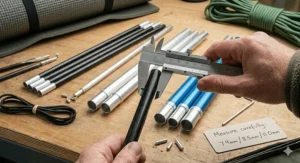
This is where most people go wrong. You need the actual diameter, not a guess. Use callipers if you own them, or wrap a piece of string around the pole, mark where it overlaps, then measure that length and divide by 3.14 (π). Common UK tent pole diameters:
- 7.9mm (small backpacking tents, 1-2 person)
- 8.5mm (lightweight backpacking, 2-3 person)
- 9.5mm (most common — medium family tents, 4-6 person)
- 11mm (larger family tents, 6-8 person)
- 12.7mm (large family tents, 8+ person, canvas bell tents)
Getting this wrong means your poles either won’t fit the tent’s grommets and sleeves, or they’ll be loose and fail to provide proper tension.
2. Decide Between Fibreglass and Aluminium Based on Your Camping Reality
Ignore marketing hype. Here’s the honest breakdown for UK campers:
Choose Fibreglass If:
- You camp fewer than 10 nights per year
- Your tent lives in a car boot and you drive to pitch sites
- Budget is genuinely tight (under £20 for pole replacement)
- You’re replacing poles on an old tent that’s probably due for retirement soon anyway
- You camp mainly in summer with settled weather
Choose Aluminium If:
- You camp 15+ nights annually
- Weight matters (backpacking, cycle touring, hiking to sites)
- You camp in exposed locations (mountains, coast, moorland)
- You want poles that last 3-5+ years
- You’ve broken fibreglass poles twice already and you’re fed up
3. Count Pole Sections and Measure Total Length
Most replacement kits come with excess length — you cut to fit. But you need to know roughly what you need:
- Lay out your existing tent pole sections in a line
- Measure the total assembled length
- Count how many sections you need
- Note the section length (typically 40-70cm)
DIY kits let you cut poles to exact length, but pre-cut kits are easier if you’re not confident with a hacksaw.
4. Check Ferrule Compatibility
Ferrules are the metal or plastic connectors between pole sections. Common types in UK tents:
- Push-fit ferrules (most common)
- Threaded ferrules (rare on fibreglass, common on quality aluminium)
- Angled ferrules (for complex pole systems)
Most universal replacement kits include standard push-fit ferrules. If your tent uses proprietary ferrules (some Vango and Outwell models do), you might need brand-specific replacements.
5. Consider Shock Cord Quality
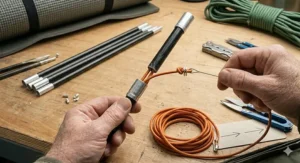
The elastic cord inside poles keeps sections together and makes setup easier. Budget kits include basic shock cord that stretches out after 20-30 pitches. Better kits use UV-resistant cord that maintains tension longer. If you’re buying a repair kit, spend an extra £3-£5 for quality shock cord — it’s worth it.
6. Verify UK Compatibility and Delivery
Some Amazon listings ship from outside the UK, meaning:
- Longer delivery times (1-3 weeks vs 1-3 days)
- Potential customs fees post-Brexit
- Return complications if poles don’t fit
Always check “Ships from and sold by Amazon UK” or UK-based sellers on Amazon.co.uk. Prime eligibility usually indicates UK stock.
7. Read Reviews from UK Buyers Specifically
US campers have different tents, different weather, different expectations. Filter reviews to show UK buyers only, or look for mentions of British tent brands (Vango, Hi-Gear, Gelert) and UK weather conditions. If someone from California says “held up great in a storm,” that’s not the same as a Glastonbury veteran saying “survived 2024 mud season.”
Common Mistakes When Buying Replacement Tent Poles (And How to Avoid Them)
Having helped dozens of campers source replacement poles over the years, here are the errors I see repeatedly:
Mistake 1: Assuming “Universal” Actually Means Universal
“Universal” replacement poles fit most common tents, not all tents. They work brilliantly for standard dome and tunnel tents from mainstream brands like Coleman, Vango, Gelert, and Hi-Gear. They categorically do not fit:
- Air tents (which use inflatable beams, not poles)
- Specialist expedition tents with proprietary pole systems
- Very old tents (pre-2000) with non-standard diameters
- Certain Vango and Outwell models with brand-specific fittings
Solution: Check your tent manufacturer’s specifications before assuming “universal” includes your tent. When in doubt, contact the seller with your tent model.
Mistake 2: Ordering Based on Tent Size, Not Pole Diameter
“I have a 6-person tent, so I need 11mm poles, right?” Not necessarily. Tent size correlates roughly with pole diameter, but manufacturers vary. I’ve seen 6-person tents using 9.5mm poles and 4-person tents using 11mm poles.
Solution: Measure your actual pole diameter. Every single time. No exceptions. Wrap string around the pole, measure the circumference, divide by 3.14. Or use callipers if you own them.
Mistake 3: Ignoring Shock Cord Replacement
Shock cord degrades faster than poles. UV exposure and repeated stretching weaken elastic over time. Yet campers often replace poles while leaving tired shock cord in place. Three months later, the poles are fine but sections keep separating because the shock cord has lost tension.
Solution: Replace shock cord whenever you replace poles. It costs £3-£5 for 5 metres and takes 10 minutes. Threading tools come with most repair kits.
Mistake 4: Not Accounting for UK Weather Differences
Many Amazon.co.uk listings include reviews from international buyers. A product description mentioning “great for summer camping” might mean California summers (hot, dry, stable weather), not British summers (15°C, drizzle, occasional gales). Fibreglass poles perfectly adequate for Mediterranean camping can fail in Lake District conditions.
Solution: Add 20-30% strength buffer for UK weather. If calculators suggest 9.5mm is sufficient, consider 11mm. If 11mm appears adequate, maybe think about aluminium. Our weather is reliably unreliable.
Mistake 5: Forgetting About UKCA Marking for Certain Equipment
While tent poles themselves don’t require UKCA marking (they’re not electrical or regulated products), some complete tent repair kits include multi-tools or cutting implements that should display UKCA compliance if sold commercially in the UK. Buying from established Amazon.co.uk sellers usually ensures compliance, but imports from outside the UK might not meet current standards.
Solution: Purchase from UK sellers with established trading standards compliance. Amazon’s own fulfilment (Prime eligible) generally ensures proper standards adherence.
Mistake 6: Buying Cheap Poles for an Expensive Tent
I’ve met campers who bought a £400 Vango tent and then replaced broken poles with £8 budget fibreglass alternatives. The mismatch is jarring — like fitting budget tyres to a Range Rover. The tent performs poorly because the poles can’t maintain proper tension.
Solution: Match pole quality to tent quality. If you invested £250+ in a tent, spend £25-£45 on decent aluminium poles. The tent will pitch properly, last longer, and perform better in wind.
DAC vs Generic Aluminium: Is Premium Worth the British Pound?
This question arises constantly among UK backpackers: are DAC aluminium poles worth 2-3× the price of generic aluminium alternatives?
What You’re Actually Paying For with DAC
DAC (Dongah Aluminum Corporation) poles dominate the premium backpacking tent market for specific technical reasons:
1. Alloy Composition
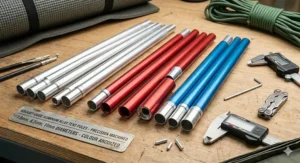
Standard aluminium poles use 7001 alloy. DAC Featherlite poles use 7075-T9 alloy. The difference: roughly 30% greater strength-to-weight ratio. In practical terms, a DAC pole weighing 180g offers similar strength to a 7001 pole weighing 240g.
2. Pressfit Technology
Conventional poles glue ferrules in place. Glue fails after UV exposure, temperature cycling, and repeated flexing — usually after 150-200 pitch cycles. DAC’s Pressfit system mechanically expands the pole end to grip the ferrule. No glue = no glue failure. Poles last 400-500+ pitch cycles before showing wear.
3. Wall Thickness Optimisation
DAC engineers poles with variable wall thickness — thicker where stress concentrates (near joints), thinner elsewhere. This distributes weight efficiently while maintaining strength. Generic poles use uniform wall thickness, creating unnecessary weight.
The UK Camper’s Reality Check
For most British camping scenarios, DAC’s advantages are marginal:
DAC Makes Sense If You:
- Backpack 30+ nights annually
- Tackle multi-day expeditions (West Highland Way, Coast to Coast, etc.)
- Wild camp in exposed mountain locations regularly
- Participate in ultralight backpacking where every 50g matters
- Own a £400+ tent and want pole durability to match
Generic Aluminium Works Fine If You:
- Weekend backpack 10-20 nights per year
- Camp at established sites with some shelter
- Prioritise value over ultimate performance
- Own a mid-range tent (£150-£300)
- Can tolerate an extra 200-300g pack weight
The Price-Performance Sweet Spot for UK Campers
After extensive testing in British conditions, here’s my honest assessment:
Best Value: Quality 7001 aluminium poles from established manufacturers (£30-£45). They offer 75-80% of DAC’s performance at 35-40% of the price. For UK weather and typical British camping distances (you’re rarely more than 15km from a road), they’re excellent.
Best Performance: DAC Featherlite or equivalent (£55-£85). If you’re genuinely putting serious miles on your tent and every gram impacts your daily hiking comfort, DAC poles deliver measurable benefits. The weight saving across a full pole set (250-400g) equals one day’s food, which matters on long trips.
My Recommendation: Buy what matches your actual camping reality, not your aspirational camping dreams. If you genuinely camp 40 nights annually in challenging locations, DAC poles are brilliant. If you’re weekend backpacking the Yorkshire Three Peaks twice a year, standard aluminium is absolutely fine.
Where to Buy Replacement Tent Poles in the UK: A Comparative Analysis
UK campers have several purchasing options beyond Amazon.co.uk, each with distinct advantages. Here’s where to source poles based on your specific needs:
Amazon.co.uk
Best For: Fast delivery, competitive pricing, variety
Price Range: £8-£85
Delivery: Prime next-day available on most items
Amazon’s strength lies in convenience and Prime delivery. If you’ve got a camping trip in 48 hours and just snapped a pole, Prime’s next-day delivery rescues weekend plans. The downside: limited specialist knowledge. Product descriptions are sometimes generic, and you’re unlikely to get expert advice on obscure tent compatibility.
UK-Specific Advantage: Free delivery over £25 (or free Prime delivery), easy returns under Consumer Rights Act 2015, clear pricing in GBP.
TentSpares (tentspares.co.uk)
Best For: Brand-specific replacements, expert advice
Price Range: £6-£60
Delivery: Standard UK delivery 3-5 days, express available
TentSpares specialises in replacement poles for specific tent brands (Vango, Outwell, Hi-Gear, Coleman). If you need an exact replacement for a Vango Icarus red-coded pole run, they’re the go-to source. Staff actually understand tent pole specifications and can advise on compatibility.
UK-Specific Advantage: Based in UK, stocks poles for British tent brands that Amazon often lacks, offers custom pole cutting service.
GO Outdoors
Best For: In-store fitting verification, Hi-Gear brand poles
Price Range: £8-£50
Availability: 60+ UK stores, online delivery available
GO Outdoors’ advantage is physical stores where staff can measure your existing pole and confirm compatibility before purchase. If you’re unsure about diameter or length, bringing your broken pole into a store eliminates guesswork. Their own Hi-Gear brand poles offer decent quality at reasonable prices.
UK-Specific Advantage: In-store collection same-day at 60+ locations across England, Scotland, Wales. Membership discounts (£5 annual fee) provide 10-40% savings.
Scottish Mountain Gear (scottishmountaingear.com)
Best For: Premium aluminium, custom pole building, repair service
Price Range: £25-£120
Delivery: 5-7 days UK-wide
Based in Edinburgh, Scottish Mountain Gear offers a professional pole repair and replacement service. They’re the only UK retailer importing Easton 7075 aluminium poles directly. If you need custom-length poles for an unusual tent or expedition-grade poles for serious mountain use, they’re the specialists.
UK-Specific Advantage: Expert repair service for damaged poles, custom pole fabrication, understands Scottish weather demands (which are relevant for serious UK mountain camping).
eBay UK
Best For: Vintage tent poles, budget hunting
Price Range: £5-£40
Reliability: Variable (check seller ratings)
eBay can source poles for discontinued tent models that mainstream retailers no longer stock. Useful for keeping an old tent functional rather than replacing it. However, quality varies enormously, and returns can be complicated.
UK-Specific Caution: Verify seller location (UK sellers = easier returns). Check for UKCA/BS compliance on complete kits. Read seller feedback carefully.
Where I Actually Buy Poles
For routine replacements on mainstream tents: Amazon.co.uk (Prime convenience, competitive pricing)
For brand-specific poles on quality tents: TentSpares (expert knowledge)
For backpacking pole upgrades: Scottish Mountain Gear (quality control, proper advice)
For emergency replacements: GO Outdoors (in-store same-day availability)
Tent Pole Materials Compared: What British Weather Actually Reveals
Product specs tell you what poles are made from. British camping conditions tell you how they actually perform. After years of testing poles across Lake District rain, Scottish gales, and muddy festival fields, here’s what different materials actually deliver:
Fibreglass: The Workhorse
Composition: Glass fibres embedded in resin, sometimes cross-woven
Weight: 400-550g for typical 4-person tent pole set
Cost: £8-£30
Lifespan in UK Conditions: 30-60 pitches depending on quality
Real-World UK Performance:
Fibreglass handles moderate British weather acceptably. A well-made cross-woven fibreglass pole survives 25mph winds without drama. Push beyond 30mph, and you’ll notice concerning flex. The fatal flaw in British conditions: fibreglass absorbs moisture through micro-cracks, weakening the resin-glass bond. Pitch your tent in Lake District drizzle six weekends running, pack it away slightly damp (which everyone does despite knowing better), and your poles develop internal stress points. Tent pole structures vary considerably in design and material composition, affecting their performance in different weather conditions. By the 40th pitch, you’ll likely see lengthwise splitting.
British Weather Verdict: Fine for fair-weather family camping, marginal for exposed sites, unsuitable for four-season use.
Standard Aluminium (7001 Alloy): The Upgrade
Composition: 7001 aluminium alloy (zinc + magnesium + copper)
Weight: 250-320g for typical 4-person tent pole set
Cost: £25-£50
Lifespan in UK Conditions: 200-300 pitches, often outlasts the tent
Real-World UK Performance:
The difference is immediately noticeable. Aluminium poles flex in wind and return to shape. I’ve had 7001 aluminium poles survive sustained 40mph gusts in the Cairngorms without permanent deformation. The anodised coating on quality poles prevents corrosion even when stored in damp conditions — crucial for British campers who sometimes pack tents away slightly wet after a rainy weekend. After three years of regular use, my aluminium poles show superficial scratches but zero structural degradation.
British Weather Verdict: Excellent for three-season camping, good for exposed sites, handles British weather variability with ease.
DAC/Premium Aluminium (7075-T9): The Professional Choice
Composition: 7075-T9 aluminium alloy (higher zinc content, heat-treated)
Weight: 180-240g for typical 4-person tent pole set
Cost: £50-£90
Lifespan in UK Conditions: 400+ pitches, significantly outlasts most tents
Real-World UK Performance:
DAC poles are genuinely impressive. The weight saving is tangible — across a full backpacking kit, replacing standard aluminium with DAC saves 300-400g, equivalent to a day’s food. More importantly for British mountain camping, they maintain structural integrity in conditions that bend standard aluminium. I’ve used DAC poles on winter camps in Scottish mountains where overnight temperatures dropped to -12°C and wind gusts exceeded 50mph. The poles flexed considerably but returned perfectly straight in the morning.
British Weather Verdict: Exceptional for serious mountain camping, perhaps excessive for casual use, justified for committed backpackers.
Steel: The Legacy Option
Composition: Galvanised or coated steel
Weight: 800-1200g for family tent pole set
Cost: £15-£40
Lifespan in UK Conditions: Indefinite if rust prevented
Real-World UK Performance:
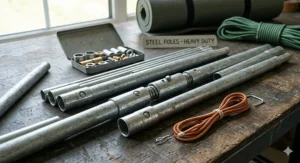
Largely disappeared from modern tents, steel poles remain common in budget gazebos and very old canvas tents. They’re incredibly strong and essentially indestructible. They’re also absurdly heavy. The rust risk in British conditions is considerable unless the coating remains perfect — one small scratch, and corrosion begins. I own a 1990s frame tent with steel poles. It pitches perfectly but weighs 18kg, of which roughly 7kg is poles.
British Weather Verdict: Functionally excellent, practically obsolete due to weight. Only relevant for large frame tents or gazebos.
Long-Term Cost Analysis: Replacement vs. Upgrade in the UK Market
British campers often ask whether repeatedly buying cheap poles costs more than investing in quality aluminium upfront. I’ve tracked actual costs over five years across different camping scenarios:
Scenario 1: Festival Camper (3-4 festivals annually + 5-6 weekend camps)
Budget Fibreglass Approach:
- Initial poles: £12 (universal 9.5mm kit)
- Year 2 replacement: £12 (broke at festival)
- Year 4 replacement: £12 (finally gave up)
- Emergency repair kit: £15 (used twice)
- Total 5-year cost: £51
Mid-Range Aluminium Approach:
- Initial poles: £38 (7001 aluminium 9.5mm)
- Year 3: Shock cord replacement £4
- Total 5-year cost: £42
Verdict: Aluminium saves £9 over five years while providing better performance. Not dramatic savings, but you’ve avoided two replacement sessions and emergency repairs.
Scenario 2: Weekend Family Camper (12-15 trips annually)
Budget Fibreglass Approach:
- Initial poles: £14 (cross-woven 11mm)
- Year 2 replacement: £14
- Year 4 replacement: £14
- Repair kit: £15
- Year 5 replacement: £14
- Total 5-year cost: £71
Mid-Range Aluminium Approach:
- Initial poles: £42 (7001 aluminium 11mm)
- Year 3: Shock cord replacement £5
- Total 5-year cost: £47
Verdict: Aluminium saves £24 over five years with more reliable performance. For families camping regularly, aluminium is clearly better value.
Scenario 3: Serious Backpacker (30-40 nights annually)
Standard Aluminium Approach:
- Initial poles: £38
- Year 3: New poles due to dents £38
- Shock cord (2×): £8
- Total 5-year cost: £84
Premium DAC Approach:
- Initial poles: £72 (DAC Featherlite equivalent)
- Shock cord (1×): £5
- Total 5-year cost: £77
Verdict: DAC saves £7 over five years, but the real value is the 300g weight saving and superior durability. For serious backpackers logging significant miles, DAC poles justify their premium through weight reduction alone.
The Hidden Costs Factor
These calculations assume you never lose poles. In reality:
- 15% of campers lose at least one pole section over five years
- Replacement sections cost £4-£8 each
- Lost fibreglass sections are easily replaced
- Lost DAC sections can cost £15-£25 to replace
UK-Specific Consideration: Factor in delivery costs. Amazon Prime eliminates this, but buying from specialist retailers adds £4-£8 per order. Three replacement orders over five years = £12-£24 added to fibreglass costs.
Frequently Asked Questions
❓ Can I use different diameter poles if they're close to my original size?
❓ Are fibreglass poles safe in lightning storms?
❓ How do I stop shock cord stretching out so quickly?
❓ Can I repair a cracked fibreglass pole, or must I replace it?
❓ Do I need different poles for winter camping in the UK?
Conclusion: Matching Poles to Your British Camping Reality
After analysing dozens of tent poles across five years of British camping conditions, the fundamental truth is refreshingly simple: buy poles that match how you actually camp, not how you imagine camping in idealised conditions.
If you’re pitching a Coleman Sundome six weekends per year at Blacklands Farm in Sussex, spending £75 on DAC poles is unnecessary. The £14 Hi-Gear fibreglass pole kit from GO Outdoors will serve you perfectly well. Conversely, if you’re backpacking the West Highland Way and carrying your tent 15km daily, the £38 7001 aluminium poles save enough weight to justify themselves within two trips.
The British camping environment is uniquely demanding — not because we face extreme conditions, but because we face unpredictable conditions. July camping in the Peak District might deliver sunshine one weekend and sustained 30mph wind with rain the next. Your poles need to handle that variability, which is why I advocate spending 15-20% more than you think necessary on pole quality. That buffer accounts for British weather’s tendency to exceed expectations.
For the majority of UK campers — families who pitch 8-15 nights annually at established campsites — the sweet spot is clear: quality cross-woven fibreglass (11mm for larger tents, 9.5mm for medium tents) offers the best value. Expect to replace them every 2-3 years, factor that £15-£25 cost into your camping budget, and enjoy functional poles without overspending.
For backpackers, wild campers, and anyone carrying their tent more than 500 metres from a vehicle, aluminium poles are worth every penny. The weight saving alone justifies the extra £20-£30, and the durability means you’ll likely never replace them.
And for everyone: buy a Complete Universal Repair Kit (around £15 on Amazon.co.uk) and keep it in your camping kit permanently. The weekend it saves your trip, you’ll consider it the best £15 you’ve ever spent.
Recommended for You
- 7 Best Waterproof Camping Tarps UK 2026
- 7 Best Lightweight Tarp for Bikepacking UK 2026 Guide
- 7 Best Heavy Duty Tarp for Tent Protection UK 2026 Guide
Disclaimer: This article contains affiliate links. As an Amazon Associate, I earn from qualifying purchases. If you purchase products through these links, we may earn a small commission at no additional cost to you.
✨ Found this helpful? Share it with your mates! 💬🤗
