
In This Article
There’s a very specific sound that haunts every family campsite on a Friday evening: the wheeze of a middle-aged parent, red-faced, hunched over a stirrup pump, muttering things that definitely aren’t in the tent’s instruction manual. Somewhere nearby, a neighbour’s electric pump hums for ninety seconds and their tent is already up, complete with them sat in a camping chair looking smug. That contrast is the whole electric vs manual tent pump debate in miniature, and it’s exactly why you’re here.
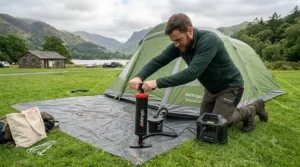
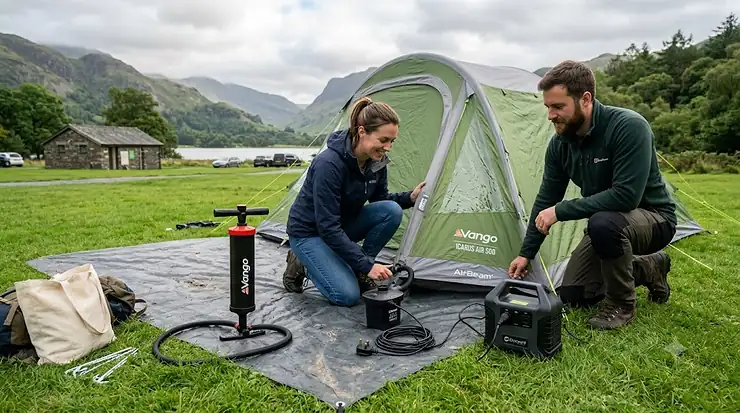
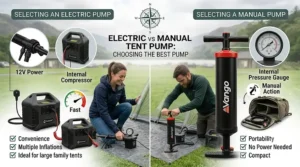
So, what’s actually different between an electric and manual tent pump? An electric pump uses a battery or mains-powered motor to force air into your tent’s beams automatically, usually with a pressure cut-off, while a manual pump relies entirely on your own arm strength to push air through a hose via a hand or foot-operated bellows or piston action.
Both get the job done. Neither is “better” in some universal sense — and if a blog tries to tell you otherwise, they’ve clearly never tried to hand-pump a six-berth air tent in the rain while a toddler screams about wanting an ice cream. What matters is your specific tent size, how often you camp, your budget, and — this one gets overlooked constantly — your own physical capacity to repeatedly push against resistance for ten-plus minutes. That last point isn’t trivial: repetitive pushing and pulling motions carry real strain risk when done incorrectly or for too long, which is worth bearing in mind before you assume “it’s just a pump, how hard can it be.”
This guide puts seven real tent pumps currently sold through amazon.co.uk — four electric, three manual — through a proper comparison: inflation speed, portability, cost, and where each one genuinely earns its keep. No padded filler, no invented five-star reviews. Just straight answers so you’re not the one hunched over a pump at 6pm while everyone else is already opening a beer.
Quick Comparison Table
| Pump | Type | Best For | Power Source | Price Range |
|---|---|---|---|---|
| Vango AirBeam Tempest | Electric | Cordless power campers | 2000mAh rechargeable battery | £70–£100 |
| Kampa Dometic Gale 12V | Electric | High-pressure awnings & tents | 12V car socket | £30–£60 |
| AstroAI Electric Pump | Electric | Mains-powered budget backup | 220–240V mains | £15–£25 |
| FLEXTAILGEAR EVO Pump | Electric | Compact portable inflate/deflate | 3800mAh rechargeable battery | £30–£50 |
| Outwell Double Action Pump | Manual | Outwell tent owners, spares | Hand-operated | £10–£20 |
| Milestone Camping XL Pump | Manual | Budget general-purpose inflation | Hand-operated | £10–£15 |
| OLPRO 2-Litre Dual Action Pump | Manual | Gauge-conscious manual pumpers | Hand-operated | £15–£25 |
Here’s the pattern worth noticing straight away: this isn’t really a clean electric-vs-manual split, it’s a spectrum. The AstroAI sits at budget-electric, roughly the same price as a decent manual pump, while the Vango Tempest sits at premium-electric, costing more than all three manual pumps combined. If cash is genuinely tight, a manual pump like the Milestone or OLPRO does the same fundamental job for a fraction of the price — it just asks more of your shoulders in return.
💬 Just one click — help others make better buying decisions too!😊
Top 7 Electric & Manual Tent Pumps: Expert Analysis
Four electric, three manual, spanning budget mains-powered units through to premium cordless kit, so whichever side of the electric vs manual tent pump debate you’re leaning towards, there’s a genuine, currently-available option below rather than a token afterthought.
1. Vango AirBeam Tempest Rechargeable Pump — best cordless power for serious campers
The standout feature is the two-stage motor: it opens in high-volume mode at 500 litres per minute to shift bulk air fast, then automatically switches to a high-pressure 40L/min mode once resistance builds, which is a genuinely clever piece of engineering rather than a marketing buzzword.
That auto-switching matters more than it sounds — most single-stage electric pumps either move a lot of air slowly at low pressure or a little air quickly at high pressure, and struggle to do both well. The Tempest’s LED display and auto cut-off let you dial in up to 10PSI with precision, and the 2,000mAh lithium battery gives roughly 30 minutes of continuous runtime, charging via USB-C in two to three hours depending on your charger’s output. Based on the spec comparison with rival electric pumps, that combination of two-stage airflow and cordless freedom is genuinely rare at this price point — most cordless competitors sacrifice one or the other.
This suits campers who’ve committed to air tents long-term and want to never touch a manual pump again, plus caravan and awning owners, since the pump doubles as a USB power bank for charging phones in a pinch. What most buyers overlook is that no car socket is needed at all, which matters if you’re pitching somewhere the car’s parked a field away — a scenario that trips up plenty of owners of mains or 12V-only pumps.
Pros:
- ✅ Two-stage motor balances speed and pressure automatically
- ✅ Fully cordless — no car or mains socket required
- ✅ Doubles as a USB power bank for devices
Cons:
- ❌ 30-minute runtime can be tight for very large multi-beam tents
- ❌ Sits at the top of the price range for this category
At £70–£100 depending on retailer and stock at the time of research, it’s a genuine investment rather than an impulse buy — but for anyone with a large family air tent, the cordless freedom alone often justifies it.
2. Kampa Dometic Gale 12V High-Pressure Electric Pump — best for high-pressure awnings and large tents
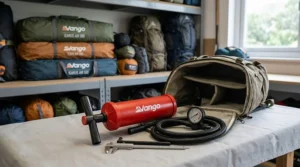
The standout advantage is raw pressure capability: this 12V car-powered pump is built to reach up to 15PSI, comfortably beyond what most family air tents and awnings actually require, which gives real headroom rather than making you inflate right up to the edge of the pump’s limit.
Here’s what to weigh with a 12V pump like this: it needs your car nearby with the engine running or a healthy battery, since sustained high-pressure inflation draws a fair bit of current. In exchange, you get a built-in pressure gauge for precise monitoring and a pump that’s become something of an unofficial standard among owners of Kampa, Dometic, and compatible Vango and Berghaus setups, based on repeated mentions across UK caravan and camping forums. On paper, this means less risk of over or under-inflating beams versus a basic manual pump with no gauge at all.
This is the pick for anyone running a large family air tent or a caravan awning who’s happy to stay tethered to a 12V socket in exchange for serious inflation headroom. Reviewers consistently note it as the pump many owners switch to after their original bundled manual or basic electric pump proves underpowered for a big multi-beam setup.
Pros:
- ✅ Reaches up to 15PSI, well beyond typical tent requirements
- ✅ Built-in pressure gauge for precise monitoring
- ✅ Widely compatible across major air tent and awning brands
Cons:
- ❌ Requires a 12V car socket — not cordless
- ❌ Can drain a weak car battery on longer inflation runs
Priced in the £30–£60 range, it sits comfortably as a mid-tier option: not as flashy as a cordless pump, but genuinely more powerful than most budget electrics.
3. AstroAI Electric Pump for Inflatables — best mains-powered budget backup
The standout here is straightforward value: a 400 litres-per-minute AC mains pump with three nozzle sizes, priced closer to a manual pump than to premium electric rivals, and built for UK 220–240V sockets rather than requiring a car or a rechargeable battery.
Because it’s mains-powered rather than battery-driven, there’s no runtime countdown to worry about and no charging admin the night before a trip — you plug it in, it runs continuously for as long as you need it. What most buyers overlook about mains pumps generally is that this convenience comes with an obvious catch: no mains hookup at your pitch means no pump, full stop, which rules it out for wild or off-grid camping entirely.
This suits campers who mostly stay at serviced campsites with electric hookups, or who want an affordable general-purpose inflator that also handles airbeds, paddling pools, and pool floats around the house, not just tent beams. Because independently verified review data specific to tent-beam use (rather than general inflatables) was limited at the time of research, it’s worth treating it as a competent all-rounder rather than a specialist large-tent solution.
Pros:
- ✅ Genuinely budget-friendly for an electric pump
- ✅ No battery to charge or degrade over time
- ✅ Doubles up for airbeds, pools, and floats beyond tents
Cons:
- ❌ Completely reliant on a mains hookup — useless off-grid
- ❌ Lower airflow than premium cordless or 12V rivals
At £15–£25, this is one of the cheapest genuine entry points into electric inflation, provided your camping style keeps you near a plug socket.
4. FLEXTAILGEAR EVO Pump — best compact portable inflate-and-deflate
The standout feature is dual functionality packed into a genuinely pocketable unit: it inflates and vacuum-deflates, running on a 3,800mAh rechargeable battery and reaching 4.5kPa of pressure through five interchangeable nozzles.
FLEXTAILGEAR has built a reputation specifically in the compact camping electronics space, and the EVO reflects that focus — it’s designed to disappear into a rucksack side pocket rather than take up a drawer. The vacuum function is the genuinely underrated part here: packing down an air tent or airbed by hand is arguably more tedious than inflating it, and a pump that sucks air back out saves real time and effort on the way home, not just on the way in.
This is best suited to smaller air tents, backpacking setups, or as a secondary pump for airbeds and camping accessories rather than as the primary pump for a large six-plus-berth family tent, where its more modest airflow compared to the Vango Tempest or Kampa Dometic Gale becomes a limiting factor. Reviewers consistently highlight the compact size and vacuum mode as the two standout reasons to choose it over bulkier alternatives.
Pros:
- ✅ Genuine dual inflate and vacuum-deflate function
- ✅ Compact enough for backpacking and smaller kit bags
- ✅ Five nozzles cover a wide range of valve types
Cons:
- ❌ Lower maximum pressure than dedicated large-tent pumps
- ❌ Battery capacity limits back-to-back large inflations
Typically priced £30–£50, it earns its keep as the pump you throw in for smaller trips rather than the workhorse for a big family setup.
5. Outwell Double Action Pump — best for existing Outwell tent owners
The standout feature is simple compatibility: this is the pump Outwell bundles with many of its own air tents, built as a double-action hand pump that pushes air on both the downward and upward stroke of the handle.
Because it moves air on both directions of the pump stroke rather than just one, it’s meaningfully faster than a basic single-action hand pump for the same physical effort, and it comes with three nozzles to fit most valve types beyond just Outwell’s own. Here’s the honest caveat, though: aggregated owner feedback flags a recurring durability issue, with some buyers reporting the hose or pressure gauge cracking at bend points after relatively light use, and a few noting a handle failure within the first couple of uses.
This suits existing Outwell tent owners who need a genuine replacement or spare that matches their original bundled pump, or anyone wanting a straightforward double-action pump without spending on an electric alternative. Given the mixed durability feedback, treating it gently — not over-forcing the handle at the top of the stroke — appears to meaningfully extend its working life based on the pattern in owner reports.
Pros:
- ✅ Double-action design inflates on push and pull
- ✅ Matches valve types on most Outwell tents directly
- ✅ Straightforward, no batteries or charging required
Cons:
- ❌ Recurring owner reports of gauge or hose cracking over time
- ❌ Handle durability has been flagged in a handful of reviews
Priced £10–£20, it’s a sensible like-for-like replacement rather than an upgrade — buy it because you need Outwell compatibility, not because it’s the toughest manual pump on this list.
6. Milestone Camping XL Hand Operated Air Pump — best budget general-purpose manual pump
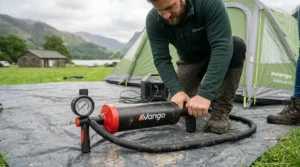
The standout advantage is genuine multi-purpose value: a lightweight, double-action hand pump measuring roughly 45cm by 20cm, supplied with three interchangeable nozzle sizes and built to handle airbeds, paddling pools, and paddleboards as comfortably as tent beams.
The continuous airflow design means air moves into the inflatable on both the push-down and pull-up of the ergonomic handle, which is the same double-action principle running through the pricier Outwell pump, just from a different manufacturer and at a noticeably lower price point. What most buyers overlook about a pump this size is that its slim, freestanding shape makes it genuinely easy to store flat in a car boot or tent bag, unlike bulkier stirrup-style manual pumps.
This is the pick for budget-conscious campers who want one manual pump to cover tents, airbeds, and summer paddling pool duty without buying three separate products. One verified owner account describes comfortably inflating a 2.7-metre inflatable boat in under five minutes without strain, which gives a useful real-world benchmark for what “double action” actually delivers in practice.
Pros:
- ✅ Genuinely multi-purpose across tents, airbeds, and pools
- ✅ Slim, freestanding shape stores easily
- ✅ Three nozzle sizes cover most common valves
Cons:
- ❌ No integrated pressure gauge for precision inflation
- ❌ Physical effort scales up noticeably for larger multi-beam tents
At £10–£15, this is about as cheap as a genuinely usable double-action pump gets, and the multi-purpose angle stretches that value further.
7. OLPRO 2-Litre Dual Action Hand Pump with Gauge — best manual pump for precision-conscious buyers
The standout feature is the built-in pressure gauge — a detail most budget manual pumps skip entirely, and one that matters more than you’d think once you’re trying to hit a specific PSI on an air tent beam by feel alone.
OLPRO is a UK tent brand in its own right, founded in 2011 and known for its inflatable-tube tunnel tents, and this pump is designed with that ecosystem in mind while remaining compatible with most other brands’ valve types. The 2-litre dual-action chamber moves air on both strokes like the Outwell and Milestone pumps above, but the addition of a gauge is what most buyers overlook as a genuine practical upgrade rather than a nice-to-have — inflating by feel risks under-pressuring a beam so it sags, or over-pressuring it so seams take unnecessary strain.
This suits manual-pump buyers who want the cost savings of hand power without giving up the precision that electric pumps take for granted, and it’s a natural fit for OLPRO tent owners specifically, though it isn’t locked to that ecosystem. Because this is a newer entrant relative to the Outwell and Milestone pumps, independently verified long-term durability data was more limited at the time of research.
Pros:
- ✅ Integrated pressure gauge, unusual at this price point
- ✅ Dual-action chamber for faster inflation per stroke
- ✅ Lightweight and compact for festival or beach use too
Cons:
- ❌ Less long-term review history than more established rivals
- ❌ Still requires sustained manual effort for large tents
Priced £15–£25, the gauge alone arguably justifies the premium over the Milestone pump if precision matters to you.
Practical Usage Guide: Getting Your Air Tent Pumped Right
Whichever pump you own, the first thirty seconds matter more than people assume. Peg out the groundsheet fully before you inflate anything — a tent that’s tugging against its own guy lines while a beam fills will inflate unevenly and put unnecessary strain on the seams. Work through beams in the order your tent’s instructions specify, not whichever looks emptiest, since air tent structures are often designed to inflate in a particular sequence for even tension.
For electric pumps, check your battery charge or fuel level (if running off a car) the night before, not the morning of — nothing kills the “electric pumps are more convenient” argument faster than discovering a flat battery at the campsite. For manual pumps, pace yourself: short, controlled strokes with your whole arm rather than frantic wrist-flicking will get more air moving per minute and tire you out considerably slower.
Common first-time mistakes include over-inflating a beam past the tent manufacturer’s stated PSI (check the label near the valve, not a generic online figure), disconnecting the pump too abruptly, which can cause a small air-loss “hiss” moment before the one-way valve seats, and forgetting to check that all valves are properly closed before you start driving pegs in around the tent’s base.
Real-World Scenarios: Which Pump Fits Your Camping Style
Picture three different weekends away.
First, a family with two young kids and a large six-berth air tent, camping at serviced sites three or four times a summer. The Kampa Dometic Gale 12V or Vango AirBeam Tempest both make sense here — the kids need entertaining, not watching a parent wheeze over a manual pump, and the car (or a charged battery) is always nearby at a serviced pitch.
Second, a couple doing occasional weekend trips with a compact two-to-three person air tent, budget-conscious and not fussed about speed. The OLPRO or Milestone manual pumps fit neatly — the tent’s small enough that manual effort is genuinely reasonable, and the money saved versus an electric pump can go toward better sleeping mats instead.
Third, a solo backpacker or wild camper who values pack weight above almost everything else and occasionally uses a small inflatable sleep mat or compact air tent. The FLEXTAILGEAR EVO’s compact size and dual inflate/vacuum function suit this profile far better than a bulky 12V pump that needs a car socket they probably don’t have access to anyway.
Camping frequency is the single biggest deciding factor across all three scenarios — an electric pump earns back its higher upfront cost fastest for people camping regularly, while occasional campers rarely feel the manual effort enough to justify the premium.
Problem → Solution: Common Tent Pump Issues Solved
Problem: My electric pump’s battery died mid-inflation. Keep a manual pump as a genuine backup, even if you mainly use electric — it’s cheap insurance against exactly this scenario, and most seasoned air tent owners eventually learn this the hard way once.
Problem: My manual pump feels impossibly hard to push after a few minutes. This usually means you’re pushing against too much resistance too quickly rather than pacing your strokes; slow down and check the valve is fully seated, since a poor connection makes the pump work harder for less air transferred.
Problem: The tent beam feels soft even after “full” inflation. Check for a slow leak at the valve seal first — this is far more common than a genuine puncture, and often solvable by reseating the valve cap rather than replacing anything.
Problem: My 12V electric pump won’t reach full pressure. A weak or partially discharged car battery is the most common culprit; run the engine while inflating rather than relying on battery charge alone, especially for pumps rated to higher PSI like the Kampa Dometic Gale.
Problem: I’m not sure which nozzle fits my tent’s valve. Most air tents, according to the Camping and Caravanning Club’s buying guide, use inflatable tube structures with a one-way limited-loss valve system, so check your specific tent’s valve type against the nozzle set included with your pump before assuming a mismatch means a faulty pump.
Pump Buying Guide for Camping: What Actually Matters
- Match pump power to tent size, not just budget. A small two-berth tent barely needs an electric pump; a six-plus-berth family tent genuinely benefits from one.
- Check the pressure rating against your tent’s requirements. Most family air tents sit around 4–10PSI; buying a pump with headroom above that figure avoids straining it at maximum output.
- Decide how you’ll actually camp, not how you imagine you will. Wild or off-grid campers should discount mains-only electric pumps entirely.
- Factor in charging or fuel logistics for electric pumps. A cordless pump is only genuinely cordless if you remember to charge it beforehand.
- Look for a built-in pressure gauge if precision matters to you. It’s a small feature that meaningfully reduces guesswork on both electric and manual pumps.
- Buy a manual backup even if you go electric. It’s the single cheapest insurance policy against a dead battery ruining your pitch.
- Read owner reports for durability patterns, not star averages alone. A recurring “hose cracked after a few uses” comment matters more than a headline rating.
Inflation Speed Comparison: How Fast Is Fast Enough?
This is where the electric vs manual tent pump debate gets its sharpest edge, so let’s put real numbers next to each other rather than vague impressions.
The Vango AirBeam Tempest’s two-stage motor moves up to 500 litres per minute in its initial high-volume phase, which for a typical multi-beam family tent translates to a full inflation in roughly five to ten minutes depending on tent size. The Kampa Dometic Gale, built for higher pressure rather than maximum volume, generally lands in a similar real-world window for family-sized tents, trading a touch of raw speed for pressure headroom. Budget mains pumps like the AstroAI, rated at 400L/min, sit close behind on paper but can take noticeably longer in practice on larger beams since they lack the two-stage pressure-switching logic of pricier rivals.
Manual pumps, by contrast, depend entirely on the operator. A fit adult working a double-action pump like the Outwell or Milestone steadily can realistically inflate a small-to-medium tent in ten to twenty minutes, but that time climbs sharply — and the effort compounds — on anything beam-heavy or family-sized. The honest takeaway: electric pumps win decisively on raw speed and consistency, but manual pumps aren’t dramatically slower for genuinely small tents, where the time difference might be five minutes rather than twenty.
| Pump Type | Typical Small Tent | Typical Large Family Tent |
|---|---|---|
| Premium electric (Tempest, Gale) | 3–5 minutes | 5–10 minutes |
| Budget electric (AstroAI, EVO) | 4–7 minutes | 10–15 minutes |
| Manual double-action | 8–12 minutes | 20–35+ minutes |
The pattern here is unambiguous for large tents: manual effort scales badly as beam volume increases, while electric pumps barely notice the difference. If your tent sleeps five or more, this table alone is a strong case for going electric.
Pump Portability vs Power: The Real Trade-Off
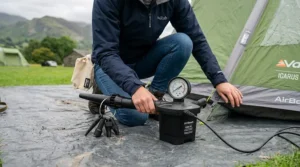
Every pump on this list sits somewhere on a line between “genuinely portable” and “genuinely powerful,” and very few manage both at once — this is arguably the most underappreciated trade-off in the whole electric vs manual tent pump conversation.
The FLEXTAILGEAR EVO sits at the portable end: pocketable, battery-powered, and light enough to not notice in a rucksack, but that compactness caps its maximum pressure and airflow relative to bulkier rivals. The Kampa Dometic Gale sits at the power end: genuinely capable of reaching 15PSI, but tethered to a 12V socket and not something you’d casually carry on a backpacking trip. Manual pumps split the difference in an interesting way — the Milestone and OLPRO are both physically light and easy to pack, but “portable” doesn’t mean “effortless,” since all the power still has to come from your own arms rather than a battery or car socket.
The practical rule of thumb: if you’re driving to a serviced pitch, prioritise power and speed, since portability barely matters when the car’s parked ten metres away. If you’re backpacking, wild camping, or working with limited storage space, prioritise genuine portability even if it costs you some inflation speed — a pump you can actually carry beats a powerful one left at home because it wouldn’t fit.
Air Tent Pump Comparison: Electric vs Manual Head-to-Head
Stepping back from individual products, here’s the honest, side-by-side verdict on electric vs manual tent pumps as categories.
Electric pumps win on speed, consistency, and physical effort — you press a button and, within minutes, the job’s done regardless of how tired or unfit you are. They also tend to include pressure gauges and auto cut-off as standard, reducing the risk of over-inflation damaging seams. The trade-offs are cost, a dependency on charging or a power source, and one more thing that can technically break or run flat at the worst possible moment.
Manual pumps win on price, reliability in the sense that there’s no battery to die or motor to fail, and genuine simplicity — a hand pump either works or it doesn’t, with far fewer failure points than an electric motor and circuit board. The honest cost is entirely physical: repeated pushing and pulling for ten-plus minutes is genuinely tiring, and doing it with poor technique or in an awkward posture carries real strain risk, similar to any other repetitive manual task. The Health and Safety Executive’s general guidance on safe handling technique — keeping movements smooth rather than jerky, and not pushing beyond what you can comfortably manage — applies just as sensibly to an enthusiastic bout of tent-pumping as it does to lifting boxes.
Neither category is objectively superior; the right choice depends on tent size, camping frequency, budget, and your own tolerance for physical effort versus upfront cost.
Cost vs Convenience Analysis: What You’re Really Paying For
The maths here is more interesting than “electric costs more, manual costs less,” though that’s the headline truth. A manual pump like the Milestone at £10–£15 does the identical fundamental job as a £70–£100 Vango Tempest — moving air into a beam until it reaches the right pressure. What you’re actually paying the extra £60-£90 for is time, physical effort saved, and consistency across repeated use.
Break it down per camping trip: if you camp four times a year and each pitch-up takes fifteen extra minutes and a moderate arm workout with a manual pump versus five minutes and zero effort with an electric one, that’s roughly forty minutes and considerable fatigue saved annually — arguably not worth £70-plus for many casual campers. But for someone camping fortnightly through the summer, or for anyone with a physical condition that makes sustained pushing genuinely uncomfortable, that same forty minutes multiplies quickly, and the electric pump’s cost starts looking like a reasonable trade rather than a luxury.
There’s also a hidden cost worth naming honestly: electric pumps can fail, run flat, or need replacement batteries over time, while a decent manual pump like the Outwell or OLPRO has essentially no consumable cost beyond the occasional nozzle or gauge replacement. Convenience isn’t free, and it isn’t guaranteed to last forever either — factor that into whether the premium genuinely suits your camping habits.
Common Mistakes When Buying a Tent Pump
The single most common mistake is buying based on tent size alone without checking valve compatibility — not every pump’s nozzle set fits every brand’s valve, and discovering this at the campsite rather than at home is a miserable way to start a trip. The second is assuming “electric” automatically means “fast enough,” when budget mains pumps without two-stage motors can genuinely struggle on the largest family tents despite being electric.
Buyers also frequently underestimate battery runtime on cordless electric pumps, assuming one charge will comfortably handle multiple tents or a tent plus an awning, when most rechargeable units are rated for a single large inflation cycle at best. Finally, plenty of manual pump buyers skip checking for a pressure gauge, then find themselves guessing at PSI by how firm a beam feels to the touch — a method that works eventually, but with far more trial and error than a £5-more pump with a built-in gauge would require.
Safety Considerations for Electric and Manual Pumps
Electric pumps, whether mains, 12V, or battery-powered, introduce genuine electrical considerations that manual pumps simply don’t carry. Keep mains cables and connections away from wet grass and standing water wherever possible, and always check the weather forecast before setting up, since heavy rain significantly raises the practical risk around any mains-powered equipment used outdoors. RoSPA’s camping safety guidance specifically recommends checking whether heavy rain is expected as part of general campsite safety planning, which applies directly to anyone relying on a mains or 12V pump at an exposed pitch.
For manual pumps, the main risk is genuinely physical rather than electrical — repetitive strain from sustained pumping, particularly for anyone with an existing back or shoulder issue. Pace yourself, take breaks on larger multi-beam tents, and don’t be the person who insists on finishing the whole tent in one unbroken pumping session out of stubbornness; there’s no prize for it, and a five-minute breather costs you nothing.
Across both types, never exceed your tent manufacturer’s stated maximum PSI — over-inflation is the most common cause of beam or seam damage regardless of which pump put the air in.
Frequently Asked Questions
❓ Is an electric or manual tent pump better for a large family tent?
❓ How long does an electric tent pump battery typically last?
❓ Can I use a car 12V pump without the engine running?
❓ Do manual pumps need a pressure gauge?
❓ Is it worth buying both an electric and a manual pump?
Conclusion
The electric vs manual tent pump question doesn’t really have a universal winner, and honestly, anyone claiming otherwise is probably trying to sell you something. Electric pumps like the Vango AirBeam Tempest and Kampa Dometic Gale earn their higher price through speed, consistency, and saved effort — genuinely worth it for large family tents or frequent campers. Manual pumps like the Milestone and OLPRO earn their place through low cost, zero battery anxiety, and enough capability for smaller tents or occasional trips.
The smartest move, if your budget allows it, is owning both: an electric pump for convenience on most trips, and a compact manual pump tucked away as the backup that never runs flat. Whichever you choose, check your tent’s specific pressure requirements, match the pump to your actual camping frequency rather than an idealised version of it, and you’ll spend a lot more of your weekend enjoying the campsite than wrestling with the tent.
✨ Don’t Miss These Exclusive Deals!
🔍 Take your next camping trip to the next level with these carefully selected electric and manual tent pumps. Click on any highlighted item to check current pricing and availability on amazon.co.uk. Whichever you choose, you’ll be sat in your camping chair with a drink in hand while the neighbours are still wrestling with theirs! ⛺
Recommended for You
- Rechargeable Tent Light: 7 Best Picks for UK Camping in 2026
- Clip On Tent Light 2026: 7 Picks That Won’t Let You Down
- Best Hanging Lantern for Tent in 2026: 7 Top UK Picks
Disclaimer: This article contains affiliate links. As an Amazon Associate, I earn from qualifying purchases. If you purchase products through these links, we may earn a small commission at no additional cost to you.
✨ Found this helpful? Share it with your friends! 💬🤗
