
In This Article
Picture this. It’s late May. The sun has finally shown up for a whole three consecutive days, and you’re ready to celebrate by dragging the tent out of the garage. You unzip the bag — and something genuinely unpleasant hits you in the face. That musty, faintly ammonia-tinged smell. The kind that, if you’re unlucky, has been setting up residence in your flysheet since October.
Sound familiar? You’re in excellent company. Thousands of UK campers discover the same problem every spring, and the culprit is almost always the same: storing a tent in a sealed, non-breathable bag that traps every last particle of British autumn damp inside with it. A good breathable tent storage bag isn’t a luxury accessory — it’s proper insurance for a piece of kit that costs anywhere from £80 to £800.
Here’s the short version of what one is: a breathable tent storage bag is an oversized storage sack made from mesh, ventilated fabric, or a combination of both, designed specifically to allow air to circulate around your packed tent during the off-season, preventing the humid conditions that cause mould, mildew, and fabric degradation. In a country where average annual rainfall sits at around 885mm and where most of us pack down in drizzle at least half the time, it arguably matters more here than anywhere.
This guide covers seven of the best options available on Amazon.co.uk in 2026, along with genuinely practical advice on how to use them, what to avoid, and why the bag your tent came in is almost certainly the worst thing you could put it back into.
Quick Comparison: Breathable Tent Storage Bags at a Glance
| Product | Material | Best For | Approx. Size | Price Range |
|---|---|---|---|---|
| GFYWZ Large Folding Tent Bag | Oxford/Mesh combo | Festival & family tents | 90×40×22 cm | Under £20 |
| Vango Smart Pack Roller Bag | 1000D water-repellent fabric | Large inflatable tents | 80×56×70 cm | £30–£50 |
| Large Mesh Drawstring Stuff Sack | Polyester mesh | Backpacking tents | Various | Under £10 |
| Heavy Duty Breathable Gear Tote | Reinforced mesh | Car camping & Scouts | XL sizes | £15–£25 |
| Cotton Pillowcase / DIY Fabric Sack | Natural cotton | Budget solution | Any | Under £5 |
| Multi-Compartment Ventilated Camping Bag | Polypropylene mesh | Families with accessories | 100×45 cm | £20–£35 |
| Oxbridge Gear Breathable Storage Bag | Woven poly/mesh hybrid | Premium off-season storage | Large | £25–£40 |
What the table tells you: mesh-heavy options win on pure breathability, while hybrid fabric bags offer better dust and pest protection — a real consideration if your garage or shed attracts spiders the size of small birds. Neither approach is wrong; the right pick depends on where you’re storing the tent.
💬 Just one click — help others make better buying decisions too! 😊
✨ Don’t Miss These Exclusive Deals!
🔍 Take your off-season tent storage to the next level with these carefully selected products. Click on any highlighted item to check current pricing and availability on Amazon.co.uk. These picks will help you keep your camping kit in perfect condition — spring after spring.
Top 7 Breathable Tent Storage Bags: Expert Analysis
1. GFYWZ Large Folding Outdoor Tent Storage Bag
The GFYWZ is, in many ways, the bag that gets the job done without making a fuss about it — very British, really. Its Oxford cloth outer paired with a mesh-ventilated interior panel offers a practical middle ground: enough structure to protect against dust and garage debris, enough airflow to stop condensation turning your flysheet into a petri dish.
The 90×40×22 cm dimensions handle a decent four-person family tent without forcing you to re-enact some kind of wrestling match at the end of a weekend in the Lake District. UK buyers with tents whose original stuff sacks have given up the ghost — or who’ve “upgraded” to rolling rather than stuffing — will find the oversized opening genuinely useful. One verified UK reviewer put it simply: the original sleeve had ripped, and this “is perfect.” Another noted the quality was excellent and wished for a slightly smaller option too, which is worth flagging if your tent is compact.
✅ Good value for money
✅ Roomy opening for faff-free packing
✅ Mesh panel allows meaningful ventilation
❌ Less robust in very damp sheds — not fully weatherproof externally
❌ Limited colour options
In the under-£20 range, this is a solid choice for the majority of UK campers with mid-size festival or family tents. Check current price on Amazon.co.uk.
2. Vango Smart Pack Roller Tent Bag
If you’ve spent serious money on a Vango AirBeam or a large tunnel tent, putting it back into a flimsy nylon sack is a bit like protecting a good bottle of Bordeaux with a carrier bag. The Vango Smart Pack Roller solves the storage problem with the confidence of a brand that’s been making outdoor kit since 1966. It’s made from 1,000D tough water-repellent fabric with a reinforced base and three wheels — which matters enormously when you’re trying to shift a 20 kg inflatable tent across a damp garage floor at 10pm in November.
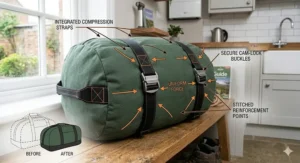
The zip-round opening drops to ground level, meaning you can roll or drag your tent straight in rather than attempting to cram it in from the top. It measures 80×56×70 cm, comfortably accommodating large tents including the Vango Antrim Air 600XL. The compression straps are a particularly thoughtful touch — they actually work, unlike the afterthoughts you find on cheaper bags.
What most UK buyers overlook: the 1,000D fabric means you’re also getting rodent resistance, which is relevant if your tent lives in a rural shed. It’s not technically a mesh breathable bag in the pure sense, but the robust zip ventilation and roomy interior prevent the sealed-bag trapping effect.
✅ Exceptional build quality for large tents
✅ Wheeled base — genuine practical help
✅ Compression straps that actually function
❌ Higher price point (£30–£50 range)
❌ Bulky when not in use
Best for: Families with large or inflatable tents, or anyone whose camping kit costs more than their camping budget. Check current price on Amazon.co.uk.
3. Ultralight Mesh Drawstring Stuff Sack (Various Brands)
At the budget end, a large polyester mesh drawstring sack is the purest possible breathable tent storage bag — it’s essentially an open-weave net with a drawstring, and that simplicity is both its greatest strength and its one obvious limitation. Airflow is maximum. Every surface of your tent can breathe freely. Moisture has nowhere to hide.
For backpackers and solo campers storing a 1–2 person tent in a flat or terraced house — where space is at a premium and the tent is likely living in a wardrobe rather than a garage — this is exactly what you need. These sacks weigh next to nothing, fold flat, and cost under £10. If you’re a student at a UK university with a bike-accessible campsite habit, this is your answer.
The limitation is straightforward: a mesh bag offers zero protection against dust, insects, or the occasional spider that’s made itself at home in your shed. In a loft or under a bed, fine. In a workshop, less so.
✅ Maximum ventilation — the breathable tent storage bag in its purest form
✅ Ultra-lightweight and packable
✅ Genuinely affordable
❌ No dust or pest protection
❌ Offers no structure — tent needs to be properly dry first
Under £10, often under £5 for single units. Widely available on Amazon.co.uk from multiple sellers.
4. Heavy Duty Reinforced Mesh Camping Storage Tote
Think of this as the sensible middle option — the one you’d recommend to your brother-in-law who camps eight weekends a year and needs something that isn’t going to fall apart by August. Heavy-duty reinforced mesh bags typically feature double-stitched seams, a robust zip or buckle closure, and mesh panels on multiple sides rather than just one. This multi-directional ventilation is meaningfully better for off-season storage.
Sizes in the XL range (around 140×34×54 cm on some versions) accommodate larger family tents with room to breathe — literally. The reinforced stitching at stress points matters more than the spec sheet suggests; ordinary mesh bags start to fray at the handles after a season or two of lugging damp canvas around.
UK campers who store kit in sheds, outbuildings, or garages will appreciate the slight added barrier against dust while retaining the airflow properties. Worth noting: in price terms, these sit in the £15–£25 bracket and represent arguably the best value-per-year of any option here.
✅ Multi-directional mesh ventilation
✅ Durable reinforced seams
✅ Good for shed or garage storage
❌ Heavier than pure mesh options
❌ Some variants lack compression — tent can spread out awkwardly
5. Large Cotton Pillowcase or Natural Fabric Sack (DIY Solution)
Not technically an “Amazon product,” but absolutely worth including because the camping community has known this trick for years and it deserves proper recognition: a large cotton pillowcase, or any cotton or linen sack, is one of the most effective breathable tent storage bags you can find. Natural fibres breathe freely. They’re washable. They cost almost nothing. And, crucially, they won’t off-gas any synthetic fumes over your flysheet during nine months in a loft.
The Camping and Caravanning Club specifically recommends keeping camping gear in breathable, natural-fibre storage rather than sealed plastic — and for good reason. The Camping and Caravanning Club’s advice on mould and mildew is worth bookmarking if you’re serious about extending the life of your kit.
For small to medium tents, a king-size pillowcase or a cotton laundry bag from any high street shop works perfectly. Cost: under £5. Drawback: no structure, limited protection from pests, and you’ll need to source something big enough for a six-person tent.
✅ Outstanding breathability — natural fibre
✅ Negligible cost
✅ Washable and sustainable
❌ Limited size for larger tents
❌ No pest or dust barrier
6. Multi-Compartment Ventilated Camping Equipment Bag
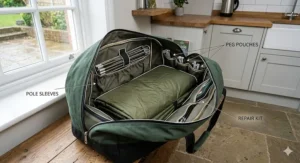
This category of bag — usually featuring a large main compartment with mesh panels plus separate sections for poles and pegs — addresses something the simpler bags can’t: the problem of poles and stakes punching through tent fabric during storage. Separating tent components is recommended by camping experts specifically to prevent abrasion damage during the months your kit sits untouched.
Multi-compartment versions in the £20–£35 range on Amazon.co.uk typically offer 100×45 cm or larger main chambers, with a secondary sleeve for poles (usually around 60–70 cm long — sized for standard aluminium poles) and a small zipped pocket for pegs and guy ropes. The polypropylene mesh used in better versions resists mould itself, which is rather the point.
For families with children doing Duke of Edinburgh or Scouts, where the tent gets used hard and packed quickly in the rain, the ability to keep everything together in one organised bag is a genuine quality-of-life upgrade.
✅ Keeps tent components separated and safe
✅ Organised storage reduces set-up faff
✅ Good breathability with mesh panels
❌ Bulkier overall footprint
❌ Pole sleeves may not suit all tent pole lengths
Best for: Families, Scout leaders, and anyone whose current approach is “shove it all in and deal with it later.”
7. Oxbridge Gear Large Breathable Off-Season Storage Bag
At the premium end of the breathable tent storage bag market — roughly £25–£40 — you start finding products specifically engineered for off-season rather than trip-to-trip storage. These bags typically feature a woven polyethylene or polypropylene outer that resists UV degradation (relevant if your storage space gets any light), a large mesh insert panel on at least two faces, and double-zip access for easy loading.
What distinguishes a proper off-season bag from a basic mesh sack is the combination of structural protection and ventilation. Your tent isn’t just protected from damp — it’s protected from compression damage, UV, dust, and the various creatures that find damp canvas irresistible during British winters. The polyethylene outer is also easy to wipe down, which matters when you’re pulling a muddy tent bag out of the garage next March.
UK reviewers frequently note that this tier of product is where you actually stop thinking about it — which is exactly what you want from storage equipment.
✅ UV-resistant outer material
✅ Dual ventilation panels
✅ Easy wipe-clean exterior
❌ Higher price — overkill for occasional campers
❌ May be larger than needed for compact tents
For anyone with a tent they genuinely care about — particularly those who’ve already had to write off a tent to mould — this is where to spend the extra £15.
How to Actually Use a Breathable Tent Storage Bag (A Step-by-Step Guide for British Conditions)
Step 1: Never Pack It Damp. Ever.
This bears repeating because apparently it needs to. If you return from a weekend in the Brecon Beacons in horizontal rain, you cannot put the tent away that evening. Even if it looks dry on the outside, seams, corners, and groundsheet edges hold moisture for much longer than you’d expect. The 48-hour rule is the absolute minimum: either re-pitch in the garden (weather permitting — ha) or drape individual sections over banisters, drying rails, or a garden line until every last inch is dry.
As WM Camping explains, once mould sets in on a tent fabric, you’re dealing with potential ammonia-like odours, black staining, and damaged waterproofing — none of which is covered by any manufacturer’s warranty.
Step 2: Shake It Out Properly
Before folding or stuffing, invert and shake every section to remove soil, grass, pine needles, and whatever else the campsite contributed. These organic materials are mould food. Leaving them in creates a running buffet that gets worse every week.
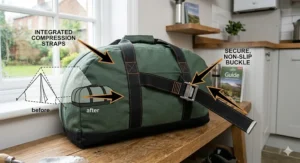
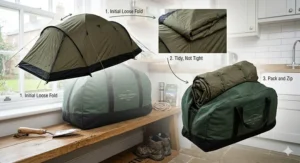
Step 3: Loosely Roll — Don’t Compress
The old instinct to compress a tent into the tightest possible bundle is exactly wrong for off-season storage. Tight packing creates permanent creases that weaken fabric coatings over time and restricts the airflow that a breathable bag needs to do its job. Loosely roll or stuff, leaving the bag comfortably full rather than straining at the seams.
Step 4: Separate Your Components
Poles and pegs in their own bags, ideally. Aluminium poles have edges that will work their way through mesh fabric given nine months and gravitational incentive.
Step 5: Choose the Right Storage Location
A cool, dry, consistently ventilated space is ideal. A loft that gets hot in summer and cold in winter — not ideal. A damp garage — genuinely problematic. Aim for relative humidity below 50% where possible. Mould growth accelerates significantly above 60% humidity, which in many British homes is achievable year-round without a dehumidifier. An airing cupboard or a spare wardrobe in a heated room is often better than the garage or shed, despite the obvious size challenges.
Step 6: Add a Silica Gel Pack
A couple of silica gel desiccant sachets tucked inside the bag won’t compensate for storing a wet tent, but they do manage ambient humidity during long storage. They’re reusable after 30 minutes in a low oven.
The Mould Problem: Why British Campers Face a Uniquely Awkward Situation
Let’s be direct about something. The UK is not an easy place to keep camping gear in good condition. The Met Office’s guidance on camping in wet and windy weather essentially exists because it’s needed — British summers routinely involve at least one genuinely soggy weekend, and the autumn camping season ends in circumstances that frequently don’t involve sunshine.
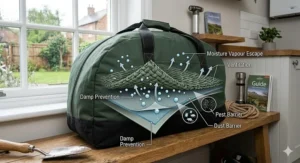
Mould and mildew thrive in damp, humid environments — precisely what most British storage spaces are during the colder months. A sealed nylon stuff sack traps whatever moisture remains in the tent fabric and creates what amounts to a small, dark, humid box — the ideal growing conditions for fungal spores that are already present in any outdoor environment. The breathable tent storage bag breaks this cycle by maintaining air circulation even during storage, preventing the humidity from building to problematic levels.
The health angle is worth noting too. ICE Cleaning’s analysis notes that mould and mildew compromise not just the structural integrity of outdoor shelters but pose real health risks — particularly for those with respiratory sensitivities. Children sleeping in a mouldy tent is not a small concern.
The financial argument is equally clear. Replacing a decent family tent costs between £200 and £600. A quality breathable bag costs under £40. The maths is not complicated.
Three UK Camper Profiles: Which Bag Fits You?
The Weekend Festival Camper (Manchester, Early 20s)
You own a three-person dome tent that lives in the boot of your car from June to September and in a corner of your student flat for the rest of the year. Budget: under £15. Space: minimal — you need something that folds to nearly nothing when empty. Best option: the ultralight mesh drawstring sack. It costs almost nothing, keeps things ventilated, and the flatmate won’t complain about it taking up wardrobe space.
The Family Camper (Semi-Detached, West Yorkshire, Three Kids)
You’ve invested in a six-person inflatable tunnel tent — probably a Vango or Outwell — and it lives in the garage for seven months a year. You need something with structure, wheels (the tent is genuinely heavy), and enough ventilation to protect what is, let’s be honest, a significant household investment. The Vango Smart Pack Roller Bag is made for exactly this situation. Yes, it’s £30–£50. No, it’s not excessive for a tent that cost £500.
The Wild Camping Enthusiast (Rural Scotland, Solo, Lightweight)
Your tent is a two-person ultralight shelter that weighs under 1.5 kg and packs to roughly the size of a litre water bottle. At home, it lives in a proper loft space. You want serious breathability and minimal bulk. The cotton pillowcase or a heavy cotton laundry bag is genuinely your best option — natural fibres, zero weight when empty, and the anti-mildew credentials are excellent for long-term loft storage.
How to Choose a Breathable Tent Storage Bag in the UK: 6 Key Criteria
- Material and breathability rating. Pure mesh gives maximum airflow; hybrid fabric bags balance ventilation with protection. For humid garages and sheds, lean toward multi-face mesh panels rather than a single ventilation section.
- Size relative to your tent. As a general rule, go 20–30% larger than your tent’s original bag. Your tent should sit loosely, not be compressed. An overly tight bag defeats the purpose of breathable storage.
- Durability of stitching. The handles and zip points are where cheaper bags fail first. Double-stitched stress points and reinforced handles add only pennies to manufacturing cost but years to the product lifespan.
- Pest resistance. In a rural area or older property, consider whether a pure mesh bag offers enough barrier against mice and insects. A woven polypropylene outer with mesh panels is a better compromise.
- Storage environment. Flat or house storage: mesh is fine. Garage or shed: go for a more robust outer material with internal ventilation. Outdoor storage: you need a weatherproof outer — at which point you’re looking at a different category of product entirely.
- Whether you need compartments. If you have a tent with separate inner, flysheet, footprint, and poles, a multi-compartment bag pays dividends in both organisation and fabric protection. If it’s a simple two-pole dome, compartments add bulk without much benefit.
Common Mistakes When Buying a Breathable Tent Storage Bag
Buying too small. The urge to compress your tent into the smallest possible package is entirely understandable — storage space in British homes is famously not abundant — but a bag that forces you to compress the tent tightly is actively harmful. Creased fabrics lose their coating integrity over time.
Assuming “waterproof” means “good for storage.” Waterproof bags are for transport. They seal moisture in just as effectively as they seal it out. For off-season storage, you want the opposite of waterproof.
Ignoring the storage location. A breathable bag in a flooded basement is still a flooded-basement bag. The bag works in conjunction with a sensible storage environment, not instead of one.
Buying the cheapest possible mesh bag for a premium tent. A £3 drawstring net is fine for a £60 festival tent. For a tent you’ve spent £400 on, the protection offered by a structured, durable bag with proper ventilation is worth the extra £20–£30.
Not cleaning the tent before storage. A breathable bag cannot counteract the mould spores that arrive pre-loaded in a muddy, unwashed tent. Clean first, dry thoroughly, then store.
FAQ
❓ What is the best way to store a tent over winter in the UK?
❓ Will a breathable tent storage bag actually prevent mould?
❓ Are breathable tent storage bags available for next-day delivery in the UK?
❓ Can I store my tent in a plastic bag or airtight container?
❓ How big a breathable bag do I need for a family tent?
Conclusion: Stop Letting Britain’s Weather Win
The good news is that this particular problem — the spring discovery of a mouldy, rank-smelling tent — is almost entirely preventable. It requires two things: a proper dry-down after each trip, and a breathable tent storage bag that keeps air moving through your kit during the months it’s not in use.
For most UK campers, the ideal option sits between £15 and £40. That’s a fraction of what even a budget tent costs, and vanishingly small compared to the price of replacing a quality one. Whether you opt for an ultralight mesh sack for a solo shelter or a wheeled roller bag for a family inflatable, the principle is the same: give your tent room to breathe, keep it dry, and it will look after you for many more soggy British summers to come.
For further reading on caring for your outdoor kit, the Scouts Association’s guidance on camping in wet British weather is a sensible reference, as is Which?’s broader advice on outdoor gear maintenance for those wanting independent consumer guidance.
✨ Don’t Miss These Exclusive Deals!
🔍 Ready to protect your camping investment? Click on any highlighted product above to check the latest pricing and availability on Amazon.co.uk. A quality breathable tent storage bag is the most cost-effective thing you can do for your camping kit this year.
Recommended for You
- Best Wheeled Tent Bag UK 2026: 7 Top Picks Reviewed
- Best Compression Bag for Tent 2026: 7 Top UK Picks
- Best Tent Storage Bag UK 2026: 7 Top Picks for Smarter Camping
Disclaimer: This article contains affiliate links. As an Amazon Associate, I earn from qualifying purchases. If you purchase products through these links, we may earn a small commission at no additional cost to you.
✨ Found this helpful? Share it with your mates! 💬🤗
