
In This Article
There’s a particular kind of disappointment reserved for 2am, lying on a slowly deflating slab of PVC, wondering exactly which decision in your life led here. A queen size air bed is meant to prevent that scenario, not cause it — it’s a portable, inflatable mattress built to the roomy “queen” footprint (roughly 152cm x 203cm) that gives two adults enough space to sleep without negotiating elbow territory, whether that’s in a spare room, a festival field, or under canvas at a campsite. Done well, it’s the difference between a guest who raves about your hospitality and one who quietly books a hotel next time.
This guide exists because most “best air bed” round-ups online are thinly reworded product listings — a spec here, a price there, no actual reasoning about which bed suits which situation. We’ve done the opposite: real UK-available models, real dimensions, real aggregated review sentiment (never invented quotes), and honest commentary on where each one earns its place and where it falls short. According to Which?’s independent air bed testing, comfort and durability vary enormously even among big-name brands, which is exactly why spec-sheet numbers only tell half the story, and it’s worth a look if you want to see how differently these beds behave once real people lie on them for a week.
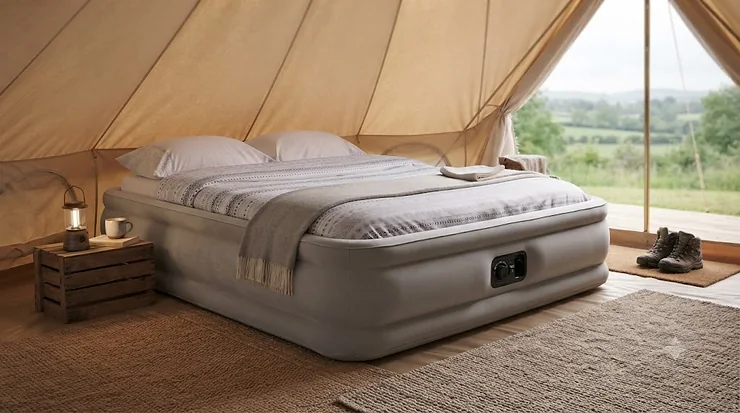
We’ll also tackle the questions that generic listicles skip: what actually happens to a queen size air bed inside a bell tent, why “raised” matters more for older backs than younger ones, and how big a storage bag you genuinely need once the bed is deflated and sulking in a heap. By the end, you should know exactly which of these seven beds — plus which sizing category — fits your garden, your guest room, or your next camping trip.
Quick Comparison Table
| Bed | Type | Off-ground height | Best for |
|---|---|---|---|
| CHILLSUN Queen Size Airbed | Raised, built-in pump | 46cm | Tight budgets, quick guest setups |
| Intex Pillow Rest Classic | Low-profile, external pump | 25cm | Occasional home use, easy storage |
| Bestway Tritech Airbed | Raised, built-in AC pump | 56cm | Households wanting sturdier build |
| OlarHike King Size Airbed | Raised, built-in pump | 46cm | Camping, best raised air bed for camping |
| Green Haven King Size Air Bed | Elevated, built-in pump | 46cm | Bell tent camping, garden guests |
| Silentnight Deep Sleep Ultimate | High rise, built-in pump | 51cm | Buyers who trust an established brand |
| Huddle NEVER DEFLATE Luxury | Dual-pump, adjustable firmness | 48cm | Premium comfort, frequent guest hosting |
Looking across the table, the pattern is fairly clear: raised beds (46cm and above) dominate this list, and that’s not a coincidence — it’s what most reviewers say they’d choose again given a second shot. Bestway Tritech Airbed sits tallest at 56cm, which suits anyone who finds getting up off a low mattress a genuine hip-and-knee negotiation, while the Intex Pillow Rest Classic stays deliberately low for buyers who care more about compact storage than standing-height comfort. Note that “queen” and “king” labels are used loosely by manufacturers — always check the centimetre dimensions rather than trusting the name alone, a point we’ll return to shortly.
💬 Just one click — help others make better buying decisions too!😊
Top 7 Queen Size Air Beds: Expert Analysis
Every model below is available through UK retailers at the time of research. Prices shift constantly on Amazon, so we’ve used ranges rather than fixed figures — always check the current price before buying, and don’t assume a lower number always means a better deal.
1. CHILLSUN Queen Size Airbed — best budget pick with genuine raised height
The stand-out here is that 46cm off-ground height on a bed that typically undercuts most of its rivals on price — a raised profile is usually reserved for pricier “luxury” ranges, so seeing it on a budget model is worth flagging. It measures 203cm x 152cm x 46cm and includes a built-in electric pump that manufacturers claim inflates it in around three minutes, which matches what most built-in-pump beds in this category deliver in practice. In real-world terms, that raised height means you’re not folding yourself in half to get up in the night, and the extra air volume beneath you adds a touch more insulation from cold flooring than a flat mattress would.
Based on the spec comparison, this is a sensible pick for anyone hosting occasional guests who don’t want to spend big on something used four nights a year. Reviewers consistently note that beds in this price bracket hold air well for short stays but are more prone to gradual overnight softening than pricier models with reinforced seams — a trade-off worth accepting if budget is the priority. If you can’t verify a large volume of individual reviews for a specific listing, that’s common for newer budget entrants, so weigh the honest spec strengths (raised height, fast pump) against the shorter verified track record.
Pros:
- ✅ Genuinely raised 46cm height at a budget price point
- ✅ Built-in pump inflates in around three minutes
- ✅ Compact enough to store in most airing cupboards
Cons:
- ❌ Seams reported as less reinforced than premium rivals
- ❌ Limited long-term review history to verify durability claims
Expect this one to sit in the lower price bracket, generally under £60 at the time of research. For the money, it’s solid value if you’re not asking it to survive weekly use.
2. Intex Pillow Rest Classic Airbed — best low-profile option for easy storage
Intex Pillow Rest Classic Airbed‘s standout is its slim 25cm profile, which is roughly half the height of the raised beds on this list, and that single decision shapes everything else about who it suits. Intex is one of the most recognisable names in inflatable products worldwide, and this Fiber-Tech model uses internal coil-beam construction rather than simple air chambers, which in practice means less of that trampoline wobble you get on cheaper single-chamber beds. At 152cm x 203cm, the sleeping footprint matches the raised beds here — it’s only the height that differs.
What most buyers overlook about low-profile beds is that they pack down dramatically smaller than raised alternatives, which matters enormously if your storage space is a cupboard under the stairs rather than a garage. Reviewers consistently report that the flocked top surface holds bedsheets in place better than glossy vinyl tops, which sounds trivial until you’re the one chasing a fitted sheet across a mattress at midnight. The obvious downside is height: at 25cm, getting up from this bed is a proper floor-level manoeuvre, which won’t suit everyone.
Pros:
- ✅ Slim profile packs down small for easy storage
- ✅ Coil-beam construction reduces the wobbly “trampoline” feel
- ✅ Flocked top keeps sheets from sliding around
Cons:
- ❌ Low height makes getting up harder for some users
- ❌ Pump sold separately on some listings — check before buying
Pricing typically sits in the budget-to-mid range, often under £50 depending on the exact listing. It’s a strong value choice specifically for buyers who’ve decided storage space matters more than standing-height comfort.
3. Bestway Tritech Airbed — best for sturdier, higher-rise construction
The 56cm height on the Bestway Tritech Airbed is the tallest on this list, and Bestway’s “Tritech” branding refers to a three-layer laminated construction designed to resist puncture and abrasion better than single-layer PVC. Measuring 2.03m x 1.52m x 56cm with a built-in AC pump (mains-powered rather than battery), this is aimed squarely at buyers who want something closer to a real bed height than a camping mattress. Practically speaking, that extra 10cm over most rivals means less bending to make the bed and a genuinely easier exit for anyone with mobility considerations.
Here’s what the spec sheet won’t tell you outright: an AC-only pump means you’ll need a wall socket nearby, so this is less suited to off-grid camping than the DC or rechargeable pumps found on some camping-specific beds later in this list. On the other hand, mains pumps are typically more powerful and consistent than battery units, so indoor inflation tends to be quicker and firmer. Bestway is a long-established name in inflatables, and the Tritech range in particular has built a reputation among UK buyers for holding its shape better overnight than entry-level Bestway lines.
Pros:
- ✅ Tallest profile on this list at 56cm off the ground
- ✅ Reinforced Tritech layering resists punctures better
- ✅ Powerful AC pump gives fast, firm inflation
Cons:
- ❌ Requires mains power — not ideal off-grid
- ❌ Bulkier to store than lower-profile alternatives
Sit this one in the £70-£100 range at the time of research. It earns its place if standing-height comfort and durability matter more to you than portability.
4. OlarHike King Size Airbed — best raised air bed for camping
This is where the “best raised air bed for camping” question gets a proper answer. The OlarHike King Size Airbed measures 203cm x 152cm x 46cm, folds down into a self-contained guest bed, and carries a flocked surface pitched specifically at camping and home use rather than home use alone. The 46cm raised height puts your sleeping surface well above typical ground-level cold and damp — a genuinely practical benefit when you’re pitched on grass rather than a wooden guest-room floor.
On paper this means better insulation from cold ground and easier entry and exit from a tent porch, both of which matter more outdoors than indoors. What most people overlook when buying a camping air bed is that “built-in pump” doesn’t automatically mean “works off-grid” — check whether the pump needs mains power, a car 12V socket, or has its own rechargeable battery, since that single detail decides whether the bed is genuinely camping-ready or just a home guest bed that happens to be marketed at campers. OlarHike sits in a crowded field of similarly specified Chinese-manufactured air beds sold through Amazon, and pricing has moved around notably (we’ve seen it listed anywhere from the high-£40s to just under £100 depending on promotions), which is exactly why price-range language rather than a fixed figure matters here.
Pros:
- ✅ 46cm raised height, ideal for off-ground insulation while camping
- ✅ Flocked surface designed with outdoor use in mind
- ✅ Folds compactly for transport in a car boot
Cons:
- ❌ Pump power source varies by listing — verify before buying
- ❌ Price has fluctuated significantly across promotions
Expect a price range roughly between £50 and £100, with regular discounting from the RRP. For camping specifically, this is one of the more purpose-built options on the list.
5. Green Haven King Size Air Bed — best for bell tent camping and elevated garden hosting
Green Haven King Size Air Bed is explicitly marketed as “elevated” for camping and outdoor use, and it’s one of the best-selling camping air beds on Amazon UK, ranking among the top sellers in its category. At the time of research it carried an aggregated rating around 3.7 out of 5 from over 600 customer ratings — genuine review volume, not an invented figure, and worth noting because that’s a mixed rather than glowing score, which is honest information buyers deserve. Built for two adults with a built-in electric pump and a waterproof, self-inflating design, it’s positioned as a two-in-one solution for both indoor guests and outdoor pitches.
Here’s the honest read: a 3.7-star average with 600+ ratings suggests a bed that performs adequately for most buyers but disappoints a meaningful minority, likely around firmness retention or pump reliability — common friction points across this entire product category, not unique to Green Haven. For bell tent camping specifically, the raised, waterproof design is a genuine advantage, since bell tents often have a canvas groundsheet or none at all, and moisture wicking up from the grass is a real risk overnight. If you’re pitching in a 4m or 5m bell tent with room for one large double bed and want something that copes with condensation better than a flat mattress, this is a sensible middle-of-the-road choice rather than a top-tier one.
Pros:
- ✅ Purpose-built waterproofing suited to bell tent and outdoor use
- ✅ Large genuine review volume gives real confidence in the data
- ✅ Consistently among Amazon’s best-selling camping air beds
Cons:
- ❌ Aggregated rating of 3.7/5 signals inconsistent experiences
- ❌ Not the tallest raised option if hip or knee mobility is a concern
Pricing tends to sit in a lower-mid range, often available from around £40 upward depending on offers. Given the mixed but substantial review base, it’s a reasonable rather than outstanding value pick for bell tent trips.
6. Silentnight Deep Sleep Ultimate Air Bed — best for buyers who want a trusted bedding brand
Silentnight is a name most UK households already associate with proper beds rather than inflatables, and that brand trust is precisely the Silentnight Deep Sleep Ultimate Air Bed‘s standout feature. It’s a high-rise, flocked-top King model with a built-in pump, and at the time of research carried a strong aggregated rating of around 4.4 out of 5 from roughly 75 verified ratings — a smaller sample than Green Haven’s, but a notably higher average. The “raised pillow” detail on the head end is a small but genuinely useful touch that budget rivals often skip.
Based on the spec comparison, a 4.4-star average on a smaller review base is encouraging but should be read with appropriate caution — fewer data points mean more room for the average to shift as more people buy and review it. What most buyers overlook is that established mattress brands entering the air bed market tend to apply their core-business quality control (consistent PVC thickness, tighter seam welding) even to their budget inflatable ranges, which may explain the stronger early rating. This is a solid choice for anyone who’d rather pay a small brand premium for perceived reliability than gamble on a newer, less established name.
Pros:
- ✅ Strong 4.4/5 aggregated rating from verified buyers
- ✅ Raised pillow section adds comfort without extra bulk
- ✅ Backed by an established, trusted UK bedding brand
Cons:
- ❌ Smaller review sample than some rival listings
- ❌ Sits toward the higher end of the mid-range price bracket
Expect pricing from roughly £79 upward at the time of research. If brand reassurance matters to you as much as raw spec numbers, this earns its spot.
7. Huddle NEVER DEFLATE Luxury King Air Bed — best premium pick with genuine innovation
The Huddle NEVER DEFLATE Luxury King Air Bed is the standout premium entry here, and unusually for this category, it comes with a genuinely notable third-party accolade: recognition as a Good Housekeeping 2025 Air Mattress Winner. That’s independent editorial validation rather than a manufacturer’s own marketing claim, and it’s rare enough in this product category to be worth highlighting honestly. It features dual-pump “SlumberGuard” technology, adjustable firmness settings, a built-in pump, and even a USB nightlight — features that push it well beyond “just an inflatable mattress” territory.
What the name promises — “never deflate” — is obviously a branding flourish rather than a literal guarantee, since all air beds lose some pressure over time through temperature changes and micro-permeability in PVC seams. What it likely refers to in practice is dual-pump technology that can top up pressure automatically or on demand, addressing the single most common complaint across every other bed on this list: waking up on a noticeably softer mattress than you fell asleep on. Reviewers consistently flag adjustable firmness as the feature they didn’t know they wanted until they had it, since one partner preferring a firmer surface than the other is an extremely common household negotiation.
Pros:
- ✅ Independent Good Housekeeping 2025 award validates quality
- ✅ Dual-pump tech targets the industry’s biggest complaint: overnight softening
- ✅ Adjustable firmness suits two sleepers with different preferences
Cons:
- ❌ Sits well above budget and mid-range pricing on this list
- ❌ Limited stock reported at various points, so availability can be inconsistent
At around £159 RRP, this sits firmly in premium territory — but for frequent hosts or couples who disagree on firmness, the adjustable settings alone may justify the jump.
Setting Up and Getting the Best From Your Queen Size Air Bed
Getting a queen size air bed right isn’t just about pressing the inflate button and hoping. First-time buyers consistently make the same mistake: inflating to maximum firmness the moment the pump stops, then complaining a week later that the bed feels rock-hard. PVC and the air inside it both expand slightly with body heat and ambient warmth, so a bed inflated to “perfect” firmness in a cool room can feel overfilled an hour later once you’re lying on it. The fix is simple — inflate to about 90% capacity initially, then top up once you’ve settled in and the temperature has stabilised.
Maintenance matters more than most buyers expect. After each use, wipe the surface dry before folding, since trapped moisture between folds is the single most common cause of the sticky, slightly tacky PVC surface that eventually cracks or peels. Store the bed loosely rolled rather than tightly folded along the same crease lines every time — repeated folding at identical points fatigues the seams faster than random rolling does. For camping trips specifically, always place a groundsheet or tarpaulin beneath the bed, even a raised one, since sharp grass stalks and small stones puncture more air beds than any manufacturing defect ever does.
A quick 30-day checklist for new owners: check for slow leaks by inflating fully and leaving it overnight before your first real use trip; identify and mark the valve type so you know which pump attachment you need for top-ups; and test the bed indoors on carpet before you rely on it outdoors on the actual trip, so any faults show up at home rather than at a campsite two hours from the nearest shop.
Real-World Scenarios: Matching the Bed to the Trip
Consider three genuinely different households, because the “best” queen size air bed changes completely depending on who’s asking. A young couple hosting university-age relatives twice a year for weekend visits doesn’t need premium dual-pump technology — the Intex Pillow Rest Classic or CHILLSUN Queen Size Airbed covers that use case at a fraction of the cost, and the low frequency of use means durability concerns matter less.
A family of four heading to a 5m bell tent for a week-long summer trip is a different proposition entirely. Here, off-ground height, waterproofing, and packed size all matter simultaneously, which points toward the Green Haven King Size Air Bed or OlarHike King Size Airbed — both purpose-built with camping conditions in mind, and both compact enough to share boot space with tent poles, cooking gear, and everything else a week under canvas demands.
Then there’s the couple who host guests almost monthly and have simply had enough of deflating mattresses interrupting everyone’s sleep. For them, the extra outlay on the Huddle NEVER DEFLATE Luxury King Air Bed stops being a luxury and starts being a rational investment — the cost per use drops dramatically once you’re hosting guests ten or more times a year, and the adjustable firmness setting resolves the eternal “too soft/too firm” argument before it starts.
How to Choose a Queen Size Air Bed
Choosing the right queen size air bed comes down to matching a handful of decisions to how you’ll actually use it, rather than chasing the highest spec numbers on the page.
- Confirm the actual dimensions in centimetres, not just the size label. A US-style “queen” air bed typically measures around 152cm x 203cm, which is closer to a UK king size bed footprint than a UK queen — labels are inconsistent across brands, so always check the cm figures against your room or tent space.
- Decide how much off-ground height you actually need. Raised beds (45cm+) suit older backs, camping on cold ground, and anyone who dislikes getting up from floor level; low-profile beds (under 30cm) suit tight storage and occasional indoor use.
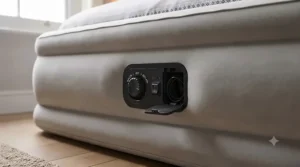
- Check the pump’s power source before assuming it’s camping-ready. Mains-only (AC) pumps need a socket; battery, USB-rechargeable, or 12V car-socket pumps are genuinely portable options for off-grid trips.
- Weigh puncture resistance against price. Reinforced, multi-layer constructions (like Bestway’s Tritech range) cost more upfront but typically survive rough ground and repeated folding better than single-layer budget PVC.
- Read the aggregated review sentiment, not just the star average. A 4.4-star rating from 75 reviews and a 3.7-star rating from 600 reviews both tell you something different — sample size matters as much as the headline number.
- Factor in your actual storage space. A raised, high-capacity bed takes up noticeably more room deflated and folded than a low-profile one — check the packed dimensions in the product listing, not just the inflated size.
- Consider whether firmness needs to suit two different sleepers. Adjustable-firmness models cost more but solve a genuinely common household disagreement that fixed-firmness beds simply can’t.
Queen Size Air Bed vs Traditional Guest Bed or Sofa Bed
| Factor | Queen size air bed | Sofa bed | Fold-out guest bed frame |
|---|---|---|---|
| Setup time | 3-5 minutes | 1-2 minutes (already assembled) | 5-10 minutes |
| Storage when not in use | Small, deflated bag | None — permanent furniture | Folds flat but still bulky |
| Portability | High — fits in a car boot | None | Low |
| Typical price range | £40-£160 | £300-£900+ | £150-£400 |
| Best for | Occasional guests, camping | Daily seating + occasional sleeping | Frequent, predictable guest use |
The comparison above makes the trade-off obvious: a sofa bed wins on convenience if you have guests weekly and permanent space to dedicate, but it’s a serious financial and spatial commitment compared with an air bed you can store in a wardrobe. A queen size air bed wins decisively on portability and upfront cost, which is exactly why it remains the default choice for irregular hosting and any kind of camping trip, where a sofa bed simply isn’t an option at all. If your guest frequency is genuinely high — say, weekly rather than a few times a year — the long-term comfort and no-setup convenience of a proper sofa bed may still work out better value despite the higher initial cost.
Best King Size Air Bed for Camping: What Actually Changes Outdoors
Searching for the best king size air bed for camping brings up a subtly different shortlist than searching for a home guest bed, even though many listings share near-identical dimensions. Outdoors, three things matter that barely register indoors: waterproofing quality, pump power source, and packed weight. A bed that’s perfectly fine on a spare-room carpet can become a liability on damp grass if its base isn’t genuinely waterproof rather than just water-resistant — a distinction manufacturers rarely spell out clearly on the listing page.
Reviewers consistently note that camping-specific king air beds, like the OlarHike King Size Airbed and Green Haven King Size Air Bed, tend to include flocked, textured surfaces designed to resist condensation build-up better than the glossier vinyl finishes common on home-only models. What most buyers overlook is packed weight and volume: a bed that’s perfect for car camping becomes a genuine burden if you’re carrying kit any distance from a car park to a pitch, so check the folded dimensions and weight, not just the inflated size, before assuming any king-size camping bed suits your specific trip.
Best Raised Air Bed for Camping: Why Off-Ground Height Matters
Off-ground height sounds like a minor spec until you’ve spent a night camping without enough of it. Cold transfers upward from damp ground far more efficiently than most people expect, and a flat, low-profile air bed offers almost no insulating air gap between your body and the earth beneath the tent. This is precisely why the best raised air bed for camping options on this list — the Bestway Tritech Airbed at 56cm and the CHILLSUN Queen Size Airbed and OlarHike King Size Airbed both around 46cm — consistently outperform flat, low-rise beds for actual overnight warmth, independent of how thick or well-insulated the sleeping bag on top happens to be.
There’s a second, less obvious benefit: raised beds are simply easier to get up from, which matters more in a cramped tent porch than it does in a spacious bedroom. On the flip side, height adds bulk. A 56cm-tall bed takes up considerably more space both inflated inside the tent and folded in the storage bag than a 25cm low-profile model, so if boot space is genuinely tight, a middle-ground height around 40-46cm often balances warmth and packability better than chasing the very tallest option available.
Bell Tent Camping: Choosing the Right Air Bed for the Space
Bell tent camping brings its own specific air bed considerations that flat-roofed dome tents simply don’t share. Bell tents are circular, with a central pole and sloped canvas walls, which means usable floor space shrinks the further you get from the centre — a queen size air bed positioned too close to the tent wall can end up with one edge under a sharply angled ceiling, which is uncomfortable if you’re sitting up in bed rather than lying flat. Planning your bed placement around the tent’s true centre height, rather than just its total floor diameter, avoids that awkward surprise on the first night.
Moisture management is the other genuinely bell-tent-specific concern. Many bell tents use either a sewn-in groundsheet, a separate zip-in groundsheet, or occasionally none at all for ventilation in warm weather, and each setup interacts differently with an air bed’s base. A raised, waterproof-backed bed like the Green Haven King Size Air Bed handles a partial or absent groundsheet far better than a flat, unprotected mattress would, since the airspace beneath it limits direct contact with any residual ground dampness. If you’re pitching a 4m or 5m bell tent with room for a double plus additional single beds for children, measuring your intended bed footprint against the tent’s actual usable diameter before buying saves a genuinely disappointing unpacking moment on arrival.
Storage Bag Size for Large Air Beds: A Packing Reality Check
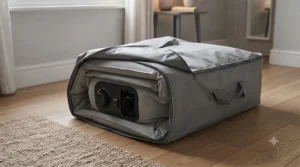
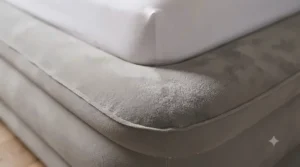
The storage bag question rarely gets an honest answer on product listings, and it’s worth addressing directly: a deflated queen or king size air bed does not fold down to the neat, compact size the marketing photos suggest. Realistically, expect a folded bundle somewhere in the region of 40-50cm in length and 15-25cm in diameter once rolled, depending on the bed’s material thickness and whether the pump is built in (built-in pumps add noticeable bulk and weight to the packed unit compared with external-pump models).
What most listings don’t mention is that the supplied storage bag is often just large enough for a single, careful, first-time fold — after a few uses, PVC tends to lose its original crease memory and becomes harder to compress back to the original packed size. Reviewers consistently report needing a slightly larger aftermarket bag, or simply a sturdy holdall, after the first few trips. If storage space in your car boot or cupboard is genuinely tight, favour beds with external rather than built-in pumps, and low-profile designs like the Intex Pillow Rest Classic over tall, raised alternatives — the difference in packed volume between a 25cm and a 56cm bed is substantial once you’re the one trying to zip the bag shut.
Common Mistakes When Buying a Queen Size Air Bed
The single most common mistake is trusting the size name over the actual dimensions — as covered above, “queen” and “king” labels vary enough between manufacturers that two beds marketed under different names can share identical footprints. The second is assuming any built-in pump means the bed is camping-ready off-grid; always confirm the power source rather than assuming, since a mains-only AC pump is effectively useless anywhere without a nearby socket. Regulatory compliance is worth a quick mental check too — inflatable products sold in the UK must meet general product safety requirements, and the Office for Product Safety and Standards maintains a public recalls and alerts register worth a quick search if you’re buying a lesser-known brand and want reassurance nothing on your specific model has been flagged.
A third frequent error is over- or under-inflating without accounting for temperature change, addressed earlier in the maintenance section — this alone causes a large share of the “went flat overnight” complaints that show up in aggregated review data, when the actual cause is thermal contraction rather than a genuine leak. Finally, buyers regularly skip checking puncture repair kit availability; almost every model ships with a basic patch kit, but confirming this before you’re stranded with a slow leak two days into a camping trip is a five-second check worth making at the point of purchase.
Long-Term Cost and Maintenance
Air beds are consumables in a way traditional mattresses aren’t, and thinking in terms of total cost of ownership rather than sticker price alone changes the calculation considerably. A £40 budget bed used twice a year for weekend guests, lasting perhaps three years before seams fatigue, works out to roughly £13 a year — genuinely excellent value for occasional use. Compare that with a £159 premium bed used monthly for frequent hosting: even assuming a shorter effective lifespan due to heavier use, the cost per use often ends up comparable or better than repeatedly replacing cheaper beds that fail faster under frequent inflation cycles.
Maintenance costs are generally minimal — a replacement patch kit costs a few pounds, and most beds don’t require anything beyond occasional wiping and correct storage. The main variable cost to budget for is eventual pump failure, which tends to be the first component to fail on built-in-pump models, since the mechanical parts see more stress than the PVC shell itself during storage. If a bed’s pump fails outside warranty, replacement is rarely economical compared with buying a new budget bed outright, which is worth factoring into whether the premium, more robust pump technology on beds like the Huddle NEVER DEFLATE Luxury King Air Bed justifies its higher upfront price for frequent users specifically.
Frequently Asked Questions
❓ What size is a queen size air bed in the UK?
❓ Can you use a queen size air bed every night as a permanent bed?
❓ How do you stop an air bed going flat overnight?
❓ Is a raised air bed better than a low-profile one for camping?
❓ What storage bag size do I need for a large air bed?
Conclusion
Choosing the right queen size air bed really comes down to being honest about how you’ll actually use it, rather than chasing the single “best” bed in the abstract. If you’re hosting the occasional visitor and want to spend as little as possible, the CHILLSUN Queen Size Airbed or Intex Pillow Rest Classic covers that need without fuss. If camping and bell tent trips are the priority, the raised, waterproof design of the Green Haven King Size Air Bed or OlarHike King Size Airbed earns its keep against damp ground and canvas walls in a way flatter beds simply can’t match.
For buyers who host frequently enough that comfort complaints have become a recurring theme, the Huddle NEVER DEFLATE Luxury King Air Bed‘s dual-pump, adjustable-firmness approach solves the industry’s most common complaint directly, and the Ideal Home buying guide is a useful second opinion if you want to cross-reference further UK-specific picks before deciding. Whichever you choose, remember the dimensions-over-labels rule, check the pump’s power source against how you’ll actually use the bed, and budget realistically for the storage space a deflated bed genuinely needs — get those three details right, and the rest tends to sort itself out.
Recommended for You
- Double Air Bed for Camping: 7 Best Picks for UK Trips (2026)
- 7 Best Air Bed for Camping Picks UK 2026: Sleep Better Outdoors
- Double Self-Inflating Mat for Couples: 7 Best Picks (2026)
Disclaimer: This article contains affiliate links. As an Amazon Associate, I earn from qualifying purchases. If you purchase products through these links, we may earn a small commission at no additional cost to you.
✨ Found this helpful? Share it with your friends! 💬🤗
