
In This Article
There’s a very specific kind of cold that creeps into a tent at 3am — the sort that has nothing to do with your sleeping bag rating and everything to do with the fact that nylon is, structurally speaking, about as insulating as a crisp packet. An electric tent heater exists to solve exactly that problem: it’s a compact, mains-powered appliance designed to take the edge off a chilly pitch without the fumes, flames, or faff of gas. Plug it into a campsite’s electric hookup, dial in a heat setting, and within minutes the air inside your canvas stops punishing you for choosing the outdoors over a hotel.
This guide has done the legwork so you don’t have to trawl a hundred listings at midnight. We’ve researched seven genuinely available electric tent heater models — from featherweight 500W desk-style units to proper 2000W campsite workhorses — and weighed up their real specs, their aggregated review sentiment, and where each one actually earns its keep. According to the Camping and Caravanning Club’s guidance on campsite electricity, the total wattage of everything switched on at once needs to stay under whatever your pitch’s hookup can actually supply — the single most important fact most buying guides skip entirely. We haven’t. Whether you’re chasing the best electric heater for tent camping as a family of four, hunting for a genuinely quiet electric heater that won’t wake the kids, or trying to work out whether a 12v tent heater beats a plug in tent heater for your setup, you’ll find a straight answer here — plus the honest trade-offs nobody puts on the box.
Quick Comparison Table
| Heater | Power Output | Noise Level | Best For |
|---|---|---|---|
| Pro Breeze Mini Heater | 500W | Quiet | Solo campers, small tents |
| Kampa Diddy | 750W/1500W | Moderate | Classic plug in tent heater pick |
| Beldray Portable Fan Heater | 1000W/2000W | Moderate-loud | Larger tents, fast warm-up |
| VonHaus 2000W PTC Space Heater | 2000W | Moderate | Families, campsite electric hookup |
| Dreo Compact Ceramic Heater | 1500W | Very quiet (~40dB) | Best electric heater for tent overall |
| GiveBest Ceramic Space Heater | 750W/1500W | Quiet | Energy efficient camping heater use |
| WAMHEET 12V Car Heater | 150W | Quiet | 12v tent heater, off-grid pitches |
Looking across the line-up, wattage is the real dividing line: anything from the Pro Breeze Mini Heater up to the GiveBest Ceramic Space Heater sits comfortably within a standard 6A campsite hookup, while the Beldray Portable Fan Heater and VonHaus 2000W PTC Space Heater need a 10A or 16A pitch to run flat out. The WAMHEET 12V Car Heater is the odd one out in the best way — it’s the only genuine option here for pitches with no mains supply at all, running instead off a vehicle’s 12V socket or a leisure battery.
💬 Just one click – help others make better buying decisions too!😊
Top 7 Electric Tent Heaters: Expert Analysis
1. Pro Breeze Mini Heater — quietest budget option for one-person tents
The standout feature here is size: this is a 500W ceramic fan heater small enough to sit on a camp table without eating your porch space. Under the hood, the ceramic PTC element and built-in thermostat mean it cycles on and off automatically once it hits your set temperature, rather than blasting continuously and hammering your power draw. Its 19 x 10.5 x 16.5cm footprint and heat dial keep the controls refreshingly simple — no app, no menu, just a dial and a switch.
Based on the spec comparison, this is squarely a personal heater rather than a whole-tent solution — 500W will warm the immediate area around a sleeping bag but won’t touch the far corners of a family-sized dome. Reviewers consistently note that positioning matters enormously: placed close to legs or a sleeping area it performs well, but from across a room it barely registers, according to genuine buyer feedback left on its Amazon listing. One recurring theme in that feedback is a short mains cable, which solo campers with a nearby EHU post shouldn’t mind, but tent occupants pitched further from the bollard may want an extension.
Pros:
- ✅ Genuinely quiet operation for light sleepers
- ✅ Thermostat cuts running costs automatically
- ✅ Compact enough for one-person or backpacking tents
Cons:
- ❌ Underpowered for anything bigger than a 2-person tent
- ❌ Mains cable reported as noticeably short
At around under £30, the Pro Breeze Mini Heater is one of the cheapest genuine entries into electric tent heating, and for solo or duo campers on a budget it represents solid value — just don’t expect it to heat a bell tent.
2. Kampa Diddy — the classic plug in tent heater campers actually buy
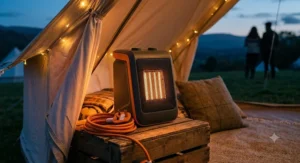
Kampa is a name campers already trust for awnings and accessories, and the Diddy’s standout feature is its dual 750W/1500W setting, which lets you match output to whatever amperage your pitch allows. The instant fan-forced heat means there’s no warm-up lag — flick it on and warm air arrives within seconds, which matters when you’re stood in a damp tent porch in your socks.
What most buyers overlook about this model is that the lower 750W setting isn’t a compromise tacked on for marketing — it’s genuinely there so the heater won’t trip a 6A campsite hookup, something a 2000W unit simply can’t offer. The ceramic heating element and cool-touch housing are sensible safety choices for a device that’s going to spend its life on a groundsheet near sleeping bags and dog beds. Aggregated feedback from UK camping bloggers who’ve used the Diddy repeatedly describes it as a firm favourite precisely because it’s compact, cheap to run on the low setting, and rarely trips even fussy hookups — though a small minority note the plastic housing feels basic for the price.
Pros:
- ✅ Two power settings suit different hookup amperages
- ✅ Trusted, purpose-built camping brand
- ✅ Compact and genuinely portable at just over a kilogram
Cons:
- ❌ Plastic build feels basic compared to premium rivals
- ❌ No thermostat, so you manage temperature manually
Priced in the £25-£35 range, the Kampa Diddy is arguably the definitive answer if someone asks what a plug in tent heater actually looks like in practice — proven, purpose-built, and priced to be an easy add to the camping kit list.
3. Beldray Portable Fan Heater — best for fast warm-up in larger tents
The Beldray’s party trick is its three-way heat control — fan-only, 1000W, and 2000W — plus a flat-lay design that lets you position it either upright or lying flat depending on your tent’s layout. That flat-lay stability is a genuinely clever bit of engineering: a wide, low profile is far harder to knock over than a tall, narrow unit, which matters a great deal when there are guy-lines, dogs, and stumbling campers involved.
Here’s what to weigh: the top 2000W setting delivers serious, fast heat that will noticeably warm a family tent within minutes, but it also sits right at the ceiling of what a standard 10A hookup can handle before things start tripping. Reviewers who’ve used the Beldray on campsites report that the lower 1000W setting is the one they actually reach for most nights, saving the full 2000W for a quick blast before bed. The overheat protection and tip-over cut-off are standard safety fare, but worth confirming are present before any purchase given the higher wattage involved.
Pros:
- ✅ Can be positioned flat or upright for flexible placement
- ✅ Fastest warm-up of the fan heaters on this list
- ✅ Three heat settings including a cool fan-only mode
Cons:
- ❌ 2000W setting needs a 10A+ hookup to avoid tripping
- ❌ Louder than ceramic alternatives on higher settings
Expect to pay in the £20-£30 range, making the Beldray Portable Fan Heater a strong value pick for anyone who wants proper heat output without stepping up to a premium ceramic model.
4. VonHaus 2000W PTC Space Heater — built for family tents on full hookup
VonHaus pitches this one squarely at bigger groups, and the standout feature is straightforward: a 2000W PTC element designed to deliver fast, even warmth across a tent housing four or more people, rather than the single-person radius of smaller units. PTC (positive temperature coefficient) ceramic technology is genuinely worth understanding here — as the element heats up, its own resistance rises and naturally limits further heat build-up, which is a meaningfully safer design than older exposed-coil heaters.
What the spec sheet won’t tell you, but general market feedback on PTC space heaters of this type suggests, is that even heat distribution across a tent depends heavily on airflow and oscillation — a static 2000W unit in one corner will still leave cold pockets, so positioning centrally (safely, away from fabric) matters more than raw wattage alone. This is very much a family-trip heater rather than a backpacking one: it’s not the lightest option here, and it demands a proper 10A or 16A campsite electric hookup to run comfortably alongside lights, chargers, and a kettle.
Pros:
- ✅ Genuinely capable of heating a 4+ person family tent
- ✅ PTC ceramic tech is inherently safer than exposed coils
- ✅ Fast heat-up suited to cold mornings before breakfast
Cons:
- ❌ Demands a 10A or 16A hookup, not suited to 6A pitches
- ❌ Bulkier to pack than the smaller units on this list
At a price typically in the £35-£50 range, the VonHaus 2000W PTC Space Heater earns its place as the family-sized answer, provided your chosen campsite’s electrics can actually support it.
5. Dreo Compact Ceramic Heater — best electric heater for tent camping overall
If there’s one model on this list that repeatedly comes up as the best electric heater for tent use among campervan and motorhome owners too, it’s this compact 26.2cm PTC ceramic unit. The standout feature is a genuinely low 40dB operating noise — quiet enough to run through the night without becoming the reason nobody sleeps — paired with a DC motor and 9-blade fan system that’s unusually refined for something this size.
Based on the spec comparison, what separates this from the fan heaters further up the list is precision: an LED display and adjustable thermostat let you dial in a target temperature between 3°C and 35°C, and 70° oscillation spreads that 1500W output around the tent rather than concentrating it in one hot spot. Reviewers covering this model for campervan use consistently flag the quiet running as the headline benefit, alongside overheat and tip-over protection and a removable, washable filter — a small but genuinely useful touch for anyone camping somewhere dusty. The trade-off is price: this sits above the basic fan heaters on this list, reflecting its more sophisticated build.
Pros:
- ✅ Whisper-quiet 40dB running noise for undisturbed sleep
- ✅ Precise thermostat control from 3°C to 35°C
- ✅ Oscillation spreads heat evenly rather than in one direction
Cons:
- ❌ Pricier than basic fan heaters on this list
- ❌ 1500W ceiling means it won’t out-blast the VonHaus on raw power
Typically priced in the £45-£65 range, the Dreo Compact Ceramic Heater is the one to choose if quiet, controlled, campsite electric hookup heating is the priority over sheer brute force.
6. GiveBest Ceramic Space Heater — the energy efficient camping heater pick
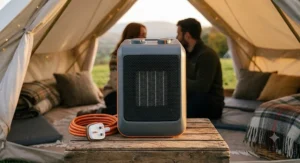
GiveBest’s standout feature is flexibility built around efficiency: a 2-in-1 heater and fan setup that switches between 1500W and 750W heat modes, plus a cool fan-only setting for warmer nights — meaning one device covers considerably more of the camping calendar than a heat-only unit. The built-in thermostat is the real efficiency story here, cycling the element on and off to hold a set temperature rather than running continuously at full draw.
Here’s what most buyers overlook: an energy efficient camping heater isn’t necessarily the lowest-wattage model on paper — it’s the one that spends the least time actually drawing power, and a genuine thermostat does more for that than a low wattage rating alone. A 3-second quick heat function means you’re not stood shivering waiting for warmth to arrive, and the flame-resistant housing plus dual overheat and tip-over shut-offs (including a tip-over beep that resumes once the unit is set upright again) are sensible inclusions for tent use specifically. Aggregated feedback on ceramic heaters of this design generally praises the thermostat’s accuracy, though as with most budget ceramic units, buyers should expect a plastic rather than metal casing.
Pros:
- ✅ Genuine thermostat cycling reduces real-world running costs
- ✅ 2-in-1 heat and fan modes extend seasonal usefulness
- ✅ Flame-resistant housing with dual safety shut-offs
Cons:
- ❌ Plastic casing feels less premium than metal-bodied rivals
- ❌ 1500W ceiling limits it to small-to-medium tents
Priced around £30-£45, the GiveBest Ceramic Space Heater is the model to reach for when running costs, not just purchase price, are the deciding factor.
7. WAMHEET 12V Car Heater — the genuine 12v tent heater for off-grid pitches
Every heater above this one assumes you have access to a mains electric hookup. The WAMHEET 12V Car Heater doesn’t, and that’s precisely its standout feature: a 150W unit that plugs straight into a 12V cigarette lighter socket or portable power station, making it the only realistic 12v tent heater option here for wild camping, overlanding, or pitches with no electric hookup at all.
What the spec sheet won’t tell you, but the maths will, is that 150W is a fraction of the output of the mains units on this list — it’s built for quick defrosting and a directional blast of warm air rather than filling a whole tent, and it’s genuinely designed as a car demister first and camping accessory second. Reviewers of similarly specified 12V heaters consistently note they’re best treated as personal or windscreen-clearing tools rather than a substitute for a proper tent heater, and that they’ll drain a small leisure battery faster than most people expect if left running continuously. The adjustable swivel stand at least means you can direct what heat there is exactly where you need it.
Pros:
- ✅ Works anywhere with a 12V socket — no mains hookup needed
- ✅ Genuinely portable and lightweight
- ✅ Adjustable swivel stand for directional warmth
Cons:
- ❌ Far lower heat output than any mains option on this list
- ❌ Will drain a small leisure battery quickly if run continuously
At typically under £20, the WAMHEET 12V Car Heater is less a rival to the other six products here and more a specialist backup — genuinely useful, but only within its limits.
Setting Up Your Electric Tent Heater Safely
Getting an electric tent heater right on your first trip is mostly about respecting two numbers: your campsite’s hookup rating, and your heater’s wattage. Power in watts equals volts multiplied by amps, so on the UK’s standard 230V supply, a 10A hookup gives you roughly 2,300W to play with, while a 16A hookup stretches to around 3,680W. That means running the VonHaus 2000W PTC Space Heater flat out on a 10A pitch leaves you almost no headroom for a kettle or phone charger before the breaker trips.
Before your first night, walk through this quick routine: check the amp rating on the site’s hookup post, add up the wattage of everything you plan to run simultaneously, and choose your heat setting accordingly — this is exactly why models like the Kampa Diddy and GiveBest Ceramic Space Heater offering a low-power mode earn their keep. Position the heater on a flat, stable surface at least a metre from tent fabric, sleeping bags, and guy-lines, never directly on groundsheet fabric that could melt, and always run it on a purpose-built outdoor hookup cable rather than a household extension lead. A common first-30-days mistake is leaving a heater running while cooking or asleep — nearly every model here includes tip-over and overheat protection, but that’s a backup, not a substitute for switching it off before you nod off.
Which Heater Matches Your Camping Style?
Picture Sam, a solo hiker pitching a one-person tent on a certified location with a modest 6A hookup: the Pro Breeze Mini Heater at 500W fits both the space and the power budget, warming the immediate sleeping area without any risk of tripping a low-amp supply. Now picture the Whitfield family, four of them plus a dog in a large canvas bell tent on a proper campsite pitch with 16A available: here the VonHaus 2000W PTC Space Heater makes far more sense, with enough output to actually heat the shared space rather than one corner of it.
Then there’s Priya, wild camping in the Peak District with zero access to mains electricity at all — for her, every heater on this list except the WAMHEET 12V Car Heater is simply unusable, since there’s no hookup to plug into. And finally, consider Tom and his partner, festival campers who value a full night’s sleep above all else and are willing to pay a bit more for it: the Dreo Compact Ceramic Heater‘s low 40dB running noise makes it the obvious pick over louder fan heaters that would otherwise buzz through their canvas walls until dawn.
✨ Don’t Miss These Exclusive Deals!
🔍 Take your tent heating setup to the next level with these carefully selected picks. Click through to check current pricing and availability, and turn your next chilly camping trip into a genuinely cosy one.
Fixing Common Tent Heating Problems
Most electric tent heater complaints trace back to a small handful of avoidable issues, so here’s how to head them off. If your heater keeps tripping the campsite hookup, the fix almost always lies in the maths from the section above — drop to a lower wattage setting like the Kampa Diddy‘s 750W mode, or unplug other appliances before switching the heater on. If the tent still feels cold despite the heater running, check first for gaps in guy-lines or an unclosed door flap letting warmth straight back out; even the VonHaus 2000W PTC Space Heater can’t out-heat an open tent.
Condensation building up on the tent’s inner walls is a genuinely common side-effect of any heater use in an unventilated space — cracking a vent or door slightly, rather than sealing the tent completely, actually helps here, and a fan-only mode like the one on the GiveBest Ceramic Space Heater can help move damp air around. If noise is the problem and a heater is keeping everyone awake, that’s less a fault than a mismatch — swap to the quietest option on this list, the Dreo Compact Ceramic Heater, rather than assuming all electric heaters are equally loud. And if you’re pitched somewhere with no hookup at all, don’t force a mains unit to work off an inverter; the WAMHEET 12V Car Heater exists precisely for this scenario.
How to Choose an Electric Tent Heater
- Check your hookup’s amp rating first. Everything else follows from this — a 6A pitch rules out the higher settings on the Beldray Portable Fan Heater and VonHaus 2000W PTC Space Heater before you even consider features.
- Match wattage to tent size, not to the biggest number on the box. A 500W unit like the Pro Breeze Mini Heater is genuinely enough for one or two people; a family tent needs 1500W-2000W to actually feel warm throughout.
- Prioritise a thermostat if running costs matter to you. Models like the GiveBest Ceramic Space Heater cycle on and off automatically, which meaningfully cuts electricity use compared with a heater that runs continuously at full power.
- Weigh noise against heat output. The quietest options, such as the Dreo Compact Ceramic Heater, tend to sit at the lower end of the wattage range — a genuine trade-off, not a flaw.
- Confirm safety features are present, not assumed. Overheat protection and a tip-over cut-off should be non-negotiable on any electric heater destined for a tent floor.
- Consider whether you’ll ever camp off-grid. If wild camping features in your plans, a 12V option like the WAMHEET 12V Car Heater is worth owning alongside a mains unit, not instead of one.
- Weigh portability against power. The lightest units pack smallest but heat least; heavier PTC units like the VonHaus 2000W PTC Space Heater trade pack size for genuine heating capability.
Electric Tent Heater vs Gas Tent Heater
The core trade-off between electric and gas tent heating comes down to one word: combustion. Gas heaters burn propane or butane to produce heat, which means genuinely higher output per unit size, no dependency on a campsite hookup, and usable warmth almost anywhere — but it also means carbon monoxide risk, the need for proper ventilation, and a legal requirement for a carbon monoxide alarm in any enclosed space they’re used in. Electric heaters like the Kampa Diddy or Dreo Compact Ceramic Heater sidestep that risk entirely; there’s no flame, no combustion gas, and no oxygen depletion to monitor, which is precisely why electric is generally considered the safer default for families and less experienced campers.
| Factor | Electric Heater | Gas Heater |
|---|---|---|
| Requires mains hookup | Yes (except WAMHEET 12V Car Heater) | No |
| Carbon monoxide risk | None | Present — requires ventilation & CO alarm |
| Typical running cost | Predictable, metered | Depends on cylinder/cartridge cost |
| Best For | Campsites with hookup, families | Off-grid, no electric access |
The verdict from this comparison is fairly clear-cut: if your pitch has a hookup, electric wins comfortably on safety alone, with models like the VonHaus 2000W PTC Space Heater offering comparable warmth to a gas unit without any combustion by-products. Gas only pulls ahead genuinely when there’s no electricity available whatsoever — in which case the safety trade-offs need to be actively managed, not ignored.
Common Mistakes When Buying an Electric Tent Heater
The single most frequent mistake is buying purely on maximum wattage without checking the campsite hookup rating first — a 2000W heater is worthless if your pitch only supplies 6A. A close second is assuming all “portable” heaters are genuinely tent-safe; some budget models marketed generically as space heaters lack the tip-over and overheat protection that purpose-camping models like the Kampa Diddy build in as standard.
Buyers also frequently underestimate noise as a factor until the first night it keeps them awake, which is why we’ve flagged decibel levels wherever verified data exists, favouring quieter units like the Dreo Compact Ceramic Heater for anyone sharing a tent. Finally, plenty of shoppers overlook portability entirely and end up with a heater too bulky to justify the boot space it eats — worth weighing against the Pro Breeze Mini Heater‘s compact footprint if car space, or backpack space, is tight.
What to Expect: Real-World Performance
On paper, wattage looks like the whole story, but real tent performance depends just as much on tent size, insulation, and how sealed the space is. A 500W unit like the Pro Breeze Mini Heater will noticeably raise the temperature within arm’s reach inside twenty minutes, but expect the far end of a larger tent to stay stubbornly cool. Step up to 1500W-2000W units like the VonHaus 2000W PTC Space Heater or Beldray Portable Fan Heater on its top setting, and most campers report the whole interior of a medium family tent reaching a comfortable temperature within ten to fifteen minutes, provided doors and vents are mostly closed.
Where the spec sheet genuinely doesn’t tell the full story is heat retention once the heater switches off — canvas and polyester tents lose warmth fast, typically dropping several degrees within half an hour of the heater being unplugged, which is exactly why the sensible routine is to warm the tent before bed and switch off overnight rather than expecting all-night heating from any of these units.
Features That Actually Matter (And Those That Don’t)
Genuinely worth paying for: a real thermostat (not just a heat dial), tip-over and overheat protection, and — if noise matters to you — a published decibel rating rather than a vague “quiet operation” claim. The GiveBest Ceramic Space Heater‘s thermostat and the Dreo Compact Ceramic Heater‘s 40dB rating are exactly the kind of specifics worth checking before you buy, rather than taking marketing copy at face value.
Less important than the marketing suggests: oscillation is a nice-to-have rather than essential in a small tent where heat naturally circulates in a confined space anyway, and remote controls add convenience but little actual heating benefit for a device you’ll mostly set once and leave. Colour options and app connectivity, where offered on similar models, are genuinely irrelevant to how warm your tent gets — don’t let them sway a decision that should really rest on wattage, hookup compatibility, and safety features.
Safety, Regulations & Campsite Compliance Guide
Electric tent heater safety isn’t optional extra reading — it’s the single most important section in this guide. The London Fire Brigade records over 160 heater-related fires annually in the UK, and specifically warns that fires typically start when bedding, blankets, or clothing sit too close to a heater. In the tighter confines of a tent, that risk is amplified: sleeping bags, clothing, and guy-lines all sit closer to a heater than they would in a house.
Before your trip, run through this checklist: confirm the heater has both overheat protection and a tip-over cut-off (every model reviewed here includes both), always run it via a purpose-built outdoor hookup cable rather than a domestic extension lead, and never leave any electric heater running unattended or overnight while you sleep. Check that your chosen campsite hookup cable meets British Standard requirements with proper RCD and MCB protection before connecting anything. Many UK campsites now list maximum heater wattage in their site rules specifically because of overload risk, so it’s worth checking your site’s terms before you pack.
Long-Term Cost & Energy Efficiency
Purchase price only tells half the story — running cost is where an energy efficient camping heater genuinely earns its keep over a season of trips. A heater with a proper thermostat, like the GiveBest Ceramic Space Heater, spends a meaningful proportion of its runtime cycled off once it hits temperature, whereas a basic heat-only unit like the Beldray Portable Fan Heater on its top setting draws its full wattage continuously until manually switched down.
| Heater | Power Draw | Thermostat | Typical Value Verdict |
|---|---|---|---|
| Pro Breeze Mini Heater | 500W | Yes | Cheapest to run, limited coverage |
| GiveBest Ceramic Space Heater | 750W/1500W | Yes | Best balance of cost and coverage |
| Kampa Diddy | 750W/1500W | No | Manual control keeps costs predictable |
| VonHaus 2000W PTC Space Heater | 2000W | No | Highest running cost, highest output |
Looking at this table, the clear pattern is that thermostatic control matters more to long-term running cost than headline wattage alone — the GiveBest Ceramic Space Heater will typically cost less to run over a weekend than the wattage-matched Kampa Diddy simply because it isn’t drawing full power constantly. For occasional weekend campers, purchase price should carry more weight; for anyone heating a tent regularly across a season, the thermostat becomes the genuinely decisive factor.
Frequently Asked Questions
❓ What is an electric tent heater?
❓ Is it safe to run an electric heater in a tent overnight?
❓ What size electric heater do I need for a family tent?
❓ Can I use a 12v tent heater without a campsite hookup?
❓ What's the quietest electric heater for camping?
Conclusion
Choosing the best electric tent heater for your own trips really comes down to three honest questions: what does your pitch’s hookup actually support, how many people need warming, and how much do you value quiet running over raw heat output. For solo campers on modest hookups, the Pro Breeze Mini Heater is genuinely hard to beat on price and footprint. Families with proper 16A pitches will get more consistent warmth from the VonHaus 2000W PTC Space Heater, while anyone prioritising sleep quality above all else should look seriously at the Dreo Compact Ceramic Heater‘s low noise rating.
None of these choices are wrong, exactly — they’re simply matched to different trips. What matters most, whichever model ends up in your kit bag, is respecting the safety basics: check your hookup’s amp rating, never leave a heater running overnight, and keep it clear of fabric and bedding. Electrical Safety First’s own research found a striking number of people admit to leaving heaters switched on and unattended, and that single habit accounts for a disproportionate share of preventable incidents — so treat the safety checklist above as seriously as the buying advice.
Recommended for You
- Camping Heater Indoor Safe: 7 Tested Picks for 2026 (Don’t Guess)
- How to Store Tent Long Term: 7 Genius Fixes for 2026
- Tent Lighting Setup Guide: 7 Brilliant Picks for 2026
Disclaimer: This article contains affiliate links. As an Amazon Associate, I earn from qualifying purchases. If you purchase products through these links, we may earn a small commission at no additional cost to you.
✨ Found this helpful? Share it with your friends! 💬🤗
