
In This Article
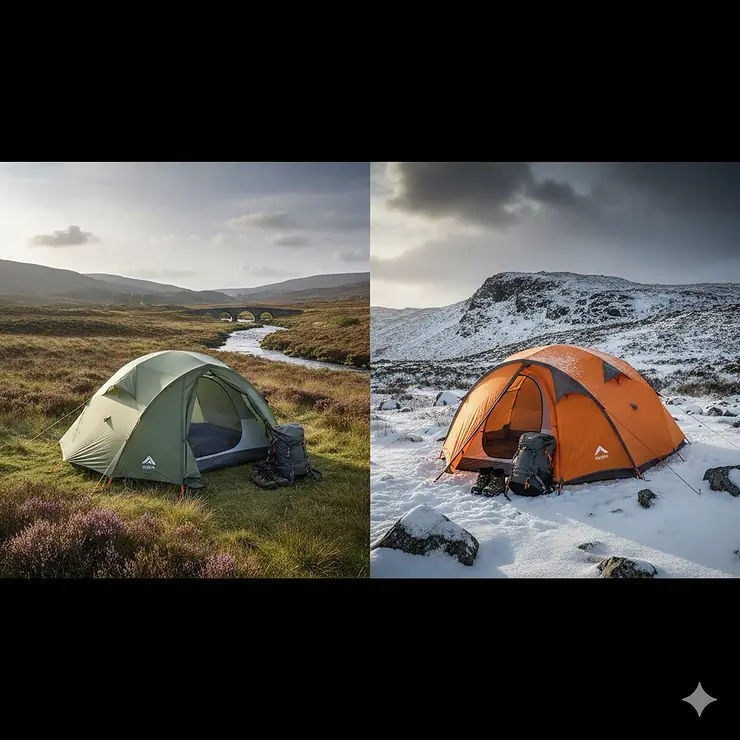
Standing in the outdoors section at your local retailer or scrolling through Amazon.co.uk, you’ve probably noticed those mysterious numbers on tent packaging: “3 season” or “4 season.” But what do they actually mean? More importantly, which one should grace your next camping adventure across the UK’s diverse landscapes?
Here’s the thing that confuses most first-time tent buyers: these ratings aren’t about how many months you can use the tent. Rather, they’re about the weather conditions your shelter can handle. A 4 season tent isn’t necessarily better than a 3 season one—in fact, pitching a heavily insulated 4 season tent during a sweltering August weekend in Cornwall could leave you feeling like you’re camping in a sauna!
The tent season rating system helps campers understand what their shelter can withstand, from the gentle spring drizzle in the Cotswolds to the fierce winter gales atop Snowdonia. According to the Camping and Caravanning Club, selecting the appropriate season rating can significantly impact your comfort, safety, and overall camping experience.
Whether you’re planning weekend family trips to established campsites or embarking on wild camping expeditions in the Scottish Highlands, understanding the difference 3 season 4 season tent options offer will help you make an informed decision. In this comprehensive guide, we’ll explore seven top-rated tents available on Amazon.co.uk, compare their features, and help you determine exactly what you need for your UK camping adventures.
Quick Comparison Table
| Feature | 3 Season Tent | 4 Season Tent |
|---|---|---|
| Best For | Spring, summer, autumn | Winter & extreme weather |
| Ventilation | Excellent (mesh panels) | Limited (solid fabric) |
| Weather Protection | Moderate rain & wind | Heavy snow, strong winds |
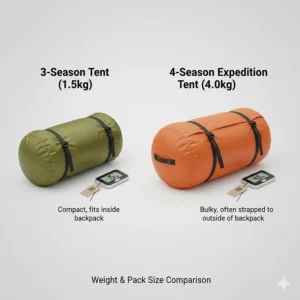
| Weight | Lighter (1.5-4kg) | Heavier (2-6kg) |
| UK Price Range | £49-£150 | £89-£310 |
| Warmth | Cooler, breathable | Well-insulated |
| Typical Use | Festival, family camping | Mountaineering, winter camps |
| Condensation | Less prone | More prone without ventilation |
💬 Just one click – help others make better buying decisions too! 😊
Top 7 Tents: Expert Analysis
1. Naturehike Cloud-Up 2 Ultralight Tent – Best 3 Season Budget Pick
The Naturehike Cloud-Up 2 has become something of a legend amongst UK backpackers, and for good reason. This 3 season tent strikes an impressive balance between affordability and performance.
Key Specifications:
- Weight: 1.75kg (incredibly portable)
- Waterproof rating: 4000mm (excellent for UK weather)
- Packed size: 40cm × Ø13cm
Price: £65-£87 on Amazon.co.uk
Customer Feedback: UK buyers consistently praise its quick setup and surprising resilience. One Yorkshire camper noted it handled torrential rain across the Dales without a single leak. The lightweight design makes it ideal for bikepacking and multi-day hikes. However, some reviewers mention the zips feel slightly budget-friendly compared to premium brands.
✅ Pros:
- Ultralight for backpacking
- Exceptional waterproofing at this price point
- Free-standing design with Y-frame structure
❌ Cons:
- Zip quality could be better
- Thin groundsheet (footprint included helps)
2. Naturehike Cloud Peak 3-4 Person – Best 3.5 Season Crossover
For those wondering “do i need 4 season tent uk” conditions, the Cloud Peak answers with versatility. Marketed as a 3-4 season tent, it bridges the gap beautifully.
Key Specifications:
- Capacity: 3-4 people
- Double-layer construction
- Reinforced pole structure
Price: £89-£120 on Amazon.co.uk
Customer Feedback: Scottish Highlands campers report excellent performance in shoulder season conditions. The additional insulation compared to pure 3 season models makes it suitable for early spring and late autumn trips. One reviewer used it during October in the Cairngorms and stayed comfortable despite near-freezing temperatures.
✅ Pros:
- Versatile across multiple seasons
- Spacious interior for gear storage
- Better insulation than standard 3 season tents
❌ Cons:
- Slightly heavier than pure 3 season options
- Can feel warm in peak summer
3. Vango Odyssey 200 – Best UK Brand 3 Season Value
British outdoor enthusiasts trust Vango for a reason. The Vango Odyssey 200 represents solid UK engineering at an accessible price point.
Key Specifications:
- 2-person capacity
- TBS II (Tension Band System) for stability
- Fire-retardant materials
Price: £74-£97 on Amazon.co.uk
Customer Feedback: Lake District regulars appreciate the robust British design that handles wind exceptionally well. The sewn-in groundsheet and generous headroom receive particular praise. Some users note it’s slightly bulkier packed than ultralight alternatives, but the durability justifies the extra weight for car camping.
✅ Pros:
- Proven British brand reliability
- Excellent wind resistance
- Good headroom for UK weather gear changes
❌ Cons:
- Heavier pack size
- Limited colour options
4. Coleman Coastline 3 Plus – Best 3 Season Family Tent
For family camping across UK campsites, the Coleman Coastline 3 Plus delivers practical features and reliable performance.
Key Specifications:
- Tunnel design with vestibule
- 3000mm waterproof coating
- Integrated cable slot for modern camping
Price: £82-£116 on Amazon.co.uk
Customer Feedback: Families camping in Wales and the South Coast rave about the spacious vestibule for storing muddy boots and gear. The quick setup means less time pitching and more time enjoying the outdoors. Several reviewers mention using it for 3-4 years with consistent performance. The only common complaint? At 7.2kg, it’s strictly for car camping.
✅ Pros:
- Generous living space
- Family-friendly features
- Quick tunnel design setup
❌ Cons:
- Heavy for backpacking
- Large packed size (66cm × 18cm × 18cm)
5. OneTigris Backwoods Bungalow – Best Budget 4 Season Option
The OneTigris Backwoods Bungalow has gained cult status amongst winter camping enthusiasts seeking 4 season protection without premium pricing.
Key Specifications:
- Hot tent compatible (stove jack included)
- Reinforced winter-grade materials
- 2-person capacity
Price: £138-£190 on Amazon.co.uk
Customer Feedback: Lake District winter campers report excellent performance with a wood stove installed. The robust construction handles snow loading admirably. UK buyers appreciate the value proposition compared to brands like Hilleberg. Some mention condensation management requires careful ventilation when using heating.
✅ Pros:
- Genuine 4 season capability at budget price
- Stove jack for winter heating
- Durable materials
❌ Cons:
- Heavy (not suitable for long backpacking)
- Requires practice for optimal condensation control
6. Naturehike Mongar 2 Person – Best Lightweight 4 Season
For those needing 4 season tent ventilation alongside winter protection, the Naturehike Mongar 2 offers clever design solutions.
Key Specifications:
- Geodesic dome structure (superior wind resistance)
- Convertible mesh panels
- 8000mm waterproof base
Price: £149-£199 on Amazon.co.uk
Customer Feedback: Scottish mountaineers praise its performance in high-altitude winter conditions. The geodesic design proved stable in 60mph winds on Ben Nevis. Several buyers highlight the intelligent ventilation system that minimises condensation whilst retaining warmth. The only criticism? The stuff sack could be more robust.
✅ Pros:
- True 4 season performance
- Excellent ventilation management
- Lighter than most 4 season options (2.8kg)
❌ Cons:
- Premium pricing for Naturehike
- Complex setup compared to tunnel designs
7. Vango Banshee 200 Pro – Best UK Brand 4 Season Investment
The Vango Banshee 200 Pro represents British tent engineering at its finest, designed specifically for UK and Scottish winter conditions.
Key Specifications:
- Vango’s TBS II stability system
- Hydrostatic Head: 4000mm
- Award-winning design
Price: £199-£245 (check current Amazon.co.uk pricing)
Customer Feedback: Experienced winter campers across Scotland and the Lake District consider this their go-to tent. One reviewer completed the Cape Wrath Trail in March using the Banshee, praising its exceptional weather protection. The British design understands UK conditions intimately. Investment-level pricing puts it beyond casual campers’ budgets.
✅ Pros:
- Exceptional build quality
- Designed specifically for British conditions
- Proven track record in extreme UK weather
❌ Cons:
- Premium price point
- Potentially overkill for casual camping
Understanding Tent Season Ratings
The tent season rating system can be confusing, especially since it’s not standardised across manufacturers. According to outdoor gear experts, these ratings measure a tent’s ability to handle specific weather conditions rather than literal seasons.
What Makes a 3 Season Tent?
3 season tents dominate the UK camping market for good reason—they’re versatile enough for most British camping scenarios. Designed for spring, summer, and autumn use, these shelters feature:
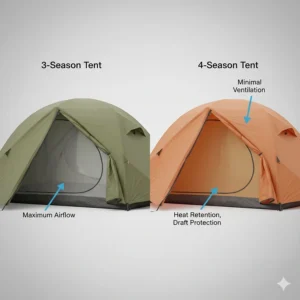
Ventilation-First Design: Large mesh panels promote airflow, crucial for preventing condensation during humid British summers. This breathability keeps you comfortable when temperatures rise but means they’re less insulated for cold weather.
Moderate Weather Protection: A quality 3 season tent handles impressive amounts of rain (typical UK waterproof ratings of 3000-5000mm) and withstands moderate wind. However, they’re not engineered for heavy snow loads or extreme winter gales.
Lightweight Construction: Most 3 season tents prioritise packability, using lighter fabrics and fewer poles. This makes them ideal for backpacking and cycle touring across the UK.
When to Choose 3 Season:
- Festival camping (Glastonbury, Reading, Leeds)
- Family holidays at established UK campsites
- Spring through autumn wild camping
- Backpacking the West Highland Way or Coast to Coast
- Cycle touring adventures
Research from the British Mountaineering Council suggests 3 season tents suit approximately 80% of UK recreational camping needs.
What Makes a 4 Season Tent Different?
4 season tents—often called winter or mountaineering tents—tackle conditions that would damage lighter shelters. The tent season rating system designates these as expedition-grade for good reason.
Robust Construction: Heavier fabrics, reinforced seams, and additional guy-out points create shelters that laugh at Scottish winter storms. Dome or geodesic designs distribute wind load effectively.
Reduced Ventilation: Solid fabric panels replace much of the mesh found in 3 season models. Whilst this significantly improves insulation and wind protection, it requires careful condensation management.
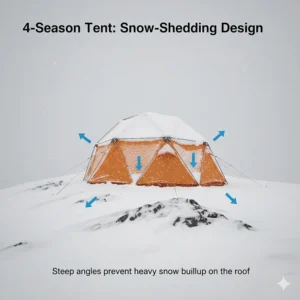
Snow Load Capability: Steeper wall angles and stronger pole structures prevent collapse under snow accumulation—essential for winter mountaineering or Cairngorms camping.
Superior Insulation: The trade-off for warmth? 4 season tents can become uncomfortably hot during summer months, even in the UK.
When to Choose 4 Season:
- Winter mountaineering in Scotland
- High-altitude camping (Snowdon, Ben Nevis in winter)
- Extreme weather expeditions
- Year-round wild camping in exposed locations
- Scottish Highlands winter adventures
The 3.5 Season Alternative
Some manufacturers market “3.5 season” tents as compromise solutions. These 3 season tent winter camping adaptable models offer:
- Convertible ventilation panels
- Slightly more robust construction than pure 3 season
- Better insulation without full 4 season weight
- Suitable for UK shoulder seasons
For campers questioning “do i need 4 season tent uk” conditions, a 3.5 season option often provides the perfect middle ground.
Climate Considerations for UK Campers
Regional Weather Variations
The UK’s compact size belies its dramatic weather diversity. Your tent choice should reflect where you’ll camp most:
Scottish Highlands: Even summer conditions can turn harsh rapidly. Many experienced Scottish campers opt for 4 season tents or robust 3 season models year-round. Winter expeditions absolutely require 4 season protection.
Lake District: Notoriously changeable weather means versatile 3 season tents work well spring through autumn. Winter camping demands 4 season capability due to elevation and exposure.
Snowdonia: Similar to the Lakes, with added wind exposure on higher peaks. A quality 3 season tent handles most conditions, but winter mountaineering requires 4 season specification.
Southern England & Wales: Milder overall, making 3 season tents perfectly adequate for most camping. Even winter wild camping rarely necessitates 4 season gear at lower elevations.
Seasonal Temperature Ranges
UK camping temperatures vary more than many expect:
- Summer (June-August): 12-22°C typically, occasionally reaching 28°C+
- Spring/Autumn (March-May, September-November): 5-15°C, with frost possible
- Winter (December-February): -5°C to 8°C in lowlands; -15°C+ possible in Scottish mountains
Your tent’s season rating should match your coldest anticipated conditions, not average temperatures.
Key Features Comparison
Ventilation Systems
Proper airflow prevents condensation—the bane of British camping. 3 season tents excel here with extensive mesh panels and multiple vents. However, this ventilation becomes a liability in winter when you need heat retention.
4 season models sacrifice ventilation for insulation but incorporate thoughtful design features:
- Adjustable vents that close completely
- Chimney-style top vents for moisture escape
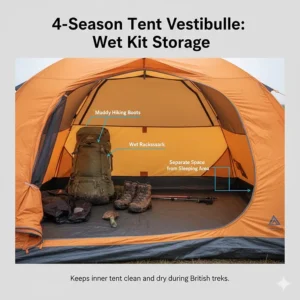
- Vestibule ventilation preventing complete air stagnation
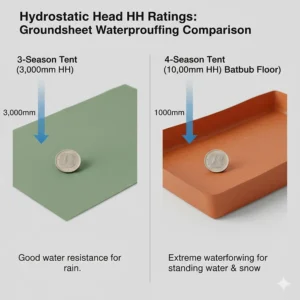
Waterproofing Technology
UK camping demands serious waterproofing. The hydrostatic head test measures this:
- 1500mm: Basic water resistance (light showers)
- 3000mm: Good waterproofing (standard UK rainfall)
- 4000mm+: Excellent protection (heavy/prolonged rain)
- 5000mm+: Premium waterproofing (extreme conditions)
Both 3 and 4 season tents achieve high waterproof ratings, but 4 season models often use heavier coated fabrics for added durability.
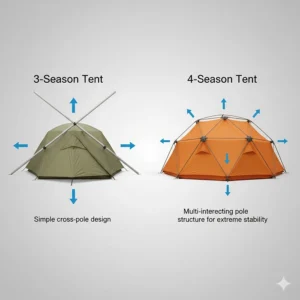
Pole Structure & Stability
3 Season Designs:
- Tunnel tents: Excellent space-to-weight ratio, moderate wind resistance
- Dome tents: Good stability, free-standing convenience
- Simple pole configurations: Quick setup, adequate strength
4 Season Designs:
- Geodesic domes: Superior wind resistance through multiple crossing poles
- Reinforced tunnel designs: Stronger poles, additional guy-out points
- Complex structures: Longer setup time, exceptional stability
Weight Considerations
Backpackers obsess over weight for good reason—every gram counts across multi-day treks:
3 Season Solo Tents: 1.2-2.5kg typically
3 Season 2-Person: 1.8-4kg typically
4 Season Solo: 2-3.5kg typically
4 Season 2-Person: 2.5-6kg typically
Car camping removes weight constraints entirely, allowing focus on comfort and features.
Practical Usage Scenarios
Festival Camping
UK music festivals present unique challenges: unpredictable weather, limited space, potential security concerns, and thousands of neighbours.
Best Choice: Budget 3 season tent
Why? You need something:
- Affordable (festivals have unfortunate tent theft/damage rates)
- Easy to pitch (possibly after a few pints)
- Adequately weatherproof (Reading Festival rain is legendary)
- Lightweight enough to carry from car parks
The Naturehike Cloud-Up 2 or similar budget 3 season models prove ideal. Don’t invest in premium 4 season gear for festival environments.
Family Camping Holidays
Established UK campsites offer facilities that enable more luxurious camping. Families prioritise space, comfort, and ease over ultralight designs.
Best Choice: Spacious 3 season tent
Family requirements differ:
- Multiple compartments for privacy
- Standing headroom (makes rainy days bearable)
- Large vestibule for gear/boot storage
- Integrated groundsheet (keeps kids clean)
Options like the Coleman Coastline 3 Plus deliver family-friendly features. Weight matters less since you’re car camping.
Backpacking Adventures
Multi-day trails like the West Highland Way, Pennine Way, or Coast to Coast demand different priorities:
Best Choice: Lightweight 3 season tent (spring-autumn) or 3.5 season (shoulder seasons)
Backpacking essentials:
- Minimal packed weight and size
- Quick pitch capability (tired legs appreciate this)
- Reliable weatherproofing (wild camping means no shelter alternatives)
- Durability (rough ground, frequent pitching)
The Naturehike Cloud-Up 2 exemplifies excellent backpacking tents, balancing weight, performance, and cost.
Winter Mountaineering
Scottish winter climbing or high-altitude camping represents the most demanding UK tent usage.
Best Choice: True 4 season tent, non-negotiable
Winter requirements:
- Extreme wind resistance (100mph+ gusts possible)
- Snow load capability
- Minimal condensation despite reduced ventilation
- Bulletproof construction
The Naturehike Mongar 2 or Vango Banshee 200 Pro represent proper 4 season solutions. Cheaper alternatives risk dangerous failure in extreme conditions.
Common Mistakes to Avoid
Mistake 1: Assuming More Seasons = Better
Many first-time buyers assume 4 season tents work better year-round. In reality, a 4 season tent during August camping feels like sleeping in a greenhouse. The limited ventilation and additional insulation create uncomfortable stuffiness.
Solution: Match the tent to your actual usage. If 90% of camping happens May through September, buy a quality 3 season tent. Don’t overspend on capabilities you won’t use.
Mistake 2: Ignoring Pack Size & Weight
That spacious 6-person family tent looks fantastic online, weighing “only” 15kg. Then you attempt carrying it 5 miles to a wild camping spot and regret every gram.
Solution: Consider transport method honestly. Car camping? Weight irrelevant. Backpacking? Every 100g matters. Festival camping? Moderate weight acceptable. Choose accordingly.
Mistake 3: Underestimating UK Weather Severity
“I’ll only camp in good weather” ranks amongst famous last words for British campers. UK weather changes rapidly, and even summer storms can thoroughly drench inadequate shelter.
Solution: Assume you’ll encounter rain. Buy tents with minimum 3000mm waterproofing, taped seams, and bathtub-style groundsheets. Check customer reviews specifically mentioning UK weather performance.
Mistake 4: Neglecting Condensation Management
Waking to water droplets raining from your tent ceiling ruins mornings. Many blame faulty waterproofing when condensation is actually the culprit.
Solution: Understand condensation physics. Warm air (your breath) meeting cold fabric (tent walls) creates moisture. 3 season tents manage this through ventilation. 4 season tents require careful vent adjustment and sometimes vestibule cooking to minimise moisture sources.
Mistake 5: Buying Based Solely on Capacity Ratings
Tent manufacturers’ capacity ratings prove notoriously optimistic. A “2-person” tent often barely accommodates two people plus minimal gear.
Solution: Add one person to your actual needs. If you’re two people camping with gear, consider a 3-person tent. UK weather often means spending extended time inside your tent, so extra space proves invaluable.
Top 7 Products Comparison Table
| Model | Type | Capacity | Weight | Waterproof | Price (£) | Rating |
|---|---|---|---|---|---|---|
| Naturehike Cloud-Up 2 | 3 Season | 2 Person | 1.75kg | 4000mm | 65-87 | ⭐⭐⭐⭐½ |
| Naturehike Cloud Peak | 3-4 Season | 3-4 Person | 2.9kg | 4000mm | 89-120 | ⭐⭐⭐⭐ |
| Vango Odyssey 200 | 3 Season | 2 Person | 3.8kg | 3000mm | 74-97 | ⭐⭐⭐⭐ |
| Coleman Coastline 3+ | 3 Season | 3 Person | 7.2kg | 3000mm | 82-116 | ⭐⭐⭐⭐½ |
| OneTigris Backwoods | 4 Season | 2 Person | 4.5kg | 5000mm | 138-190 | ⭐⭐⭐⭐ |
| Naturehike Mongar 2 | 4 Season | 2 Person | 2.8kg | 8000mm | 149-199 | ⭐⭐⭐⭐½ |
| Vango Banshee 200 Pro | 4 Season | 2 Person | 2.1kg | 4000mm | 199-245 | ⭐⭐⭐⭐⭐ |
Maintenance & Care Tips
Prolonging Tent Lifespan
Quality tents represent significant investments deserving proper care:
After Each Trip:
- Thoroughly dry before storage (mildew destroys waterproof coatings)
- Shake out debris and dirt
- Spot clean stains with mild soap
- Check for damage and repair promptly
Storage Best Practices:
- Store loosely, never compressed long-term
- Keep in cool, dry location away from UV exposure
- Avoid storing in stuff sacks (compression damages fabrics)
- Use larger storage bags or hang if possible
Waterproofing Maintenance: Waterproof coatings degrade over time, especially with UV exposure. Re-treat annually if camping frequently:
- Clean tent thoroughly first
- Apply fresh waterproofing spray to flysheet
- Consider seam sealer for high-stress areas
- Test waterproofing before major trips
Repairing Common Damage
Small repairs extend tent life significantly:
Pole Repairs:
- Carry pole repair sleeve on trips
- Replace shock cord when loose
- Straighten minor bends carefully
Fabric Tears:
- Repair tape works temporarily
- Stitch small holes with appropriate thread
- Professional repairs for large damage
Zip Maintenance:
- Clean zips regularly (dirt causes failures)
- Lubricate with silicone spray or beeswax
- Replace pulls when damaged
Seasonal Preparation
Spring Preparation (March-May):
- Inspect for winter storage damage
- Re-waterproof if needed
- Check pole elastic tension
- Practice pitching (refresh your memory!)
Summer Care (June-August):
- Monitor UV damage
- Clean thoroughly after muddy festivals
- Check ventilation mesh for tears
Autumn Checks (September-November):
- Prepare for wetter conditions
- Inspect seam sealing
- Tighten guy lines
Winter Storage (December-February):
- Deep clean and completely dry
- Inspect comprehensively
- Store loose and accessible
- Consider professional cleaning for stubborn stains
Budget Considerations
Price vs Value Analysis
UK tent pricing varies dramatically: £30 supermarket specials to £500+ expedition models. Understanding this spectrum helps budget effectively.
Budget Range (£30-£80): Pros: Accessible entry point, adequate for occasional fair-weather camping
Cons: Questionable durability, limited weatherproofing, festival-level quality
Best For: First-time campers testing waters, single-use festival camping
Mid-Range (£80-£150): Pros: Solid construction, reliable waterproofing, multi-year lifespan
Cons: Won’t match premium features, heavier materials common
Best For: Regular recreational camping, weekend adventures, family holidays
Examples: Naturehike Cloud-Up series, Coleman Coastline range, entry Vango models
Premium Range (£150-£300): Pros: Excellent materials, thoughtful design, proven durability
Cons: Higher cost, features may exceed casual needs
Best For: Serious backpackers, multi-season camping, frequent use
Examples: Vango Banshee series, Naturehike Mongar, OneTigris premium models
Expedition Range (£300+): Pros: Bombproof construction, extreme condition capability, lifetime investment
Cons: Expensive, potential overkill for UK conditions
Best For: Winter mountaineering, professional guides, hardcore adventurers
Examples: Hilleberg, Mountain Hardwear Trango (not covered in detail here)
Cost-Per-Use Calculation
Smart camping economists calculate cost-per-use rather than sticker price. A £200 tent used 30 nights annually costs £6.67 per night year one, dropping to £3.33 by year two. That £50 festival tent lasting one muddy Reading weekend? £50 per use.
Formula: (Purchase Price) ÷ (Number of Camping Nights) = Cost Per Night
Suddenly, investing in quality makes financial sense for regular campers.
Where to Save vs Spend
Worth Investing More:
- Waterproof rating (cheap tents leak—guaranteed UK disappointment)
- Pole quality (aluminium outlasts fibreglass significantly)
- Seam construction (taped seams prevent leaks)
- Brand reputation (customer service matters when things go wrong)
Acceptable Budget Options:
- Packed size (car camping eliminates this concern)
- Weight (within reason for your use case)
- Additional features (integrated lights, multiple doors, etc.)
- Brand prestige (Naturehike outperforms pricier alternatives often)
FAQ
❓ What is the main difference 3 season 4 season tent designs?
❓ Do I need 4 season tent UK camping throughout the year?
❓ Can you use 3 season tent winter camping in the UK?
❓ How does tent season rating system determine classifications?
❓ What affects 4 season tent ventilation and condensation control?
✨ Don’t Miss These Exclusive Deals!
🔍 Take your camping adventures to the next level with these carefully selected tents. Click on any highlighted item to check current pricing and availability on Amazon.co.uk. These shelters will help you create authentic outdoor memories your family will treasure for years!
Conclusion: Making Your Decision
Choosing between 3 season vs 4 season tent options ultimately depends on your specific UK camping plans, budget, and adventure ambitions. After analysing seven top-rated models and exploring the nuances of season ratings, several clear patterns emerge.
For the majority of UK campers—those enjoying festival weekends, family holidays at established campsites, and spring-through-autumn adventures—a quality 3 season tent like the Naturehike Cloud-Up 2 or Coleman Coastline 3 Plus provides excellent performance without unnecessary expense or weight. These models handle typical British weather admirably whilst offering the ventilation needed for comfortable warm-weather camping.
However, if your aspirations include winter mountaineering across Scottish peaks, year-round wild camping in exposed locations, or serious high-altitude adventures, investing in genuine 4 season protection becomes non-negotiable. The Naturehike Mongar 2 offers impressive capability at accessible pricing, whilst the Vango Banshee 200 Pro represents the pinnacle of British tent engineering for extreme conditions.
The 3.5 season compromise—exemplified by the Naturehike Cloud Peak—suits campers questioning whether they need full 4 season capability. These versatile options extend your camping season into shoulder months without the weight penalty and summer discomfort of pure winter tents.
Remember, the “best” tent isn’t the most expensive or highest-rated—it’s the one matching your actual usage patterns. A £65 3 season tent used enthusiastically beats a £250 4 season model gathering dust because it’s overkill for your needs. Start with where you’ll realistically camp, factor in UK weather realities, and choose accordingly.
Whatever you select, proper maintenance, realistic expectations, and adventurous spirit matter more than season ratings. The UK’s diverse landscapes await, from Cornwall’s coastal campsites to Snowdonia’s challenging peaks. Your perfect tent—whether 3 season, 4 season, or somewhere between—is waiting on Amazon.co.uk to facilitate those adventures. Choose wisely, camp often, and embrace whatever weather the British skies deliver!
Recommended for You
- 7 Best Backpacking Tent UK 2026
- 7 Best Coleman Tent UK 2026
- Best Vango Tents UK 2026: 7 Top Picks Tested & Reviewed
Disclaimer: This article contains affiliate links. If you purchase products through these links, we may earn a small commission at no additional cost to you. Prices shown are approximate and may vary.
✨ Found this helpful? Share it with your mates! 💬🤗
