
In This Article
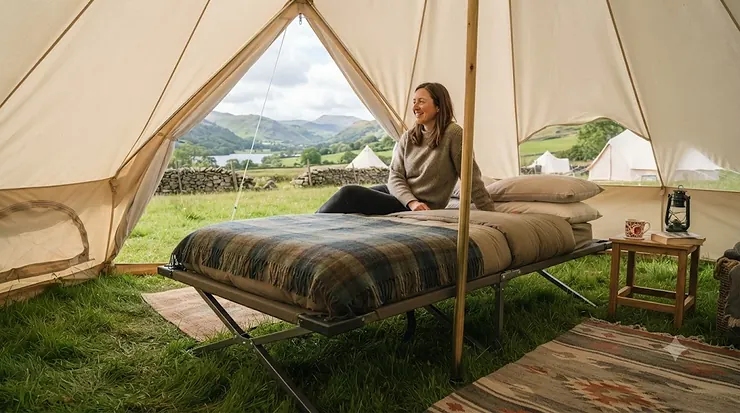
There’s a particular kind of camping regret that hits around 3am: lying on a thin roll mat, cold seeping up through the groundsheet, wondering why you didn’t just spend the extra £30. A raised camp bed for comfort solves that specific problem by lifting you clear off the ground on a folding frame — typically somewhere between 19cm and 48cm high — so cold, damp and lumpy terrain simply stop being your problem. It’s the difference between “camping” and “sleeping on the floor with extra steps.”
In plain terms: a raised camp bed for comfort is a folding cot with a taut fabric or cushioned sleeping surface stretched over a steel or aluminium frame, designed to elevate you above ground-level cold and unevenness while still packing down small enough to fit in a car boot. Unlike a basic sleeping mat, it doesn’t rely on your own body heat to fight the cold ground — the air gap underneath does that job for you.
This guide covers seven genuinely available UK camp beds, from no-frills budget cots through to a UK-made bed with a proper wooden headboard that wouldn’t look out of place at a boutique bell-tent site. We’ll also get into the practical questions people actually search for at 11pm before a trip: which beds are kindest on a bad back, which ones make getting up in the night less of an ordeal, and whether a side table is worth bothering with. According to NHS guidance on back pain, poor sleep support is a recognised contributor to discomfort, and a camp bed that’s too low or too soft can undo weeks of careful management in a single weekend away. Let’s get into it.
Quick Comparison Table
| Bed | Height Off Ground | Best For | Price Range |
|---|---|---|---|
| Vango Hush Grande Camp Bed | 19cm | First-time buyers on a budget | Around £35-£55 |
| Suteck Camping Cot with Side Pocket | Approx 18cm | Budget comfort with storage | £30-£45 range |
| KingCamp Folding Camping Cot with Side Pocket | Approx 20cm | All-round mid-range pick | £50-£75 range |
| Coleman Pack-Away Camping Cot with Removable Side Table | Approx 25cm | Anyone wanting a side table | £70-£100 range |
| Outwell Posadas XL Camp Bed | 48cm | Easiest bed to get in and out of | £70-£95 range |
| Robens Outpost Tall | 35cm | Bad backs and dodgy knees | £110-£150 range |
| Jay-Be Revolution Folding Guest Bed | Standard bed height | Glamping aesthetics | £150-£220 range |
The height column matters more than it looks. Nineteen centimetres versus forty-eight centimetres sounds like a small gap on paper, but it’s the difference between a knee-height perch you can practically fall backwards onto, and a low cot you have to lower yourself down to and then haul yourself back up from — repeatedly, in the dark, at 2am. If getting up and down easily is your priority, the height figure deserves more attention than the price tag.
💬 Just one click — help others make better buying decisions too!😊
Top 7 Raised Camp Beds for Comfort: Expert Analysis
Not every camp bed is solving the same problem. Some are built purely to get a festival-goer off cold ground for two nights; others are engineered for a fortnight of touring with a bad hip in tow. The seven below cover that whole spread, from cheap-and-cheerful to genuinely boutique.
1. Vango Hush Grande Camp Bed — best entry-level raised comfort
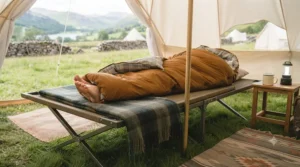
For anyone dipping a toe into camp beds for the first time, the Vango Hush Grande Camp Bed is the sensible starting point. Its DuoWeave and Endure fabric combination sits over a steel frame rated to 120kg, with a generous 199 x 76cm sleeping surface that’s noticeably wider than most beds in this price bracket, plus the option to add a self-inflating mat on top for extra cushioning.
The 19cm lift off the ground isn’t dramatic, but based on the spec comparison with sleeping directly on a mat, it’s still enough to break the direct thermal contact with cold earth that does most of the damage to a night’s sleep. What most buyers overlook about this model is how much the fabric choice matters here: DuoWeave is genuinely softer against bare skin than the stiffer nylon used on some rivals, which matters if you’re the kind of camper who sleeps in a t-shirt rather than a full sleeping bag liner. Reviewers consistently praise how compact it folds for a bed this size, though several note that without an added mat on top, the fabric alone feels thin under hips and shoulders for side-sleepers specifically.
Pros:
- ✅ Wide 76cm sleeping surface for the price point
- ✅ Soft DuoWeave fabric, comfortable against skin
- ✅ Compact folded size for car boot storage
Cons:
- ❌ Only 19cm off the ground, less ideal for cold nights
- ❌ Feels thin for side-sleepers without an added mat
At around £35-£55, the Vango Hush Grande Camp Bed is the easiest bed on this list to justify buying on a whim before a last-minute trip.
2. Suteck Camping Cot with Side Pocket — best budget comfort with storage
Budget camp beds usually make you choose between cushioning and storage; the Suteck Camping Cot with Side Pocket tries to give you both. Its 1200D double-layer Oxford fabric is noticeably thicker than typical entry-level cots, and the built-in side pocket keeps a phone, headtorch or book within arm’s reach without needing a separate table.
Double-layer Oxford at this density does something a single-layer cot can’t: it resists sagging in the middle overnight, which is usually the first sign of a budget cot’s decline. Based on the spec comparison with single-layer alternatives at a similar price, that extra fabric layer is doing real, measurable work rather than just adding marketing language. The side pocket is a small but genuinely useful touch — reviewers repeatedly mention it as the feature they didn’t know they needed until they had it, since fumbling for a phone on the tent floor in the dark is a universally annoying camping experience. The trade-off, as with most cots at this height, is limited elevation, so it’s best suited to milder-weather trips rather than late-autumn camping on frosty ground.
Pros:
- ✅ Thicker double-layer Oxford fabric resists sagging
- ✅ Built-in side pocket for essentials within reach
- ✅ Genuinely budget-friendly for the build quality
Cons:
- ❌ Low profile offers less insulation from cold ground
- ❌ Narrower than some rivals for broader-shouldered sleepers
Typically priced £30-£45, the Suteck Camping Cot with Side Pocket earns its spot as the pick for anyone who wants a bit of bedside storage without paying premium prices for it.
3. KingCamp Folding Camping Cot with Side Pocket — best all-round mid-range pick
Sitting comfortably in the middle of this list, the KingCamp Folding Camping Cot with Side Pocket pairs a 10-point ground-contact base with a symmetrical triangular frame, which — unlike the simpler four-leg designs on cheaper beds — locks firmly to eliminate the wobble that catches people off guard when they first sit down.
The tear-resistant, double-layer 1000D Oxford fabric here is built for repeat use rather than a single trip, and reviewers consistently note it holding up well across multiple seasons of regular camping rather than degrading after a handful of outings. What the spec sheet won’t tell you, but owners mention often, is that the gentle sloping incline built into the design gives genuinely more room to stretch out than a flat cot of the same length — a small design choice that makes a bigger difference to comfort than most people expect before trying it. The anti-corrosion alloy steel frame is a sensible upgrade over painted steel for anyone camping near the coast, where rust becomes a real issue on cheaper frames within a season or two. The only real drawback is assembly: it requires a touch more effort to set up than the simplest budget cots, though it’s still a five-minute job once you’ve done it once.
Pros:
- ✅ Stable 10-point base, minimal wobble once set up
- ✅ Durable double-layer 1000D Oxford fabric
- ✅ Anti-corrosion frame, good for coastal camping
Cons:
- ❌ Slightly fiddlier assembly than basic budget cots
- ❌ Heavier to carry than the lightest entry-level options
At £50-£75 depending on colourway, the KingCamp Folding Camping Cot with Side Pocket is the safe, well-rounded choice for anyone who camps more than once or twice a year.
4. Coleman Pack-Away Camping Cot with Removable Side Table — best for side table attachments
If bedside storage matters more to you than shaving off a few hundred grams of pack weight, the Coleman Pack-Away Camping Cot with Removable Side Table solves it properly rather than as an afterthought. The genuinely detachable side table clips onto one end and includes a built-in cup holder, giving you somewhere to put a headtorch, glasses or a mug of tea without reaching down to a damp groundsheet.
This is worth dwelling on specifically because most “camp bed with storage” claims online turn out to be a thin fabric side pocket rather than an actual rigid table — this one is the real thing, a proper flat surface that can hold a book or a phone without it sliding off the moment you shift position. Based on the spec comparison with pocket-only rivals, a rigid table is meaningfully more useful for anything with a flat base, like a torch or a water bottle, that would simply tip out of a fabric pouch. Reviewers consistently highlight the side table as the standout feature, with several specifically buying this model after finding sliding items off a sloped cot surface annoying on a previous bed. The extra-wide design also fits taller campers comfortably, up to roughly 6ft 6in, though that width and the added table hardware do make it bulkier to pack down than a simple cot.
Pros:
- ✅ Genuine rigid side table with cup holder, not just a pocket
- ✅ Extra-wide design suits taller campers
- ✅ Sturdy steel frame with high weight capacity
Cons:
- ❌ Bulkier to pack down than table-free alternatives
- ❌ Side table adds a little extra weight to carry
In the £70-£100 range, the Coleman Pack-Away Camping Cot with Removable Side Table is the clear pick for anyone who’s decided a proper bedside surface isn’t a luxury, it’s a requirement.
5. Outwell Posadas XL Camp Bed — best for ease of getting in and out
Height is the whole story with the Outwell Posadas XL Camp Bed. At 48cm off the ground, it’s dramatically taller than most of the beds on this list, which changes the entire experience of getting up during the night — instead of a knee-bending crouch down to a low cot, it’s closer to sitting on the edge of a normal bed at home.
The padded mesh cushion is worth explaining properly: rather than a flat solid fabric surface, the mesh promotes airflow underneath you, which reduces the overheating and condensation build-up that plagues solid-surfaced cots on warm nights. Elasticated corner straps hold a separate sleeping mat firmly in place too, which solves the common annoyance of a mat sliding around mid-sleep. Based on the spec comparison against lower-profile cots, that 48cm height genuinely reduces dampness reaching your sleeping surface, since it sits well clear of the cold, moisture-laden air that settles in the lowest few centimetres above ground level on a dewy morning. Aggregated review sentiment consistently praises how much easier this bed is for anyone with limited knee mobility to use, though a handful of reviewers note the height means it can feel slightly precarious for restless sleepers who move around a lot.
Pros:
- ✅ 48cm height makes getting in and out genuinely easier
- ✅ Breathable mesh cushion reduces overheating and damp
- ✅ Elasticated straps keep a separate mat secure
Cons:
- ❌ Higher profile can feel less stable for restless sleepers
- ❌ Bulkier packed size than lower-profile cots
At roughly £70-£95, the Outwell Posadas XL Camp Bed is the strongest option here specifically for anyone who’s found low camp beds a genuine physical struggle in the past.
6. Robens Outpost Tall — best camp bed for bad backs
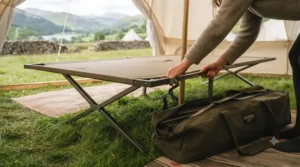
Marketed explicitly around its extra height, the Robens Outpost Tall sits at 35cm off the ground — tall enough that bags and boots slot neatly underneath, and tall enough that getting up from it doesn’t require the same knee-and-back effort as a standard low cot. The 7075-grade aluminium frame is a genuine step up in material quality from the steel frames used on most beds in this list.
Corner straps hold an insulated mat firmly in place on top, which matters more than it sounds: a mat that shifts around during the night undoes a lot of the comfort benefit of the raised frame underneath it. What most buyers overlook about this bed is that the extra height doesn’t just help with getting up — it also reduces how far you have to bend forward when making the bed or reaching down for something from a seated position, both movements that the Health and Safety Executive links to a higher risk of joint and lower-limb strain when repeated frequently, which a multi-night camping trip effectively forces you to do. Aggregated review sentiment is consistently positive on comfort and stability specifically from campers managing existing back or knee issues, several of whom mention it as the bed that made multi-day camping trips viable again after a lower cot became genuinely uncomfortable. The trade-off is a noticeably heavier pack weight than the shorter Outpost Low variant, and a higher price to match the premium materials.
Pros:
- ✅ 35cm height significantly eases getting up and down
- ✅ Premium 7075 aluminium frame, lighter than steel per strength
- ✅ Storage space underneath for bags and boots
Cons:
- ❌ Heavier to carry than shorter camp beds
- ❌ Highest price among the non-glamping options here
Priced around £110-£150, the Robens Outpost Tall is worth the outlay specifically for anyone whose back or knees have made them dread getting up from a normal camp bed.
7. Jay-Be Revolution Folding Guest Bed — best for glamping aesthetics
For anyone chasing the boutique-bell-tent look rather than a purely functional cot, the Jay-Be Revolution Folding Guest Bed is the clear outlier on this list — and deliberately so. Made in the UK, it pairs an FSC-certified wood headboard with a proper Rebound e-Fibre mattress, on 360° castors that let you glide it into position rather than dragging it across a groundsheet.
The word “glamping” first appeared in the UK back in 2005, and as the concept is generally understood, it blends the escapism of camping with genuine home comforts rather than stripped-back survival gear — and a folding bed with an actual wooden headboard fits that brief far more convincingly than a bare fabric cot ever could. Based on the spec comparison with the other six beds here, the e-Fibre mattress is a materially different product category from a taut fabric cot surface: it compresses and rebounds more like a real mattress topper, which is precisely the kind of detail that separates “glamping” from “camping with a slightly nicer cot.” Reviewers consistently describe the comfort as closer to a proper guest bed than anything else marketed for outdoor use, which tracks given this bed is genuinely designed to double as household guest bedding when it’s not away in a bell tent. The obvious trade-offs are weight and price — this isn’t a bed you’re backpacking with, and the wooden headboard needs a little more care in transit than a fully soft-sided cot.
Pros:
- ✅ Genuine wooden headboard, unmatched aesthetic on this list
- ✅ Rebound e-Fibre mattress, closer to home comfort
- ✅ 360° castors make repositioning easy
Cons:
- ❌ Heaviest and bulkiest bed on this list by far
- ❌ Not designed for backpacking or long carries to a pitch
At £150-£220, the Jay-Be Revolution Folding Guest Bed is the pick specifically for glamping setups, campervan use, or anyone who wants their sleeping arrangement to look as good as it feels.
Setting Up Your Raised Camp Bed for a Comfortable Night
Getting the bed itself right is only part of the equation; where and how you set it up changes the experience almost as much as the product you bought. Position the bed away from the tent’s lowest corner or entrance, where cold air pools first, and — where the tent shape allows it — angle it so your head is slightly uphill if you’re pitched on any kind of slope, which genuinely reduces the tendency to slide down the bed overnight.
For the first few uses, take the time to check the frame is fully locked into place before you settle in — most instability complaints about camp beds actually trace back to a leg or cross-brace that wasn’t clicked fully home, not a fault with the bed itself. If you’re using a bed like the Robens Outpost Tall or Outwell Posadas XL Camp Bed with corner straps for a separate mat, tension those straps properly; a loose mat sliding around at night is one of the most common and most avoidable comfort complaints in camp bed reviews. A common early mistake is packing the bed away still slightly damp from morning condensation — even a few minutes of open-air drying before folding it into its bag will meaningfully cut down on the musty smell that develops in stored fabric cots between trips.
Real Campers, Real Needs: Three Owner Scenarios
The festival-goer on a tight budget. Two or three nights, mild weather, minimal packing space in a shared car. The Vango Hush Grande Camp Bed or Suteck Camping Cot with Side Pocket both make sense here — light, cheap, and good enough for a short stretch of mild-weather sleeping without any real compromise.
The retired couple touring campsites for a fortnight in the caravan awning. Comfort and ease of movement matter far more than pack weight here, and joint health is a genuine consideration. The Robens Outpost Tall or Outwell Posadas XL Camp Bed directly address this — the extra height on both beds turns getting up in the night from a chore into a non-issue.
The couple glamping for a weekend in a bell tent for a birthday trip. This isn’t about minimising pack weight at all; it’s about the whole experience looking and feeling right. The Jay-Be Revolution Folding Guest Bed matches that brief precisely, doubling as genuine home furniture the rest of the year rather than living in a garage between trips.
Getting In and Out Without the Ouch: Solving Common Camp Bed Problems
Problem: a low camp bed leaves you crouching and straining to get up at night. Solution: prioritise height over every other spec if this is a recurring issue — a bed at 35-48cm like the Robens Outpost Tall or Outwell Posadas XL Camp Bed changes this from a squat-and-push motion to something closer to standing up from a normal chair.
Problem: the bed feels wobbly or unstable when you first sit on the edge. Solution: check every leg has clicked fully into its locked position — this is the single most common cause of wobble, not a design flaw — and favour beds with a wide multi-point base, like the KingCamp Folding Camping Cot with Side Pocket, over narrow four-leg designs.
Problem: cold seeps through from underneath despite the raised design. Solution: pair the bed with a separate insulated sleeping mat rather than relying on elevation alone, and use the corner straps on beds that include them to stop that mat migrating around during the night.
Problem: no obvious place to put a phone, glasses or water within reach. Solution: choose a bed with genuine bedside storage built in, whether that’s a fabric pocket like on the Suteck Camping Cot with Side Pocket or a full rigid surface like the Coleman Pack-Away Camping Cot with Removable Side Table, rather than improvising with a boot or a bag on the groundsheet.
Side Table Attachments: Do You Need One?
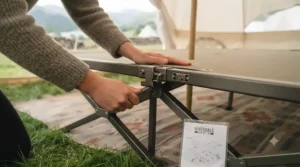
This is a genuinely useful upgrade for some campers and a non-issue for others, so it’s worth being specific about who benefits. If you wear glasses, use a phone alarm, or take any medication overnight, having a stable, dry surface at bed height — rather than reaching down to a groundsheet in the dark — removes a small but real friction point from every single night of a trip.
Side table attachments on camp beds fall into two genuine categories worth distinguishing clearly: a soft fabric side pocket, sewn directly into the cot fabric as on the Suteck Camping Cot with Side Pocket or KingCamp Folding Camping Cot with Side Pocket, and a rigid, genuinely flat table, as fitted to the Coleman Pack-Away Camping Cot with Removable Side Table. A fabric pocket suits lightweight items like a phone or headtorch that won’t tip; a rigid table is the better call for anything with a flat base, a drink, or a book you want to actually rest open. If you’re already planning to pack a separate folding camping table for the pitch generally, a built-in side table attachment becomes somewhat redundant weight; if you’re travelling light and want one fewer item to pack, it earns its keep.
How to Choose a Raised Camp Bed for Comfort
- Check the height off the ground first, not last — this single spec affects both warmth and how easy getting up and down feels more than almost any other factor.
- Match the weight capacity to the actual user, generously — a cot rated close to your weight will feel less stable than one with meaningful headroom in its rating.
- Consider the fabric type against your typical sleepwear — DuoWeave-style soft fabrics feel noticeably better against bare skin than stiffer Oxford fabrics if you sleep without much between you and the cot surface.
- Decide whether you need a separate mat or not — taller, foam-topped beds may not need one; low fabric cots almost always benefit from an added mat for both warmth and comfort.
- Think about packed size against your actual transport — a bed that’s perfect for car camping may be entirely impractical if you’re walking any distance to a pitch.
- Look at the leg and frame structure, not just the fabric — a wide, multi-point base is more stable than a simple four-leg design, particularly on uneven pitches.
- Factor in storage, realistically — a side pocket or table only earns its keep if you’ll actually use it; otherwise it’s just extra bulk to pack.
Common Mistakes When Buying a Raised Camp Bed
The most common mistake is buying purely on price and folded pack size without checking the height off the ground at all — a cheap, compact bed that turns out to be only 15-19cm off the ground offers noticeably less of the “raised comfort” benefit than a taller design, even if both are technically described as camp beds. A close second is assuming a wider or longer bed will automatically be less stable; in practice, width often adds stability by spreading weight across a broader base, so ruling out a wider bed on that assumption alone is usually the wrong call.
Another frequent misstep is ignoring weight capacity ratings and simply picking based on visible size, when a bed rated close to your actual weight will sag and feel less supportive well before it reaches its stated limit. Finally, plenty of buyers skip checking whether a separate sleeping mat is genuinely needed for warmth, discovering only on a cold first night that “raised” doesn’t automatically mean “insulated” — the two are related but not identical.
Raised Camp Bed vs Sleeping on an Air Mattress or Ground Mat
| Factor | Raised Camp Bed | Air Mattress or Ground Mat |
|---|---|---|
| Ease of getting up | Easy, especially on taller designs | Difficult, particularly for stiff joints |
| Cold ground insulation | Good, via the air gap underneath | Relies entirely on mat thickness/R-value |
| Puncture risk | None — no air chambers to fail | Real risk from stones, twigs, zips |
| Storage underneath | Yes, on taller designs | None |
| Pack size | Larger, generally | Usually smaller and lighter |
The comparison here isn’t simply “better vs worse” — it’s a genuine trade-off between pack size and physical ease. An air mattress can be excellent value and genuinely comfortable when it’s working, but a slow puncture overnight is a uniquely miserable camping experience that a raised camp bed simply cannot suffer from. For anyone prioritising reliability and ease of getting up over minimising pack weight, a raised bed wins on both counts; for ultralight backpackers counting every gram, a ground mat still has its place.
Best Camp Bed for Bad Backs: What Actually Matters
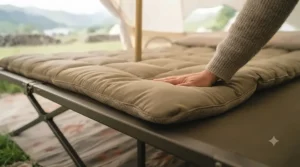
Searching specifically for the best camp bed for bad backs usually means one of two underlying problems: discomfort while lying down, or difficulty getting up afterwards. They need slightly different solutions. For lying-down discomfort, a flat, well-supported, non-sagging surface matters most — which is why the double-layer Oxford fabric on the KingCamp Folding Camping Cot with Side Pocket or the padded mesh cushion on the Outwell Posadas XL Camp Bed genuinely outperforms thinner single-layer fabrics that sag into a hammock shape under body weight overnight.
For the getting-up problem, height is the deciding factor, full stop. NHS advice on back pain generally recommends staying active and avoiding positions that strain the back unnecessarily, and repeatedly hauling yourself up from a very low surface — night after night on a trip — is exactly the kind of repeated strain worth avoiding if you already have a known issue. That’s precisely why the Robens Outpost Tall, at 35cm, and the Outwell Posadas XL Camp Bed, at 48cm, are the two genuinely strong picks on this list for existing back or joint problems, rather than any bed chosen purely on comfort of the lying-down surface alone.

Best Camp Bed for Glamping: Chasing the Aesthetic Without Sacrificing Comfort
Glamping aesthetics are about more than just how a bed looks in photos — though that matters more than camping purists like to admit. A bare aluminium-framed cot with taut fabric reads as “camping equipment” even inside the most beautifully furnished bell tent, while a bed with a genuine headboard, proper mattress-style padding, and a finished, furniture-like appearance reads as “bedroom,” which is precisely the effect glamping sites are built around.
The Jay-Be Revolution Folding Guest Bed is the clear standout here specifically because it isn’t trying to be a camping product with a nicer finish bolted on — it’s genuinely a piece of folding furniture that happens to work outdoors, right down to the FSC-certified wood and castor wheels that have nothing to do with traditional camping engineering at all. If a full furniture-style bed is more than your setup needs or your budget allows, layering matters too: a simpler raised bed like the Outwell Posadas XL Camp Bed, dressed with proper bedding, a throw, and a couple of cushions rather than a sleeping bag, closes a surprising amount of the aesthetic gap without the premium price tag.
✨ Don’t Miss These Exclusive Deals!
🔍 Ready to upgrade your next trip? Click through to check current pricing and availability on these picks, and find the raised camp bed that actually suits how — and where — you sleep.
Long-Term Value: Price Range & Cost Per Trip
| Bed | Price Range | Expected Lifespan | Cost-Per-Trip (approx., 10 trips/yr) |
|---|---|---|---|
| Vango Hush Grande Camp Bed | £35-£55 | 2-3 years | £1.50-£2.50 |
| Suteck Camping Cot with Side Pocket | £30-£45 | 2-3 years | £1.30-£2.00 |
| KingCamp Folding Camping Cot with Side Pocket | £50-£75 | 3-5 years | £1.30-£2.00 |
| Coleman Pack-Away Camping Cot with Removable Side Table | £70-£100 | 3-5 years | £1.80-£2.50 |
| Outwell Posadas XL Camp Bed | £70-£95 | 4-6 years | £1.30-£2.00 |
| Robens Outpost Tall | £110-£150 | 5-8 years | £1.60-£2.50 |
| Jay-Be Revolution Folding Guest Bed | £150-£220 | 8-10+ years | £1.50-£2.20 |
Spread across enough trips, the price gap between “cheapest” and “most premium” on this list narrows considerably. The Jay-Be Revolution Folding Guest Bed looks like an outlier at checkout, but given it’s also genuinely usable as household guest bedding between trips — not just stored in a garage — its real-world cost-per-use is arguably lower than its price tag suggests. Meanwhile, the Robens Outpost Tall‘s premium aluminium frame is specifically built to outlast several seasons of steel-framed budget cots, which is exactly where its higher upfront cost gets clawed back over time.
Camp Bed Safety & Setup Guide
A raised camp bed introduces a couple of safety considerations worth a moment’s thought, beyond simple comfort. Position it well away from any cooking area or stove — fire and rescue services specifically advise keeping cooking appliances away from tent walls and sleeping areas, and a fabric-and-frame bed positioned too close to a stove or lantern is exactly the kind of ignition risk that guidance is aimed at. Never use a fuel-burning heater or stove near or under a camp bed inside a tent, both for the fire risk and for carbon monoxide exposure, which builds up fastest in the low, still air near ground level where a bed sits.
Beyond fire safety, check the bed’s stated weight capacity against everyone who might sit or lie on it at once — two adults perching on the edge of a bed rated for one person’s weight is a common and entirely avoidable way for a frame to fail. Finally, on taller beds like the Robens Outpost Tall or Outwell Posadas XL Camp Bed, make sure the ground underneath is reasonably level before setup; the added height means a bed on uneven ground tips more noticeably than a low-profile cot would in the same spot.
FAQ
❓ How high should a raised camp bed be for comfort?
❓ Do I still need a sleeping mat on top of a raised camp bed?
❓ Is a raised camp bed for comfort suitable for glamping?
❓ What weight can a typical raised camp bed hold?
❓ Are side table attachments worth paying extra for?
Conclusion
There’s no single best raised camp bed for comfort — there’s the right bed for how you actually camp, and pretending otherwise leads to buying twice. A festival weekend and a fortnight-long touring trip with a bad hip are simply not the same problem, and a bed built for one won’t necessarily solve the other.
What stays consistent across every genuinely good pick on this list is height, stability, and honest packed weight for the trip you’re actually planning. Whether that’s the wallet-friendly Vango Hush Grande Camp Bed, the back-friendly Robens Outpost Tall, or the aesthetic-first Jay-Be Revolution Folding Guest Bed, match the bed to the actual discomfort you’re trying to solve, rather than the nicest photo on the listing page.
Recommended for You
- Folding Camp Bed: 7 Best Sturdy UK Picks for 2026
- Roll Mat for Festivals: 7 Best Picks for Comfy Camping (2026)
- EVA Foam Camping Mat: 7 Best Picks for UK Trips (2026)
Disclaimer: This article contains affiliate links. As an Amazon Associate, I earn from qualifying purchases. If you purchase products through these links, we may earn a small commission at no additional cost to you.
✨ Found this helpful? Share it with your friends! 💬🤗
