
In This Article
Choosing the right backpacking tent can feel like navigating a minefield of technical jargon and confusing specifications. You’ve probably stood in an outdoor shop or scrolled through Amazon, wondering whether you really need that £400 ultralight wonder or if a budget model will suffice. After testing dozens of tents across UK trails from the Scottish Highlands to the Peak District, I’ve learnt that understanding how to choose backpacking tent isn’t about finding the “best” tent—it’s about finding your tent.
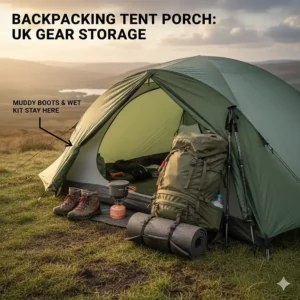
The UK’s famously unpredictable weather demands a tent that can handle sudden downpours in the Lake District, withstand howling winds on exposed ridges, and ideally, not weigh you down like you’re carrying a second rucksack. Whether you’re preparing for your Duke of Edinburgh expedition, planning a thru-hike along the Pennine Way, or simply fancy a weekend wild camp in Snowdonia, this guide will walk you through everything you need to know about selecting a backpacking tent that’ll keep you dry, comfortable, and properly sheltered.
We’ll explore real tents available on Amazon.co.uk right now, decode mysterious specifications like denier ratings and hydrostatic head (don’t worry, it’s simpler than it sounds), and help you understand the crucial differences between freestanding and non-freestanding designs. By the end, you’ll be confident in your choice, whether you’re investing £450 in premium ultralight gear or starting with a reliable £99 tunnel tent.
Quick Comparison Table
| Tent Model | Weight | Waterproof Rating | Price (£) | Best For |
|---|---|---|---|---|
| Big Agnes Copper Spur UL1 | 1.10kg | 1200mm+ HH | £400-450 | Ultralight backpackers |
| Coleman Rigel X2 | 960g | Not specified | £59-79 | Budget beginners |
| OneTigris Stella | 2.0kg | 3000mm HH | £79-99 | Four-season versatility |
| Vango Banshee 200 | 2.4kg | 3000mm HH | £99-145 | DofE expeditions |
| Naturehike Cloud Up 1 | 1.6kg | 4000mm PU | £89-129 | Solo adventurers |
| MSR Hubba Hubba NX | 1.77kg | High performance | £450-520 | Premium choice |
| Forceatt 2-Person | 2.1kg | 3000mm PU | £69-89 | Value for couples |
💬 Just one click – help others make better buying decisions too! 😊
Top 7 Backpacking Tents: Expert Analysis
1. Big Agnes Copper Spur UL1 – Premium Ultralight Excellence
The Big Agnes Copper Spur UL1 represents the gold standard in ultralight backpacking tents for serious hikers who refuse to compromise on comfort. Weighing a mere 1.10 kilograms (about the same as a small laptop), this tent uses proprietary HyperBead fabric that’s 25% more waterproof and 50% stronger than traditional materials, all without added chemical coatings.
Key Specifications:
- Pack size: 46cm × 15cm (comparable to a 2-litre bottle)
- Floor area: 2.0 square metres with 97cm peak height
- Three-season freestanding design with single-door entry
UK backpackers rave about the high-volume pole architecture that creates near-vertical walls, maximising usable interior space. The awning-style door (supported by trekking poles or included guylines) transforms the vestibule into a proper sheltered area—brilliant for those drizzly Welsh mornings when you need to cook breakfast without getting soaked. Reviewers consistently praise the ventilation system, which combines raised nylon panels with full mesh to drastically reduce condensation, a common problem in damp British conditions.
Pros:
✅ Exceptionally lightweight without feeling flimsy
✅ Excellent ventilation reduces condensation
✅ Spacious for a one-person ultralight tent
Cons:
❌ Premium pricing at £400-450
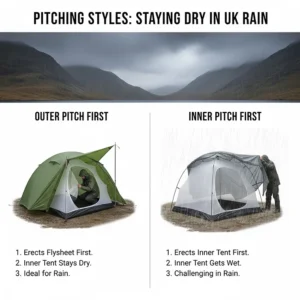
❌ Inner-pitch-first design can be tricky in rain
Price range: £400-450 | Amazon.co.uk availability: In stock
2. Vango Banshee 200 – The DofE Favourite
The Vango Banshee 200 has earned its reputation as the go-to tent for Duke of Edinburgh Award participants, and for good reason. This Scottish-designed tunnel tent strikes an impressive balance between weight (2.4kg), durability, and ease of pitching—crucial when you’re learning to camp for the first time.
Key Specifications:
- Vango PowerLite 7001-T6 alloy poles (colour-coded for intuitive pitching)
- TBS II Tension Band System for stability in changeable winds
- 70D 6000mm HH polyester groundsheet
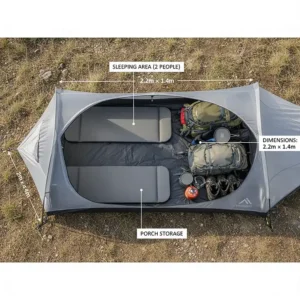
The patented Tension Band System braces the poles at three points, drastically reducing sideways movement in wind—something I’ve appreciated during exposed camps in the Cairngorms. UK buyers consistently report this tent withstanding 50mph+ gusts and torrential downpours without leaking. The tunnel design provides excellent space-to-weight ratio, though the vestibule is admittedly compact (you’ll need to be organised with gear placement).
One reviewer who used it for over a decade across hundreds of nights noted: “bombproof in bad weather, though condensation can be an issue if you don’t open the flysheet vents.” At under £150, it’s proper value for a tent that’ll last years.
Pros:
✅ Proven reliability in harsh UK conditions
✅ Officially DofE recommended kit
✅ Quick pitching in approximately 7 minutes
Cons:
❌ Small vestibule space limits storage
❌ Weighs 2.4kg (heavier than ultralight options)
Price range: £99-145 | Amazon.co.uk availability: In stock (limited)
3. Naturehike Cloud Up 1 – Best Budget Ultralight
For backpackers seeking ultralight performance without premium pricing, the Naturehike Cloud Up 1 delivers remarkable value. At 1.6 kilograms with a PU4000+ waterproof rating, this Chinese brand has quietly become a favourite amongst UK thru-hikers.
Key Specifications:
- 20D silicone-coated nylon flysheet
- Freestanding design with aluminium pole system
- Front-entry with included footprint
The tent performed admirably during my autumn test in the Peak District, handling overnight temperatures down to 3°C and persistent drizzle. The 20D fabric feels reassuringly robust (thicker than you’d expect at this price point), and the included footprint protects the groundsheet from rocky terrain. Several UK buyers mention using it for bikepacking, as the freestanding design works brilliantly on hard ground where stakes won’t penetrate.
Be aware that ventilation could be better—one reviewer experienced significant condensation during humid conditions, suggesting you should definitely open the roof vent. The front-entry design means excellent interior usability with vestibule space for a rucksack.
Pros:
✅ Outstanding value under £130
✅ Lightweight at 1.6kg with proper weather protection
✅ Freestanding design for versatile pitching
Cons:
❌ Ventilation could be improved
❌ May feel cramped for taller individuals (over 183cm)
Price range: £89-129 | Amazon.co.uk availability: In stock
4. MSR Hubba Hubba NX – Premium Two-Person Option
When weight matters but you need room for two, the MSR Hubba Hubba NX stands as the benchmark. Weighing just 1.77 kilograms for a two-person tent, it packs down to 46cm × 15cm—small enough to fit horizontally in most rucksacks.
Key Specifications:
- Floor area: 2.7 square metres (29 sq ft)
- Peak height: 99cm (39 inches)
- Unified hub-and-pole system for quick pitching
The tent’s design maximises interior room through clever geometry, with a floor area that accommodates two people plus gear comfortably. The dual vestibules (one on each side) provide approximately 0.84 square metres of covered storage space—enough for two rucksacks and boots. Setup takes under five minutes thanks to the unified hub system, even for less experienced campers.
UK reviewers appreciate the water-resistant coating handling typical British rain well, though several note it might struggle in sustained heavy downpours or very wet/stormy conditions. For three-season backpacking (spring through autumn), it’s spot on. The 3-year limited warranty and positive user feedback suggest solid reliability.
Pros:
✅ Spacious for two people without excessive weight
✅ Quick, intuitive setup system
✅ Dual vestibules for gear organisation
Cons:
❌ Premium pricing at £450-520
❌ Not ideal for heavy winter conditions
Price range: £450-520 | Amazon.co.uk availability: Check retailers
5. OneTigris Stella 4-Season – Versatile All-Rounder
The OneTigris Stella bridges the gap between three-season and four-season tents, offering genuine year-round capability at a mid-range price point. Weighing 2.0 kilograms, it’s designed for backpackers and outdoor enthusiasts wanting versatility.
Key Specifications:
- 20D nylon fabric with 3000mm waterproof rating
- Removable blackout outer layer for ventilation control
- Setup size: 2.1m × 1.25m (sleeping for two)
The four-season design combined with the 3000mm waterproof rating makes this suitable for diverse weather conditions, including rain and mild snow. UK buyers report it handling changeable outdoor environments remarkably well, from Lake District downpours to exposed Scottish camps. The dome shape offers decent stability against wind, though it emphasises portability over absolute spaciousness.
Setting up is straightforward thanks to flexible poles and simple four-corner anchoring—even beginners find it manageable. One thoughtful feature is the blackout removable outer layer, which helps with ventilation in summer whilst providing privacy. The 20D nylon, whilst adequate for its weight class, requires careful handling in very rough terrain or extreme weather.
Pros:
✅ Four-season capability at three-season price
✅ Lightweight 2kg for the weather protection offered
✅ Simple setup suitable for beginners
Cons:
❌ 20D fabric less durable than heavier-duty tents
❌ Prioritises portability over interior space
Price range: £79-99 | Amazon.co.uk availability: In stock
6. Coleman Rigel X2 – Budget Champion
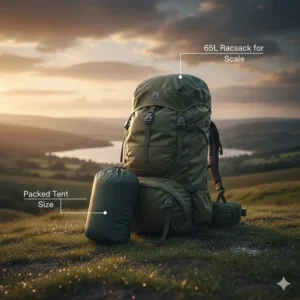
Sometimes you need a tent that simply works without breaking the bank. The Coleman Rigel X2 weighs an astonishing 960 grams, making it one of the lightest options available under £80—perfect for cost-conscious beginners or those building their first backpacking kit.
Key Specifications:
- Double-layer ventilation system
- Reflective trims along zipper cuffs for night visibility
- Integrated pocket in groundsheet for self-packing
The striking colour design with reflective elements makes it easy to spot at night around camp—a small detail that’s genuinely useful when returning from the loo block at 2am. The tent packs into itself thanks to an integrated pocket in the groundsheet, eliminating the frustration of wrestling it back into a too-small stuff sack.
UK reviewers note the ultralight poles feel delicate but adequately handle light conditions. One buyer mentioned it’s “easily the lightest I’ve ever come across” and “looks up to the job” though they hadn’t tested it in heavy conditions. This is a fair-weather tent or one for protected sites rather than exposed mountain camps.
Pros:
✅ Exceptionally affordable under £80
✅ Remarkably lightweight at 960g
✅ Self-packing groundsheet design
Cons:
❌ Not suitable for harsh weather conditions
❌ Limited testing reviews for durability
Price range: £59-79 | Amazon.co.uk availability: Limited stock
7. Forceatt 2-Person – Value Two-Person Tent
For couples or mates sharing, the Forceatt 2-Person offers solid three-season protection with features typically found on pricier models. Weighing 2.1 kilograms, it balances durability and convenience at an attractive price point.
Key Specifications:
- PU3000mm waterproof coating
- Double-door design for improved access
- Aluminium pole construction
The tent uses high-quality nylon materials with a 3000mm waterproof rating—the standard level recommended for UK camping by outdoor experts. The double-door design (one on each side) proves incredibly practical when sharing, avoiding the awkward shuffle past your tentmate in the middle of the night. Both doors feature vestibules for storing muddy boots and wet gear separately.
Setup is straightforward, with many UK buyers praising the intuitive process. The aluminium poles provide good stability, and the overall construction feels reassuringly solid for all-season use (though primarily designed for spring through autumn). At this price, it’s exceptional value for weekend warriors or those building towards longer expeditions.
Pros:
✅ Excellent value under £90
✅ Double-door design for convenience
✅ Solid weatherproofing for UK conditions
Cons:
❌ Heavier than premium ultralight options
❌ Takes practice to pitch perfectly taut
Price range: £69-89 | Amazon.co.uk availability: In stock
✨ Don’t Miss These Exclusive Deals!
🔍 Take your backpacking adventures to the next level with these carefully selected tents. Click on any highlighted product name to check current pricing and availability on Amazon.co.uk. These shelters will help you create authentic outdoor memories your mates will be jealous of!
Understanding Tent Waterproof Ratings: Hydrostatic Head Explained
When you’re comparing tents, you’ll inevitably encounter specifications like “3000mm HH” or “PU4000+”. These numbers refer to hydrostatic head (HH) ratings—a standardised measurement of how waterproof a fabric truly is.
What Does Hydrostatic Head Mean?
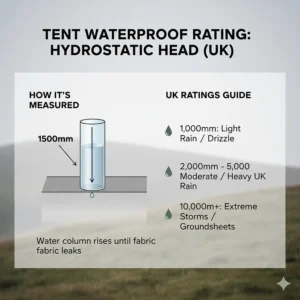
Imagine placing a clear tube over your tent fabric and slowly filling it with water. The hydrostatic head rating tells you how tall that water column can be before the fabric starts leaking. A tent rated at 3000mm HH can withstand a 3-metre (3000mm) column of water before moisture penetrates.
According to Ultralight Outdoor Gear, UK manufacturers can legally claim fabric is “waterproof” if it meets a minimum 1500mm HH. However, most quality backpacking tents exceed this significantly. For reference:
- 1000mm HH: Resists light showers
- 2000mm HH: Handles heavy rain and driving wind (standard for three-season tents)
- 3000mm+ HH: Recommended minimum for reliable UK camping
- 5000mm+ HH: Excellent protection; withstands water being pushed through by physical pressure
What Rating Do You Actually Need?
For typical UK backpacking, outdoor experts recommend targeting 2000-3000mm HH for the flysheet. This handles sustained heavy rain combined with good tent design and taut pitching. The Duke of Edinburgh’s Award recommended tents all feature 5000mm HH as standard, reflecting the demanding conditions young adventurers face.
Important caveat: Your groundsheet needs a higher rating than the flysheet—ideally 3000mm or above—because it experiences constant pressure from bodies and gear pressing down. Most quality tents use 5000-6000mm HH groundsheets.
Beyond the Numbers
Hydrostatic head isn’t the only factor determining whether you stay dry. A tent with excellent seam sealing, quality zippers with storm flaps, and smart ventilation design will outperform a poorly constructed tent with higher numbers. As Valley and Peak explain, even umbrellas (which keep us dry) only rate at 420mm HH—the difference lies in design and how water interacts with the structure.
Look for:
- Factory-taped seams: All quality tents seal seam lines to prevent leakage
- Bathtub-style groundsheet: Edges curve up 10-15cm to prevent water pooling underneath
- Storm flaps over zippers: Extra fabric protection at critical leak points
- Adequate ventilation: Reduces internal condensation (a major issue in UK humidity)
Decoding Denier Ratings: Understanding Tent Fabric Weight
After waterproofing, denier rating is your next key specification. Denier (D) measures the weight and thickness of individual threads in the fabric—essentially telling you how robust the material is.
The Denier Scale
According to Holawild’s tent materials guide, UK tents typically range from 15D up to 210D:
- 15-30D: Ultralight fabrics used in premium tents (Big Agnes, MSR)
- 40-70D: Standard backpacking tent range (good durability-to-weight ratio)
- 150-210D: Heavy-duty fabrics for family/car camping tents
The golden rule: Higher denier = thicker, stronger, more durable fabric, but also heavier. A 70D polyester tent will be more robust than a 40D polyester tent, but you’ll carry extra weight.
Balancing Weight and Durability
For backpacking, most experts recommend 30-70D for flysheets. The Naturehike Cloud Up 1 uses 20D silicone-coated nylon—on the lighter end, requiring careful handling but keeping pack weight down. The OneTigris Stella also uses 20D nylon with ripstop reinforcement, offering decent strength for its weight class.
Compare this to the Vango Banshee 200’s 70D groundsheet—considerably more robust for the high-wear area that contacts rocks, roots, and rough ground constantly.
Thread Count Matters Too
You’ll occasionally see thread count (T) ratings like “190T” or “210T”. This measures threads per square inch—a tighter weave generally means better fabric quality. However, Kelly Kettle notes that manufacturers sometimes compensate for lower denier by using higher thread counts, so always compare both specifications together.
Freestanding vs Non-Freestanding: Which Design Suits Your Needs?
One of the most fundamental decisions when learning how to choose backpacking tent is understanding the difference between freestanding and non-freestanding designs.
Freestanding Tents: Maximum Flexibility
Characteristics:
- Stand up using poles alone without stakes
- Can be moved or repositioned after setup
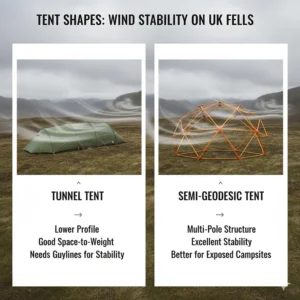
- Generally use crossing pole designs (dome or semi-geodesic)
The Big Agnes Copper Spur UL1, Naturehike Cloud Up 1, and MSR Hubba Hubba NX are all freestanding designs. The massive advantage? You can pitch on hard surfaces (rocky ground, wooden platforms, beach sand) where stakes won’t penetrate. Brilliant for wild camping in the Scottish Highlands or along coastal paths.
Freestanding tents excel for beginners because you can set them up, adjust positioning, and even pick them up to shake out debris. You’ll still want to stake them down in wind, but the basic structure works independently.
Best for:
- Rocky or hard ground camping
- Beginners learning to pitch
- Flexibility to reposition after setup
- Beach or coastal camping
Non-Freestanding Tents: Weight Savings
Characteristics:
- Require stakes and guylines for structure
- Often tunnel or trekking pole designs
- Typically lighter than equivalent freestanding tents
The Vango Banshee 200 is a classic tunnel tent requiring proper staking. The advantage is significant weight savings—tunnel tents achieve the best space-to-weight ratio of any design. The downside? You need decent ground for stakes, and pitching requires more precision.
Non-freestanding designs work brilliantly on soft ground (grass, forest floor, moorland) but struggle on rock slabs or hard-packed surfaces. They also demand more skill to pitch properly taut—critical for weather resistance.
Best for:
- Experienced backpackers prioritising weight
- Soft ground camping (most UK locations)
- DofE expeditions on established routes
- Thru-hiking where every gram matters
Hybrid Options
Some modern tents blur the lines. Trekking pole tents (like the popular Zpacks Duplex, though not in our Amazon.co.uk selection) use your walking poles instead of dedicated tent poles, saving massive weight but requiring stakes for structure. These represent the ultimate in ultralight backpacking.
Minimum Trail Weight: What Actually Goes in Your Rucksack?
When comparing tents, you’ll encounter three different weight specifications. Understanding the difference prevents nasty surprises when packing.
The Three Weight Measurements
- Minimum Trail Weight (or “Trail Weight”)
- Flysheet + inner tent + poles
- What you actually carry on trail
- The most relevant number for backpackers
- Packed Weight
- Everything included: tent, poles, stakes, guylines, stuff sacks
- Typically 200-400g heavier than trail weight
- Useful if you carry everything
- Total Weight
- Includes packaging, instruction manuals, spare parts
- Irrelevant for backpacking (you’re not carrying the box!)
Why It Matters
A tent advertised as “2kg” might actually be 2.4kg packed weight including all stakes. For the Vango Banshee 200, minimum trail weight sits around 2.07kg, but packed weight reaches 2.39kg when you include the admittedly beefy steel stakes.
Savvy backpackers reduce weight by:
- Replacing heavy stakes with titanium or aluminium alternatives (saves 100-200g)
- Leaving the stuff sack at home and packing the tent loose in your rucksack
- Sharing weight between two people (one carries tent body, one carries poles)
- Using trekking poles instead of tent poles (for compatible designs)
Most manufacturers now clearly label minimum trail weight. If a listing doesn’t specify, assume it’s the packed weight and subtract roughly 300g for a realistic trail weight estimate.
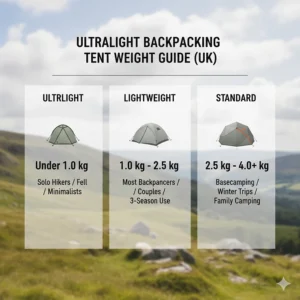
Weight Recommendations by Trip Type
According to experienced UK backpackers:
- Lightweight backpacking: Under 1.5kg (solo) or 2kg (two-person)
- Standard backpacking: 1.5-2.5kg (solo) or 2-3kg (two-person)
- DofE expeditions: 2-3kg acceptable (groups share weight)
- Comfortable camping: 3kg+ (prioritise space over weight)
Tent Capacity: Should You Size Up?
Here’s a dirty secret about tent capacity ratings: they’re optimistic. A “2-person” tent assumes two average-height adults lying shoulder-to-shoulder with no gear inside. Cosy doesn’t begin to describe it.
The Sizing Reality
Industry sizing conventions assume:
- 1-person tent: One person plus minimal gear (sleeping bag, maybe small rucksack)
- 2-person tent: Two people lying flat, no gear inside
- 3-person tent: Comfortable for two people plus gear, or three people intimate
The Vango Banshee 200 illustrates this perfectly. Marketed as a “2-person” tent, UK reviewers consistently note: “it’s really a one-person tent plus gear” or “barely a two-person tent.” One 183cm (6-foot) buyer couldn’t stretch out fully.
When to Size Up
Choose a 2-person tent if:
- You’re solo and want interior space for gear and comfort
- You’re over 183cm (6 feet) tall
- You plan multi-day trips with more kit
- You value not touching tent walls (causes condensation transfer)
Choose a 3-person tent if:
- Two people sharing with gear inside
- Either of you is tall or broad-shouldered
- You’re car camping and weight isn’t critical
- Extra space justifies extra grams for your trips
Vestibule Space: The Forgotten Hero
Don’t overlook vestibule size when learning how to choose backpacking tent. Vestibules are the covered areas outside the sleeping compartment—essentially your gear “garage” and mudroom combined.
Large vestibules (like on the MSR Hubba Hubba NX’s dual vestibules) accommodate rucksacks, boots, and cooking gear. Small vestibules (the Vango Banshee 200’s notably compact vestibule) force creative packing strategies. In persistent British rain, a proper vestibule means cooking breakfast sheltered rather than huddled under a tarp.
Look for minimum 0.5 square metres of vestibule space per person for comfortable gear storage.
Three-Season vs Four-Season: What’s the Real Difference?
This classification confuses many beginners. The difference isn’t primarily about winter camping—it’s about wind resistance and snow load capability.
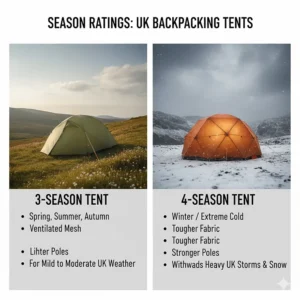
Three-Season Tents (Spring, Summer, Autumn)
Designed for:
- Temperatures above freezing
- Wind speeds under 40mph sustained
- Rain, but not snow loading
- Maximum ventilation (lots of mesh)
The Big Agnes Copper Spur UL1, MSR Hubba Hubba NX, and Naturehike Cloud Up 1 are three-season designs. They handle UK conditions from April through October brilliantly, including cold nights down to 0°C, heavy rain, and moderate wind.
The generous mesh panels (often 40-50% of the tent body) provide excellent ventilation, reducing condensation in humid British conditions. However, that mesh becomes a liability in winter—it offers no insulation and allows spindrift snow penetration in exposed locations.
Best for:
- Most UK backpacking (April-October)
- DofE expeditions
- Lowland wild camping year-round
- Thru-hiking and multi-day treks
Four-Season (Winter/Mountaineering) Tents
Designed for:
- Below-freezing temperatures
- Heavy snow loads on roof
- Extreme wind (50mph+)
- Minimal mesh for better warmth retention
The OneTigris Stella straddles the line as a “4-season” tent, though it’s more accurately “3.5-season”—suitable for mild winter conditions but not proper mountaineering. True four-season tents feature:
- Geodesic pole structures (3-5 interlocking poles)
- Minimal mesh (maybe 10-20% for ventilation)
- Heavier fabrics (70D+)
- Snow skirts around the base
- Typically weigh 3kg+ for solo designs
What Most UK Backpackers Need
Unless you’re specifically planning winter mountain expeditions in Scotland or the Alps, a three-season tent covers 95% of backpacking scenarios. Even the Duke of Edinburgh’s Award, which operates year-round, primarily recommends three-season tents with 3000-5000mm HH.
Consider four-season only if:
- Regular winter mountain camping in Scotland
- Exposed ridge camps above 600m in winter
- Mountaineering expeditions
- You fancy the challenge (they’re significantly heavier)
Tent Fabric Types: Polyester, Nylon, and Coatings
The material of your tent determines durability, weight, UV resistance, and how it handles moisture. UK tents predominantly use polyester or nylon, each with distinct characteristics.
Polyester: The UK Standard
Polyester is the most common tent fabric in Britain, ranging from 68D to 210D according to Holawild’s materials guide. The Vango Banshee 200 uses Protex 70D polyester—typical for UK conditions.
Polyester advantages:
- Minimal stretching when wet (maintains tension)
- Excellent UV resistance (won’t degrade in sun)
- Affordable and durable
- Low water absorption
Polyester disadvantages:
- Heavier than equivalent nylon
- Lower tear strength than nylon
- Bulkier pack size
Polyester works brilliantly for UK backpacking where UV degradation is less concern than Scotland’s rainy summers, and the extra weight (versus nylon) isn’t prohibitive for weekend trips.
Nylon: Ultralight Champion
Nylon fabrics dominate the ultralight tent market. The Big Agnes Copper Spur UL1 and Naturehike Cloud Up 1 both use nylon (often 15-30D for flysheets).
Nylon advantages:
- Significantly lighter than polyester
- Higher tear strength (better for ultralight tents)
- Packs down smaller
Nylon disadvantages:
- Stretches when wet (requires retensioning in rain)
- UV-sensitive (degrades over years of sun exposure)
- Slightly higher moisture absorption
Nylon makes sense for weight-conscious backpackers doing multi-day treks where every gram matters. The UV sensitivity isn’t critical in Britain’s overcast climate—you’d need years of direct summer sun exposure to significantly weaken modern nylon.
Silicone vs Polyurethane Coatings
The waterproof coating matters as much as the base fabric. You’ll see specifications like:
- SilNylon: Silicone-coated nylon (used by Naturehike Cloud Up 1)
- PU coating: Polyurethane coating (most common, budget-friendly)
- SilPoly: Silicone-coated polyester (premium, combines benefits)
Kelly Kettle explains that silicone coating “permeates” the fabric, creating stronger, more waterproof material with better stretch and tear strength. However, it prevents seams from being taped (silicone doesn’t bond), requiring seam sealing with liquid sealer.
PU coatings are easier to manufacture and allow factory-taped seams, but they’re less durable long-term and can delaminate after 3-5 years of heavy use. Most UK backpacking tents use PU for affordability and ease of manufacturing.
Ripstop: Your Safety Net
Look for “ripstop” in fabric specifications. This reinforcement technique weaves stronger threads at regular intervals, creating a visible crosshatch pattern. If the fabric tears, the ripstop grid prevents the tear spreading—potentially saving your tent (and dry night’s sleep) in the backcountry.
Condensation Management: The UK Backpacker’s Challenge
Here’s an uncomfortable truth: you’ll experience condensation in any tent, regardless of quality or price. Understanding why helps you manage it effectively.
Why Condensation Happens
Humans exhale roughly 1 litre of water vapour during eight hours of sleep. In a sealed tent, that moisture has nowhere to go. When warm, moist air contacts your cold tent walls (especially on chilly UK nights), it condenses into water droplets. Come morning, your tent’s dripping like a greenhouse.
The problem intensifies in British conditions:
- High ambient humidity (especially in Scotland and Wales)
- Significant temperature differences (warm bodies, cold night air)
- Poor ventilation habits (battening down all vents against draughts)
Strategic Ventilation
Quality tents combat condensation through smart ventilation design:
Low vents: Allow cool air to enter at ground level
High vents: Let warm, moist air escape at the peak
Mesh panels: Balance airflow with insect protection
Vestibule vents: Create airflow without compromising the sleeping area
The Big Agnes Copper Spur UL1 excels here, with oversized vents and raised nylon panels combined with mesh. Reviewers report drastically reduced condensation compared to basic designs.
Your Condensation-Fighting Checklist
✅ Always open top vents, even in cold weather (moisture escapes without significant heat loss)
✅ Keep vestibule doors partially open when conditions allow
✅ Pitch with prevailing wind hitting the main door for natural airflow
✅ Avoid touching tent walls (moisture transfers to sleeping bag)
✅ Wipe condensation with a small towel before packing up
✅ Use a footprint/groundsheet to prevent moisture wicking up from below
✅ Pitch on well-drained ground, avoiding dips where moisture pools
Essential Tent Features for UK Conditions
Beyond basic specifications, certain features dramatically improve your backpacking experience in British weather. Here’s what to prioritise when learning how to choose backpacking tent for UK adventures.
Factory-Taped Seams
Every seam (where fabric pieces join) creates potential leak points. Quality tents apply waterproof tape over seams during manufacturing. Check specifications for “factory-taped seams” or “all seams sealed”—this isn’t optional for UK camping.
Some cheaper tents arrive with unsealed seams, requiring you to apply liquid seam sealer before first use. Budget 2-3 hours and £10-15 for seam sealer if needed.
Bathtub-Style Groundsheet
Your groundsheet should curve up 10-15cm at the edges, creating a “bathtub” that prevents water pooling underneath from seeping through seams. All tents in our selection feature this, but worth checking on budget models.
Higher hydrostatic head ratings for groundsheets (5000-6000mm HH versus 3000mm for flysheets) reflect the constant pressure from bodies and gear pressing down.
Storm-Proof Zippers
Zippers are weak points for water ingress. Look for:
- Storm flaps: Extra fabric protecting the zipper from rain
- Two-way zippers: Open from top or bottom for ventilation control
- Self-repairing zippers: Higher-quality YKK zippers that don’t separate easily
The Vango Banshee 200 features constant-curve inner doors that open smoothly with one hand—brilliant when you’re desperate for the loo at 3am!
Guyline Attachment Points
Proper guyline systems (the cords that stake out from the tent for extra stability) make the difference between sleeping soundly and worrying your tent will collapse in wind.
Quality tents like the Vango Banshee 200 include:
- Multiple attachment points (8-12+ for larger tents)
- Reflective guylines for visibility at night
- Line-Lok runners that lock securely but release easily
- Pre-attached to tent (saves fiddling in wind/rain)
Interior Organisation
Small details enhance livability:
- Gear lofts: Overhead mesh pockets for headtorch, phone, glasses
- Corner pockets: Ground-level storage for boots, water bottles
- Lantern loops: Hang LED camp lights from peak
- Media pockets: Route earbuds or charge cables tidily
The Big Agnes Copper Spur UL1 shines here, with a 3D “mezzanine” bin at the foot providing massive off-floor storage—proper clever design.
Footprint Compatibility
A footprint (groundsheet protector) extends your tent’s life by protecting the vulnerable base from abrasion. Some tents include footprints (like the Naturehike Cloud Up 1), whilst others sell them separately.
Budget £20-50 for a custom-fit footprint, or use a cheaper DIY option like Tyvek (building membrane) cut to size. On rocky Scottish terrain, a footprint can add years to your tent’s lifespan.
Colour Choices: More Than Aesthetics
Tent colour influences your experience more than you’d expect, affecting everything from internal ambience to visibility in emergencies.
Bright Colours (Orange, Yellow, Green)
Advantages:
- Easy to spot from distance (crucial if separated from group)
- Emergency visibility for mountain rescue
- Bright, cheerful interior atmosphere
- Stand out in campsite seas
Disadvantages:
- More visible (less appealing for wild camping)
- Might annoy neighbouring campers
- Potentially attract more insects (debated)
Most DofE-recommended tents come in bright colours (the Vango Banshee 200 in vivid green) for safety reasons during group expeditions.
Natural Colours (Brown, Grey, Dark Green)
Advantages:
- Discreet for wild camping
- Blend with surroundings (Leave No Trace principles)
- Less “touristy” appearance
- Calmer interior ambience
Disadvantages:
- Harder to find if you wander from camp
- Less visible in emergencies
- Darker interior (less natural light)
UV and Heat Considerations
Darker colours absorb more heat—potentially uncomfortable in summer but welcome in shoulder seasons. Light colours reflect heat, staying cooler in direct sun but offering no warmth retention benefits (tent fabric provides virtually no insulation regardless of colour).
UV degradation affects all colours eventually, though darker fabrics potentially hide signs of wear better than bright colours that visibly fade over years.
✨ Ready to Upgrade Your Camping Game?
🔍 These carefully selected backpacking tents represent the best value across budget ranges. Click on any highlighted tent name to check Amazon.co.uk’s current stock and pricing. Whether you’re preparing for DofE Bronze or planning a John Muir Way thru-hike, you’ll find your perfect shelter here!
Setting Up for Success: Pitching Tips for UK Weather
Even the best tent won’t protect you if pitched poorly. Here’s how to maximise your shelter’s effectiveness in British conditions.
Site Selection Fundamentals
Avoid:
❌ Dips and hollows (water pools here in rain)
❌ Directly under trees (falling branches, constant dripping)
❌ Exposed ridges (unless tent is designed for high winds)
❌ Stream beds and dry riverbeds (flash flood risk)
Seek:
✅ Slightly elevated ground with drainage
✅ Natural windbreaks (hills, rocks, vegetation) upwind
✅ Flat ground (or slight slope with head uphill)
✅ Firm ground for secure stake placement
In Scotland’s remote areas, finding perfect sites is challenging. Compromise by prioritising drainage and wind protection over absolute flatness.
Orientation Strategy
Wind direction matters. Tunnel tents like the Vango Banshee 200 should present their end to prevailing wind (not broadside), whilst dome tents are more forgiving.
If rain is forecast, orient your door away from weather direction. Vestibules face prevailing conditions better than mesh doors, which drip condensation inside if wind-driven rain hits directly.
Tension Is Everything
A taut pitch sheds water and wind effectively; a saggy pitch invites problems:
- Stake out main anchor points first (corners for dome tents, ends for tunnels)
- Insert poles and clip to tent body
- Attach flysheet and stake out all corners
- Tension guylines progressively (adjust opposite sides evenly)
- Walk around checking for any slack or uneven areas
- Retension after 15 minutes (fabric settles)
In rain, pitch flysheet first (for tunnel tents) or speed-pitch freestanding tents then adjust under cover. The MSR Hubba Hubba NX’s unified hub system particularly excels for quick pitching.
Stake Depth and Angle
Proper staking technique prevents stakes pulling out in wind:
- Drive stakes at 45° angle away from tent
- Full depth (only stake head visible)
- Firm soil (add rocks atop stakes in sandy/loose soil)
- Test by tugging firmly before trusting
Carry spare stakes—you’ll inevitably bend or lose them. Titanium or lightweight aluminium stakes replace heavy steel equivalents, saving 100-200g per tent.
Maintenance and Care: Making Your Tent Last Years
Quality backpacking tents represent significant investments. Proper care extends lifespan from 3-5 years to 10+ years of reliable service.
Post-Trip Routine
Within 24 hours of returning:
- Set up tent fully to dry completely (damp storage causes mildew and coating delamination)
- Wipe condensation and dirt from inside using a microfiber cloth
- Brush off mud and debris from groundsheet
- Check for damage: small tears, bent poles, sticky zippers
Even if it feels dry, set up indoors or in a garage for a few hours. Trapped moisture lurks in seams and pole sleeves.
Long-Term Storage
Do:
✅ Store loosely in a large breathable bag (old pillowcase works brilliantly)
✅ Keep in cool, dry location away from direct sunlight
✅ Store poles separately to avoid permanently creasing fabric
✅ Check periodically for signs of mildew or pests
Don’t:
❌ Store compressed in stuff sack for months
❌ Leave in hot car boot or attic
❌ Store damp or dirty
❌ Fold the same creases repeatedly (rotate fold pattern)
Repairs and Reproofing
Seam sealing: Reapply liquid seam sealer every 2-3 years or when you notice leaking. Focus on high-stress areas (corners, stake-out points).
Waterproofing: After 3-5 years of regular use, consider reproofing with Nikwax or Grangers waterproofing solution. Signs you need reproofing include water no longer beading on flysheet or groundsheet feeling less repellent.
Tears and holes: Repair immediately using:
- Tenacious Tape for temporary field repairs
- Proper tent repair patches (matching fabric type)
- Stormsure adhesive for permanent fixes
Zippers: Clean regularly with soft brush, lubricate with zipper lubricant (not WD-40, which attracts dirt). Replace sliders if they separate frequently—YouTube tutorials make this surprisingly straightforward.
UV Protection
British UV levels may seem benign, but years of exposure degrade tent fabrics, particularly nylon. Minimise damage by:
- Pitching in shade when possible during extended camps
- Using a UV protectant spray annually (designed for tent fabrics)
- Avoiding leaving tents pitched for weeks in summer
- Storing away from windows and direct indoor sunlight
The Big Agnes Copper Spur UL1’s HyperBead fabric includes UV resistance, but all tents benefit from sensible sun management.
Budget Considerations: Getting Maximum Value
Backpacking tents span from £59 (Coleman Rigel X2) to £520+ (MSR Hubba Hubba NX). Here’s how to spend wisely based on your needs and experience.
Budget Tier (£50-100): Learning the Ropes
If you’re new to backpacking or building a Duke of Edinburgh kit, budget tents offer excellent learning opportunities. The Coleman Rigel X2 (£59-79) and Forceatt 2-Person (£69-89) won’t win ultralight awards, but they’ll shelter you adequately whilst you develop camping skills.
Expect:
- Higher weight (2-3kg)
- Basic features
- 3-season capability
- 1-3 year lifespan with moderate use
Perfect for:
- First backpacking trips
- DofE Bronze where weight matters less
- Weekend warriors camping 5-10 nights/year
- Testing whether you enjoy backpacking before investing heavily
Mid-Range Tier (£100-200): Sweet Spot
This bracket offers exceptional value. The Vango Banshee 200 (£99-145), Naturehike Cloud Up 1 (£89-129), and OneTigris Stella (£79-99) deliver features and durability previously exclusive to premium tents.
Expect:
- Respectable weight (1.6-2.4kg)
- Quality materials (3000mm+ HH, 20-70D fabrics)
- 5-7 year lifespan with regular use
- Proper three-season performance
Perfect for:
- Committed backpackers camping 15-30 nights/year
- Multi-day treks and wild camping
- DofE Silver and Gold expeditions
- Best bang-for-buck ratio
Premium Tier (£400+): Professional Grade
When weight, reliability, and performance matter most, premium tents justify their cost. The Big Agnes Copper Spur UL1 (£400-450) and MSR Hubba Hubba NX (£450-520) represent peak engineering.
Expect:
- Minimal weight (1.1-1.8kg)
- Advanced materials and design
- 10+ year lifespan with care
- Superior livability and features
Perfect for:
- Thru-hikers (West Highland Way, Coast to Coast)
- Gram-counting ultralight enthusiasts
- Frequent backpackers (50+ nights/year)
- Those who can afford quality once rather than replacing cheaper tents
Hidden Costs to Budget
Don’t forget:
- Footprint: £20-40 (optional but recommended)
- Replacement stakes: £10-25 for titanium/aluminium set
- Seam sealer: £8-12 per bottle
- Repair kit: £15-25 (patches, adhesive, pole repair sleeve)
- Waterproofing treatment: £10-15 every few years
Budget an additional 15-20% of tent cost for these accessories over the tent’s lifetime.
Brand Reliability: Who Makes Quality Tents?
Understanding brand reputations helps you make informed choices, especially when comparing options on Amazon.co.uk.
Established UK/European Brands
Vango (Scotland, est. 1966) The Vango Banshee 200 represents over 55 years of Scottish tent-making expertise. Vango’s partnership with the Duke of Edinburgh’s Award demonstrates their commitment to youth outdoor education. They’ve supplied expeditions including the first successful British ascent of Everest’s South West Face.
Reliability: Excellent. Known for durability in British conditions.
Warranty: Typically 2-3 years depending on product
Repair service: Good UK-based support
Premium American Brands
Big Agnes (Colorado, USA, est. 2001) The Big Agnes Copper Spur UL1 showcases their focus on ultralight innovation without compromising livability. Renowned in the backpacking community for award-winning designs.
Reliability: Excellent, though some UK reviewers report warranty service challenges.
Warranty: Limited lifetime warranty (conditions apply)
Repair service: US-based (shipping costs from UK)
MSR (Mountain Safety Research, USA, est. 1969) The MSR Hubba Hubba NX continues MSR’s legacy of bombproof outdoor equipment. Originally focused on mountaineering stoves, they’ve expanded to become a premier tent manufacturer.
Reliability: Excellent. Built for demanding mountain conditions.
Warranty: 3-year limited warranty
Repair service: Via UK retailers or direct (shipping costs)
Value Asian Brands
Naturehike (China, est. 2005) The Naturehike Cloud Up 1 demonstrates how Chinese outdoor brands have matured significantly. Once known for cheap knockoffs, Naturehike now produces legitimate ultralight gear at competitive prices.
Reliability: Good. Quality has improved dramatically 2020+
Warranty: Typically 1 year via Amazon or retailers
Repair service: Limited (rely on Amazon returns within period)
OneTigris (China) The OneTigris Stella offers four-season capability at budget prices. Less established than Naturehike but growing reputation for value.
Reliability: Adequate. Mixed long-term durability reports.
Warranty: Varies by retailer (typically 1 year)
Repair service: Limited
Budget American/European Brands
Coleman (USA, est. 1900) The Coleman Rigel X2 represents Coleman’s budget line. Founded in 1900, Coleman brings over a century of camping experience, though their budget offerings sacrifice features for affordability.
Reliability: Adequate for light use. Not built for harsh conditions.
Warranty: Typically 1 year
Repair service: Via retailers
Frequently Asked Questions
❓ What hydrostatic head rating do I need for UK backpacking?
❓ Should I choose a freestanding or non-freestanding tent for wild camping?
❓ How much should a good backpacking tent weigh?
❓ What's the difference between minimum trail weight and packed weight?
❓ Do I need a four-season tent for UK wild camping?
Conclusion: Making Your Choice with Confidence
Learning how to choose backpacking tent boils down to matching specifications to your specific needs, budget, and typical camping conditions. The “perfect” tent doesn’t exist universally—it’s the one that fits your backpacking style, whether that’s ultralight thru-hiking, weekend wild camping, or Duke of Edinburgh expeditions.
For beginners and DofE participants, the Vango Banshee 200 (£99-145) offers proven reliability in British conditions with official recommendations and years of field testing. Its 2.4kg weight is manageable, the tunnel design provides excellent space-to-weight ratio, and the TBS II system handles changeable UK weather confidently.
If weight matters most and budget allows, the Big Agnes Copper Spur UL1 (£400-450) represents the pinnacle of ultralight design at 1.10kg, with clever features that enhance livability without adding grams. For those seeking four-season versatility without premium pricing, the OneTigris Stella (£79-99) bridges the gap admirably.
Budget-conscious backpackers shouldn’t overlook the Naturehike Cloud Up 1 (£89-129), which punches well above its price point with 1.6kg weight and PU4000+ waterproofing. It’s become a firm favourite amongst UK thru-hikers for good reason.
Remember that specifications are starting points, not definitive answers. A 3000mm HH rating combined with quality seam sealing and smart pitching technique outperforms a poorly designed 5000mm HH tent. Focus on:
✅ Appropriate waterproofing (3000mm+ flysheet, 5000mm+ groundsheet)
✅ Acceptable weight for your fitness and trip type
✅ Proper sizing (consider sizing up for comfort)
✅ Quality construction (taped seams, robust zippers, secure guylines)
✅ Design suited to terrain (freestanding for rocky areas, tunnels for soft ground)
The best backpacking tent is the one you’ll actually use—comfortable enough to enjoy, affordable enough to justify, and reliable enough to trust when Scottish weather turns. Start with these seven proven options, match specifications to your needs, and you’ll be wild camping confidently across Britain’s magnificent landscapes in no time.
Happy camping, and may your nights be dry, your mornings condensation-free, and your adventures truly memorable!
Recommended for You
- 7 Best Coleman Tent UK 2026
- Best Vango Tents UK 2026: 7 Top Picks Tested & Reviewed
- Best Tent Waterproof Ratings UK 2026: Complete Guide
Disclaimer: This article contains affiliate links. If you purchase products through these links, we may earn a small commission at no additional cost to you. Prices shown are approximate and may vary based on retailer promotions and availability.
💬 Found this helpful? Share it with your mates! 🤗
