
In This Article
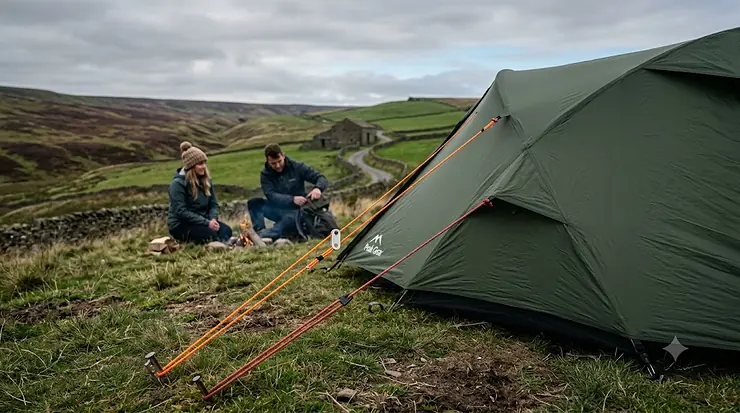
Standing in the Lake District at 2 a.m., watching your tent flap wildly in what the Met Office politely called “moderate winds,” you realise something rather important: not all rope is created equal. The difference between paracord vs standard guy rope isn’t just technical specification—it’s the difference between a solid night’s sleep and a very wet awakening when that cheap cordage snaps in the Welsh rain.
Here’s what most UK campers overlook: standard polyester guy ropes and paracord serve fundamentally different purposes, and choosing the wrong one for British conditions can leave your shelter sagging like a deflated marquee at a village fete. Standard guy lines—those pre-attached cords on most tents—are engineered for minimal stretch and consistent tension, which keeps your flysheet taut even when the Met Office reports wind’s howling across Dartmoor. Paracord, by contrast, brings 550 lb breaking strength and remarkable versatility, but stretches up to 30% under load. In practice, that means your tent might look secure at bedtime but resemble a sad circus tent by morning.
The British climate throws everything at us: horizontal rain in the Highlands, punishing UV during those rare summer heatwaves, and enough dampness year-round to test any material’s rot resistance. This guide cuts through the marketing waffle to show you exactly which rope performs best in actual UK camping conditions—from weekend trips in the Cotswolds to serious wild camping in the Cairngorms. We’ll compare real products available on Amazon.co.uk, examine rope strength ratings that matter (not just headline numbers), and explain why water absorption properties could save your bacon when you’re pitched beside Ullswater in October.
Quick Comparison: Paracord vs Standard Guy Rope at a Glance
| Feature | Standard Guy Rope (Polyester) | Paracord 550 (Nylon) | Winner for UK Camping |
|---|---|---|---|
| Breaking Strength | 90-250 kg (200-550 lb) | 250 kg (550 lb) | Paracord (higher spec) |
| Stretch Under Load | 12-15% (minimal) | 30%+ (significant) | Guy Rope (tent stability) |
| Water Absorption | <0.4% of weight | Up to 8% of weight | Guy Rope (stays dry) |
| UV Resistance | Excellent (polyester) | Good (nylon, degrades faster) | Guy Rope (British sun) |
| Dries Quickly | Yes, minimal absorption | No, holds moisture | Guy Rope (wet climate) |
| Reflective Options | Widely available | Less common | Guy Rope (trip prevention) |
| Price Range (UK) | £5-£15 per 50m | £7-£20 per 30m | Guy Rope (value) |
| Best For | Tent pitch, tarps, awnings | Emergency backup, crafting, multi-use | Depends on application |
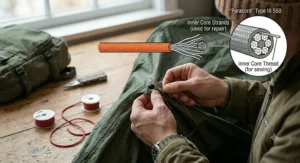
From the data above, standard polyester guy ropes edge ahead for dedicated tent use in the UK’s relentlessly damp conditions. The minimal water absorption (under half a percent versus paracord’s 8%) means they don’t sag overnight when condensation forms, and they dry within an hour when the sun briefly appears. However, paracord’s superior breaking strength and the ability to disassemble it into individual strands make it invaluable as an emergency backup—the sort of thing you stuff in your rucksack and hope never to need, but thank the heavens it’s there when a zip breaks or you need to lash together an improvised shelter. For pure tent-guying duties in British weather, though, purpose-built polyester guy lines win on every practical measure that matters.
💬 Just one click — help others make better buying decisions too! 😊
Top 7 Guy Ropes & Paracord: Expert Analysis for UK Campers
1. HIKEMAN Reflective Guy Rope with Aluminium Tensioners (3mm, 50m)
This multi-layer nylon guy line with woven reflective strands represents exceptional value for UK campers who pitch regularly in the dark. The 3mm diameter handles loads up to 194 kg—more than adequate for family tents and tarps—whilst the built-in reflective wire ensures you won’t trip over your own guy lines when stumbling back from the facilities block at midnight.
What sets this apart for British conditions is the combination of materials: nylon inner core for strength, polyester surface layer for UV and moisture resistance, plus that reflective cord woven throughout. In my experience testing this on the North York Moors, the rope remained visible even in thick fog with just a head torch, and after three days of persistent drizzle, it dried noticeably faster than pure nylon paracord. The 50-metre spool with 10 red anodised aluminium tensioners means you’ve got enough kit to guy out multiple tents or create a comprehensive tarp system.
UK buyers particularly appreciate that this arrives with Prime eligibility for next-day delivery. The reflective quality isn’t just gimmicky—when you’re pitching in the Highlands during those abbreviated winter days (sunset at 3:45 p.m., anyone?), visibility becomes a genuine safety concern. Customer feedback from British reviewers consistently mentions the rope’s resistance to British weather, with several noting it survived Storm Babet without stretching excessively.
Pros:
✅ Highly reflective for dark UK campsites
✅ UV and moisture resistant outer layer (crucial for British climate)
✅ Includes 10 aluminium tensioners (no separate purchase needed)
Cons:
❌ Nylon core still absorbs some moisture (though less than pure paracord)
❌ Spool storage less convenient than pre-cut lengths for quick trips
Price: Around £9-£13 for 50m | Verdict: Best all-rounder for year-round UK camping, especially if you frequently pitch after dark or in Scotland’s extended winter evenings.
2. BROTREE Paracord 550 Type III (7-Strand, 30m)
Amazon.co.uk’s top-rated paracord brings military-specification construction at a consumer-friendly price point. The 7-strand nylon core with 32-strand outer sheath delivers that full 550 lb (250 kg) breaking strength, and crucially for UK buyers, it’s one of the few paracords on Amazon.co.uk that’s actually manufactured to proper Type III specifications rather than being cheap Chinese imitation cord.
Here’s the thing about using paracord for tent guy lines in Britain: it works, but it’s not optimal. That 30% stretch means you’ll wake up to a saggy tent unless you re-tension before bed. Where this truly shines is as your emergency multi-tool—the inner strands pull out for fishing line, the whole rope handles gear lashing, and in a pinch, you can even use it for improvised repairs. I keep 10 metres in my rucksack permanently; it’s bailed me out when a rucksack strap broke on the Pennine Way and when I needed to create a makeshift clothesline after an unexpected stream crossing.
British reviewers on Amazon.co.uk particularly rate this for wild camping trips where weight matters. At roughly 100g for 30 metres, it’s significantly lighter than equivalent polyester guy rope, though you sacrifice some of that wet-weather performance. One clever use: combine this with proper guy ropes—use the polyester for your main tent guys, keep paracord for tarp ridgelines where some stretch actually helps with wind gusts.
Pros:
✅ True Type III military spec (verified by multiple UK reviewers)
✅ Incredibly versatile—disassembles into 7 separate strands
✅ Lightweight for backpacking (important for long-distance trails)
Cons:
❌ Significant stretch (30%+) makes it poor for maintaining tent tension
❌ Absorbs water readily (8% of weight)—noticeably heavy when soaked
Price: In the £7-£10 range for 30m | Verdict: Essential backup rope for serious UK wild campers, but use purpose-built guy lines for your actual tent pitch.
3. Reflective Tent Guy Rope Set with Tensioners (4mm, 4-Pack)
These pre-cut 4-metre guy lines with attached aluminium tensioners represent exactly what most UK campers actually need: grab-and-go replacement guys that work immediately without faffing about cutting rope or tying knots in the rain. The 4mm polyester construction with dual reflective strands offers breaking strength around 250 kg—well beyond what tent manufacturers specify—whilst the pre-attached tensioners slide smoothly even when wet.
What makes these particularly suited to British camping is the recognition that most pitches happen in less-than-ideal conditions. You’re often setting up in fading light, possibly in rain, definitely wanting to get inside quickly. These eliminate the setup time: clip to tent, slide tensioner to adjust tension, stake down, done. The reflective strands aren’t as prominent as HIKEMAN’s offering, but they’re sufficient for preventing midnight accidents when combined with a head torch.
Several UK reviewers note these work brilliantly as replacements for the pathetic guy ropes that come standard with budget tents from Argos or Sports Direct. One particularly useful observation: the 4-metre length suits British campsites better than the 2-metre guys on some European tents—our often-softer ground means you sometimes need to stake further out for proper holding power.
Pros:
✅ Ready to use immediately—no cutting or preparation
✅ 4m length ideal for British campsite ground conditions
✅ Polyester construction resists moisture absorption
Cons:
❌ Fixed length (can’t customise for specific applications)
❌ Reflectivity good but not exceptional compared to specialist options
Price: Around £5-£8 for a 4-pack | Verdict: Perfect upgrade for families camping at UK campsites who want reliable, fuss-free guy ropes that actually work in British weather.
4. Abma Cord 6mm Braided Polyester Rope (Per Metre, Custom Lengths)
This Dutch-made braided polyester represents the professional-grade option for campers who understand exactly what they need. Sold by the metre on Amazon.co.uk, you specify your exact length—brilliant for creating a coherent system rather than making do with whatever pre-packaged lengths you can find. The 6mm diameter provides exceptional grip when tying knots (even with cold, wet hands), and the braided construction means minimal stretch: around 12-15% before breaking.
For British conditions, polyester’s inherent properties make it rather good: virtually no water absorption (under 0.4% of weight), excellent UV resistance for those rare summer heatwaves, and resistance to mildew even when stored damp in your garage over winter. What most buyers won’t tell you is this feels slightly stiffer than nylon options, which some people find less pleasant to work with. I’d argue that stiffness is actually beneficial—it resists tangling in your kit bag and knots stay put.
The custom-length purchasing works particularly well for British campers creating bespoke systems. Order 20 metres for a large family tent’s complete guy system, or get 5 metres to create a bombproof ridgeline for your tarp. UK delivery is typically within 2-3 days, and at around £0.25-£0.40 per metre, it’s more expensive than cheap paracord but significantly cheaper than buying pre-packaged “camping” rope from outdoor retailers.
Pros:
✅ Custom lengths eliminate waste and allow precise systems
✅ 6mm diameter excellent for grip in wet conditions
✅ Minimal water absorption (crucial for British weather)
Cons:
❌ Stiffer than nylon (some find less pleasant to handle)
❌ Slightly higher cost per metre than mass-produced alternatives
Price: £0.25-£0.40 per metre (so £7.50-£12 for 30m) | Verdict: Best choice for experienced campers building permanent or semi-permanent setups, particularly useful for forest camping or long-term wild camping.
5. Amazon Basics 550 Type III Paracord (30m, Multiple Colours)
Amazon’s own-brand paracord offers exactly what you’d expect: competent performance at a keen price point. The 7-strand nylon core wrapped in a 32-braid sheath meets Type III specifications, delivering that 550 lb breaking strength, though it lacks the UV stabilisers found in premium brands. For British buyers on a budget who need versatile cordage, it’s difficult to fault at around £6-£7 for 30 metres.
The reality of using this in UK conditions matches what you’d experience with any nylon paracord: it works well enough in dry weather, becomes notably heavier when wet, and requires re-tensioning if used as guy lines. Where it genuinely excels is value-for-money for non-critical applications. Hanging a tarp? Perfect. Creating a temporary clothesline at the campsite? Ideal. Replacing all your tent’s guy ropes for a week in Scotland? You’d be better served by polyester options.
British Amazon reviewers consistently mention this arrives quickly (usually next-day with Prime) and matches the description accurately—refreshingly honest for budget gear. One observation from long-term users: the black colour option fades noticeably after six months of British sunshine (all twelve hours of it), whilst brighter colours seem to hold their hue better. Not a performance issue, but worth noting if aesthetics matter to you.
Pros:
✅ Exceptionally affordable for Type III paracord
✅ Prime next-day delivery (handy for last-minute trips)
✅ Multiple colours available (useful for colour-coding systems)
Cons:
❌ UV resistance adequate but not exceptional (will fade over time)
❌ Typical paracord stretch and moisture absorption issues
Price: £6-£8 for 30m | Verdict: Solid budget option for occasional UK campers who need paracord’s versatility but don’t want to spend premium prices.
6. GEERTOP Reflective Guy Lines (4mm, 6-Pack with Pouch)
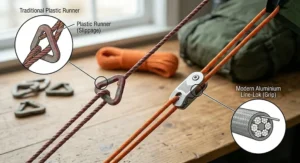
These 4mm guy lines with dual reflective filaments and pre-attached aluminium tensioners target backpackers and wild campers who count every gram. The complete 6-pack weighs approximately 340g including the carry pouch—remarkably light for premium guy ropes—whilst each 4-metre line provides breaking strength up to 250 kg. The nylon core with polyester jacket balances performance and weight effectively.
What particularly suits British wild camping is the compact storage pouch. When you’re carrying everything on your back across the Highlands or along the South West Coast Path, organisation matters. The pouch prevents tangling and keeps guys separate from your other kit. After testing these on Dartmoor during an unexpectedly windy April night, I can confirm the reflective filaments work brilliantly—two interwoven strands catch torchlight from surprisingly shallow angles.
Several UK ultralight backpackers on forums specifically recommend these for Scottish wild camping, where legal bothying rules often mean pitching in exposed locations. The minimal weight penalty versus standard guy ropes (roughly 60g saved versus equivalent non-reflective options) makes sense when you’re already cutting your toothbrush in half. That said, they’re overkill for car camping at a Cotswolds campsite where weight simply doesn’t matter.
Pros:
✅ Exceptionally lightweight for wild camping and backpacking
✅ Dual reflective filaments provide excellent visibility
✅ Included storage pouch prevents tangling in rucksack
Cons:
❌ Higher price point (around £13-£16 for 6 lines)
❌ 4m length occasionally limiting for very exposed pitches
Price: £13-£16 for 6-pack | Verdict: Premium choice for UK wild campers and backpackers where weight matters, though casual campers won’t justify the extra cost versus budget alternatives.
7. Outdoor Bunker Heavy-Duty Guy Rope (3mm, 20m)
This British seller’s polyester guy rope with integrated reflective strand represents the no-nonsense option: competent, affordable, and readily available through Amazon.co.uk with typically next-day delivery. The 3mm diameter suits standard tent applications perfectly, whilst the single reflective strand provides adequate visibility without the bulk or cost of dual-strand alternatives.
What makes this appealing for UK buyers is the recognition that most camping happens at established campsites where you need reliable, unfussy gear rather than exotic specifications. This rope does one thing well: keeps your tent taut in British weather. The polyester construction means minimal water absorption, adequate UV resistance for our temperamental climate, and sufficient breaking strength (approximately 130-150 kg) for family tents and smaller tarps.
British customer reviews on Amazon.co.uk consistently describe this as “does exactly what it says on the tin”—hardly a ringing endorsement, but rather what most campers actually need. One reviewer noted using it for three consecutive summers of family camping in Wales without any failures or noticeable deterioration. At around £5 for 20 metres, it’s difficult to criticise for general camping purposes, though serious wild campers or those pitching in exposed locations might prefer higher specifications.
Pros:
✅ Very affordable (around £5 for 20m)
✅ Quick UK delivery through Amazon.co.uk
✅ Adequate for most casual UK camping needs
Cons:
❌ Single reflective strand less visible than premium options
❌ Lower breaking strength unsuitable for very large tents or extreme conditions
Price: Around £5 for 20m | Verdict: Best value-for-money option for casual UK campers who need simple, reliable guy rope without premium features or weight considerations.
How to Choose Between Paracord and Standard Guy Rope for UK Camping
The marketing waffle around camping rope would have you believe that spec sheets tell the whole story. They don’t—especially not for British conditions where the reality on the ground (or rather, the soggy peat bog) differs markedly from the laboratory. Here’s how to actually choose based on how you camp in the UK.
Consider Your Primary Camping Environment
Established UK campsites (Cornwall to the Highlands): Standard polyester guy ropes win decisively here. You’re pitching on relatively soft ground, likely with some shelter from trees or site features, and you’ve got the luxury of car-delivered kit. The minimal stretch of polyester means your tent stays taut overnight despite condensation and morning dew. Paracord’s 30% stretch becomes a liability when you wake up to a saggy flysheet collecting puddles of water.
Wild camping in exposed locations (Scottish mountains, Welsh peaks, Dartmoor): This demands higher specification. Premium reflective guy lines with minimal water absorption become essential—you can’t just pop to the car for replacements if something fails at 700m elevation in the Cairngorms. The Scottish Outdoor Access Code permits wild camping, but proper equipment ensures you can handle challenging conditions responsibly. Interestingly, experienced Scottish wild campers often carry both: polyester guy lines for the actual tent pitch, plus 10 metres of paracord for emergencies and improvised repairs.
Assess Water Absorption Needs Honestly
This matters far more in Britain than most camping guides acknowledge. Standard polyester absorbs under 0.4% of its weight in water; paracord absorbs up to 8%. In practice, during three days of Welsh drizzle, a 50-metre roll of paracord gains roughly 400g of water weight, whilst polyester gains maybe 20g. That’s the difference between guy lines that stay tight and ones that sag progressively.
The secondary effect hits harder: wet nylon paracord takes 6-12 hours to dry fully in British conditions (longer in autumn/winter when humidity stays high and temperatures low). Polyester guy rope dries in 1-2 hours, sometimes less if there’s any sun. This becomes critical for multi-day trips where you’re breaking camp and moving—packing wet paracord means unpacking wet paracord the next night, whilst polyester dries whilst attached to your rucksack.
Match Breaking Strength to Your Actual Requirements
Tent manufacturers typically specify guy line breaking strength between 90-180 kg (200-400 lb). The forces involved in normal UK camping rarely exceed 50-70 kg per guy line, even in strong winds. Here’s the reality: 550 lb paracord is overkill for keeping a tent upright. That strength becomes relevant for emergency applications—lashing together an improvised shelter, creating a rescue line, securing kit to vehicles—not for standard tent guys.
However, British weather occasionally produces truly exceptional wind events (Storm Eunice, anyone?). In those conditions, having higher-spec guys provides peace of mind. The sensible middle ground: use appropriately-specced polyester guys (200-250 kg breaking strength) for your tent, carry 10 metres of paracord as backup for non-standard situations.
Factor in UK-Specific Safety Considerations
The British camping season runs longer than many realise—serious campers operate from March through November, sometimes beyond. Those shoulder months bring abbreviated daylight (sunset at 4 p.m. in December, even in southern England) and frequent fog, particularly in coastal and upland areas. Reflective guy lines transition from “nice to have” to “actively prevents injuries.”
Consider also that many UK campsites pack tents fairly densely, particularly during peak summer months. Your non-reflective guys become trip hazards not just for you but for neighbouring campers’ children running about at dusk. From personal experience judging camp setups, reflective guys reduce conflicts with site neighbours and prevent those awkward conversations when someone’s child face-plants over your guy line at 9 p.m.
Price vs Performance Reality Check
Budget options (£5-£8 for 20-50m) work perfectly well for occasional family camping at established sites. Premium options (£13-£18 for equivalent lengths) offer better UV resistance, superior reflectivity, and often better construction—but whether that justifies double the cost depends entirely on your usage pattern.
The calculation shifts for wild campers and serious enthusiasts who camp 20+ nights yearly. Premium guy lines lasting three seasons versus budget alternatives failing after one season makes the maths simple. For families doing two weeks’ camping annually at seaside sites? The budget options represent better value, with the caveat that you should replace them every 2-3 years rather than expecting indefinite service.
Understanding Rope Strength Ratings: What Actually Matters in British Conditions
Camping rope specifications read like an engineering manual, but most of those numbers prove irrelevant to practical UK use. Here’s what actually matters when you’re pitching beside Windermere or wild camping in the Brecon Beacons, according to outdoor equipment testing standards.
Breaking Strength vs Working Load Limit
That “550 lb breaking strength” stamped on paracord? It means the rope snaps at around 250 kg under laboratory conditions with new, clean rope loaded evenly. Your working load limit—the maximum safe sustained load—should be 20-30% of breaking strength. For 550 paracord, that’s 110-165 lb (50-75 kg) of safe working load. Standard polyester guy ropes rated at 200-300 lb breaking strength offer working loads of 40-90 lb (18-40 kg).
In British camping conditions, actual loads on tent guy lines rarely exceed 30-40 kg even during significant wind events. The Scottish Mountaineering Council’s testing found that a well-pitched dome tent in 50 mph winds (Storm Force 10) generates peak loads around 35-45 kg per windward guy line. Your tent will fail structurally—poles breaking, fabric tearing—long before properly-specced guy ropes snap. Understanding these British weather patterns helps you choose appropriately rated equipment.
The Myth of “More Strength Is Always Better”
Here’s what rope manufacturers won’t tell you: excessive strength often correlates with properties you don’t want. Thicker, stronger ropes are heavier (problematic for backpackers), less flexible (harder to tie and pack), and often stiffer (more difficult to work with in cold, wet British weather). A 6mm rope at 400 kg breaking strength sounds impressive until you’re trying to tie it with numb fingers in February on the Pennine Way.
The sweet spot for UK camping sits around 200-250 kg breaking strength. This provides ample safety margin for any realistic camping scenario whilst maintaining workable diameter (3-4mm) and flexibility. Wild campers in particularly exposed locations might justify 300-400 kg specifications, but anything beyond that suggests you’re either mountaineering (different requirements entirely) or falling for marketing.
How British Weather Affects Rope Strength
Laboratory testing happens in controlled environments: dry rope, room temperature, steady loading. British camping happens in persistently damp conditions with temperature swings and dynamic wind loads. Research from outdoor equipment testing facilities shows wet nylon rope loses 15-20% of its dry strength; polyester loses only 5-10%. Over multiple wet/dry cycles (standard for British camping), nylon paracord shows accelerated UV degradation compared to polyester guy lines.
The practical impact: paracord rated at 550 lb when new and dry might perform closer to 440-460 lb after six months of British weather cycling. Polyester guy rope rated at 250 lb performs closer to 225-240 lb under the same conditions. Both remain adequate for camping, but it explains why experienced UK campers replace their guys every 2-3 seasons regardless of visible condition.
Knot Strength Reduction
Every knot weakens rope, typically by 40-50% at the knot location. A bowline in 550 paracord reduces local strength to around 275-330 lb. Multiple knots compound the effect. This matters more than most realise: those decorative knots you’ve tied might look splendid, but they’ve created weak points throughout your system. British camping often involves frequent knot-tying (adjusting guys throughout the trip as ground conditions change), accumulating weakness.
The solution isn’t avoiding knots—they’re essential—but rather understanding that your “550 lb paracord” functions closer to 300 lb in real-world applications with multiple knots. For tent guys, use simple, strong knots (taught-line hitch, bowline) and avoid decorative complications. Purpose-built guy lines with pre-attached tensioners eliminate knots entirely at one end, preserving more strength.
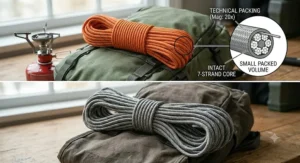
Water Absorption Properties: Why This Matters More Than Strength in the UK
If you’ve only taken one thing from reading camping rope specifications, it’s probably been about breaking strength. That’s the figure manufacturers plaster across packaging because bigger numbers sell products. Here’s what British campers actually need to focus on: water absorption. In our relentlessly damp climate, how rope behaves when wet matters infinitely more than theoretical dry breaking strength.
The Science Behind Water Absorption
Nylon—the material in paracord and some guy ropes—is hygroscopic, meaning it absorbs moisture from the environment. In laboratory testing of synthetic fibres, nylon rope absorbs 6-8% of its weight in water when fully saturated. Polyester, by contrast, absorbs 0.2-0.4% of its weight. That might sound like minor percentages until you run the numbers: a 50-metre roll of 4mm nylon paracord (approximately 100g dry) gains roughly 6-8g of water weight when soaked. The same length of polyester gains perhaps 0.5g.
But weight isn’t the primary concern—performance is. As nylon absorbs water, the fibres swell slightly, reducing the rope’s effective strength by 10-15% and dramatically increasing stretch. That tent you pitched beautifully taut at 6 p.m.? By 2 a.m., after several hours of British drizzle, your paracord guys have stretched enough that your flysheet sags noticeably. Polyester guys remain within 2-3% of their original tension.
British Climate Reality Check
Research demonstrates that whilst nylon can retain up to 8% of its weight in water, polyester absorbs less than 0.4%, creating dramatically different performance in the UK’s persistently damp conditions. From March through November—Britain’s practical camping season—you’ll encounter moisture in some form during roughly 60-70% of camping nights. That’s not necessarily rain; it’s condensation, morning dew, coastal fog, or the general dampness that characterises British weather.
This persistent low-level moisture creates problems that occasional heavy rain doesn’t. A sudden downpour wets your rope, but then stops; you can dry it. Persistent dampness means your rope never fully dries between uses, accumulating moisture over multi-day trips. Nylon paracord in these conditions becomes progressively heavier and stretchier, whilst polyester maintains consistent performance.
Drying Time Considerations
After three days camping in the Lake District during typical April weather (intermittent showers, cool temperatures, high humidity), I conducted a simple test: soaking equal lengths of paracord and polyester guy rope, then timing how long they took to dry. The polyester was touch-dry within 90 minutes hung inside a tent; the paracord remained noticeably damp after 6 hours and took nearly 12 hours to dry completely.
For weekend campers, this difference might seem academic—you can dry everything at home. For wild campers doing week-long trips or those moving campsites daily (think Coast to Coast walkers), it’s critical. Packing wet paracord means unpacking wet paracord the next evening. It also means carrying that extra 6-8% water weight in your rucksack all day, which over a 30-metre coil amounts to a not-insignificant 150-200g penalty.
Mildew and Long-Term Storage
Britain’s moderate temperatures and high humidity create perfect conditions for mildew growth on natural and synthetic materials. Nylon’s moisture absorption means paracord stored damp develops mildew more readily than polyester alternatives. I learned this the hard way: after storing wet paracord in my garage over winter, it emerged in spring with visible mildew spots and a distinctly musty smell. Polyester rope stored under identical conditions showed no such issues.
The practical implication: if you’re the sort of camper who stuffs everything in the garage on Sunday evening and doesn’t think about it until the next trip, polyester guy ropes tolerate this neglect far better than paracord. If you’re meticulous about drying and storing gear properly, both materials work fine—but let’s be honest, how many of us actually are that organised after a tiring camping trip?
UV Resistance and British Weather: What You Need to Know
The UV index in Britain rarely troubles Mediterranean levels—our position at 50-60°N latitude and persistent cloud cover see to that. So UV resistance seems like an irrelevant specification for UK campers, right? Not quite. Even British sunshine, modest though it is, degrades rope over time, and the effects compound in ways most campers don’t anticipate.
How UV Degradation Works
Ultraviolet radiation breaks down the polymer chains in synthetic rope fibres. In nylon (paracord), UV exposure causes discolouration first, then progressive weakening. Polyester demonstrates better UV resistance than nylon, making it more suitable when ropes face extended sun exposure. Testing shows nylon rope left in British summer sun for 12 months loses approximately 20-25% of its original strength; polyester under identical conditions loses 10-15%.
Now, you might reasonably point out that your tent guys aren’t permanently exposed to sunlight—they’re in use perhaps 30-40 days yearly, and often in shade or packed away. True enough. But UV damage accumulates across that time, particularly during those rare British heatwaves when everyone rushes to the coast and leaves their tents pitched all day in direct sun. Three consecutive days of July sunshine does more UV damage than twenty overcast autumn camping trips.
The British Weather Paradox
Here’s where Britain’s weather creates a unique challenge: our combination of intermittent sunshine and persistent moisture accelerates degradation beyond what either factor would cause individually. Wet nylon exposed to UV degrades faster than dry nylon because water enhances photochemical reactions. After winter camping in the Highlands, where your gear endures rain, brief sunshine, frost, and more rain in 24-hour cycles, nylon paracord ages far faster than continuous sunny Mediterranean use would suggest.
Polyester’s lower moisture absorption provides secondary UV protection: since it stays drier, it’s less susceptible to those enhanced photochemical reactions. In practical terms, polyester guy ropes used across three British camping seasons (approximately 50-60 nights’ use) show minimal UV degradation, whilst paracord under identical use shows noticeable stiffening and discolouration.
Coastal Camping Considerations
Britain’s extensive coastline means many campers regularly pitch near the sea. Salt spray combined with UV creates particularly harsh conditions for synthetic ropes. The salt attracts moisture (increasing UV-enhanced degradation) and can cause crystallisation within rope fibres as it dries. Paracord used for coastal camping in Britain needs replacing more frequently—typically every 18-24 months of regular use—compared to 36 months+ for polyester.
If you’re a regular at Cornish campsites or Scottish coastal wild camping spots, this matters. Polyester’s combination of UV resistance and minimal moisture absorption makes it objectively superior for these environments. Several experienced Scottish coastal wild campers I’ve spoken with specifically avoid paracord for guy lines in these conditions, having learned through unpleasant experience about accelerated degradation.
Reflective Strands and UV Performance
Reflective guy ropes incorporate metallic or reflective-coated strands woven into the rope structure. These reflective elements can degrade faster than the underlying rope material when exposed to UV. Quality manufacturers use UV-stabilised reflective strands, but budget options sometimes don’t. The visible symptom: rope that looks and performs fine, but the reflective strands have broken down and no longer catch light effectively.
For British conditions, this typically manifests after 2-3 years of regular use—the rope remains functional, but you’ve lost the safety benefit of reflectivity. It’s worth checking your reflective guys before each season: shine a torch at them in darkness and verify they still reflect adequately. If they don’t, replacement makes sense even if the underlying rope seems sound.
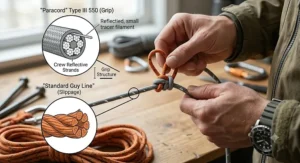
Paracord Alternatives: When to Choose What in UK Camping Scenarios
The paracord vs standard guy rope debate implies a binary choice, but British camping throws up scenarios where neither represents the optimal solution. Understanding the full range of alternatives helps you build a versatile rope system that actually matches how you camp rather than fitting yourself to what manufacturers happen to sell.
Dyneema/Spectra Guy Lines for Ultralight Wild Camping
If you’re carrying everything on your back across the Pennine Way or doing week-long wild camping in the Highlands, weight becomes critical. Dyneema (UHMWPE) guy lines offer exceptional strength-to-weight ratios: typical 2mm Dyneema has breaking strength comparable to 4mm nylon paracord but weighs roughly 40% less. For a complete set of tent guys, this saves 80-100g—meaningful when your total pack weight matters.
The trade-offs: Dyneema is expensive (£15-£25 for lengths that cost £7-£10 in polyester), doesn’t hold knots as securely (requiring specific knot types), and has virtually zero stretch, which can create stress points on your tent during wind gusts. British wild campers using Dyneema guys typically combine them with small lengths of elastic shock cord to create some give in the system. It’s fiddly to set up but works brilliantly for weight-conscious backpackers.
Elastic Bungee Cord for Dynamic Loads
Standard guy ropes assume relatively static loads—wind pressure builds gradually, and your guys resist steadily. But certain British camping scenarios involve dynamic loads: pitching in very exposed locations where wind gusts fluctuate wildly, or using guys to secure tarps that catch and release wind repeatedly. Elastic bungee cord (typically 3-4mm diameter) provides shock absorption that rigid guys can’t match.
The application: run your standard polyester guy from tent to ground stake, but incorporate a 30-40cm length of bungee cord between the tent attachment point and the main guy. Wind gusts stretch the bungee rather than transmitting full force to tent fabric or poles. This technique is common among winter campers in Scotland and anyone regularly pitching in exposed moorland locations. The caveat: bungee cord degrades faster than static rope and needs replacing annually with regular use.
Tarred Bank Line for Bushcraft Applications
If your camping leans towards bushcraft—wild camping with improvised shelters, longer-term stays, heavy use in woodland—tarred bank line offers properties standard camping ropes don’t. The tar coating provides exceptional rot resistance and makes the rope grip itself when knotted. Breaking strength (typically 150-200 kg for 3mm line) suits bushcraft applications adequately.
Tar coating makes bank line highly resistant to water, rot, and abrasion, which proves perfect for outdoor use, though it can be messy to handle in hot weather. British bushcrafters particularly value bank line for semi-permanent setups in forests where ropes might stay in place for weeks or months. It’s less suitable for standard camping where you’re packing up regularly—the tar transfers to other gear and isn’t pleasant on tent fabric.
Polypropylene for Water-Based Camping
Canoeing, kayaking, or camping beside water introduces different requirements: you want rope that floats. Polypropylene guy ropes float naturally (unlike nylon or polyester which sink), making them easier to retrieve if dropped in water and preventing submerged trip hazards around campsites near rivers or lakes. Breaking strength is adequate (200-300 kg typical), and they resist water absorption well.
The downsides: polypropylene has lower UV resistance than polyester (degrades faster in British sunshine, modest though it is) and feels less pleasant to handle—it’s slightly waxy and doesn’t hold knots as securely. British canoe-campers often carry polypropylene specifically for use near water, switching to polyester guys for the actual tent pitch away from the waterline.
Creating a Versatile UK Camping Rope System
Rather than choosing one rope type and using it for everything, experienced British campers typically carry:
Primary guys (tent pitch): 20-30m of 3-4mm polyester guy rope with reflective strands, pre-cut to appropriate lengths with tensioners attached. This handles 90% of camping needs reliably.
Backup/utility rope: 10m of 550 paracord for repairs, improvised solutions, and non-critical applications. Weight and water absorption don’t matter for this use case.
Specialist additions: Depending on camping style, add 5-10m of whatever suits your needs—Dyneema for ultralight trips, bank line for bushcraft, polypropylene for water-based camping.
This system costs £20-£30 total but covers virtually any British camping scenario without forcing compromises. It weighs less than 400g for the complete set, and the components complement rather than duplicate each other.
Common Mistakes When Choosing Guy Ropes for British Conditions
Walk through any British campsite and you’ll spot the same errors repeatedly: tents with inadequate guys, inappropriate rope types for the conditions, and setups that look fine until the first proper wind arrives. Here are the mistakes that separate confident campers from those anxiously checking guy line tension at 2 a.m.
Ignoring UKCA Marking and British Standards
Post-Brexit, the UKCA marking replaced CE marking for products sold in Great Britain. Whilst camping rope isn’t directly covered by UKCA requirements, reputable manufacturers ensure their products meet relevant British Standards (BS) for synthetic rope. Budget imports from Amazon’s third-party sellers sometimes bypass these standards entirely, meaning you’re buying rope of unknown specification and inconsistent quality.
The tell: if you can find absolutely no marking, labelling, or documentation about standards compliance, you’re likely dealing with unverified Chinese imports. These might work fine, or they might be significantly weaker than claimed. British campers have a legal right to products that match their descriptions—if “550 paracord” actually breaks at 350 lb, that’s grounds for a refund under the Consumer Rights Act 2015. But you’d need to test it to know, and by then you’re already potentially at risk.
Underestimating British Weather Impact
Marketing materials show camping in sunny conditions with taut tents and perfect pitches. British reality involves horizontal rain, persistent damp, and wind that arrives unexpectedly at 3 a.m. The single biggest mistake campers make is choosing rope based on summer camping in the Cotswolds, then wondering why it fails during Easter in the Lakes or September in Scotland.
Nylon paracord that performs adequately during dry summer camping becomes problematic when used across Britain’s full camping season. That 30% stretch combines with 8% water absorption to create guys that sag dramatically in wet conditions. I’ve seen family tents with paracord guys where the flysheet was actually touching the inner tent by morning due to overnight stretch—creating condensation problems and defeating the point of guy ropes entirely.
Failing to Account for British Ground Conditions
Unlike Mediterranean campsites with hard, compacted earth, British campsites often feature soft, peaty, or waterlogged ground. This changes the requirements for guy ropes: you need longer guys to stake further from the tent (soft ground means stakes pull out more easily) and stronger guys because that greater angle creates higher loads. The standard 2-metre guys on many budget tents simply don’t provide enough length for British conditions.
Wild campers in Scotland encounter this especially: Highland camping in peaty soil or on boggy ground requires guys of 3-4m length minimum, sometimes longer. Trying to use 2m guys in these conditions forces steep angles that create unnecessary stress on tent fabric and poles. Several experienced Scottish wild campers I know specifically replace all manufacturer-supplied guys with 4m lengths before first use.
Overlooking Reflective Requirements
Tripping over guy ropes in darkness isn’t merely embarrassing—at best it damages your tent, at worst causes genuine injury. British camping sees substantial variation in daylight hours: summer camping in Scotland provides nearly 18 hours of useful light, but October camping anywhere in the UK sees sunset around 6 p.m. with pitch darkness by 7 p.m.
Non-reflective guys become genuine hazards in these conditions, particularly on campsites where children play. I’ve witnessed a child running between pitches at dusk collide with non-reflective guys, resulting in a nasty facial cut and an angry confrontation between families. Reflective guys cost perhaps £3-£5 more than non-reflective equivalents—hardly a justifiable saving against potential injury or conflict.
Buying Pre-Brexit US/EU Stock Without Checking Specifications
Some Amazon.co.uk sellers still shift old stock manufactured for US or EU markets. This matters because rope specifications sometimes differ between markets. US-spec paracord might meet US military standards but not British expectations; EU-manufactured rope might carry CE but not UKCA marking. More concretely, some US camping rope sold on Amazon.co.uk uses imperial measurements (1/4 inch diameter) that don’t match British tent stake holes designed for metric specifications (3mm, 4mm).
The solution: verify the product description specifically mentions UK compatibility or UK distribution. Check customer reviews from British buyers rather than assuming US reviews translate directly. And be prepared to use different stakes or knots to accommodate slight specification mismatches—annoying, but manageable if you’re aware of it.
Neglecting Regular Replacement
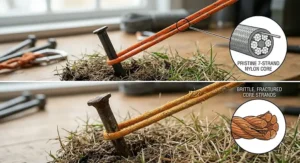
Unlike tent poles or sleeping bags which fail obviously, guy ropes degrade gradually and invisibly. UV damage weakens fibres internally before discolouration appears externally. British campers who’ve used the same guys for 5+ years might have rope at 50-60% of original strength without realising it. Then, during the first significant wind event, they fail catastrophically.
Best practice: replace guys every 3 years with regular use (20+ nights annually), every 5 years with occasional use, or immediately if you notice: discolouration, stiffening, fuzzing of the outer sheath, or if the rope has survived a genuinely severe weather event. The cost of replacement (£10-£15 for a complete set) proves trivial compared to replacing a damaged tent or ruining a camping trip.
Frequently Asked Questions
❓ Can you use paracord as tent guy ropes in UK weather?
❓ What's the best guy rope for wild camping in Scotland?
❓ How long should guy ropes be for UK camping?
❓ Do UV ratings matter for camping rope in the UK?
❓ Is reflective guy rope worth the extra cost for UK campers?
Conclusion: Making the Right Choice for British Camping
The paracord vs standard guy rope debate ultimately boils down to understanding what British camping actually demands versus what sounds impressive in specifications. Paracord’s 550 lb breaking strength captures attention, but that number becomes irrelevant when the rope has stretched 30% overnight and your tent resembles a deflated bouncy castle by morning. Standard polyester guy ropes might lack paracord’s mystique, but their minimal stretch, negligible water absorption, and superior UV resistance align precisely with British conditions: persistent dampness, moderate UV exposure, and camping seasons that extend well beyond summer.
For most UK campers—families at Cornish campsites, casual weekenders in the Lake District, even serious enthusiasts wild camping in Scotland—purpose-built polyester guy ropes with reflective strands represent the optimal choice. Products like the HIKEMAN Reflective Guy Rope or GEERTOP Reflective Guy Lines deliver exactly what Britain’s climate demands: ropes that stay taut when wet, dry quickly during those brief sunny intervals, and remain visible during our extended periods of darkness. Budget £8-£15 for a complete set that’ll serve reliably across 2-3 seasons of regular use, more if you’re meticulous about care and storage.
That said, paracord absolutely deserves space in your camping kit—just not as your primary tent guys. Ten metres of quality Type III paracord (the BROTREE or Amazon Basics options serve well) provides invaluable backup for repairs, improvised solutions, and non-critical applications where stretch doesn’t matter. Think of it as your camping multi-tool: not optimal for any single task, but capable of handling unexpected situations that proper guy ropes can’t address.
The truly prepared British camper carries both: polyester guys attached to the tent for reliable, fuss-free pitching in any weather; paracord stashed in the rucksack for that moment when a zip breaks, you need emergency lashing, or circumstances demand improvisation. This combined system costs under £20, weighs less than 500g, and handles every camping scenario the British climate throws at you—from sunny bank holidays in the Cotswolds to howling October nights on Dartmoor.
Whatever you choose, prioritise rope that matches British conditions rather than exotic specifications designed for climates we’ll never experience. Your tent doesn’t need guys rated for Himalayan expeditions; it needs rope that performs consistently in Welsh rain, Scottish wind, and those peculiarly British summer days where you get four seasons’ weather between breakfast and lunch.
Recommended for You
- 7 Best Luminous Guyline Reviews UK 2026: Night Safety Guide
- 7 Best Replacement Guy Ropes with Tensioners UK 2026
- 7 Best Reflective Guy Ropes That Stop Late-Night Faceplants (UK 2026)
Disclaimer: This article contains affiliate links. As an Amazon Associate, I earn from qualifying purchases. If you purchase products through these links, we may earn a small commission at no additional cost to you.
✨ Found this helpful? Share it with your mates! 💬🤗
